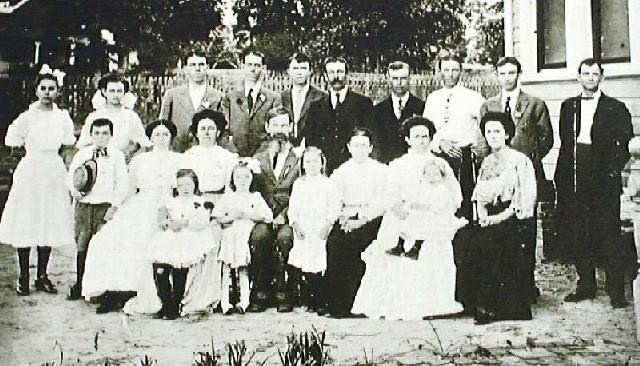
This is the only photo, to my knowledge, of Amelia Antoinette Brown Meece.
The Meece Hotel: Back row, left to right: Judene, Herbert and Annabelle Laramore, Charles, Jim, Tom and Frank Meece, Al Eggerth, Luther and Brown Meece, B. O. Laramore. Front row, left to right: Annie Meece Mangum, Mattie Meece Cubley, Little Mattie, Ella Mae Meece, Theophilus Meece, Nettie Laramore, Grandmother Meece (Amelia), Mary Inez Meece Laramore, Katherine Laramore, Bennette Meece Eggerth.
Aside from the obituary, I know absolutely nothing else about my great-grandmother Amelia Antoinette Brown Meece. In the mid to late 19th century women were virtually invisible. Marriage and motherhood were still considered the most important jobs for women. She certainly had her hands full with 11 children.
Married women lived a very restricted life; wives were expected to cater to the needs of their house and husband. Women had few rights in the 19th century. They could not own property, could not vote, did not have legal rights to their children, could not work outside the home, and were generally controlled by their husbands.
Women’s suffrage, the right-to-vote, wasn’t ratified until August 18th, 1920, 4 years after Amelia died.
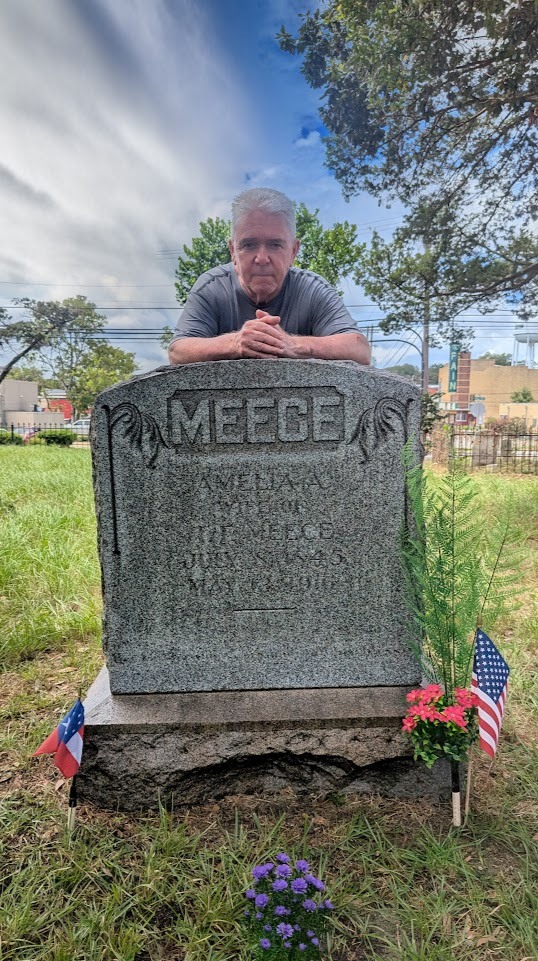
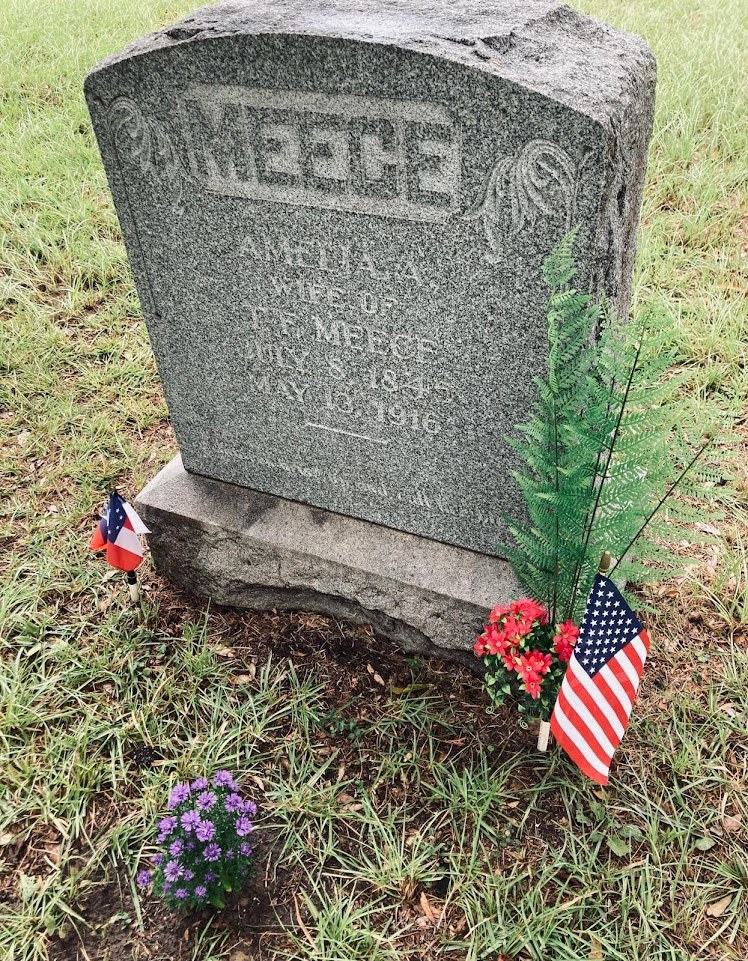
Her epitaph comes from Proverbs 31 28-29:
Her children rise up and call her blessed;
her husband also, and he praises her
“Many women have done excellently,
but you surpass them all.”
It was simply a way to honor and thank Amelia for her enduring influence in the lives of her children.
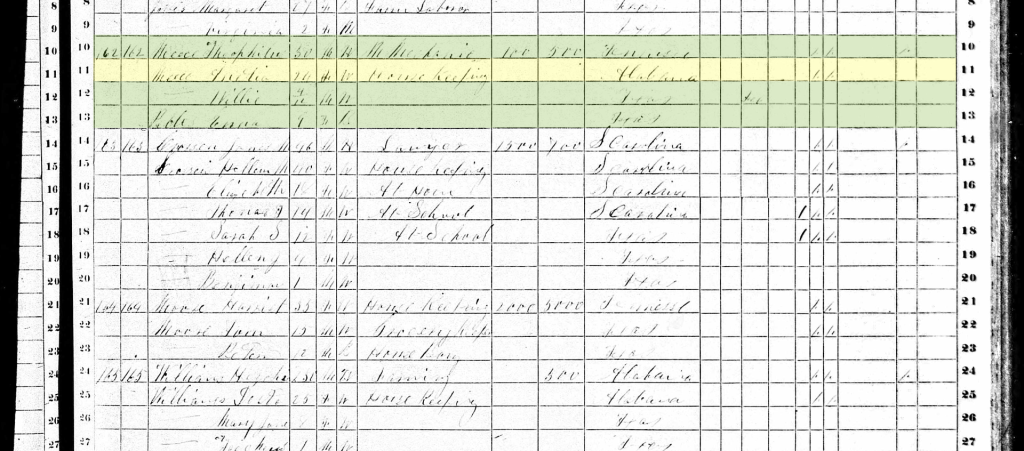
And now, to address the elephant in the room. In the 1870 United States Federal Census on line (13), a young girl by the name of Enna Pebles was listed as being a part of the Meece household. She is identified as being 9 years old, female and black. Why in the world would she be identified as a member of the household?
Enna was not a common name given to an enslaved person. It is an Italian city located in the center of Sicily. Enslaved people in the Americas were often given names by their enslavers which could include anglicized Christian names, biblical names, classical names or even slaveholder names.
Slavery had ended 5 years earlier. Where was her mother and father? The category for occupation was blank. Her birthplace was listed as Texas. Was she there to help take care of Willie, who was only (4) months old at the time? Was she there to assist Amelia with housekeeping or both? I hate to even ask this question, but was she there on loan from her father Uzel or her sister Mary? Her sister, Mary Ann, and her husband, George Scott Shotwell, were also slave owners prior to the Civil War. How do you explain this? I’m not here to sit in judgement. All I can do is report what I know to be factual at that particular time in history.
The 13th Amendment to the U.S. Constitution, abolishing slavery and involuntary servitude, was ratified on December 6th, 1865. The last state to recognize the end of slavery was Texas on June 19th, 1865. The Reconstruction Era (1865–1874) following the Civil War was particularly challenging for African Americans in Texas.
At the 1866 Constitutional Convention in Texas, the State imposed restrictive laws known as Black Codes. The codes appeared throughout the South as a legal way to put Black citizens into indentured servitude, to take voting rights away, to control where they lived and how they traveled and to seize children for labor purposes. Although the Black Codes, indentured servitude and peonage were outlawed, these practices continued in the South. Sharecropping eventually supplanted these methods of servitude.
Texas wasn’t officially readmitted to the United States until March of 1870. It was one of the last of the former Confederate states to re-enter the Union. This was directly tied to its reluctance to change. Being a “good Christian” had absolutely no bearing on slavery. Unbelievably, many 19th-century Baptists in Texas supported slavery. They believed in the plantation hierarchy and that slavery was part of God’s plan. Some of the pastors even owned slaves. I’d like to believe that Enna was in the household as part of Amelia’s missionary work in the Baptist Church but I doubt it.
Uzel Marcus Brown, Amelia’s father and my 2nd great-grandfather, was a slave owner. In the 1850 U.S. Federal Census – Slave Schedules, he owned 5 female slaves ranging in age from 7 to 42. At that time, Amelia was 4 years of age. According to the 1860 U.S. Federal Census – Slave Schedules, he owned eight female slaves & two male slaves ranging in age from 2 to 47. Names of the slaves weren’t required. At that time Amelia was 14 years old.
The 1850 United States Census identifies Uzel as a physician, 31 years of age and living in Coosa, AL, in Coosa County. He was married to Amelia Brown and he had 4 children, which included Amelia. Cropwell, Alabama was originally called Coosa or Coosa Valley until 1837. It’s located just east of Birmingham and 95 miles north of Montgomery.
Montgomery, AL, had grown into one of the most prominent slave trading communities in Alabama by 1860. At the start of the Civil War, the city had a larger slave population than Mobile, AL, New Orleans, LA, or Natchez, MS. Enslaved people who arrived at the riverfront along the Alabama River or at the train station were paraded up Commerce Street to be sold in the city’s slave markets.
Uzel was born in Monroe, GA, to James Marcus Valentine Brown and Mary Polly Colley Brown in 1818. According to the 1830 United States Federal Census, he owned 23 slaves. James and his family members were classified as Free White Persons. Monroe was founded in 1818 as the seat of the newly formed Walton County. It was incorporated as a town in 1821 and as a city in 1896. Monroe was a major cotton producer in the state. In July of 1946, a white mob attacked and killed two Black married couples who were driving through the area. The four people were pulled from their car and shot several times.
Following the 1870 census, there was no further mention of Enna Pebles. I found no mention of slave ownership on the Meece side. This does not surprise me given the fact that they were, for the most part, simple farmers. T.F. Meece was not shy about his support of the Confederacy however. After the war, he said, “I have always been proud of my service in the Confederate Army, believing that it was my duty, also a privilege to respond to the call to my country’s defense.”
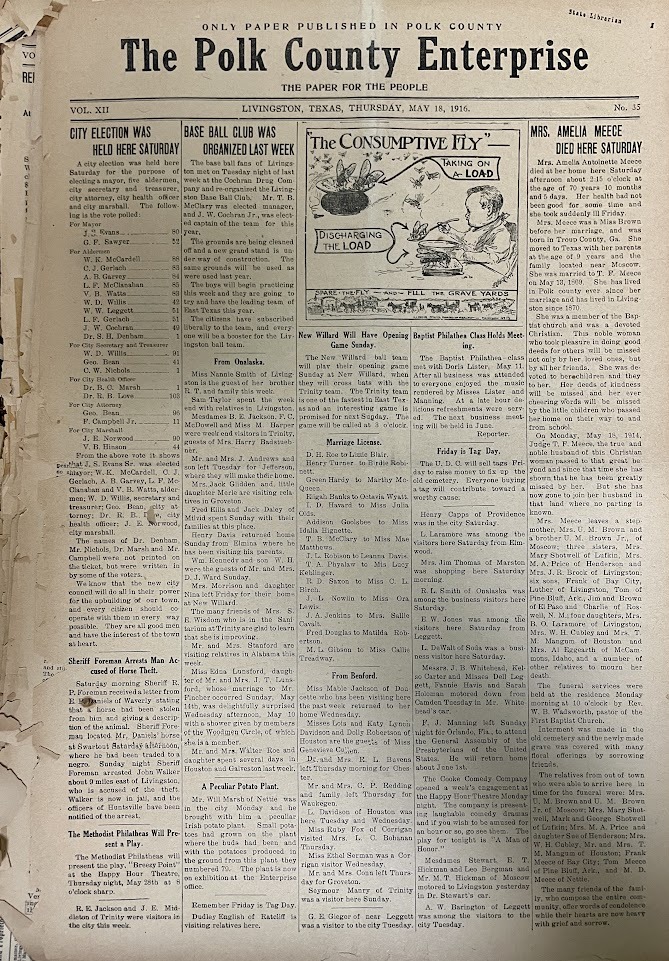
Amelia Antoinette Brown Meece – Obituary (great-grandmother)
Born July 8th, 1845
Died May 13th, 1916
MRS. AMELIA MEECE
DIED HERE SATURDAY
Mrs. Amelia Antoinette Meece died at her home here Saturday afternoon about 2:15 o’clock at the age of 70 years 10 months and 5 days. Her health had not been good for some time and she took suddenly Ill Friday.
Mrs. Meece was a Miss Brown before her marriage, and was born in Troup County, Ga. She moved to Texas with her parents at the age of 9 years and the family located near Moscow. She was married to T. F. Meece on May 18, 1869. She has lived in Polk County ever since her marriage and has lived in Livingston since 1870.
She was a member of the Baptist church and was a devoted Christian. This noble woman who took pleasure in doing good deeds for others will be missed not only by her loved ones, but by all her friends. She was devoted to her children and they to her. Her deeds of kindness will be missed and her ever-cheering words will be missed by the little children who passed her home on their way to and from school.
On Monday, May 18, 1914, Judge T. F. Meece, the true and noble husband of this Christian woman, passed to that great beyond and since that time she has shown that he has been greatly missed by her. But she has now gone to join her husband in that land where no parting is known.
Mrs. Meece leaves a stepmother, Mrs. U. M. Brown and a brother U. M. Brown Jr., of Moscow: three sisters, Mrs. Mary Shotwell of Lufkin, Mrs. M. A. Price of Henderson and Mrs. J. R. Brock of Livingston and six sons, Frank of Bay City, Luther of Livingston, Tom of Pine Bluff, Ark., Jim and Brown of El Paso and Charlie of Roswell, N. M. Four daughters, Mrs. B. O. Laramore of Livingston, Mrs. W. H. Cubley and Mr. T M Mangum of Houston and Mrs. Al Eggerth of McCammon, Idaho, and a number of other relatives to mourn her death.
The funeral services were held at the residence Monday morning at 10 o’clock by Rev. W. B. Wadsworth, pastor of the First Baptist Church.
Interment was made in the Old Cemetery and the newly made grave was covered with many floral offerings by sorrowing friends,
The relatives from out of town who were able to arrive here in time for the funeral were: Mrs. U. M. Brown and U. M. Brown Jr. of Moscow; Mrs. Mary Shotwell, Mark and George Shotwell of Lufkin; Mrs. M. A. Price and daughter Sue of Henderson; Mrs. W. H. Cubley, Mr. and Mrs. T. M. Mangum of Houston; Frank Meece of Bay City; Tom Meece of Pine Bluff, Ark., and M. D. Meece of Nettle.
The many friends of the family, who compose the entire community, offer words of condolence while their hearts are now heavy with grief and sorrow.
Epitaph; “Her children rise up and call her blessed”.