Before I move forward with T.F. Meece and the Civil War years, I would like to pay homage to my 3rd great-grandfather, John Meece. John was born in Lebanon Township, Lancaster County, PA, on October, 18th, 1782, just 5 years after the signing of the Declaration of Independence. In 1782, the area known as Lebanon Township was part of Lancaster County, Pennsylvania. Lebanon Township was one of the original Lancaster County townships named after the biblical Lebanon, reflecting the religious nature of the early settlers. He would marry my 3rd great-grandmother Catherine (Katey) Elizabeth Goad on March 12th, 1804, in Bedford County, VA. At the time, he was 21 years of age, and she was only 14 years old.
Shortly after their marriage, they moved to Maury County, TN, and purchased property alongside Rutherford Creek, just southeast of Spring Hill and northeast of Columbia. Tennessee had recently been admitted to the Union on June 1st, 1796, as the 16th state. John was a farmer, which was the primary profession in the early 1800’s. Many people farmed for subsistence, caring for their own, instead of selling crops for profit. John and Katey had 6 children; John William Meece, George Washington Meece, Phillip Meece, Abraham Meece, Thomas Richard Meece and William Carrol Meece.
Great Britain had imposed trade restrictions on the U.S. with regard to trading with France during the Napoleonic Wars. Great Britain rejected America’s claim to neutrality, they impressed American sailors, subjected American merchant vessel to search and seizure and they also armed Native Americans to suppress America’s expansion to the west. On June 18th, 1812, The United States declared war on Great Britain.
Tennessee would play a prominent role in the conflict. It is estimated that approximately 20,000 Tennesseans volunteered to fight in the War of 1812, hence the name Tennessee Volunteers. Many were motivated by the opportunity for adventure, a chance to get away from domestic life, and a sense of patriotic duty. The primary opponents of most of the Tennessee Volunteers were the Native Americans and not the British. For most Tennesseans, the Creek War of 1813-1814 was the War of 1812. John Meece was one of those volunteers.
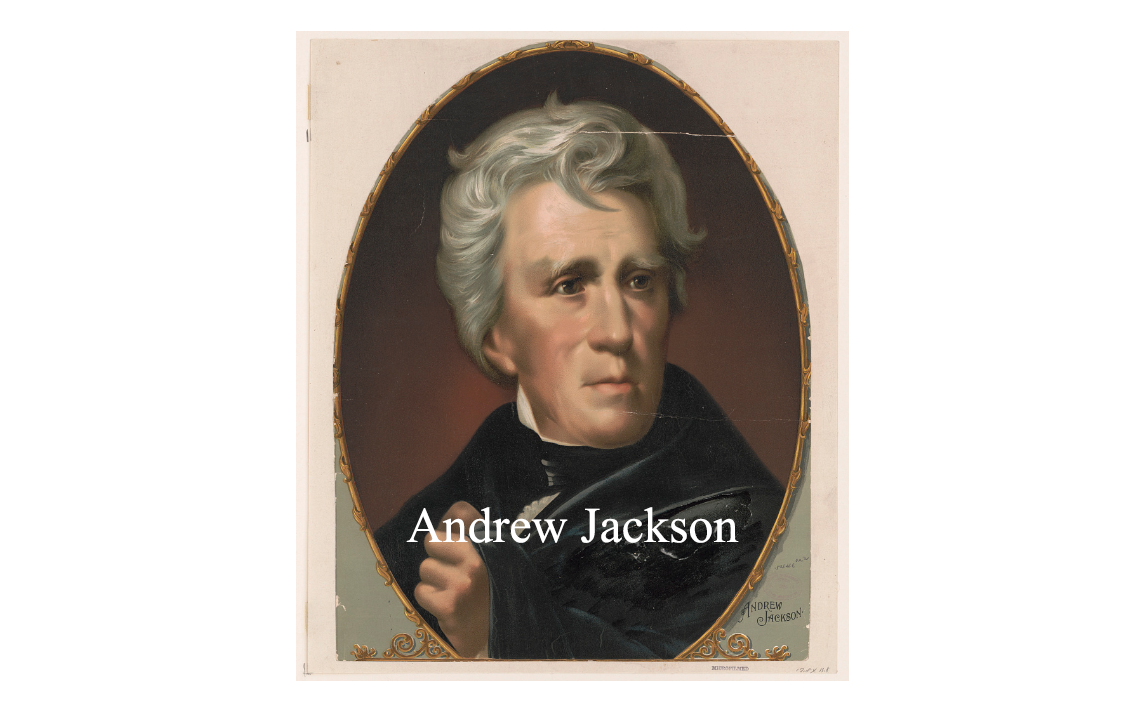
General Andrew Jackson was assigned to the Mississippi Territory (modern-day Mississippi and Alabama) and charged with quelling Indian rebellions and defending the lands against potential British invasions. Jackson’s first action was to raise and assemble in two divisions approximately 2,000 men in Nashville, TN. The troops were to be organized in Nashville by December 10, 1812, but the challenges of a difficult winter, procuring supplies and organizing the volunteer army delayed their departure until January 7, 1813. At the time Columbia, TN, had a total of 1,511 settlers. Spring Hill, TN, became a settlement in 1809 and a town in 1825. There were no population statistics at that time.
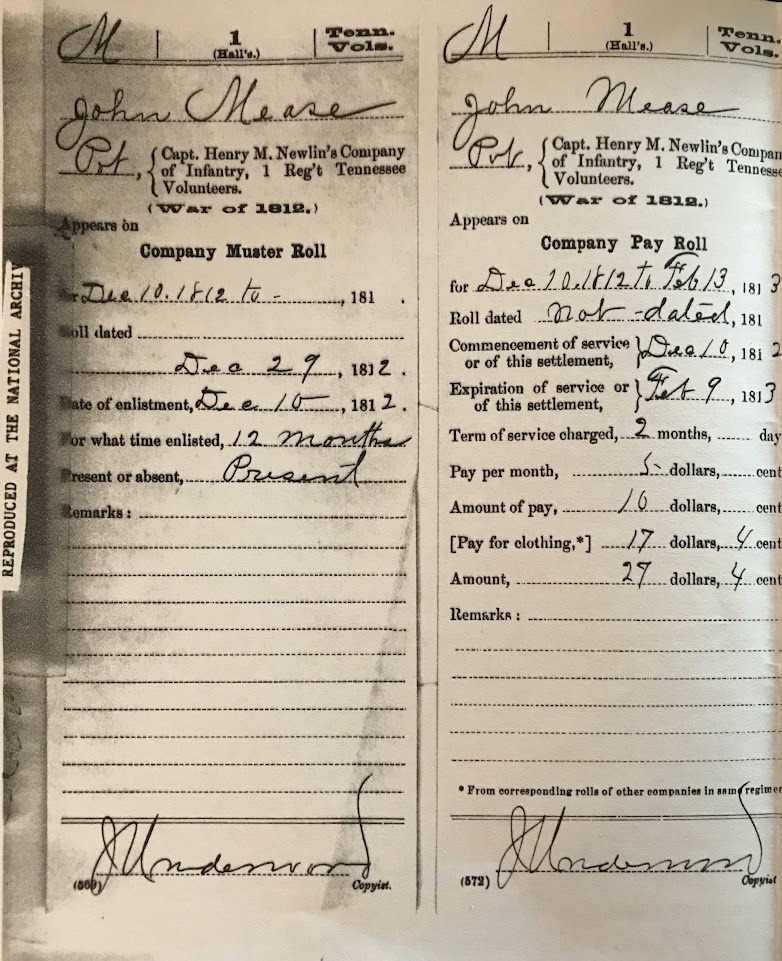
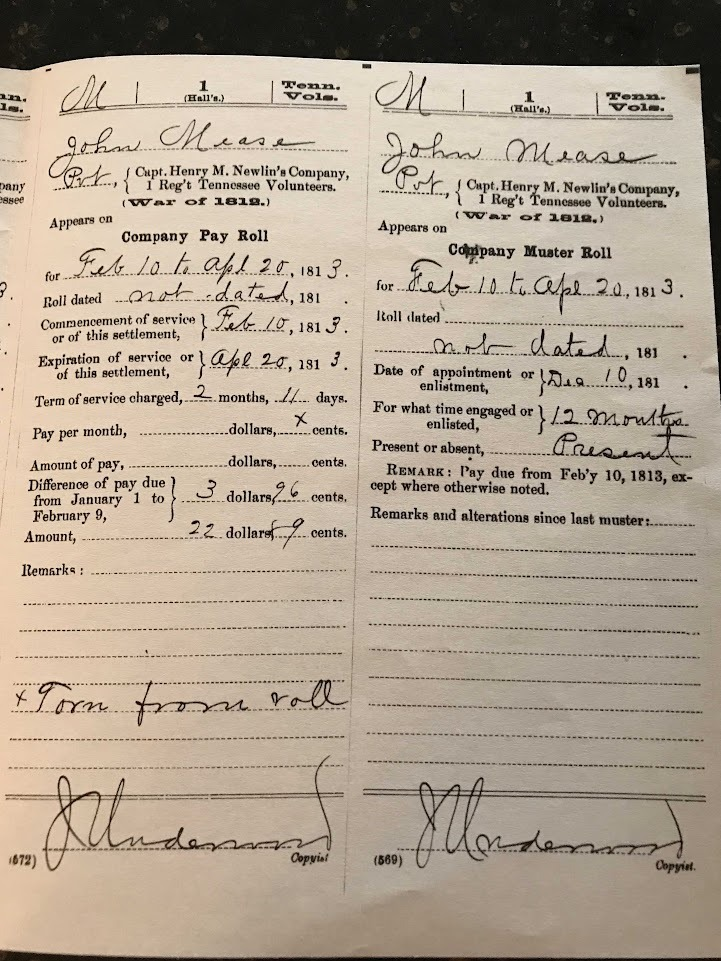
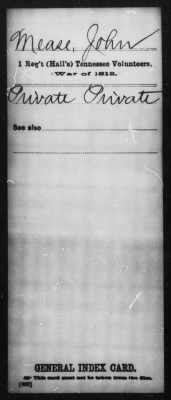
I have attached the Company Muster Roll, Company Payroll and General Index Card for John Meece (Mease). He was in the 1st Regiment (Hall’s) Tennessee Volunteers which denotes Colonel William Hall. His Company Commander was Captain Henry M. Newlin. This corresponds with the Tennessee State Library and Archives Regimental Histories of Tennessee Units during the War of 1812. The date of John’s appointment or enlistment (Dec. 10, 1812) matches the initial date that Jackson set for organizing his troops in Nashville.
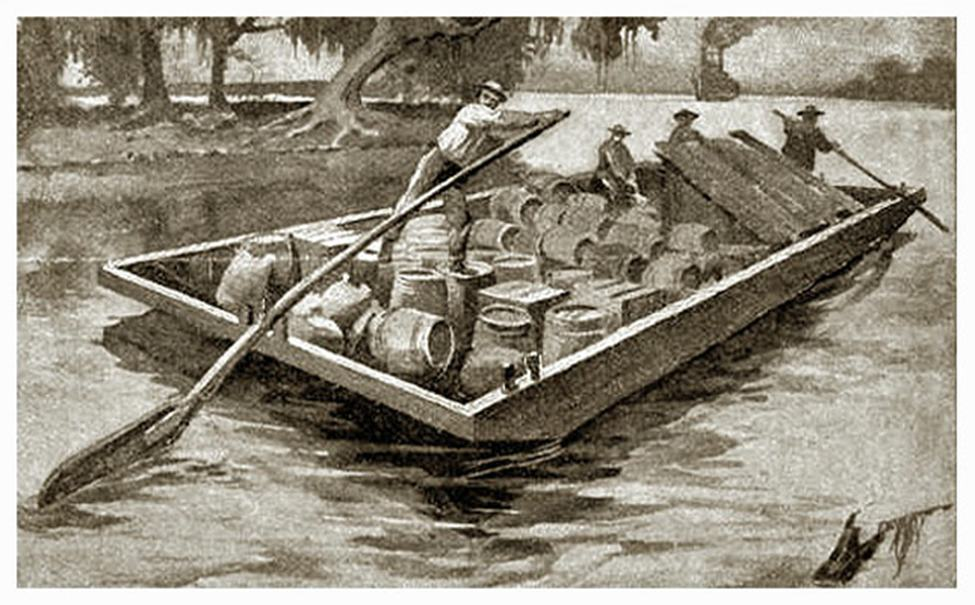
The expedition consisted of two volunteer regiments totaling 1,400 infantry and riflemen under Colonels Thomas Benton and William Hall. These men traveled down the Cumberland, Ohio, and Mississippi Rivers on a flotilla of (33) flat boats. General Andrew Jackson travelled with the flotilla. They finally reached their destination near Natchez in mid-February 1813. Although the destination of Natchez, MS, was only 500 miles away by land, the river journey from Nashville to Natchez coursed over 1,000 miles and lasted 39 days.
Flatboats were large, rectangular boats with flat bottoms and square ends used to transport people and cargo on the inland waterways in the 1800’s. They were typically 12 to 20 ft. wide and 20 to 100 ft. in length. The flat boats were rigged with 30 to 55 ft. sweeps to guide the boats in the current and a rudder or steering oar. The draught of these types of boats was at most 3’ fully loaded. These boats were designed strictly for one-way downstream travel as they had no means of propulsion. Once they reached their destination they were dismantled and the hardwoods were used for other purposes.
The final regiment, under Colonel John Coffee (Jackson’s business partner), consisted of 670 mounted infantry and cavalry. In total, Jackson’s army consisted of 2,070 men and officers. Coffee’s men rendezvoused at Columbia, TN, and marched overland, via the Natchez Trace, into the Mississippi Territory (Alabama and Mississippi). The 3 regiments would arrive in Natchez within days of one another.
Jackson received very little if any assistance from the Federal Government. Remember, this was the first declared war of a fledgling country. Jackson had to raise funds from the citizens of Nashville to pay the volunteers and to pay for all of the supplies and necessities for the trip. They waited for days to receive arms that were never to arrive. They were ill prepared in terms of supplies for the expedition to Natchez. Thankfully, the Chickasaw Indians provided them with food both on their way to Natchez and on their return trip to Nashville.
After lingering around Natchez for several weeks, Jackson received orders from the Secretary of War informing him that his services were no longer required and that he was to dismiss his troops. He had to rely on his family, friends, banking connections in Natchez and the parents of the volunteer soldiers for funding to return home. Starvation and sickness were the order of the day.
After the aborted mission to New Orleans, this unit was dismissed at Columbia, TN, (John’s home) in April of 1814. The return trip would take over a month. According to Jackson’s papers he would leave behind 6 men due to sickness. They would return home at a later date but no man would parish during the ordeal. This is pretty amazing considering the fact that three-quarters of the war deaths amongst American troops came, not from wounds, but from disease. According to an American army surgeon during the War of 1812 “It is among soldiers in the field that filth and bad provisions abound. It is among that class of men that dysentery appears with all its hideous forms.” The most common diseases were typhoid fever, pneumonia, malaria, measles, typhus, smallpox and diarrhea.”
The men came back devastated that they had not faced an enemy. They were embarrassed that they came back in tatters, starving to death, emaciated and not the victors that they had imagined. Many of the men later re-enlisted under Colonel Edward Bradley and joined Jackson in the first campaign of the Creek War. Clearly this was a result of their faith and belief in Andrew Jackson and not the Federal government.
On August 30th, 1813, a force of approximately 700 Creek Indians attacked Fort Mims in Baldwin County AL, killing 250 defenders and taking at least 100 captives. It was the first major battle of the Creek War. The Creek attack on Fort Mims, and particularly the killing of civilian men, women, and children at the end of the battle, outraged the U.S. public.
The area was already on edge because of an earlier attack, in May of 1812, by a small party of Creek Indians. Seven people were killed and a woman by the name of Martha Crawley was taken captive. The attack occurred in Humphreys County, TN, which is approximately 72 miles west of Nashville. At that time, middle Tennessee was considered western Tennessee. Anything west and south of Franklin was considered Indian Territory. Franklin, TN, was considered civilized at the time because its citizens bathed and they dressed in their finest clothes for church on Sundays.
Jesse Manley and John Crawley had left home to purchase some corn. When they returned they found the five children dead and scalped. They also found the man they left to watch the place, in their absence, dead as well. Mrs. Manley was found alive, shot once in the side of the head, once in the knee, an eye burned and her head partially scalped. She told her husband of the attack and of the fate of Martha Crawley. Mrs. Manley died a short time later.
The following is a description of the attack and kidnapping of Martha Crawley from the Nashville Clarion on May 26, 1812:
“…the persons killed were mostly children, that a Mrs. Manly was shot in the knee and shot through the jaws, a little below the ears, was scalped, and arrows left in her – but was not dead, that Capt. Crawley’s wife and another person were missing; … Mrs. Manly had stated that four Indians came into her house in McSwines bottom, she had a child in her lap of nine days old, they took the child out of her arms and threw it against the wall, which hurt it so that it is since dead, that they wounded her as above, that a little boy of hers run, but was overtaken by the Indian dogs, that they danced around him and then killed him, and killed the rest of her family.”
A call to arms!
On September 24th, 1813 Major General Andrew Jackson wrote the following:
“Your frontier is threatened with invasion by the savage foe! Already do they advance towards your frontier with their scalping knifes unsheathed, to butcher your wives, your children, and your helpless babes. Time is not to be lost. We must hasten to the frontier, or we will find it drenched in the blood of our fellow-citizens.
I am commanded by his Excellency Gov. Blount, to call into the field, at the shortest possible day, two thousand men of the Volunteer infantry and militia of my division. The undersigned therefore orders, that the whole of his volunteer Infantry, that composed the detachment under his command in the late Expedition (Natchez) for the defense of the lower country, rendezvous at Fayetteville, Lincoln County, on Monday the 4th of October next, well equipped for active service…”
Within a month after they had marched to Creek country, Jackson and his Tennessee Volunteers had won significant victories over the Creeks at Tallushatchee and Talladega. Unknown to most, Davy Crockett fought in both battles, under a three month enlistment agreement. Crockett and his family had settled in Franklin County at the time of the outbreak of the Creek War. Crockett would go on to serve in the Tennessee State Legislature as well as represent Tennessee in the United States House of Representatives. He is most well-known for his participation in the Texas Revolution and his death at the Alamo.
Following these battles, General Andrew Jackson faced a mutiny by his Volunteers regarding their enlistment periods. The problem originated with troops having volunteered for a one-year period at the time of The Natchez Expedition. Most of Jackson’s volunteers had signed up for a one-year term of service on December 10, 1812. They considered December 10, 1813, the end of their obligation. Jackson interpreted the agreement to mean one-year of active service. They had been inactive following the Natchez expedition until mustering again after the Fort Mims massacre. Jackson went so far as to threaten them with two artillery pieces on the night of December 9th, if they were to mutiny.
The volunteers and militia had strong reasons for wanting to return home. First of all, they never expected to be called to serve again. Being citizen soldiers, they had left behind families that needed to be fed, clothed, and protected against the numerous dangers of frontier life. Don’t forget, these Volunteers came from counties near Humphries County where the Manley and Crawley homesteads were attacked only 1 ½ years earlier. When John Meece departed for the Creek War he left behind his pregnant wife Catherine and their (5) young sons. Once again the troops faced starvation due to supply problems which eerily reminded them of the Natchez Expedition. As farmers, they had already made great sacrifices to participate in the fighting. They feared financial ruin if they missed the upcoming planting season.
Near the end of December, Jackson received a letter from the Governor of Tennessee. While Blount sided with Jackson in the matter, he believed that it was useless to hold the militia against its will. He advised Jackson to dismiss the militia and abandon the campaign until a new army could be raised. Jackson informed the militia of the governor’s decision. To the General’s chagrin, the Volunteers wasted no time in marching out of Fort Strother.
There were so many conflicting rules and laws governing the Federal troops or career soldiers and the volunteer troops or citizen soldiers. I cannot blame John or any of the other Volunteers for leaving. I believe that General Jackson misinterpreted the terms of their enlistment. The way that I understand the situation, Jackson and the remaining Regiment at Fort Strother were not in imminent danger.
The conflict evolved into hostilities and ended with courts-martials for a considerable number of men. Because of this, these men were not eligible for pay or pensions. Jackson would berate these men in an open letter published in the Nashville Whig on 01/11/1814; “Yet these men, these Volunteers of Tennessee have become MUTINEERS!” He would go on to ask “Will you tell them (family and friends) that you abandoned your General & your late associates in arms, within fifty miles of an assemblage of a savage enemy, that as much delights in shedding the blood of the innocent female & her sleeping babe as that of the warrior contending in battle? Lamentable, disgraceful tale!”
He would later write to his wife Rachel “…sunk from the highest elevation of patriots to mere, wining, complaining, seditionaries’ and mutineers to keep whom from open acts of mutiny I have been compelled to point my cannon against, with a lighted match to destroy them.” In the end Governor Blount would continue to speak of these men as heroes.
Although some speak of the War of 1812 as the “forgotten war” it is notable for many reasons:
• The British would attack and capture Washington, setting fire to both the White House and United States Capital, causing significant damage to the interiors of both.
• The defense of Fort McHenry would inspire Francis Scott Key to pen the words, in a poem, that were later set to The Star Spangled Banner.
• In addition to Davy Crockett, another famous figure to take part in the War of 1812 was Sam Houston. He served under Andrew Jackson in the decisive battle against the Creek Indians at Horseshoe Bend. He was severely wounded in this battle and thought to be on his deathbed. He was the only citizen to serve as Governor in two states, both Tennessee and Texas. Houston would revenge those lost at the Alamo by defeating Santa Anna’s Mexican army at the Battle of San Jacinto. The City of Houston was named in honor of Sam Houston. On a lighter note, General Sam Houston was a noted guest of the Old Andress Inn in Livingston, TX. The Inn contained a restaurant, saloon, grocery store, post office, stage station and a livery stable nearby.
• The Treaty of Ghent, ending the War of 1812, was signed on December 12th, 1814, before the Battle of New Orleans, which occurred on January 1st, 1815, when Jackson defeated the British.
I must address the most glaring discrepancy in the tale of John Meece and that is the name itself. I first discovered the Company Muster Roll, Company Payroll and General Index cards on Ancestry months ago. This information was derived from the National Archives and Fold3® Military Records. This same John Mease can be found in the Tennesseans in the War of 1812 by Byron Sistler and Samuel Sistler. It is my understanding that the original records were in very poor condition and that they were reproduced by a copyist. It’s possible that the name was transcribed incorrectly. Unfortunately, unless you were an Officer, very few records showed place of residence.
There were entries in Ancestry that spoke of the Meece letters:
“Many Meece letters state that John fought in War of 1812 and died walking home.”
“Ralph’s Letter Aug. 16, 1981 to “Dear Cousin Pegg” says “John Meece owned land here. He was in the mercantile business with a man named Gant. He went with Gen. Andy Jackson and fought in the battle of New Orleans.”
One man, a Genealogist whom I respect a lot, wrote THE GOADS a Frontier Family by Kenneth F. Haas. In Chapter XIII, ROBERT GOAD OF TENNESSEE, on page 110 he writes: “In 1804. Catherine (Katy) Goad, daughter of Robert, married, in Bedford County, John Meece. This couple accompanied (or preceded) Robert and his family to Tennessee and owned land bordering that of the other Goads in Maury County. John died young and left Katy with a large number of sons, predictably named John, Abraham, et al.”
In a forum on Genealogy.com Ken writes: “John Meece left Katy and his three young sons to fight in the Battle of New Orleans and was killed on his way home after the battle.” The multitude of participants in this forum were frequently interchanging Meece with Mease all the way back to their days in Pittsylvania County, Virginia. It appears that there were attempts to anglicize the name Miess in both Pennsylvania and Virginia. He most certainly did not die while returning from The Battle of New Orleans.
I have been in touch with Leslie from the Tennessee State Library and Archives. This a copy of the last email that I sent her;
Good morning Leslie,
I’m here to bug you one more time. When I first began researching my 3rd great-grandfather John Meece, I found the attached Index Card, Muster Roll Card and Payroll Card for a John Mease in any number of Ancestry family trees. What troubled me was the fact that no one had an explanation for the spelling discrepancies. For that matter, no one even tried. I think that it was just cool to have a relative that fought alongside Andrew Jackson in the War of 1812.
It is my understanding that literacy rates were fairly high at that point in time. It’s hard to imagine that a clerk or John would have let an error, that obvious, pass. I may be wrong but I believe we were well beyond spelling according to sound in 1812. Do you have any way of determining where John Mease was from? According to my research, John Meece would marry my 3rd great-grandmother Catherine (Katey) Elizabeth Goad on March 12th, 1804 in Bedford County, VA. Shortly afterward they moved to Maury County, TN, and purchased property alongside Rutherford Creek, just southeast of Spring Hill, TN, and northeast of Columbia, TN.
According to the Regimental Histories of Tennessee Units During the War of 1812, most of the men in Hall’s 1st Regiment were from Sumner, Davidson, Giles, Lincoln, Montgomery, Overton, Rutherford, Smith, and Wilson Counties. That’s not to say that men from other surrounding counties couldn’t have volunteered. Spring Hill, TN is only 36.4 miles from Nashville, where Jackson formed the aborted mission to Natchez. Both Colonel William Hall and Captain Henry M. Newlin are identified in the (3) cards that I have attached so I am certain that John Mease was a member of this Company. I am not certain that John Mease is John Meece.
I believe the reason that John Mease doesn’t show up in the Index to War of 1812 Pension Files is because John and his fellow Volunteers were court martialed when they left Jackson following their victory at the Battle of Talladega during the Creek War. A dispute arose between Jackson and his volunteers, who claimed their one-year’s enlistment was up on December 10th, 1813. The controversy stemmed from the Natchez Expedition which began December 10th, 1812. Jackson’s men volunteered for a one-year period of enlistment. They were dismissed in April of 1813 and called up again at the onset of the Creek War in September of 1813. Jackson felt that the time not spent in the field did not apply to the year’s enlistment but the volunteers felt otherwise.
The Volunteers left Fort Strother and traveled to Nashville to await word from the President or the Governor. Governor Blount, Governor of Tennessee, supported the position of the Volunteers and spoke of them as heroes. Jackson would go on to write a letter “To the 1st Brigade, Tennessee Volunteer Infantry”, which was published in the Nashville Whig that states in part *”Yet these men-these Volunteers of Tennessee have become MUTINEERS!”
Another story on Ancestry concerns Meece letters, which no one can produce copies of, that state that John Meece served under Andrew Jackson at the Battle of New Orleans. He mysteriously dies on the trip home. I have a deed showing that John Meece purchased a tract of land on June 21st of 1819 in the State of Tennessee. Not bad for a dead man. Anyway, all of the stories on Ancestry make for good copy but I prefer the truth. If I can pin down where John Mease was from then I’ll have my answer and a story I can print with confidence.
Regrettably, she was unable to confirm or deny. Leslie stated that “The Tennessee State Library & Archives has copies of the War of 1812 Muster Rolls on microfilm, but they are in poor condition.” The Payroll Card clearly states REPRODUCED AT THE NATIONAL ARCHIVES and it is signed by a copyist. I’m confident in the story that I’ve produced, although I am not as confident in the identity of John Mease.