This is a postcard written (verbatim) by my 2nd great-grandmother Hannah Bennette Fields Meece in March of 1856 describing their journey from Tennessee to Texas. Joining her were her husband William Carrol Meece and their children; John William Meece, Theophilus Franklin Meece, Minerva Caroline (Carrie) Meece, James Pickney Meece, Calvin Wood Meece and Monroe Marshall Dawson Meece.
“We started for Texas on Monday the 18 of February 20 we got to Nashville and left there for New Orleans and on thursday night 11 o’clock reached there 28 of feb and we staid until Sunday morning we left there for galveston on tuesday the 4 of march we went to Brothier Williams and staid thier until Thursday 20 we started across the bay we ran aground on the bar and tay there until 23 we then got of and on Friday 28 we laned at swort out on 29 we landed at Brothier Calven Fields”
Hannah B Meece
This is my translation of Hannah’s postcard.
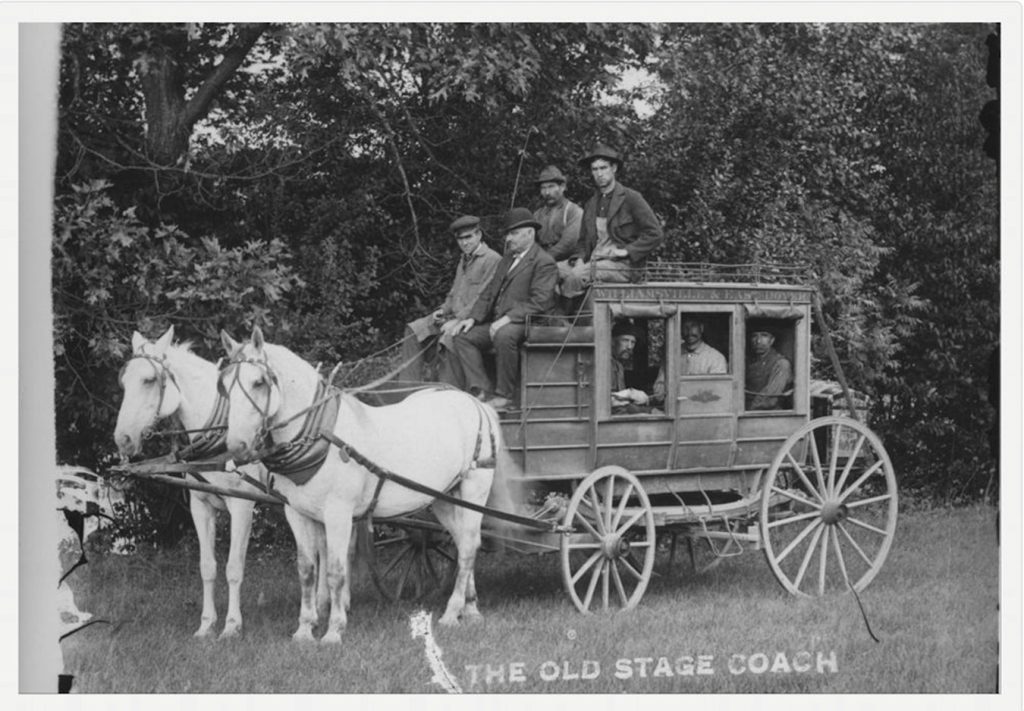
The Meece clan probably traveled from Columbia, TN, to Nashville, TN via stagecoach. The distance between the two cities is 45.9 miles. Up until the beginning of the Civil War, there were 16 major stagecoach lines departing from Nashville. These coaches carried fifteen passengers and used four-horse teams. The average speed of the coaches was six miles per hour with team changes approximately every ten miles. Smaller coaches, pulled by two-horse teams travelled between Columbia and Nashville. More than likely the stagecoach didn’t travel at night, so it’s easy to believe that the trip took two days.
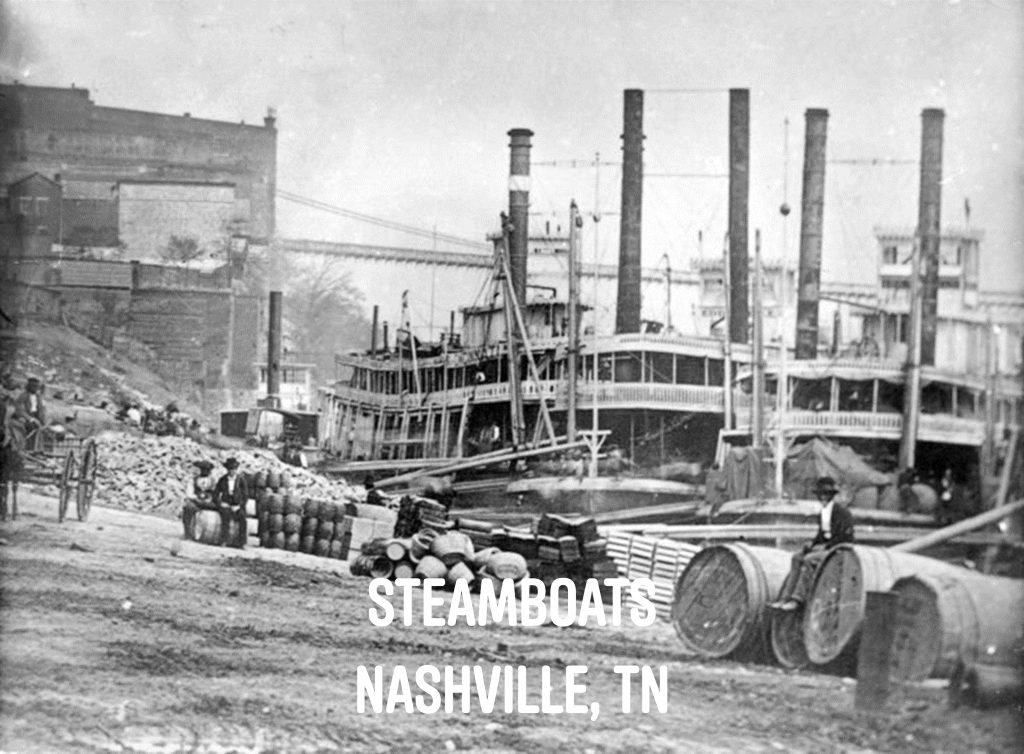
They departed Nashville on Thursday night February 21st on a steamboat. The steamboat season on the Cumberland River opened about the middle of November and lasted until about August 1st. In the 1840s, the average steamboat completed the journey downriver in approximately 7 days which is confirmed by Hannah’s description of the steamboat arriving in New Orleans on the 28th.
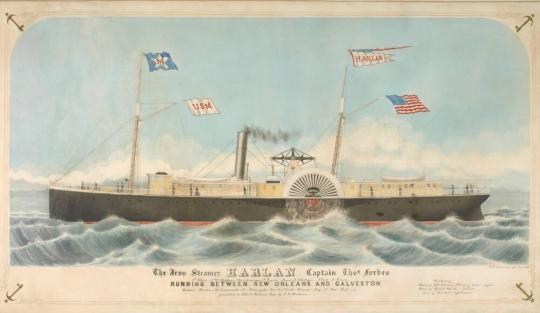
They then traveled from New Orleans to Galveston via steamship on Tuesday the 4th of March. By 1860, Morgan’s Southern Steamship Company was operating six regular routes in the Gulf of Mexico amongst New Orleans, Galveston and Port Lavaca. They stayed with her brother William Fields in Galveston until Thursday March 20th. William was somewhat famous for his book Fields’ Scrap Book, which is a collection of literary efforts, anecdotes and sketches published in 1882. It can still be found today.
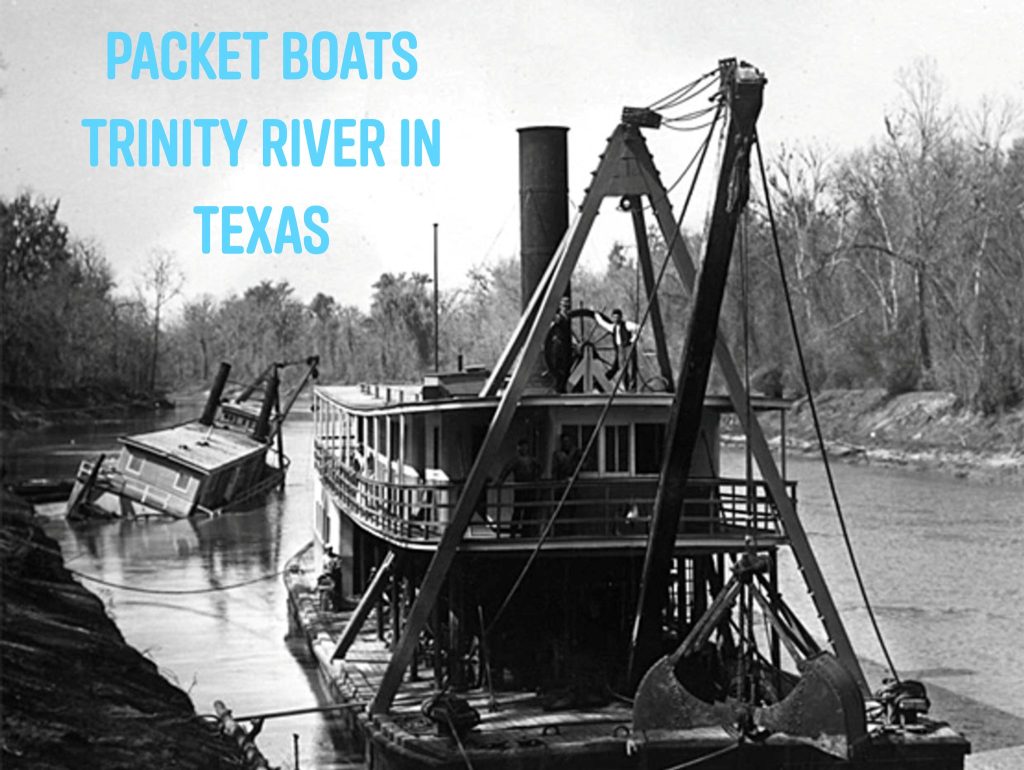
Next they traveled across the Trinity Bay to the Trinity River via a packet boat. Unfortunately, they ran aground on a sandbar, probably at the mouth of the Trinity River, and remained there for 3 days until tidal changes freed the boat. They arrived in Swartwout, TX on Friday March 28th. The distance from Galveston to Swartwout is 260 miles. Swartwout no longer exists, as it sits at the bottom of Lake Livingston.
They traveled to Livingston which was 7.1 miles from Swartwout and stayed with her brother Calvin J. Fields and his family. By the way, Calvin, his wife and two sons are buried in the Old City Cemetery in unmarked graves. They stayed there until they resettled in Colita, TX. Colita is a lovely little farming community that we visited during our trip to Texas. It was known as the Louisiana Settlement which was established in 1840 and named after Colita, a Coushatta Indian Chief. In 2000, the population was 50.
Hannah Bennett Fields was born on July 24th, 1805, in Wilkesboro, NC located in Wilkes County and she died on October 28th, 1866, in Livingston, TX, located in Polk County. I’ve changed the name from Bennette to Bennett. She was named after her father who was Bennett Fields. I believe she provided the impetus for the move to Texas. Her brother William Fields was living in Galveston, and her youngest brother, Calvin J. Fields, was living in Colita, TX, which is close to Livingston.
It is unknown where Hannah, her husband, William, and their son John are buried. It’s possible that they were buried in the Old City Cemetery located in Livingston and it’s equally possible they were buried on the family farm. Her brother Calvin and his family were buried in the Old City Cemetery. Unfortunately, their headstones were destroyed over time or by vandals. Who knows?
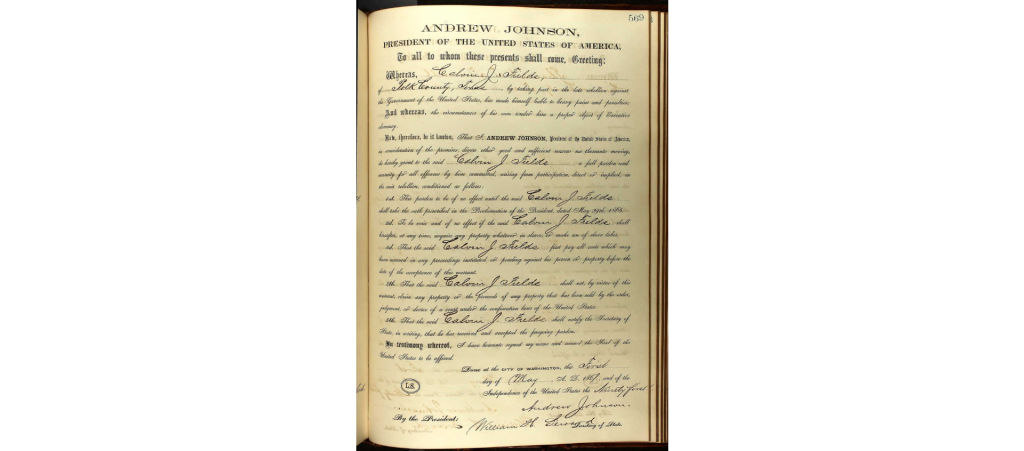
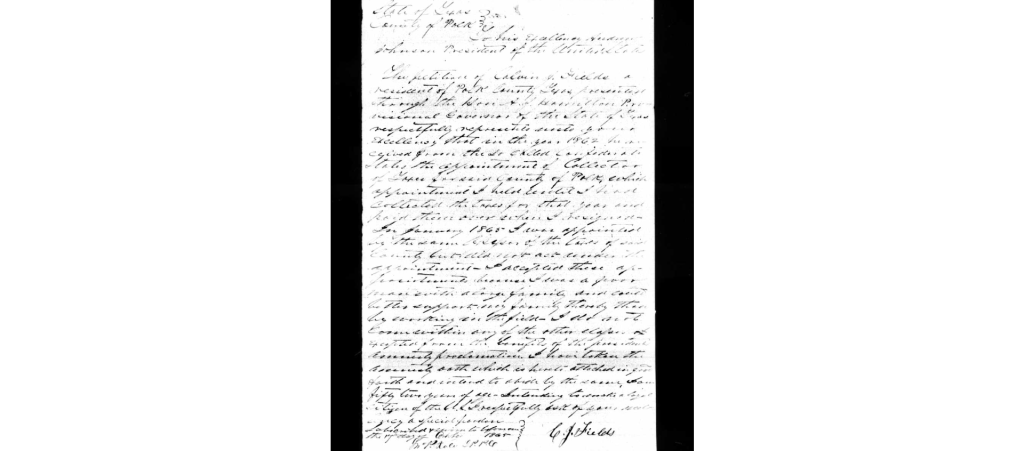
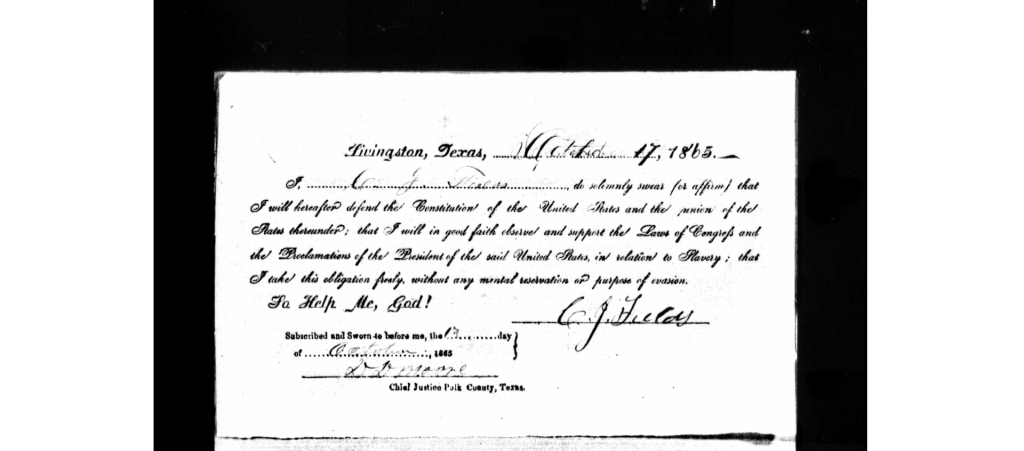
Calvin was a soldier in the Confederacy during the Civil War. I’ve discovered his various U.S. Confederate Applications for Presidential Pardons along with the U.S., Pardons Under Amnesty Proclamations, 1865-1869, signed by President Andrew Johnson. At a later date, Calvin would vouch for or co-sign a loan for William Meece.
President Andrew Johnson’s Confederate pardons were crucial in his Reconstruction plan, aiming to quickly reintegrate the South into the Union after the Civil War. Some saw it as a necessary step towards reconciliation, but others criticized it as too lenient. The pardons restored civil rights to many former Confederates but also allowed for the re-establishment of state governments that often resisted racial equality. To receive a pardon, individuals had to take an oath of allegiance to the United States. Robert E. Lee wasn’t pardoned until 1975, over a century after his death. Congress passed a resolution restoring his citizenship, which President Gerald Ford signed into law. According to the United States government, his application had been misplaced. Bureaucrats…
William Fields was somewhat famous as an author of the “Scrap Book.”
Sources: Randolph B. Campbell, “Texas and the Nashville Convention of 1850,” Southwestern Historical Quarterly 76 (July 1972); Texas State Historical Association
FIELDS, WILLIAM (ca. 1810–1858). William Fields, author and legislator, was born in North Carolina about 1810. He moved to Tennessee and published the first edition of Fields’ Scrap Book, a collection of literary efforts, anecdotes, and sketches, before moving to the Lone Star State in 1837. After living briefly in Liberty County he moved to Galveston County but returned to Liberty in 1842. He was elected to represent Polk and Liberty counties in the first of four consecutive terms in the state legislature in 1847. While in the Texas House, Fields opposed the legislature’s hurried call for delegates to the Nashville Convention of 1850. He also opposed any measure asserting the state’s supposed claim to Santa Fe that might lead to war with the United States. For most of the period he engaged in a heated newspaper quarrel with his bitter rival Thomas Jefferson Chambers. In 1855 the American (Know-Nothing) party chose Fields as its candidate for land commissioner. Claiming that he had been and would remain a Democrat, Fields mounted an unsuccessful campaign for the position in the Democratic primary. Despite the defeat, he was named state engineer in 1856.
Fields revised his Scrap Book in 1851; new editions appeared in 1854, 1856, 1860, 1872, 1884, and 1890. He accumulated little property in Liberty County; the 1854 county tax rolls assessed his estate (including one slave, four horses, thirty cattle, and a watch) at less than $1,200. Fields was married to a native of Tennessee and had at least five children. He died at Hempstead on September 9, 1858, and was interred at Galveston.
Hon. William Fields, who moved from Tennessee to Texas in 1837 and settled near the old town of Anahuac, then Liberty County, where he was engaged for years in the stock business, farming and school-teaching. He represented Liberty County in the Congress of the Republic, and also in the State Legislature after the admission of Texas to the Union. He moved to Galveston in 1855, about which date he received the appointment of State Engineer, an office which he held until his death September 9, 1858. He was a man of culture, being the compiler of ” Fields’ Scrap Book,” a meritorious literary work; and was at one time engaged in journalistic pursuits as an associate of General Felix T. Zollicoffer, of Confederate fame, in the publication of a newspaper at Columbia, Tennessee.
Died of yellow fever while on an inspection tour of the Texas & Central Railway
-14Sep1858=BURIAL
-14Sep1858=Obituary for William Fields Jr(ca.1810-1858),GALVESTON WEEKLY NEWS, Galveston, Galveston County, Texas, USA:
FUNERAL OF COL. WM. FIELDS.
The remains of Col. [William] Fields were brought to our city [Galveston] this morning, by steamer ISLAND CITY, in charge of a number of friends of the family, and the funeral took place at 9 o’clock, when a large procession accompanied the deceased to his last resting place. Rev. James Huckins performed the burial rites at graveside. Col. Fields died at Hempstead at 8 a.m. on the 9th inst. of congestive fever. He was at the time of his death the Chief Engineer for the State of Texas and had been a resident of the state for twenty years and had for many years represented Liberty County in the State Legislature. He leaves a widow and children.
-2Nov1858=Obituary for William Fields Jr(ca.1810-1858), THE HOME JOURNAL, Winchester, Franklin County, Tennessee, USA posted at https://www.findagrave.com/memorial/134303488:
Col. William Fields, a distinguished citizen of Texas, and the author of Field’s Scrapbook, died lately at Hempstead of that state. He was a native of Tennessee, a practical printer, and a most excellent learned and public-spirited gentleman