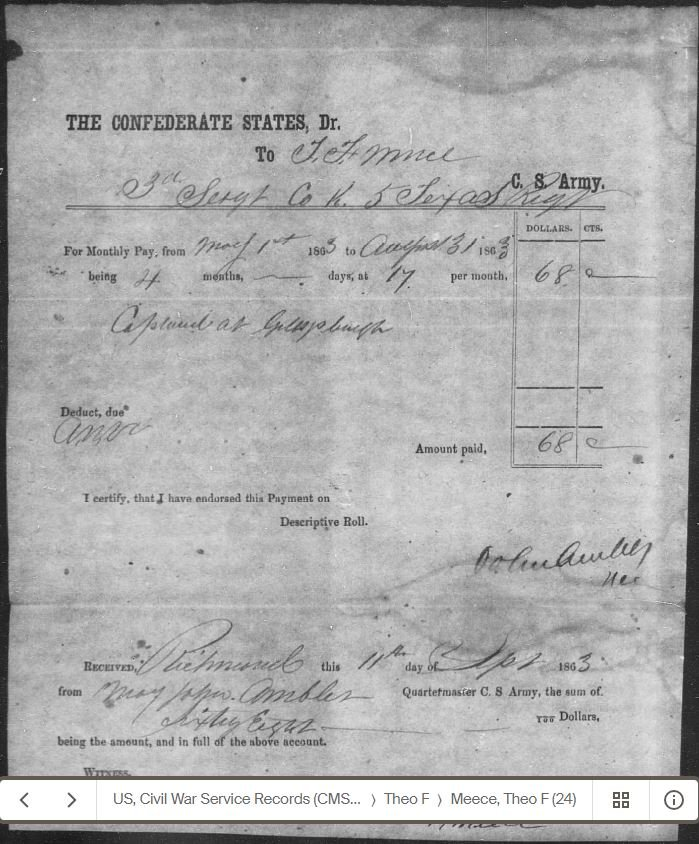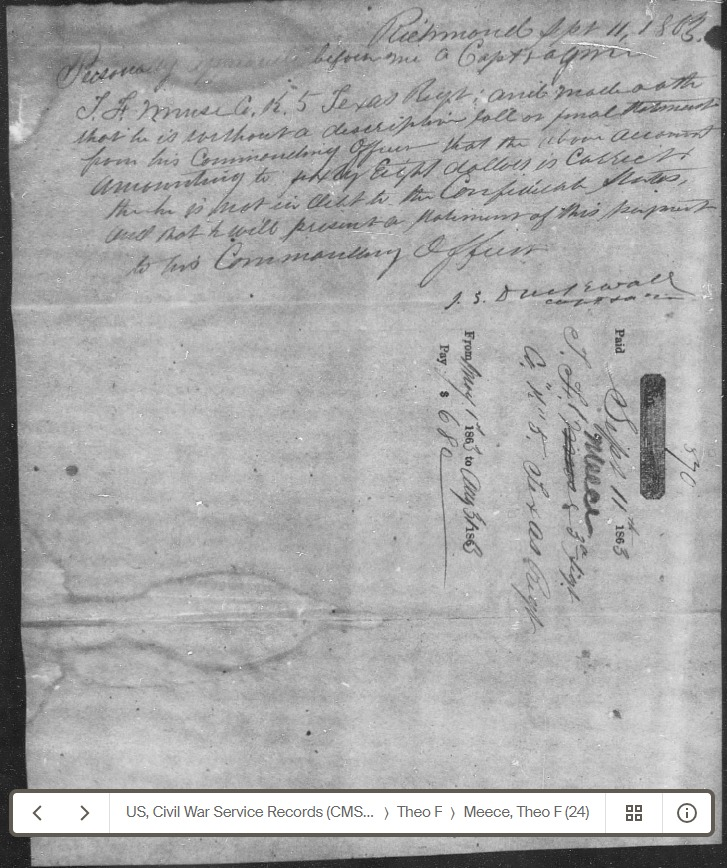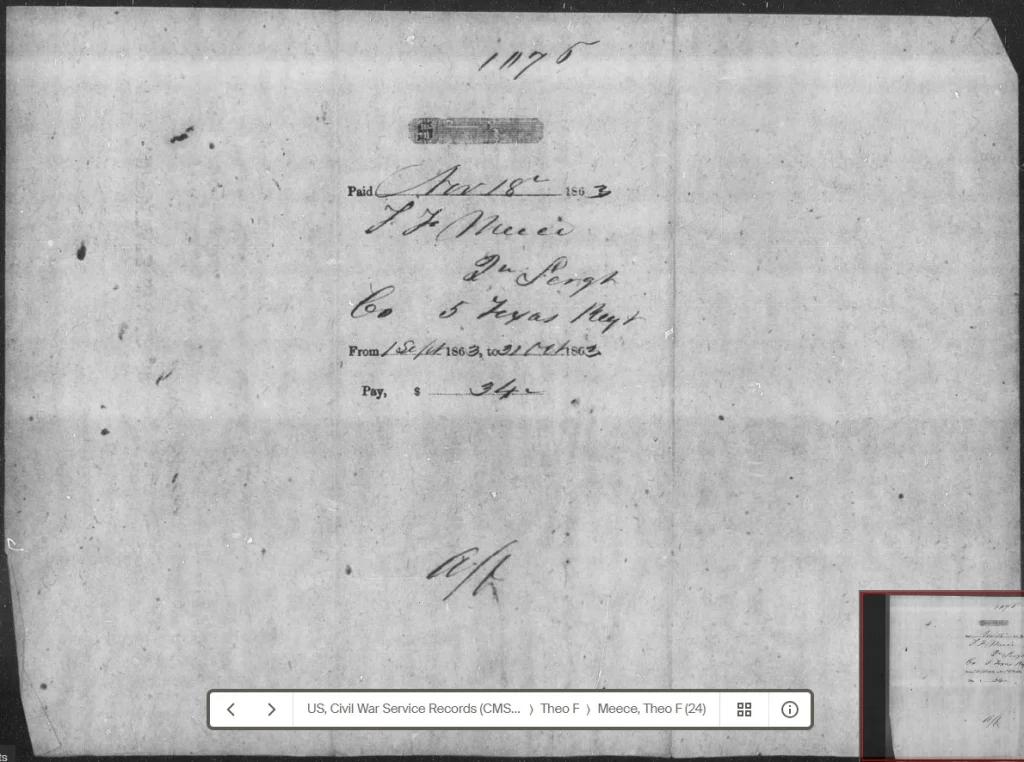
T.F. returned to Livingston, TX in June of 1865, just in time for his 25th birthday. The optimism, once prevalent at the onset of the Civil War, was gone. The Civil War had a devastating impact on the Texas economy. I’m sure that T.F. had a sense of these changes since he returned home several times during the war. These trips home were prompted by the numerous injuries that he had suffered, as well as his capture at, and parole following, Gettysburg.
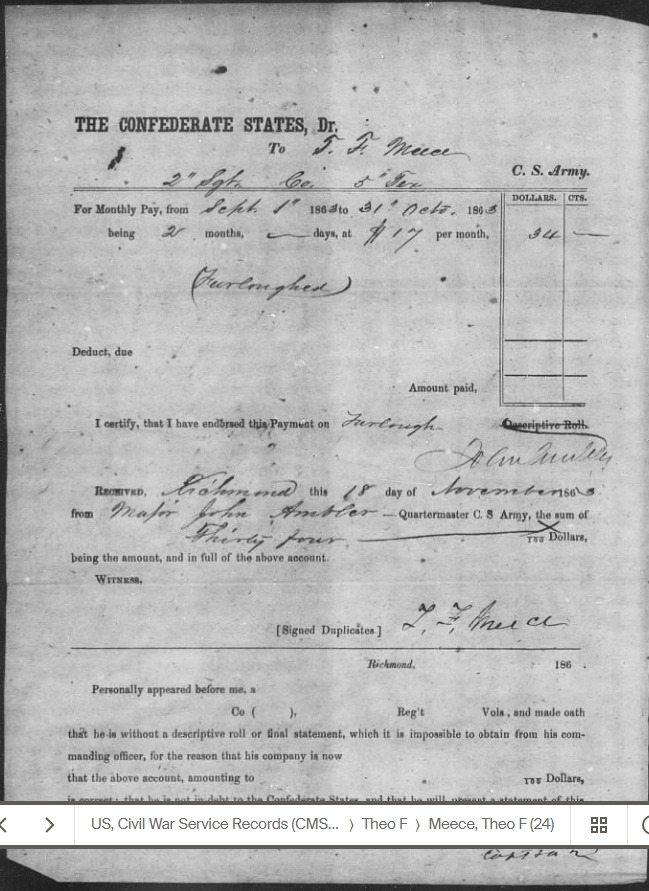
The Confederate currency was worthless, further exacerbating the financial woes of the State. T.F. was paid $17.00 per month for his service in the Confederate Army. The currency, known as the Greyback (vs. the Greenback), was not backed by hard assets. It was simply a promise to pay the bearer, after the war, based upon the very optimistic prospect of Southern victory and independence.
Reconstruction, which lasted from 1865 until 1877, was a period of turmoil and uncertainty for the South. The 13th, 14th, and 15th amendments to the Constitution, known as the “Reconstruction Amendments”, ended slavery in the United States, ensured birthright citizenship, as well as due process and “equal protection of the laws” under the federal and state governments, and expanded voting. Texas wasn’t officially readmitted to the United States until March of 1870. It was one of the last of the former Confederate states to reenter the Union. This was directly tied to its reluctance to change.
Obviously, the cotton industry, which was the State’s primary source of income, suffered due to the end of slavery. This was true in Polk County as well. Agriculture production also decreased sharply. Products such as wool, sugar, molasses, corn and sweet potatoes were common in the nineteenth century. Livestock became a steady source of income through the turn of the century. The lumber industry and the establishment of the railroads, in particular the Houston, East and West Texas Railway did much to lessen the financial impact of the post-Civil War era in Polk County.
T.F. resumed work as a merchant’s clerk at a local business house as well as working on his father’s farm and continuing the carpenter apprenticeship. At some point in time The City of Livingston Texas portrays him as: Barber: T.F. Meece under Additional Early Businesses.
T.F.’s father William C. Meece had purchased 1,100 acres of land on August 9th, 1859 for $350.00. The property was described as being located two miles NNE from Livingston on the road leading to Moscow. That road today is US-59 N. The purchase was completed with two promissory notes, co-signed by C.J. Fields. Calvin J. Fields was the brother of Hannah Fields Meece, William’s wife. Apparently, William lacked the necessary collateral to secure the promissory notes himself.
On October 28th, 1866 T.F.’s Mother Hannah B. Fields died at the age of 61. According to T.F.’s biographer, she “…died at the Polk County, Texas home.” William would eventually remarry a woman by the name of Nancy C. Burroughs on January 18th, 1869. Nancy died on November 17th, 1902 and she is buried in the Burroughs Cemetery located in Onalaska, Texas, which is in Polk County.
Sometime between the 1860 and 1870 United States Federal Census T.F.’s oldest brother John died. My best guess is that it happened sometime between 07/30/1860, when the census was taken, and 09/03/1861 when T.F. departed for duty in the Civil War. I can find no record of his service in the Confederacy or news of his death. I was able to find a multitude of records about his brothers. Similarly, I’ve been unable to identify where William, Hannah and John were buried. They are either buried at the Old City Cemetery in Livingston or they are buried on the farm. There are 167 visible tombstones and at least 65 unmarked burials, with more than 70 grave sites destroyed over the years in the Old City Cemetery. It is my belief that they were buried on the farm.
On May 15th 1869 T.F. married Amelia Antoinette Brown. Their first daughter, Willie Uzell Meece was born on February 11th, 1870. According to the 1870 United States Federal Census, T.F. described his occupation as M Mechanic. I assume this meant machine or maintenance mechanic. Perhaps, he worked for the railroad or for one of the sawmills at the time.
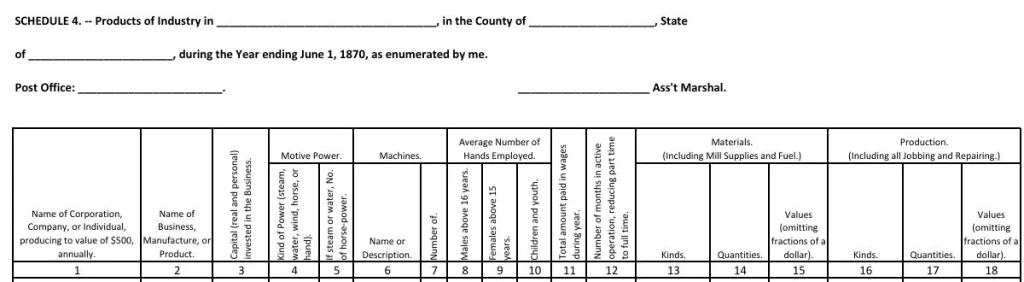
Gary B. Davis, the Livingston historian, recently discovered a document titled Schedule 4.-Product of Industry for the year ending June1, 1870. It was stamped by the Census Office on November, 3rd 1870. It looks very similar to a federal government census document. It appears that T.F. owned and operated a cabinet and wagon shop. In the 1870s, a wagon shop was a place where skilled craftsmen built and repaired horse-drawn vehicles, often incorporating a blacksmith shop for metalwork. Considering his carpentry apprenticeship, it makes sense that he would also build cabinets. Sawmills, gristmills, blacksmiths, tanyards (tanneries) and wagon shops were quite prevalent at that time in Polk County.


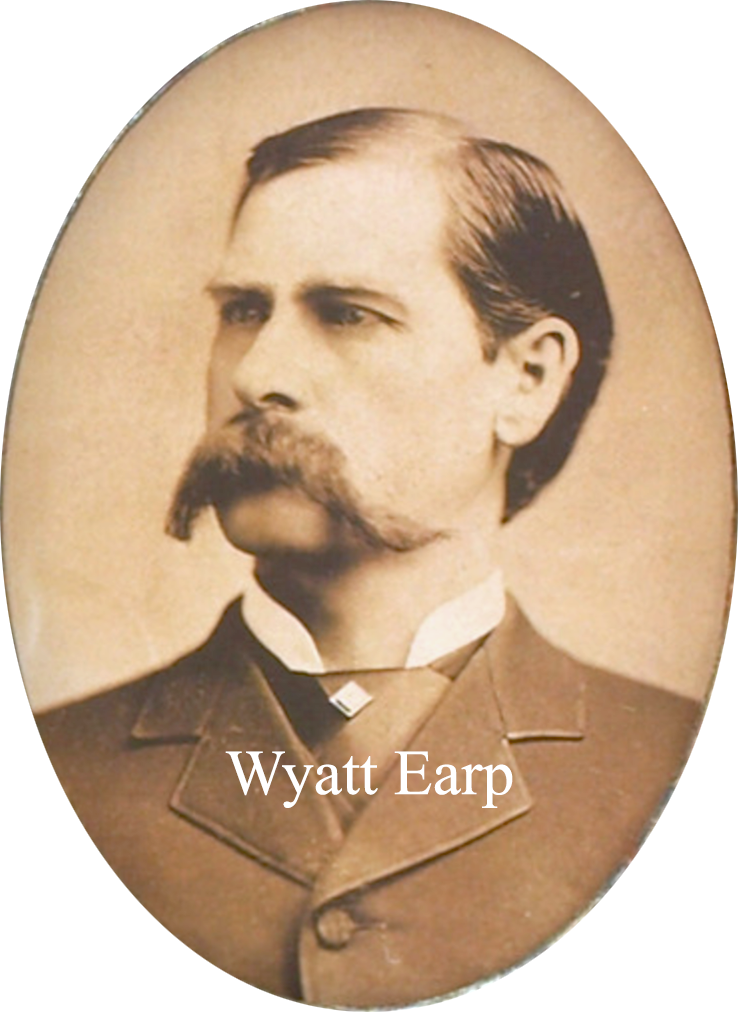
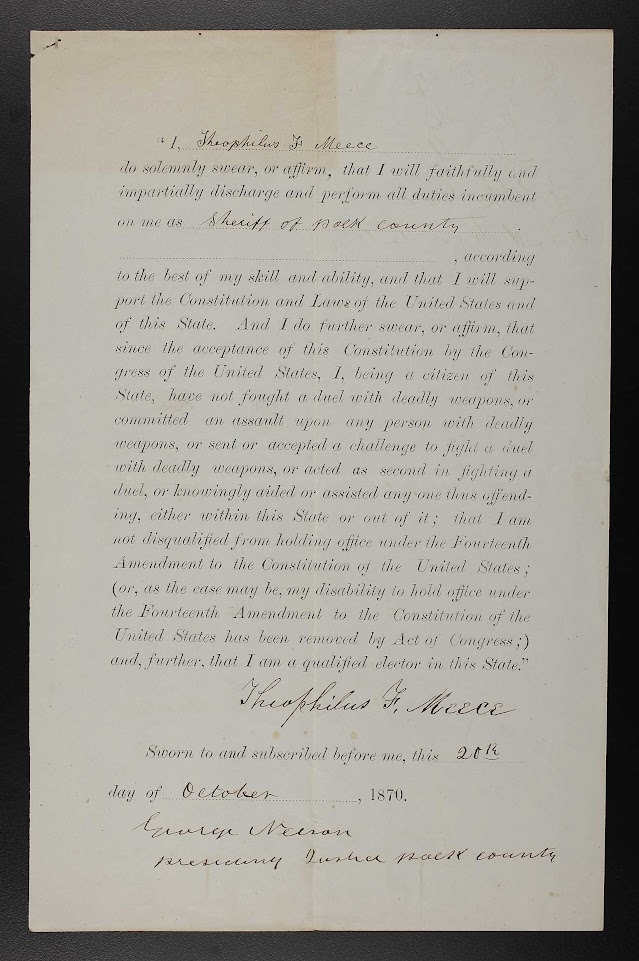
In 1871 T.F. would complete the two-year term of G.W. Barfield as Polk County Sheriff. I’m not sure why he was unable to complete his term. I’m guessing that T.F. was appointed, versus being elected, to this position. In 1872 T.F. was elected to the position of Polk County Sheriff and he served a two-year term. As a kid my Uncle Dick, Richard Charles Meece, told me that T.F. arrested Doc Holiday. According to Uncle Dick, Doc Holiday was arrested, prior to his notoriety and friendship with Wyatt Earp, on some mundane charge such as public drunkenness or drunk and disorderly.
Shortly after beginning his dental practice Holiday was diagnosed with tuberculosis and he was only given a short time to live. Both his mother and adopted brother died from consumption or tuberculosis. All of these factors contributed to Holiday’s reputation as a heavy drinker. His doctor advised him to move out West to a dryer climate.
He moved to Dallas, TX in 1873. Unable to continue his dental practice, he turned to gambling as a means of support. Dallas, TX is approximately 214 miles from Livingston, TX. The Houston and Texas Central Railway (H&TC) reached Dallas in 1872, and the Texas and Pacific Railway (T&P) connected to Dallas in 1873, forming a major rail intersection. Livingston was also reachable via packet boat on the Trinity River.
I can’t speak to that particular year (1873) but there was a time when Livingston was truly the wild wild west. In 1902 at least a dozen saloons and a couple of stores that sold whiskey by the jug were destinations for the sawmill workers on Saturday nights. Drunken brawls were frequent and the situation would denigrate to the point where side arms were randomly fired throughout the town. The sort of environment, and the money that the sawmill workers would bring to town on payday, might have attracted someone like Doc Holiday.
Was this story simply a creation or a figment of someone’s imagination? Who Knows??? I’m assuming that this tale was told by Richard’s father, Brown, who was T.F.’s youngest son. Perhaps, one of Brown’s siblings told Richard this story to further his fantasies about the wild west. I know that, as a child, it piqued my interest and I still remember it 60 years later.
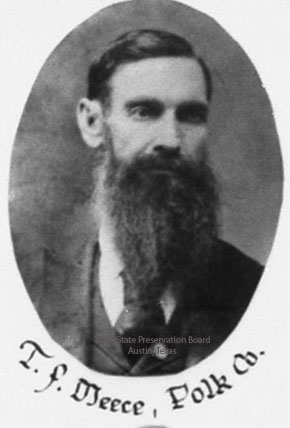
I’ve done my best to logically explain whether or not there was a possibility that this event occurred. I offer absolutely no proof. I have nothing in writing to substantiate the claim, but one can always dream. I have to confess, my Uncle Dick also told me that there was a statue of T.F. Meece in the State Capital. To my knowledge, this is not true. There is however a composite photograph of the 27th State Legislature, including a photo of T.F. Meece, in the House Chamber gallery on the East wall.