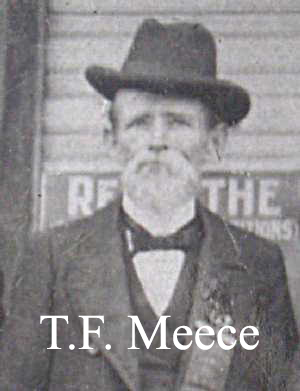
On March 1st, 1872 T.F. would purchase 49 acres of land from his father William for $300.00. Based on my research this was T.F.’s first property purchase in Polk County. Prior to that purchase, I’m assuming that T.F. and his family lived on his father’s farm, if not in the same house. His sister Minerva Caroline “Carrie” had married Stephen Joseph Nettles on January 31st, 1861 and moved away. His only remaining brother, Monroe Marshall Dawson Meece, still lived on his father’s farm.
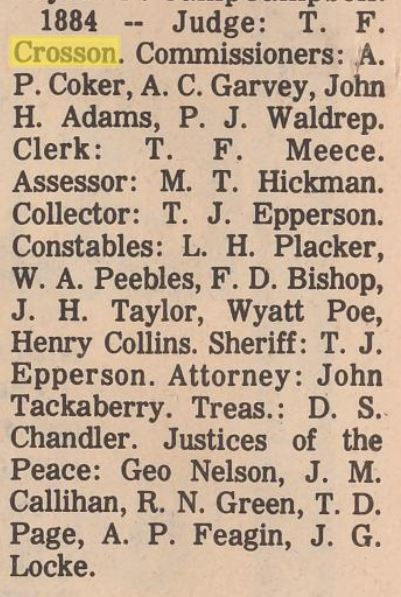
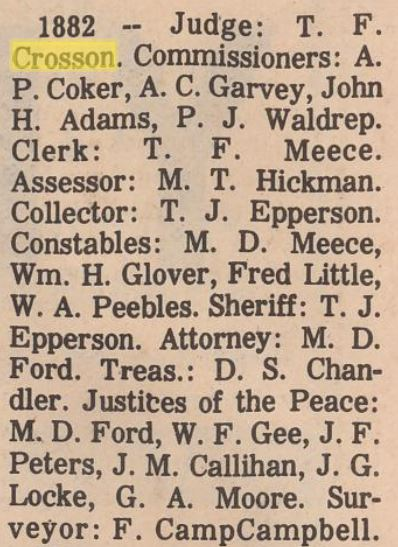
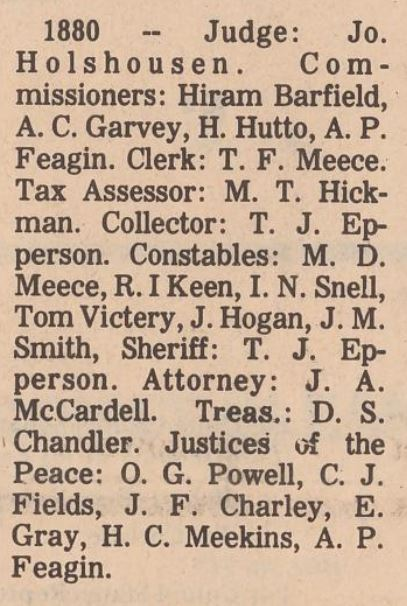
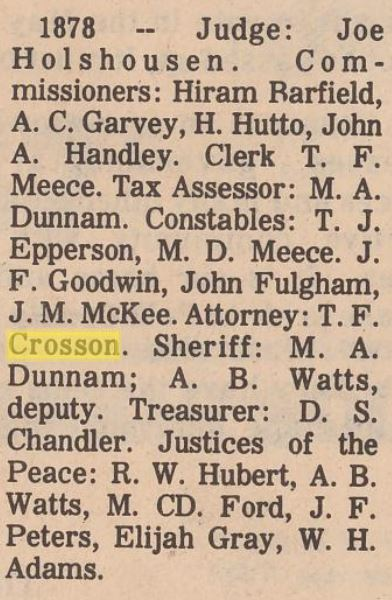
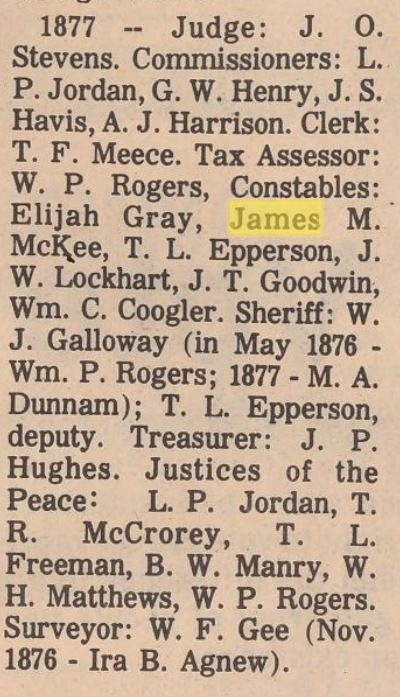
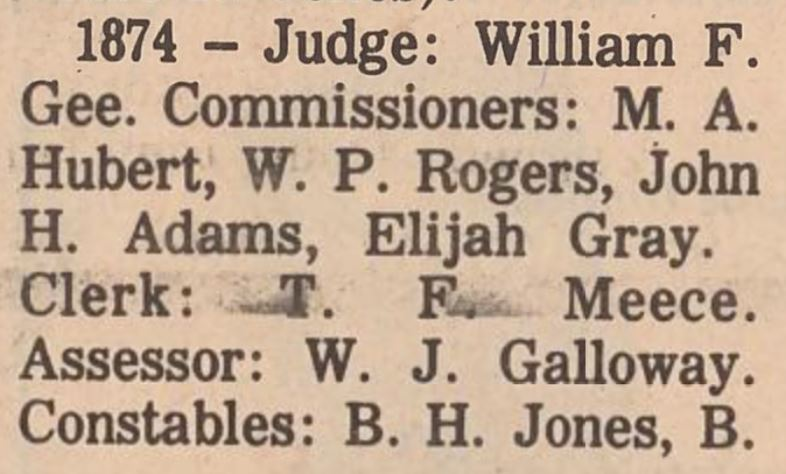
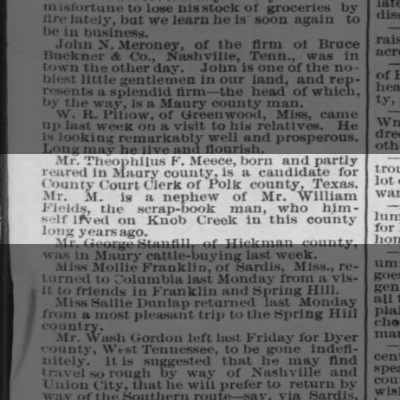
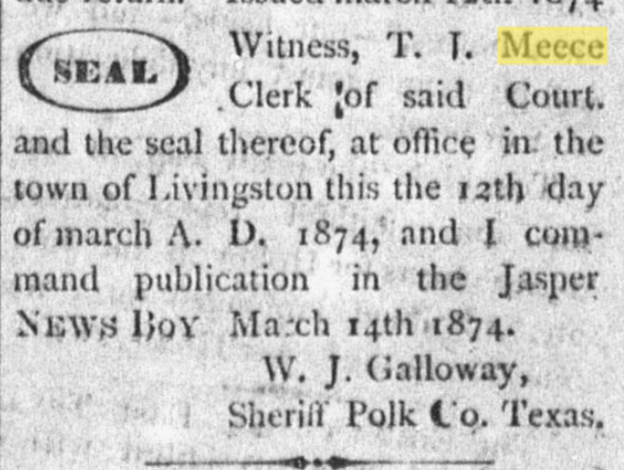
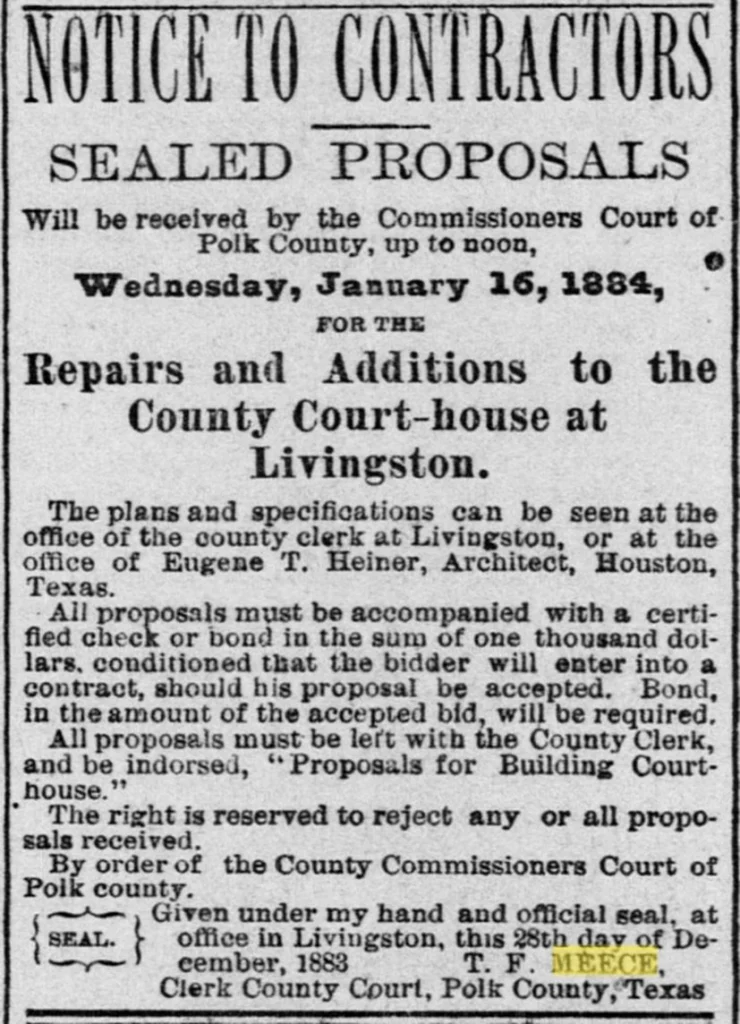
In 1874 T.F. Meece was elected Polk County Clerk. Records show that he was elected Polk County Clerk in 1874, 77, 78, 80, 82 & 1884. An article announcing his candidacy appeared in a newspaper in Columbia, TN (Maury County) on February 18th, 1886. He held that position until 1886 when his fellow soldier and friend A.B. Green was elected County Clerk.
While County Clerk, T.F. and his wife Amelia would welcome their daughter Mattie Minerva Meece September 6th, 1875. James Henry Meece was born on September 17th, 1877. Bennett Amelia Meece was born on September 6th, 1879. Luther Marshall Meece was born on October 12th, 1881. And, finally, Thomas (Tom) Epperson Meece was born on February 11th, 1884. Clearly, this was a joyous and very busy time in the lives of the Meece family. Unfortunately, the patriarch of the family, William Carroll Meece, died on December 11th, 1881.
In general, the County Clerk in 2025 serves as a vital link between the public and the county government, acting as the recorder of public records, custodian of vital statistics, and chief elections officer, while also issuing marriage licenses and serving as clerk for the county and commissioners courts. I don’t know how much these duties have evolved over the years.
Fortunately, the Parental Consent to Marry & Marriage License Applications for Polk County, Texas 1851-1899 have been saved. These requests for marriage and confirmation of age were transcribed from official records during T.F.’s tenure as Clerk. The requests were very simple in nature and rife with misspellings. Many of the petitioners “signed by mark X” meaning it was signed by a person unable to write their name, which is then witnessed and often notarized, serving as their signature. Obviously, those that could write at some level were spelling according to sound. Clearly basic literacy was still an issue in the late 1800’s.
It appears that the employer would petition, on behalf of the “colored” or “freedman”, for their marriage license. The price for the license ranged between $1.50 and $1.60. The following excerpts were transcribed from the original records:
December 14, 1880
Mr. T. F. Meece Co. Clerk
deare Sir
if Samuel Rhoden calls on you for lisons to marrey my daughter Laura Belle let him have them and all will be wright with me.
Yours
E. Gray
Lucretia A. Gray
January 5, 1882
This is to Certify that my Daughter Fannie Hays is sixteen years old and I have given my Consent for her to marry Henry Arlington.
Becky Hays (by her mark-X)
Witness J. J. Canon
Moscow, Texas Oct. 27, 1881
Mr. Meece County Clerk
Dear Sir,
One of my hands has asked me to procure a license for him & has left the money with me to pay for it—as it is silver I will send it to you by hands of Mr. McKinnon of the first person I see going to Livingston—The man is a freedman named James Alford—the woman named Sow? Hill—both are of age—Please Send license by mail tomorrow evening as they want to marry Wednesday.
Oblige Your Friend
R. A. Smalley
The following article was written in a local newspaper and depicts the difficulties of verifying one’s identity and age in 1876.
Better hitched to a mule than a bride
Farmer was upset when his best field hand wed
In 1876 James B. McConico, who lived near Dallardsville, was a lad of about 19, but to most of the community, he was mature young man who had come of age in mind and physique if not in years. So when he and his chosen love applied for a marriage license, county clerk Theophilus F. Meece assumed he was of the legal age of 21 and did not hesitate in issuing a license.
In December that year, James and one Miss Sallie A.C. Davis were married by a local justice of the peace. This came as a great shock to James’ father.
Dick McConico was not a rich man. He owned no real property and each year he scraped by with a mortgage on his upcoming sugar cane сгор, about three acres. James’ work on the place was vital to his operation.
When McConico’s son got married, his old man sued. He complained that by that marriage, he had been robbed of the present and potential use of his son’s labor. (Apparently the son’s married state gave him a legal status that enabled him to rebuke his father’s authority.)
Control of his son was very important, as McConico’s lawyer went on to explain that his client had been “entirely deprived of his potential control in shaping and directing his said minor son’s present and future conduct and actions.”
Not only did the old man not like such rebellion, in his eyes it was un- thinkable and tragic. The damages he claimed against the county clerk included not only loss of his son’s services, worth $300 a year, but also injury to McConico’s mental well-being.
Besides that, McConico had included support from his son as an integral part of his old age retirement plan.
James’s father complained to the court that before this marriage took place “I had intended to raise and educate him for future usefulness and aspirations becoming his station in life, that he might be the pride of my declining years, and my support in old age.”
But now those plans were dashed. He had lost control over his son, and it was all the county clerk’s fault.
“The plaintiff alleges,” wrote his lawyer, James E. Hill, “that he is the head of a family, a married man, about sixty years of age, having a wife, who together with plaintiff have raised, nurtured and educated a large family of children who have at all times honored, loved and respected their parents and have ever been obedient to their wishes, until the wrongful act of the defendant, who caused his minor son James B. to rebel against parental control and admonition.”
McConico also was concerned about the damages to his son, that is, in saddling him with a wife before he had lived long enough to acquire good sense. At least that’s what the following quote seems to say:
“The defendant’s wrongful act has encumbered his [McConico’s] minor son with a family, and the anxieties and cares thereto incident, before his arrival at the age of maturity. manhood and reason.”
As a result, said the distraught McConico, he had “greatly suffered in mind, which said mental suffering now exists, and will necessarily continue through plaintiff’s life.”
That lifelong suffering, decided McConico, had a price on it. He figured $2,000 ought to make him feel better.
But county clerk Meece argued that in the first place, James B. looked every bit of 21 years and more. (Remember, they didn’t have drivers licenses or other I.D.’s to prove one’s age. And birth records would not exist in Texas until 1903.)
In the second place, said Meece, James B.’s labor was not worth the $300 a year that his father claimed. He felt that a more reasonable figure would be half that. Besides, added Meece, the old man hadn’t lost his son’s services; he had learned that the boy was still living and working on his father’s place.
And also, he argued, James B. had been accepted in the community as a grown man, McConico knew that James and Sallie were considering marriage, and he knew that to do so they would have to get a marriage license. So if McConico had any objections to their getting hitched, he should have said so!
Finally, Meece said that he felt that by enabling the young couple to be wed, he had actually done the boy a good deed: “The plaintiff’s son married into a family of as much respectability as any in the country. The young lady that the son married is a lady of respectability, intelligence and refinement, and is one who in every way is calculated to render the son happy in his married life.”
But in the no-nonsense legal atmosphere of the courtroom, the son’s happiness was not an issue.
The key factor in the jury’s decision, as instructed by the judge, was whether or not McConico actually sustained any damages. That might be questionable today, but after listening to several witnesses, the jury had no doubt about it. A resounding Yes, he had been damaged.
But not damaged as much as he claimed. The court set a limit of $200, and the jury awarded McConico $160 for his troubles.
This writer was not able to find whatever happened to the elder McConico. By one record, he was still in the county in 1882.
And as far as is known, James and Sallie McConico lived happily ever after. Years later, in 1896 when Sallie sold her family’s old homestead, the couple were living in Angelina County and were still husband and wife.