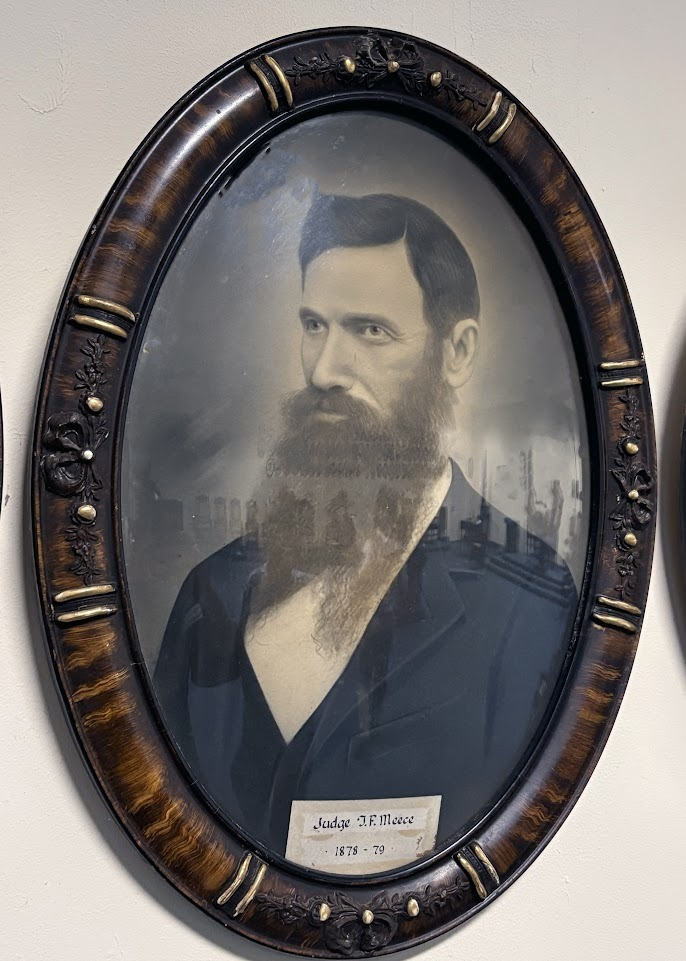
“There was one Livingstonian who has the distinction of holding seventeen positions in his life, three of which were county offices, one a state office and one an office in the Baptist Church. This man was T. F. Meece, born to William C and Hannah B. Meece in TN in 1840 and came to Livingston with his parents in 1856.” This is a passage from The History of Polk County Texas by Emma R. Haynes in 1937, (23) years after T.F. died.
In 1937, Emma R. Haynes, a schoolteacher and librarian, authored the first history of Polk County, Texas. Her work, based on extensive research and personal interviews, chronicles the county’s history from 1846 to the 1930s.There were several errors in her depiction of T.F. Meece but I believe this portrayal of his work ethic was accurate.
In my mind, the one outlier in his career path was his stint as a barber. I did not foresee that as a possible occupation. Was this something that he picked up at home or possibly something he learned as a soldier in the Confederate Army? You would have to believe that T.F. had some physical limitations, caused both by the number of and types of injuries he suffered during the Civil War. Clearly, he was a very industrious individual who did whatever it took to provide for himself and, most importantly, his family.
According to the U.S. Register of Civil, Military and Naval Service 1863-1959 for T.F. Meece 1883 > Volume 2 under The Postal Service pg. 773, T.F. was a Clerk in Post-Offices and he was paid $90.00 compensation per annum. This was yet another unexpected finding. The Postmaster at that time was Mr. Walter Demetrius Willis and he was paid $406.76 per annum. Willis would serve in this capacity for 24 years.
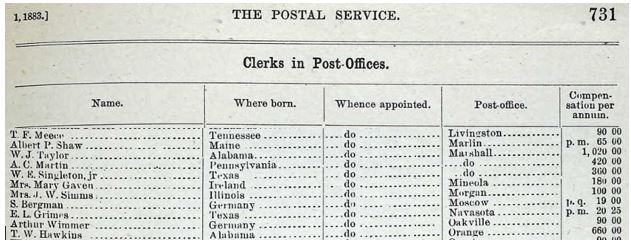
I do not know if T.F. worked additional years, before or beyond 1883, as a Postal Clerk. He held this position while he was the Polk County Clerk. Were these positions somehow interconnected or was this simply supplemental income? In 1880, a county clerk in Texas likely earned a salary in the range of $500 to $800 per year, though this could vary based on the size and population of the county. The real average annual wage in 1880 was around $375.00 per annum.
At some point during his tenure as Polk County Clerk T.F. began studying law. At that particular time, most people became lawyers by “reading law,” which meant apprenticing under an established lawyer, studying legal texts independently, and performing clerical tasks in the lawyer’s office. They were essentially learning on the job rather than attending a formal law school, which was still uncommon at the time. After completing their apprenticeship, they would then sit for a bar exam to be admitted to practice law.
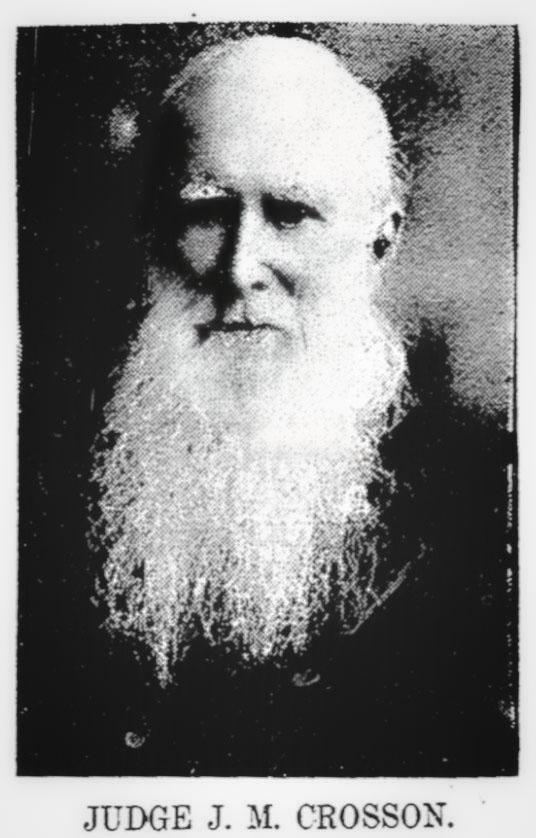
According to the Roll of Attorneys Licensed to Practice in the Supreme Court of the State of Texas, T.F. became an attorney in 1897 and he was licensed to practice in the Supreme Court of the State of Texas on August 10th,1901. It is my belief that T.F. apprenticed under Judge James Murray Crosson and/or his son. Thomas also studied law under his father and became an attorney in 1877. Thomas resigned from the office of County Judge in 1885 when he and his family moved to the town of Ballinger, TX in Runnels County.
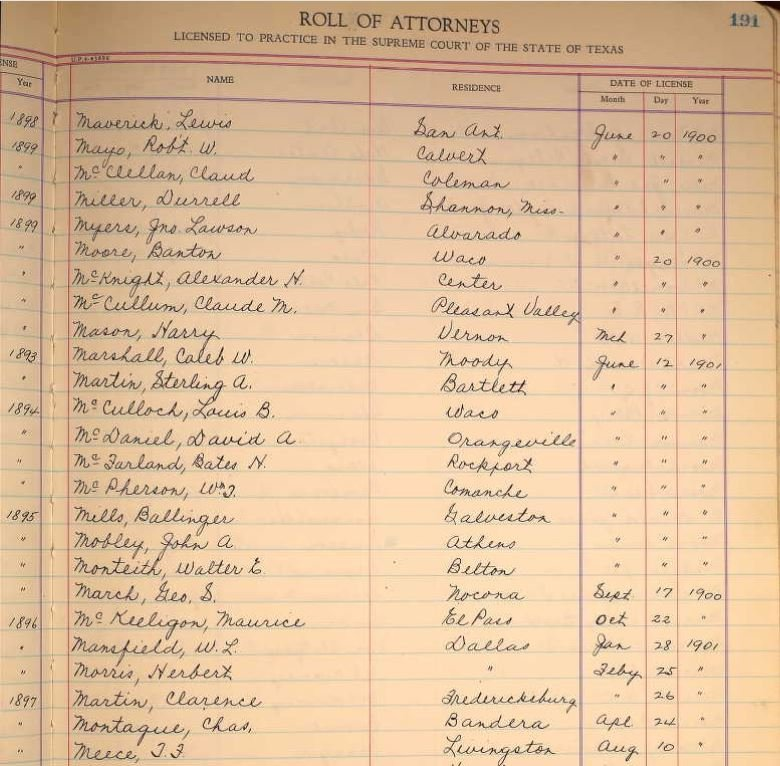
Interestingly, Judge James Murray Crosson was elected District Attorney, a position that Thomas held as well, in 1866 and “served with ability until removed by military authorities because an impediment to reconstruction, when he again resumed the law and continued therein until 1901, when he retired to private life and moved with his family to Ballinger, TX.”
Many people don’t realize this, but Livingston was the Headquarters for the Federal Army of Occupation 5th Military District with Co. A 15th Infantry and Co. B 6th Cavalry stationed there between 1867 and 1868. In another excerpt from The History of Polk County Texas, Emma R. Haynes Speaks of a young girl whose father had been killed in the Civil War. She “had to pass the Yankee Camps, but the school children were not bothered. She remembers that the soldiers were mean to their men. They were encamped in Livingston for about two years.”
On March 13th, 1882 an application, addressed to Judge Thomas T. Crosson, was filed by the citizens of Livingston to have the town incorporated. When a town is “incorporated,” it means it has been legally established as a municipality, granting it the power to govern itself and provide services to its residents. This involves a formal process where the town gains a charter from the state, creating a local government with defined powers and responsibilities. The document was signed by T.F. Meece as well as his father William Carrol Meece. At the time, the town had approximately 200 citizens.
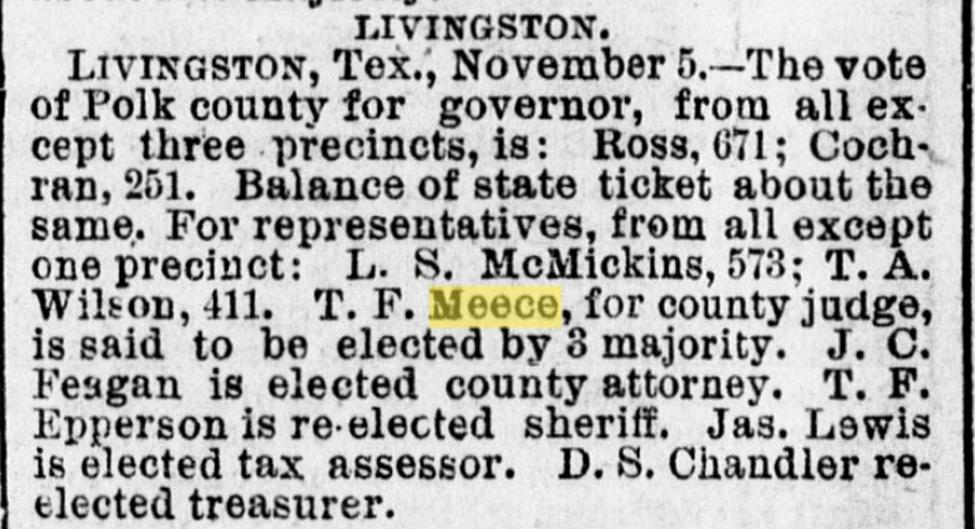
Upon the retirement of Judge Thomas T. Crosson in 1885, Theophilus Franklin Meece was appointed county judge of Polk County. T.F. then ran for that same office in the elections of November 5th, 1886 and won the position by 3 votes, serving till 1888. Evidently, the candidate did not have to be a licensed attorney with experience in the legal profession, either through practicing law or serving as a judge. In 1886, a county judge in Texas earned a salary of $1,000.00 to $1,500.00 per year. The salary might have been supplemented by fees earned from court cases and other judicial duties.
In his spare time T.F. was elected, by The Democracy of Polk County on August 11, 1874, as a delegate to the Congressional District Convention, to meet at Nacogdoches, TX on the first Tuesday in September, 1874. On May 12th, 1888 T.F. was nominated as a delegate to the Fort Worth delegation by The Democracy of Polk County.
“On motion of Judge T. F. Meece, resolved, that we endorse the course of the National Democratic administration and favor the renomination and election of President Cleveland.” In the 1888 election, Cleveland ran against Benjamin Harrison, winning the popular vote but losing the electoral college and therefore the election.
In the 1892 election, Cleveland defeated Harrison in both the popular vote and electoral college, returning him to the White House. He was the first Democrat to win election to the presidency after the Civil War and the first U.S. president to serve nonconsecutive terms. He was both the 22nd and 24th U.S. President. If you are thinking that this sounds somewhat familiar, you would be correct. Donald J. Trump was the 45th President of the United States and he is now the 47th President following the 2024 election.
On December 20th of 1884 T.F. was elected by the Livingston Lodge of the Knights of Husbandry as an officer, Vice-Dictator, for the calendar year 1885. “Knights of Husbandry” referred to the Order of the Patrons of Husbandry, commonly known as the Grange, a social and agricultural advocacy organization founded in 1867 to promote the economic and social well-being of farmers. The Grange aimed to improve the lives of farmers by promoting social interaction, advocating for fair prices and practices, and lobbying for legislation that would benefit the agricultural sector. The Grange played a significant role in advocating lower railroad rates (leading to the Granger Laws), rural free mail delivery, and other initiatives that improved the lives of farmers and rural communities.
A railroad meeting was held at the courthouse in Livingston on July 4th, 1877. The purpose of the meeting was to appoint committees, in each precinct of Polk County, to obtain additional donations for the purpose of securing a road to the towns of Livingston and Moscow on behalf of the Houston, East and West Railway Company . The chair appointed the following committees: For Livingston precinct Dr. J. H. McCardell, T. F. Meece and J. E. Hill. The central committee consisted of the following gentlemen: J. M. Crosson, J. P. Kale, T. F. Meece, Dr. J.H. McCardell and J. E. Hill. Perhaps, this is when T.F. dreamt of owning a hotel, the Meece Hotel, directly across the railroad tracks from the H.E. & W.T. Railroad Depot.
In August of 1887, after more than thirty years of sharing a building with other denominations, Livingston Baptist Church purchased city block #41 from Mrs. Patience Watts and Mrs. Susan Hunt, with the owners contributing $25 of the $75 purchase price. The Baptists met in the Presbyterian Church until the building was completed early in 1888. D. W. Jackson, former missionary in Tryon Association, was pastor, and other church leaders were M. B. Stone, S. J. Andress, Andrew Peters, T. F. Meece, Joe Peters, and E. V. Doyle. Patrick Henry Bilbro, a resident of Colita, became the minister following Jackson. P. H. Bilbro also pastored churches at Jones Prairie and Colita. In 1890, Livingston Baptist Church had 60 members. T. F. Meece was the church clerk, and J. F. Peters and M. B. Stone were deacons.
Not to forget the farm, “Mr. T. F. Meece, Livingston, Polk Co., TX, writes on May 4th, 1880: I sowed Alfalfa in August last, or September, with turnips and black winter oats, all in drills. The ground was previously well prepared and well manured. Procured a fine stand of oats, turnips, and clover, all of which grew finely until the 24th of December, when we had a “Norther” of such severity as to kill the oats, and injure the turnips and other vegetation. The clover was not checked, is now in full bloom, and presents a sightly appearance. I am well pleased with it.” A sample of alfalfa in bloom, showing a very luxuriant growth, accompanied this letter.” On June 8th, 1877 “Mr. T. F. Meece has sent us a specimen of his sweet corn, which he planted about the middle of March. The ear is fully matured.”.
My 2nd great-grandfather, William Carroll Meece, and my great-grandfather, Theophilus Franklin Meece, were both members of the Trinity Lodge #14 of the Masonic Order. T.F. was Worshipful Master in 1878 and 1879. He attended the Livingston Academy shortly after his family moved from Tennessee in March of 1856. The school trustees were allowed to use the lower floor of the Masonic Lodge for school purposes. Ironically, the lodge was located at the site of the Old City Cemetery, which is where he, his wife and daughter are buried. This is a photograph of T.F. (above) that hangs in the Trinity Masonic Lodge #14 today. It took me several months to obtain a photograph of it but it was well worth the time and trouble.
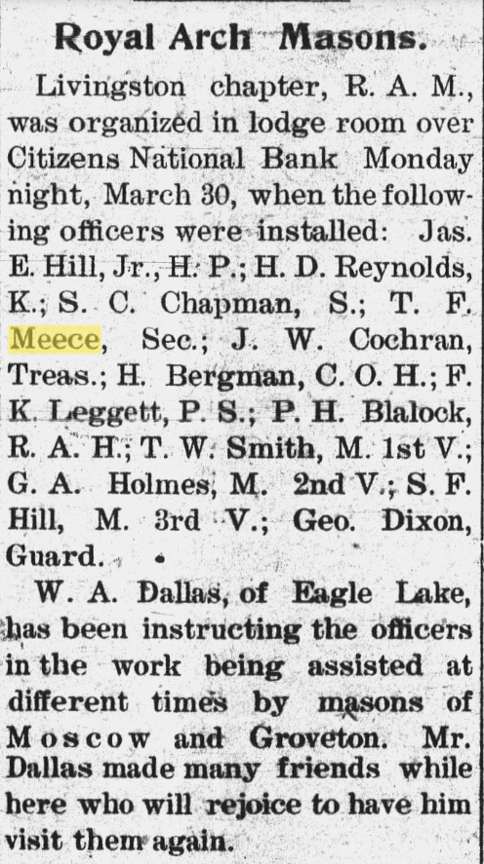
In addition to his freemasonry membership in the Trinity Lodge #14 of the Masonic Order, T.F. was also High Priest of the Royal Arch Chapter No. 295. The way I understand it, Freemasonry, also known as Craft Masonry, generally refers to the first three degrees (Entered Apprentice, Fellowcraft, and Master Mason) within the fraternity. Royal Arch Masonry, on the other hand, is a degree or order within Freemasonry that is often considered the completion of the Master Mason degree. The Royal Arch degree explores the spiritual side of Freemasonry, delving into the nature of God and the candidate’s relationship with Him. On top of all of this, T.F. was also a member of the Knight of Honor lodge, which has no affiliation with the aforementioned groups.
In August of 1878 a group of parents signed a petition to create a school community in the town of Livingston. T.F. was one of the signatories petitioning on behalf of his daughter Willie who was 9 and George who was 7. Calvin J. Fields, Hannah Bennett Fields’ brother, also signed the document on behalf of his son Thomas W. Fields who was 16 at the time.
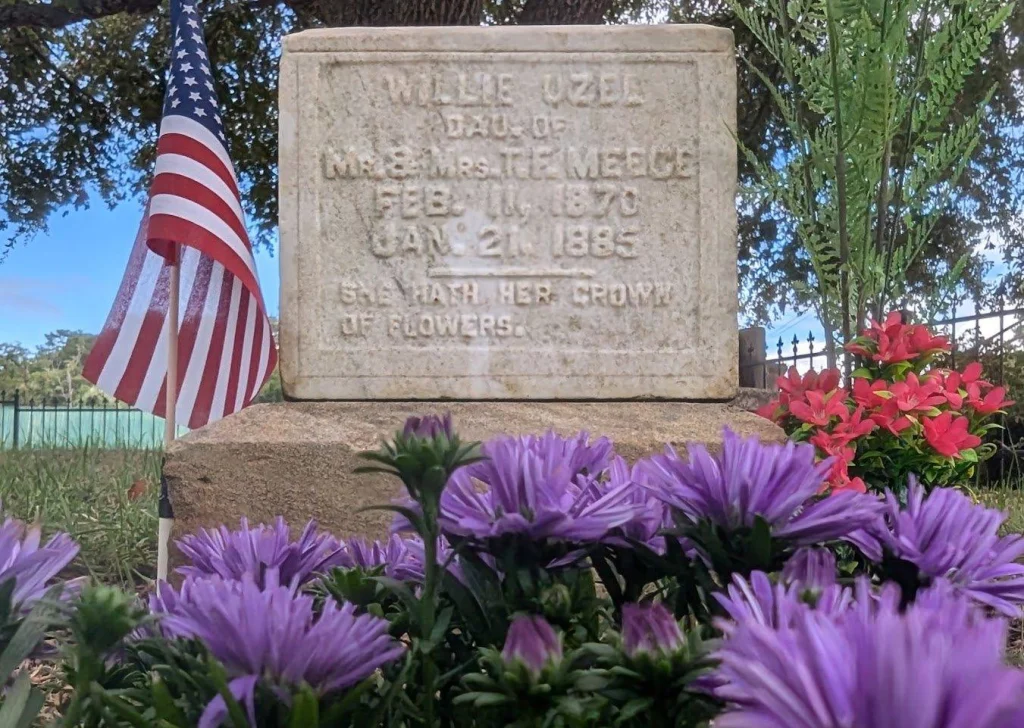
In the midst of all of this, the Meece family would suffer their greatest loss. Their 14 year old daughter, Willie Uzell Meece, would pass away on January 21st, 1885. It is unknown what she died from but smallpox, tuberculosis and yellow fever were prevalent diseases back then. Other than that, we know nothing else about Willie. This heartbreaking tragedy would be followed by the birth of Charles Stewart Meece on February 19th, 1887 and the birth of Anne Corrine Meece on October 14th, 1889. It’s difficult to imagine the juxtaposition of the grief they felt at the loss of Willie and the joy they felt at the birth of Charles and Anne.
Whew! I’m tired, from simply reporting what my great-grandfather was doing and going through in the mid to late 1800’s.