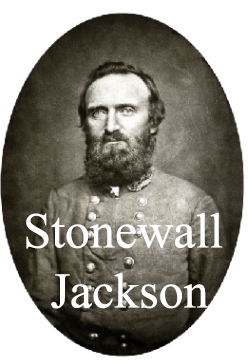
The brigade distinguished itself during the Seven Days Battles where it routed the enemy at Gaines’ Mill, captured a battery of guns, and repulsed a cavalry counterattack. The Seven Days Battles lasted from June 25th until July 1st, 1862. The Battle of Gaines Mill occurred on June 2th, 1862. Those seven days gave new life to the Confederacy. Stonewall Jackson, singled out the 4th Texas as “…soldiers indeed.” The Texas Brigade became known as the “elite shock troops” of the Army of Northern Virginia.
Lee had hoped to cut off George B. McClellan’s retreat but miscommunication and poor timing doomed the Confederate plan. The Federals had every advantage at Malvern Hill and the Confederates suffered 5,000 casualties. “It was not war,” wrote Confederate General D.H. Hill, whose brigades suffered severely, “it was murder.” The Texas Brigade was held in reserve, despite Hood’s requests to assault the Union entrenchments on the hill. Malvern Hill brought an end to the Peninsula Campaign.
It had been the bloodiest week in American history, producing more than 34,000 casualties (19,000 Confederate, 15,000 Union). The Confederates may have won but that success came at a high price. George Henry Chase Whiting’s Division lost over 1,017, almost a quarter of its total strength. The Texas Brigade lost 89 killed, 476 wounded, and 4 missing, almost one-half of those who had followed Hood into the charge. The 5th Texas itself had 76 casualties, including 13 dead and 62 wounded.
The battle at Freeman’s Ford was basically a skirmish that began when men from both sides mistakenly ran in to one another gathering corn in a cornfield on 08/22/1862. The Union Army thought that they had run across a couple of Confederate stragglers but in reality they had engaged five regiments of Confederate soldiers, led by the Texas Brigade. Two men were killed and four men were wounded.
The battle at Thoroughfare Gap was a prelude to Second Manassas. General James Longstreet began his march on 08/26/1862. The brigade now began what many in the regiment remembered to be the most grueling march of the war. The gap itself was just “a narrow passage through the mountain. The walls rose up some 300 to 400 feet on either side of the passage, nearly perpendicular. The narrow passage was barely wide enough to accommodate a railroad track. The battle was relatively small with approximately 100 casualties on both sides. It did however allow Longstreet’s forces to unite with Stonewall Jackson’s forces at Manassas.
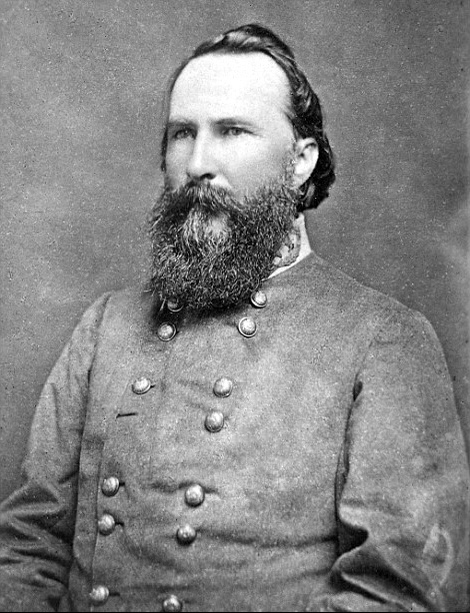
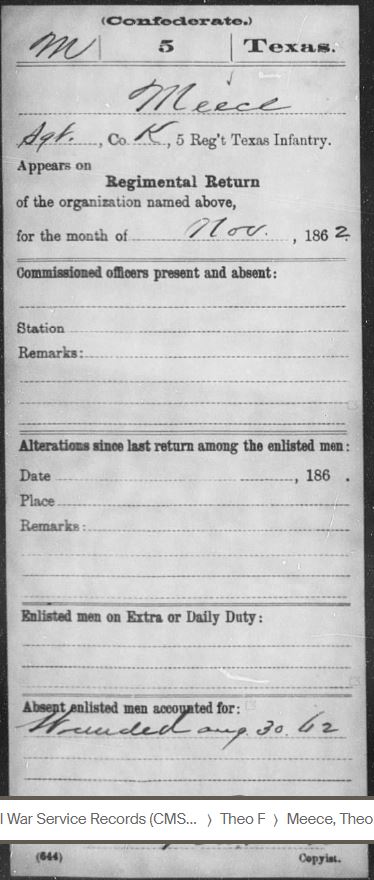
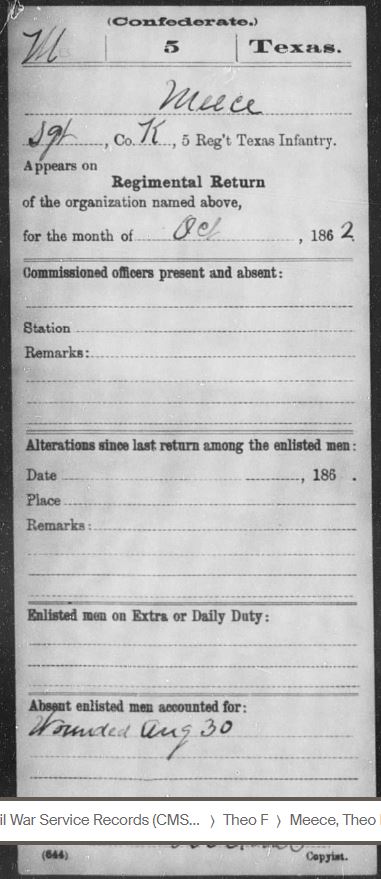
President Abraham Lincoln formed the Army of Virginia in June of 1862 and appointed Maj. Gen. John Pope to command it. On August 30th Maj. Gen. John Pope launched a major assault against the Confederate forces of Stonewall Jackson. Longstreet led a major counterattack, headed by the Texas Brigade, against the Union left. The brigade overran two Union regiments, nearly annihilated the 5th New York Zouaves, and captured a battery of guns. Its reputation for fighting was sealed when it closed a gap in the Confederate line and drove back the two Union Corps that were attacking.
Despite heavy Confederate casualties, Second Manassas was a decisive victory for the Rebels. It was the largest loss of life in any single battle for a regiment in the entire war. For its work that day, especially this assault, the 5th Texas earned the moniker “The Bloody Fifth”, a title they proudly carried with them for the rest of the war. The total estimated casualties were 21,849, which included 14,462 Union casualties as well as 7,387 Confederate casualties.
The Texas Brigade bore much more than its share of these terrible losses, 628 men in all, the greatest loss it would suffer in a single battle during the entire war. Of its five regiments, the 5th Texas, the most engaged in the fighting, suffered the heaviest casualties, over 260, more than any other regiment in Lee’s army. Initial reports placed the number killed at 15, but this figure increased to 36 when the mortally wounded were taken into account. The regiment’s wounded and dead were scattered over a distance of two miles.
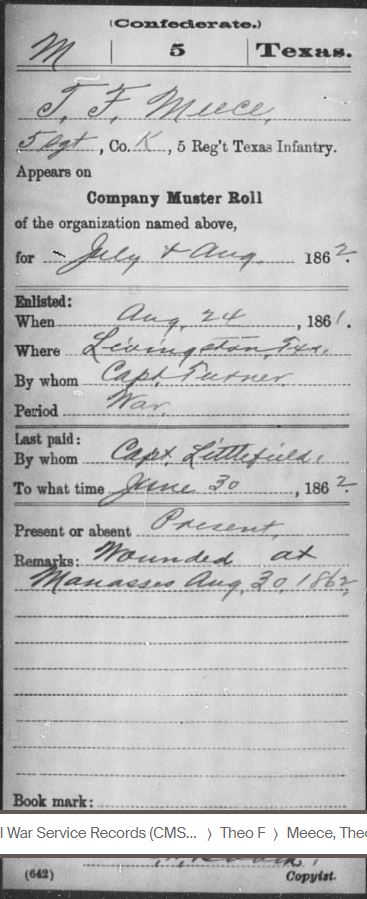
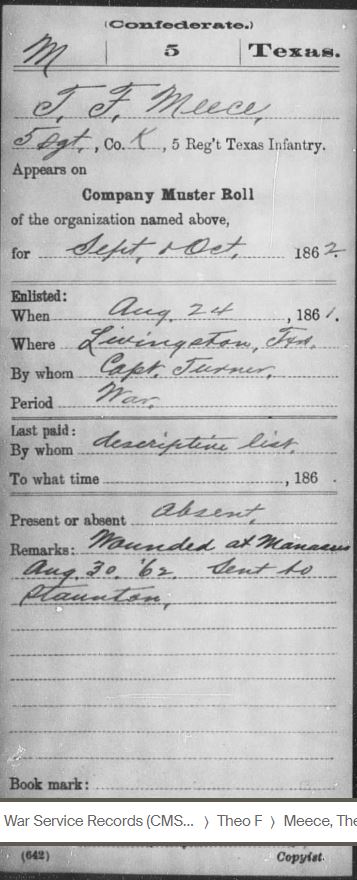
A field hospital was set up in the Chinn House, a two and a half story farmhouse, where the regiment’s surgeons worked by candlelight to save the wounded. According to T.F., he “was severely wounded in the elbow”, on Aug. 30th, 1862, and treated at the Staunton Hospital in Staunton, VA. I can only assume that he travelled there by train and that he recuperated there as well. The Virginia School for the Deaf and the Blind, located in Staunton, was established in 1839. During the Civil War, the school’s Main Hall was used as a hospital by Confederate troops, and several staff members served as doctors or nurses. I’m guessing that T.F. was treated there. Ironically my Father and Mother would stay in Staunton on their honeymoon in 1953, while visiting the Natural Bridge. I’m sure that my Dad didn’t have a clue as to the historical significance that Staunton had for our family.
T.F. was very fortunate in that he was mobile and able to leave the battlefield. Three days after the fighting ended, at least 3,000 wounded still lay on the battlefield, unable to move themselves. Many suffered without food or water and had received no medical attention. Pelted by rain or burned by the sun, some of these wounded endured a week on the bloody field, and many died from exposure and lack of care.
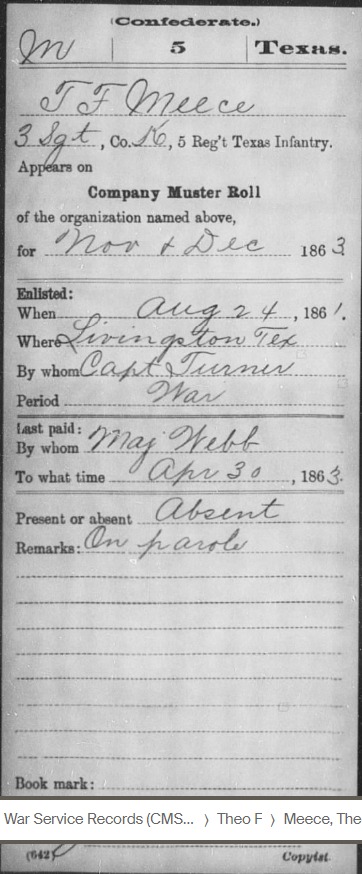
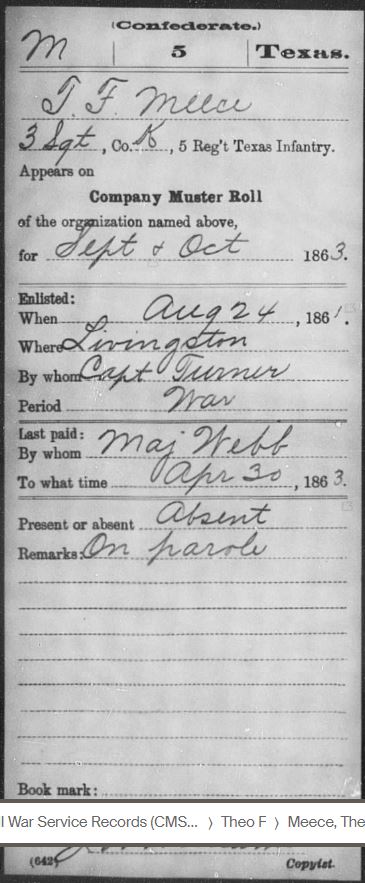
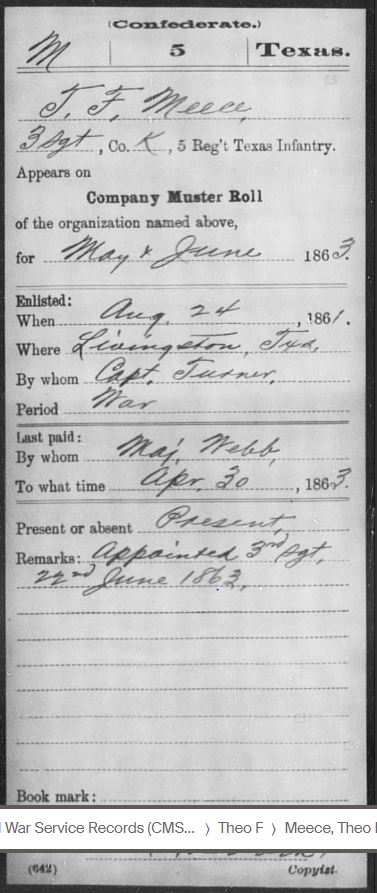
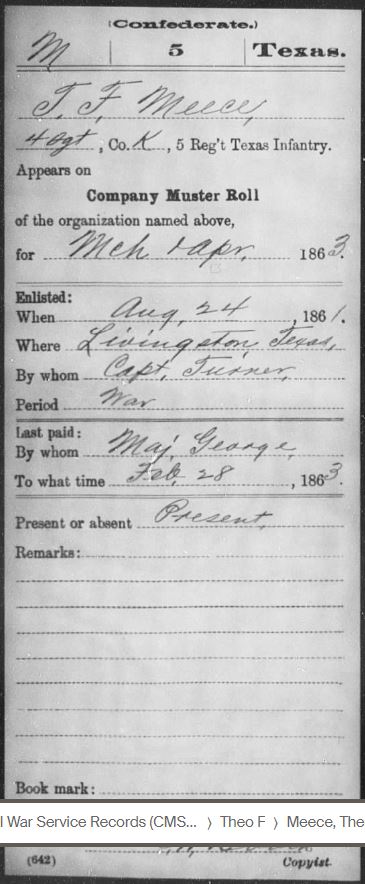
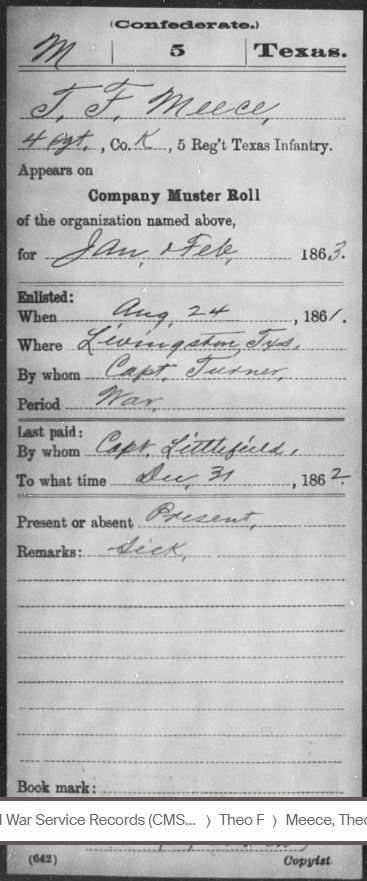
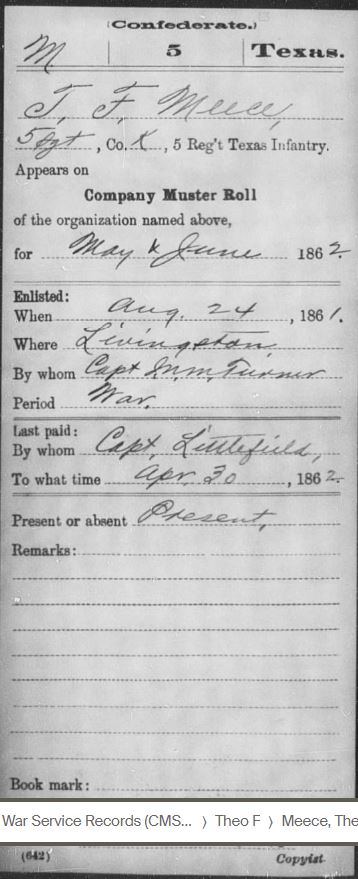
T.F. was unable to fight in the Battle of Sharpsburg or Antietam, which occurred on 9/17/1862. He may have been fortunate however. Out of 854 that went into battle at Sharpsburg, 550 of the Texas Brigade were killed or wounded. It remains the bloodiest day in American history, with a tally of 22,727 dead, wounded, or missing on both sides. On the Company Muster Roll for the months of January and February of 1863, T.F. was reported as present but sick. Once again the harsh winter would take its toll. T.F. would receive a promotion to 3rd Sergeant on June, 22nd, 1863.