Clyde John Meece was born on August 20th, 1893, in Bold Springs, TX. His father, Monroe Dawson Meece, was 46 years old and his mother Danielle Alice “Allie” Baggett Meece was 32 years old. More than likely his father selected the middle name John in honor of his brother John W. Meece. The 1900 United States Federal Census showed nothing of significance. Not surprising considering the fact that he was only 6 years of age. In the 1910 census he was identified as being able to read, write and speak English. He was 16 years of age. The census worker began to write farm under occupation but stopped after penning the first letter.
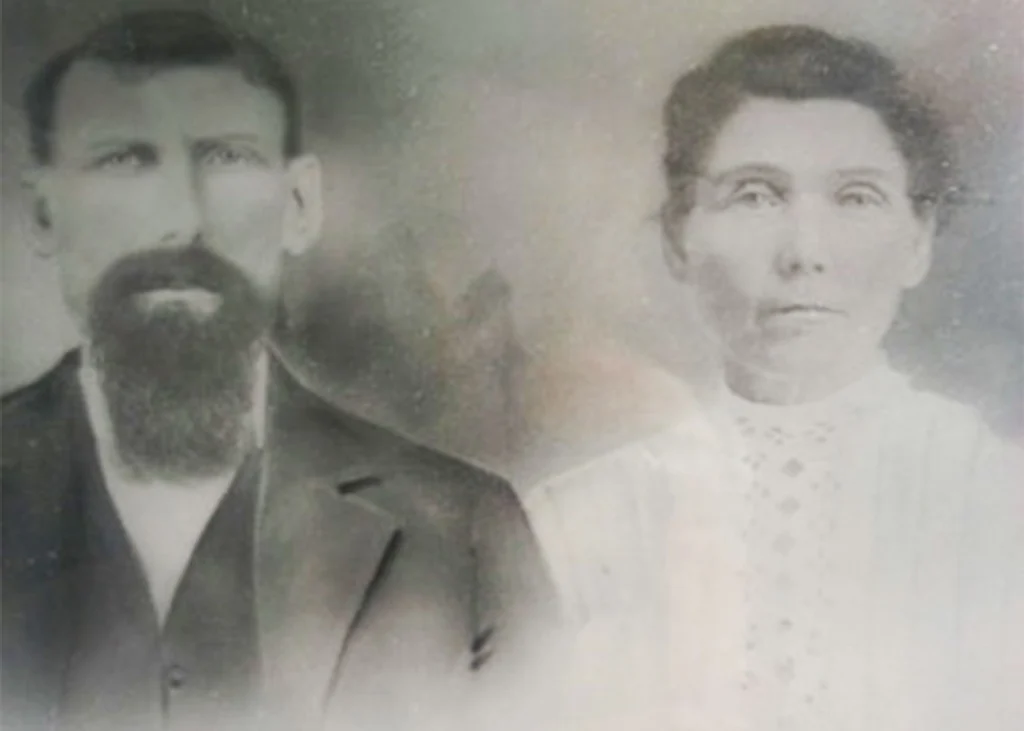
On June 5th, 1917, he completed the U.S., World War I Draft Registration Card. Clyde was 23 years old. He described himself as medium height, medium build, blue eyes and having black hair. He listed his occupation as farming and his status as single. Amusingly, he listed his place of birth as Nettie, TX.
Bold Springs, along with Colita, is one of a series of small communities known collectively as the Louisiana Settlement. Bold Springs was established during the 1840s and named after the springs in the area. A Baptist church (Bethel) was organized there in 1849. The community subsequently had a small turpentine distillery. The Bold Springs post office was known as Nettie after the postmistress, Nettie Burgess, which operated from 1903 to 1923. Nettie was not officially known as a town or community per se.
Clyde joined the Ninetieth Division, 360th Infantry, Company D. It was also known as the “Alamo Division.” The Insignia had red monogram of letters “T” and “O”, symbolizing Texas and Oklahoma, the native states of the first members of the division. The Ninetieth Division was organized at Camp Travis in September and October of 1917. Camp Travis, originally known as Camp Wilson, was five miles northeast of downtown San Antonio on the northeastern adjacent boundary of Fort Sam Houston. Camp Wilson was renamed Camp Travis in honor of Alamo hero William B. Travis.

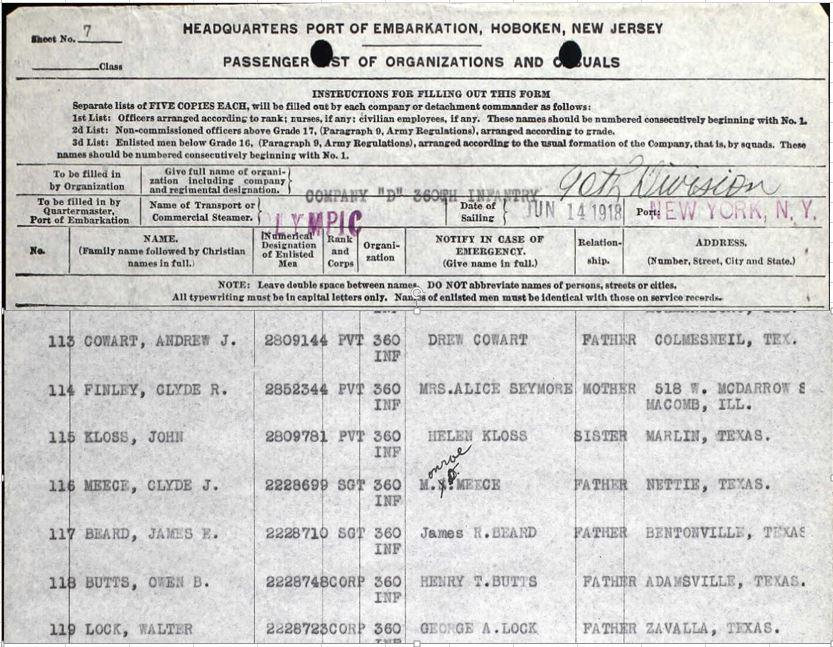
On June 14th, 1918, Clyde boarded the RMS Olympic for transport to, more than likely, Liverpool, England. The majority of the division traveled to England although a few travelled directly to France. The 360th Infantry was sent to Rouvres, France, where the division stayed for six weeks. They trained eight hours a day until they were called to action.
General John J. Pershing deliberately delayed committing large-scale American forces into frontline combat. When he arrived in Europe, he found the newly drafted troops to be inexperienced, poorly equipped, and fundamentally untrained in the realities of modern trench warfare. Pershing established his own training camps in France to bring green soldiers up to speed before letting them fight.
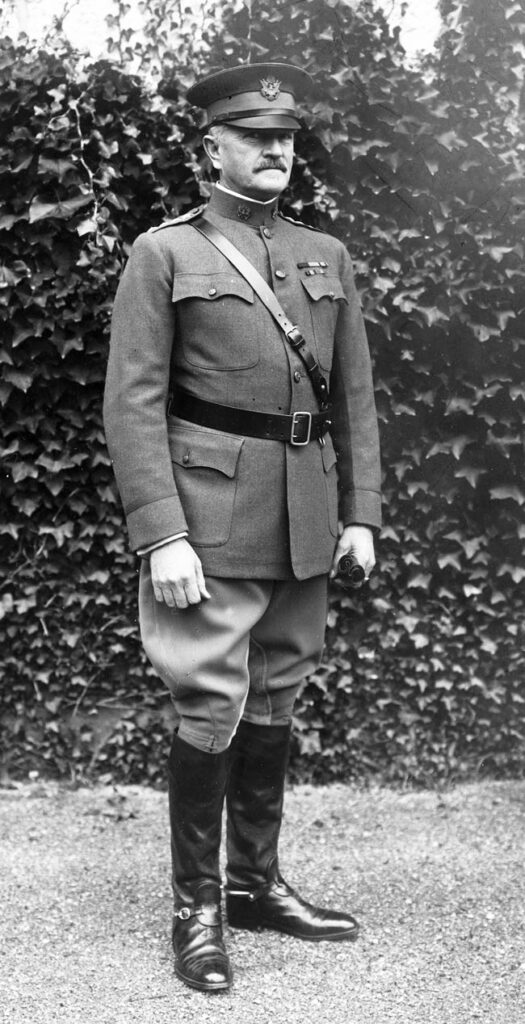
Pershing served as the commander of the American Expeditionary Forces (AEF) during World War I from 1917 to 1920. In addition to leading the AEF to victory in World War I, Pershing served as a mentor to many in the generation of generals who led the United States Army during World War II, including George C. Marshall, Dwight D. Eisenhower, Omar Bradley, Lesley J. McNair, George S. Patton, and Douglas MacArthur.
My grandfather and Clyde’s first cousin, Brown Louis Meece, also fought in France during World War I. He was a 2nd Lieutenant in the American Expeditionary Forces Battery “A” 65th Artillery (C. A. C.) Coast Artillery Corps. Brown was reassigned to the 24th Anti-Aircraft Battery, 1st Anti-Aircraft Sector. America entered the war with little or no knowledge of the science of anti-aircraft gunnery and relied on the French for training. Fortunately, for my father and I, he returned home unscathed.
Just prior to this sailing, the Olympic crew sighted a German U-boat in the English Channel on May 12th, 1918. The gunners opened fire at once, and the ship turned to ram the submarine. The Olympic struck the submarine, just aft of her conning tower, with her port propeller slicing through U-103’s pressure hull. It was learned afterwards that the submarine was preparing to fire two torpedoes at the Olympic.
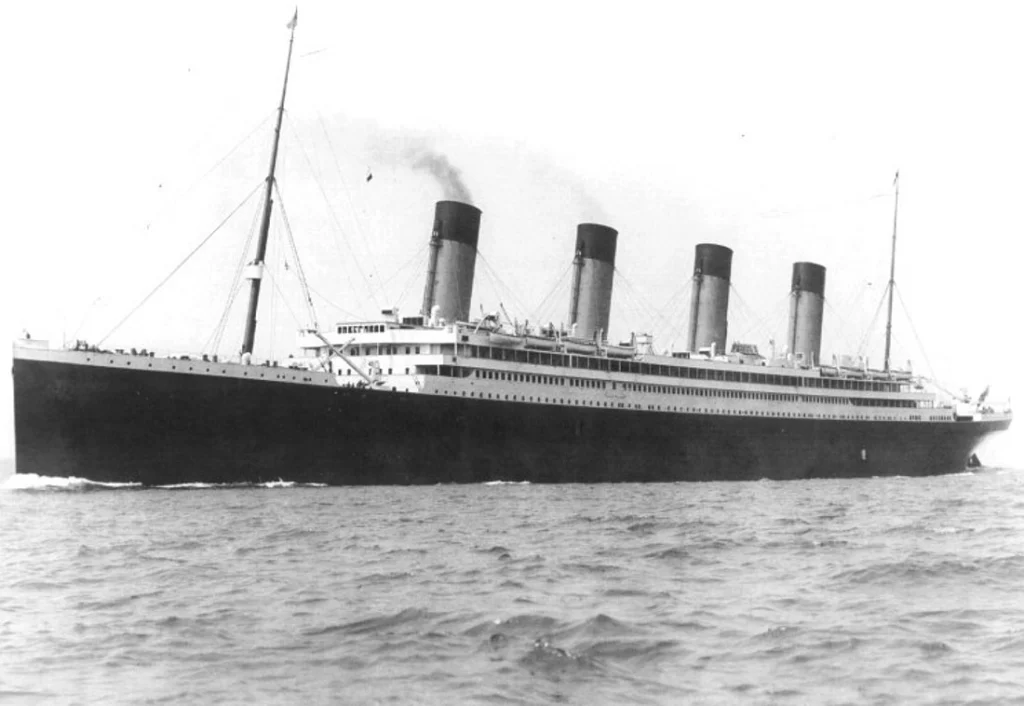
RMS Olympic was a British ocean liner and the lead ship of the White Star Line’s trio of Olympic-class liners. Her sister ships were the Titanic and Britannic. On April 14th, 1912, the Olympic was on a return trip from New York when the crew received a distress call from the Titanic. The Captain of the RMS Carpathia waived off the Olympic when it was roughly 100 miles away. There was nothing more that could be done.
The Captain of the Olympic offered to take on the survivors, but he was turned down. Ismay of the White Star Line was concerned that asking the survivors to board a virtual mirror-image of Titanic would cause them distress. The Olympic was ultimately placed in service as a troop ship during the First World War. During the war, the Olympic was reported to have transported 201,000 troops. I wonder if the troops knew the historical significance of the vessel they were boarding.
The division was under fire from Aug. 20th to Nov. 11th and fought for seventy-five days without relief. During this time, it was a part of two major offensives and seven minor operations. The 360th Infantry played a role in the third phase of a major offensive that began on November 1st, 1918. During the Meuse-Argonne offensive and during the troops advance, descriptions of the battle included:
• “The battalion suffered very heavily from artillery fire”.
• “Two attempts were made to push forward, but the result was so ghastly that the line was halted. The men took refuge in shell-holes, and the situation was reported to regimental headquarters”.
• “When they began to emerge from cover, terrific machine gun fire poured into the lines”.
• “Lieutenant Fleming Burk, commanding Company D (Clyde’s Company), was wounded, and replaced by Lieutenant Alfred L. Jones.”
I’ve attached the full article published in a La Grange, TX, newspaper detailing the battle. The Stars and Stripes published on November 15th, 1918, was referenced in the article. The Stars and Stripes was a daily American military newspaper reporting on matters concerning the members of the United States Armed Forces and their communities. I don’t know if they were trying to rally the troops or scare the holy hell out of them. The local author showed a total lack of empathy for the Texas families that were reading this trash. Could you imagine, if you were a parent that had a son in the Ninetieth Division 360th Infantry, reading this article.
I can’t even conceive what Clyde was feeling in the midst of this battle. Here he was, a young man from a small farming community suddenly thrust into the hellscape that was World War I and the Meuse-Argonne offensive. I’m sure he was proud and felt a sense of duty but the fear and anxiety had to be off the charts. It was the deadliest campaign in American history, resulting in over 26,000 soldiers being Killed in Action (KIA) and over 120,000 casualties. The U.S. was only involved in WWI for approximately 19 months.
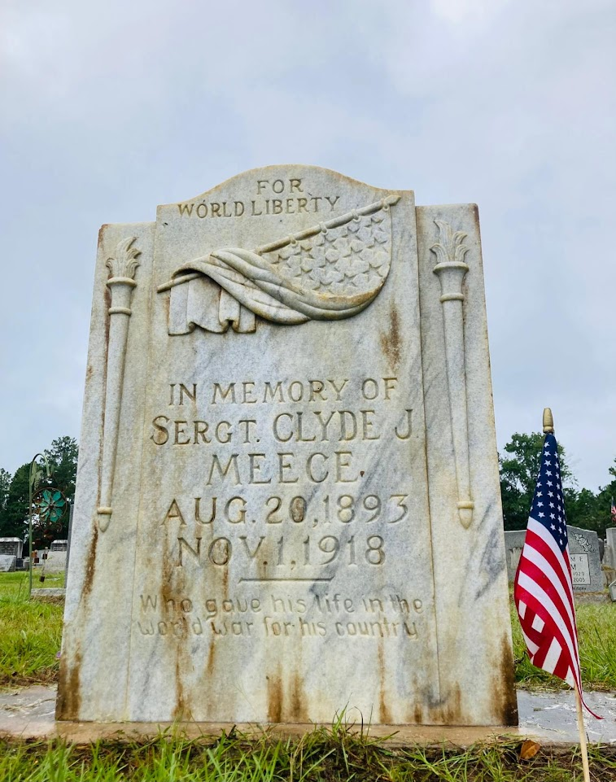
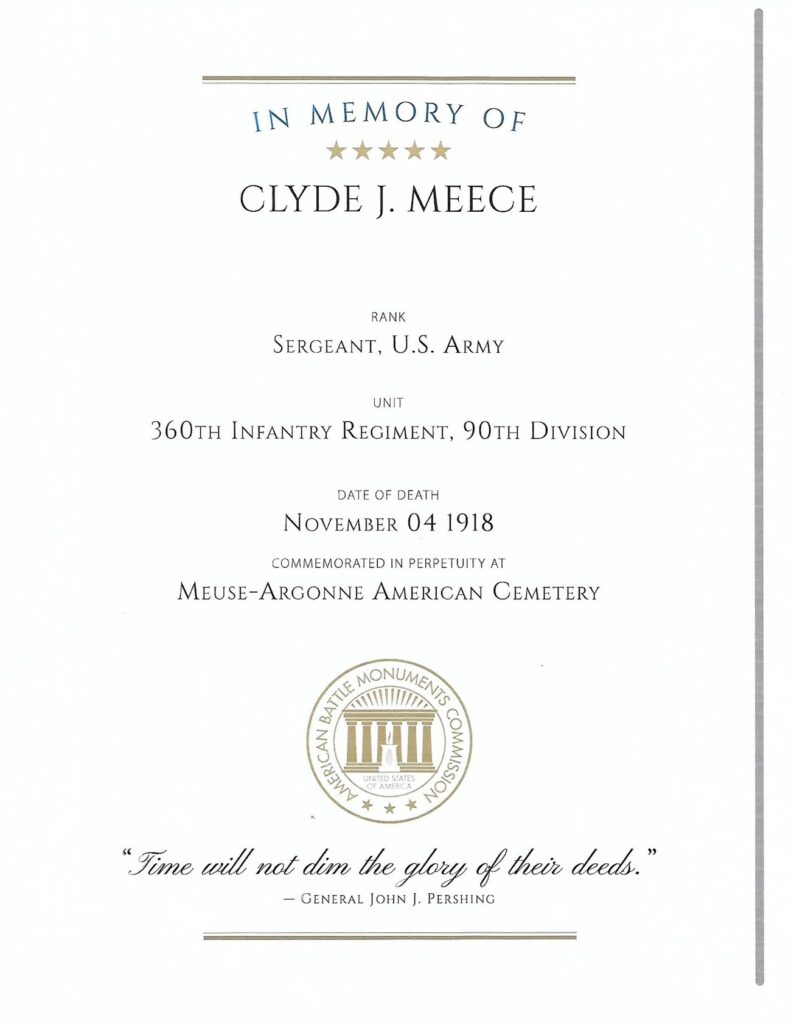
Sergeant Clyde John Meece was reported, at that time, Missing in Action (MIA). Dog tags were in use during WW1 so identification of the dead was not an issue. According to the headstone located at Bold Springs Cemetery in Bold Springs, TX, Clyde died on November 1st, 1918. According to the Veterans Administration Master Index and the memorial at Meuse-Argonne American Cemetery in France, Clyde died on November 4th, 1918. I’ve included two articles reporting his death. One is dated December 7th, 1918, and the other is dated December 12th, 1918.
December 12th, 1918
IN THE LAST DAYS OF THE WAR
THE PART PLAYED BY THE BOYS FROM TEXAS
Address to Relatives and Friends of the 360th Infantry
News coming in slowly from the blood-bathed banks of the Meuse shows that our boys knew how, like Crockett and Bowie, to die but not to surrender or retreat.
There is practically authentic information in hand showing its battle losses, between September 10 at St. Mihiel and Sedan on November 11 will total, if not exceed, 50 per cent. When our boys come home for the final muster out more than one-half of the old faces will be gone. As our men were shot down their places were taken by others, but the regiment never faltered.
Raked by deadly and venomous boche artillery and machine gun fire, it swept onward, never failing to attain its objective. On November 5, presumably at Dun-Meuse, its losses were 5 officers killed, 29 officers wounded, and 900 of its heroes in the ranks killed or wounded. When the sun went down the night of November 10, Stenay had been taken and the gateway of the German retreat closed; but it was not until about 11 a.m. next day that the 90th division occupied that stronghold and gap.
The Stars and Stripes, printed in Paris on November 15, in describing that crossing at Dun-Meuse, tells how the Americans–Texans, if you please, plunged into that river, icy cold, bridged it, waded it, swam it, mounted the opposite heights and in hand-to- hand work, drove back the Hun hosts, forever silencing their terrific artillery, machine gun and hand grenade work. Even after that, the work of the 90th division was not done, for with thinned ranks it went undaunted up that narrow path leading northward along the Meuse raked by machine guns and artillery. Of the last 24 hours of that work Stars and Stripes says:
“The heights near Wadelincourt were hard to reach. The last 24 hours of the American path to those heights were marked by some of the bitterest moments of the Argonne-Meuse drive. The valley that runs northward was commanded by many machine guns, swept by the fire from guns across the river which will not soon be forgotten by the troops that trod it. That deadly path was travelled that day.”
After telling how an advance of 15 kilometers had been made under such conditions, Stars and Stripes proceeds to give the lineup in what it calls the “Hinge of the Hinge” of the final American operations. It says:
“When the full story comes to be told, it will be shown that when the order came to ‘cease firing’ on November 11, the divisions in line in that region (“The Hinge of the Hinge”) were, from left to right, the 77th (New York City), 2d (Regulars), 89th (Kansas, Missouri, South Dakota, Nebraska, Colorado, New Mexico, Arizona), 90th (Oklahoma and Texas) 5th (Regulars), and 32d (Michigan) and Wisconsin). When the drive started its third and last phase on November 1 the divisions there were: 78th (Western New York, New Jersey, Delaware), 77th (New York City), 80th (Virginia, West Virginia and Western Pennsylvania), 2d (Regulars), 89 (States above named), 5th (Regulars) and 90th.”
This shows that on November 1 the 78th and 80th were in line for the final drive in that “Hinge of the Hinge,” but when the order came to ‘cease firing’ on November 11 the 78th and 80th had been retired or changed and the 32d had been thrown in. The above also shows that while the 90th was on the extreme right of the “Hinge of the Hinge” on November 11, it, along with the 5th Regulars held the very center of that bloody “Hinge of the Hinge.”
The Casualty List
Official casualty lists given out by the war department during the week ending Saturday morning (and no other sort are mentioned in these bulletins) show that 112 additional 360th infantrymen carried. Here are their names and home towns:
Sgt. Fred H. Lindsey, Lufkin, K. Sgt. Clyde Meece, Nettie, K. Sgt. Weaver Shoffner, Huntington, K.
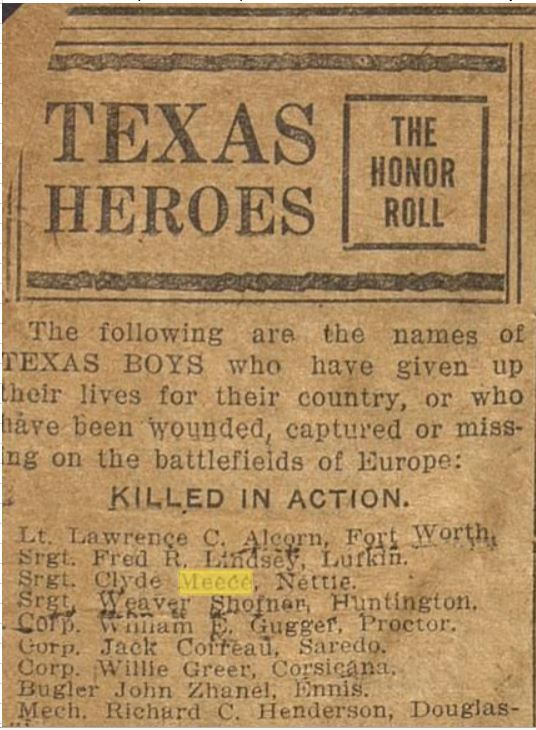
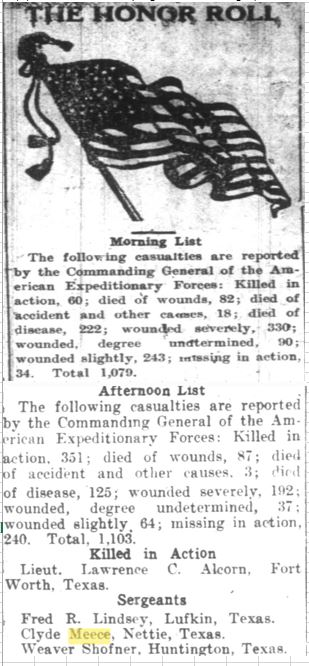
On the morning of November 11th in Compiègne, France, an armistice was reached between the Allies and Germany, declaring a cessation to hostilities on the western front effective the 11th hour, of the 11th of day, of the 11th month. As sad as Clyde’s death was, it was made far worse knowing that he had been just days away from surviving this horrible war and returning home.
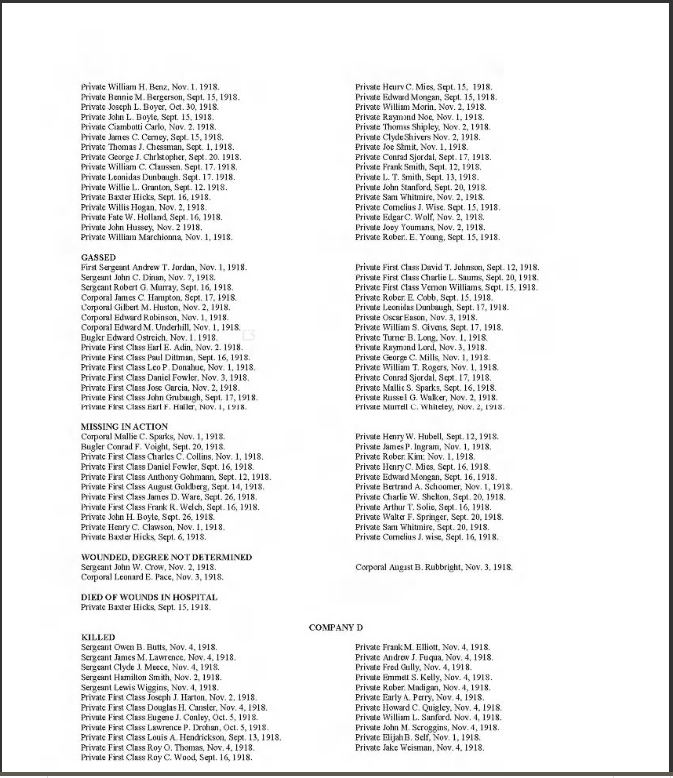
It’s highly probable that it took several days to weeks before the Army notified his parents of his death, especially considering the fact that he was, at that time, MIA. News of the armistice probably reached them first, and I’m sure that they were elated and expecting him to return home safely. His parents, Monroe and Danielle, must have been absolutely devastated and heartbroken when the news finally arrived. Closure, if it does exist, was made even more difficult by the fact that they did not have his remains.
World War I has been somewhat forgotten and overshadowed by World War II and the “Greatest Generation.” World War I took the lives of more than 9 million soldiers, 21 million more were wounded. Civilian casualties numbered close to 10 million. According to most historical records, approximately 116,516 Americans died in World War I, with the majority of those deaths attributed to combat and disease, particularly the influenza pandemic of 1918. Combat deaths were estimated at 53,402 and disease related deaths were estimated at 63,114. World War 1 helped to spread one of the world’s deadliest global pandemics, the Spanish flu epidemic of 1918, which killed an estimated 20 to 50 million people. These are mind numbing numbers!
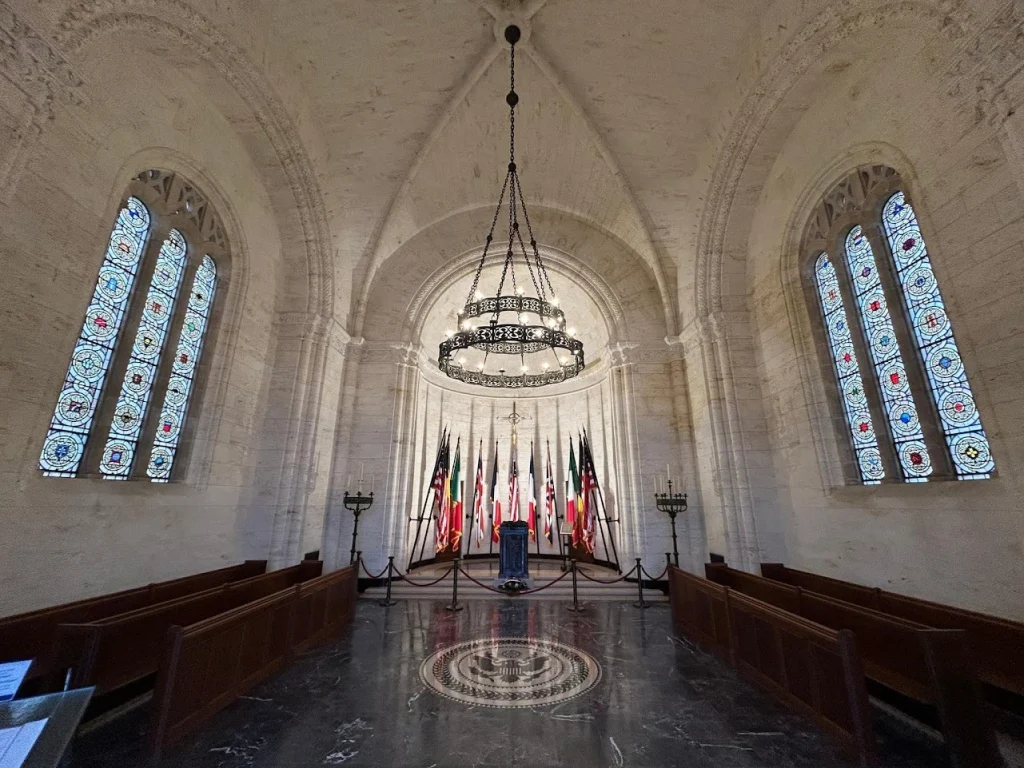
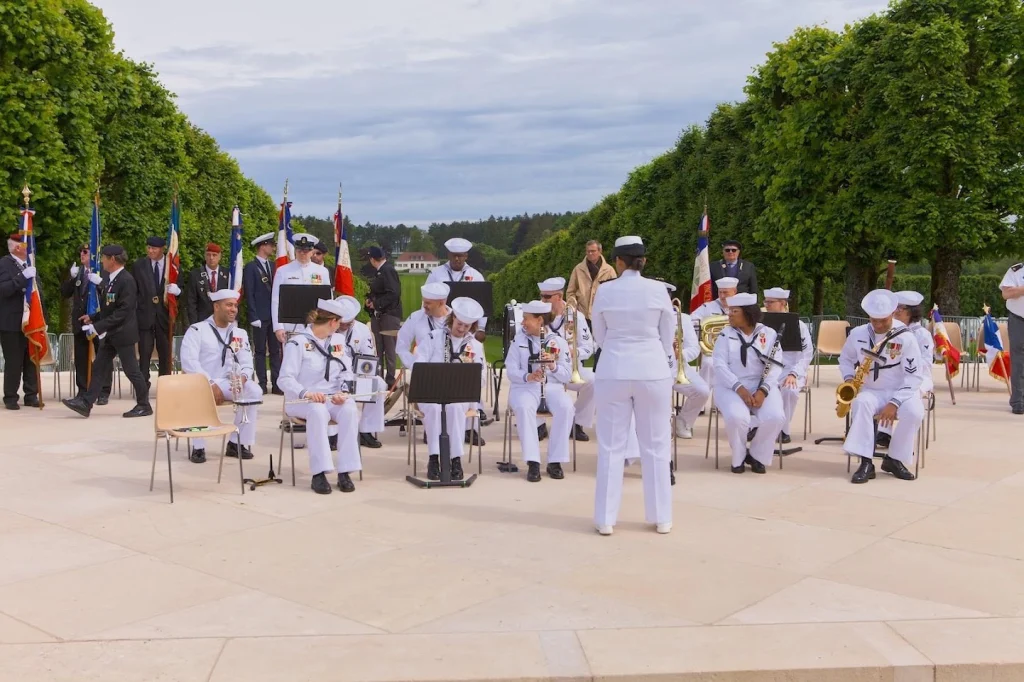
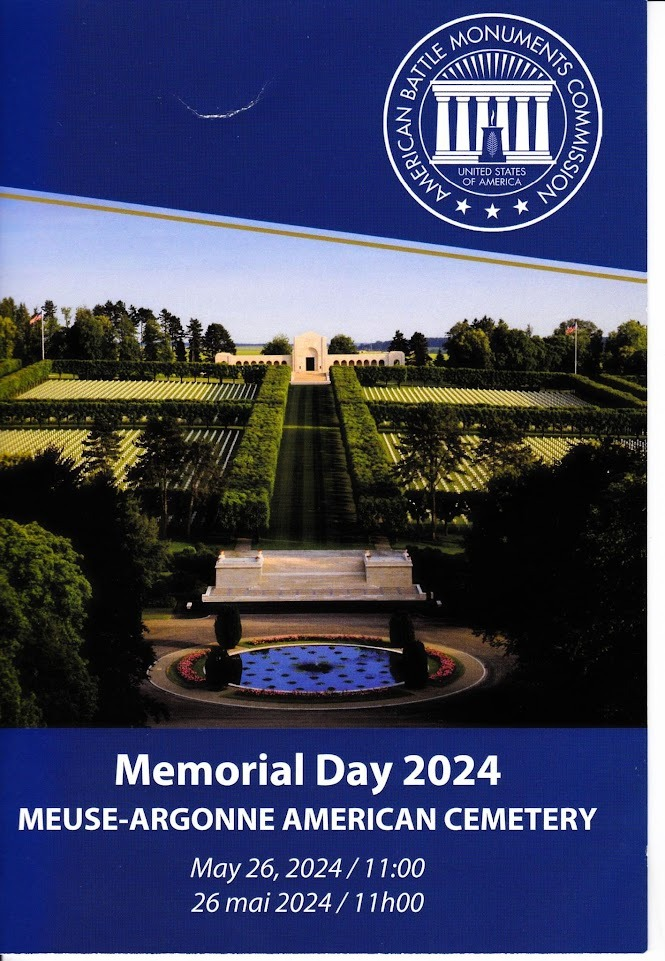
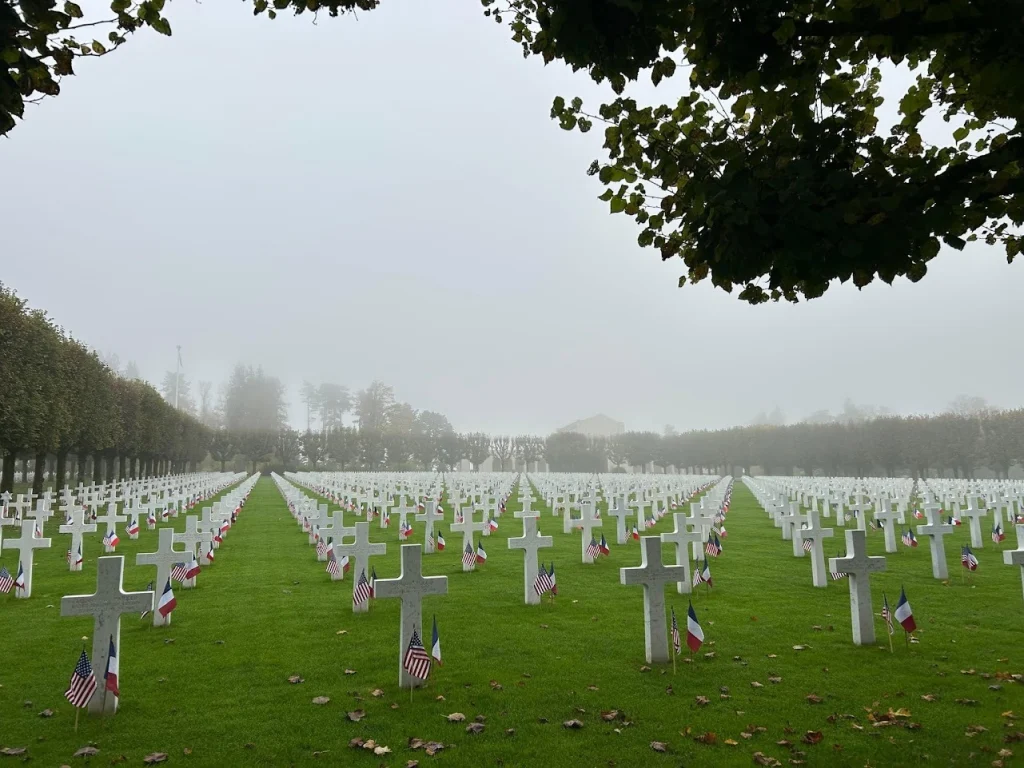
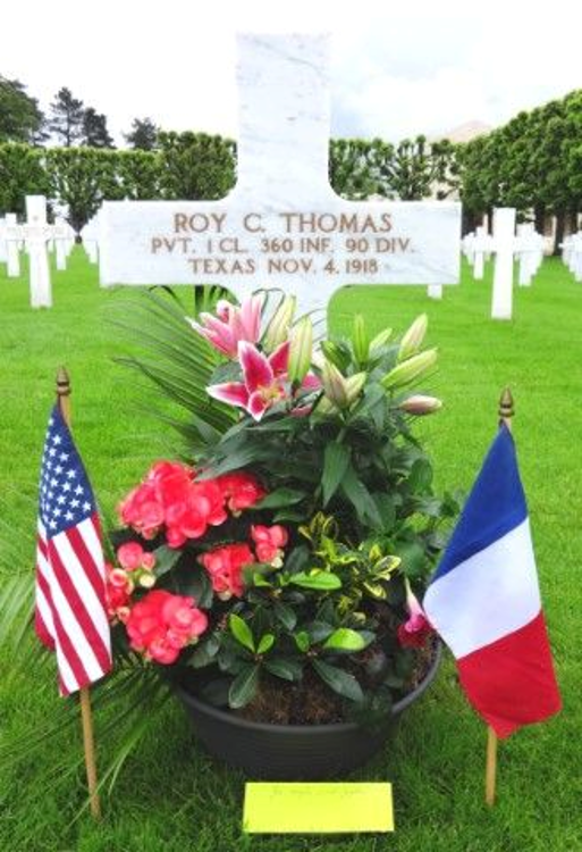
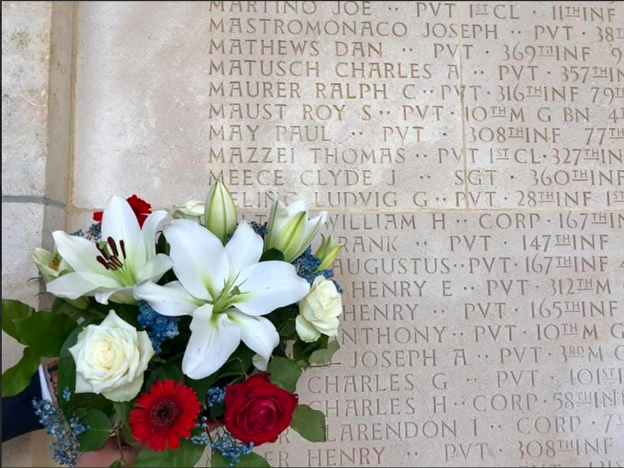
According to Lynda Smith Evans, “my 3rd cousin, a woman by the name of Trish Thomas places flowers at the memorial every year for Clyde. She also places flowers at the grave for her Uncle Roy C. Thomas. Both were killed just days before they were to come home. Both of them were from Livingston, TX. Claude was found but Clyde was MIA”. The Meuse-Argonne American Cemetery, by the way, is absolutely gorgeous. The French should be lauded for the way they memorialized the American dead.
Lynda Smith Evans’ grandmother was Gertie Lee Meece Hood. Gertie was a sister of Clyde John Meece, therefore Clyde was the granduncle of Lynda Smith Evans. It always gets a little confusing when trying to explain the genealogy of it all.
Clyde has a beautiful headstone located at the Bold Springs Cemetery adjacent to the Bethel Baptist Church in Bold Springs, TX. I’m not sure of its composition but it is very porous and it doesn’t weather well. We travelled to Livingston, TX, over Labor Day weekend in 2024. The primary purpose of the trip was to meet my Great Grandfather Theophilus Franklin (T.F.) Meece. We spent a portion of two days tending to the Meece grave sites at the Bold Springs location. As you can tell by the pictures most of that time was spent on Clyde’s headstone.
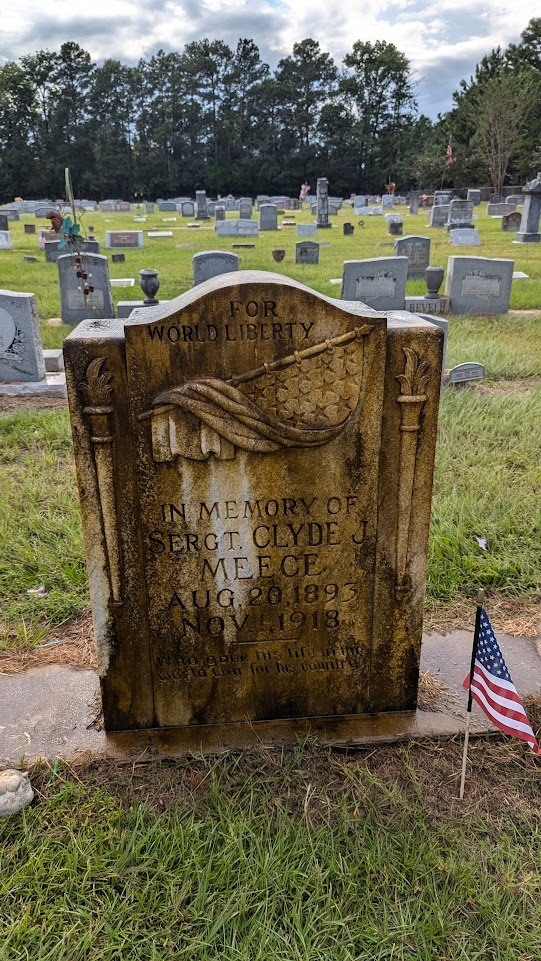
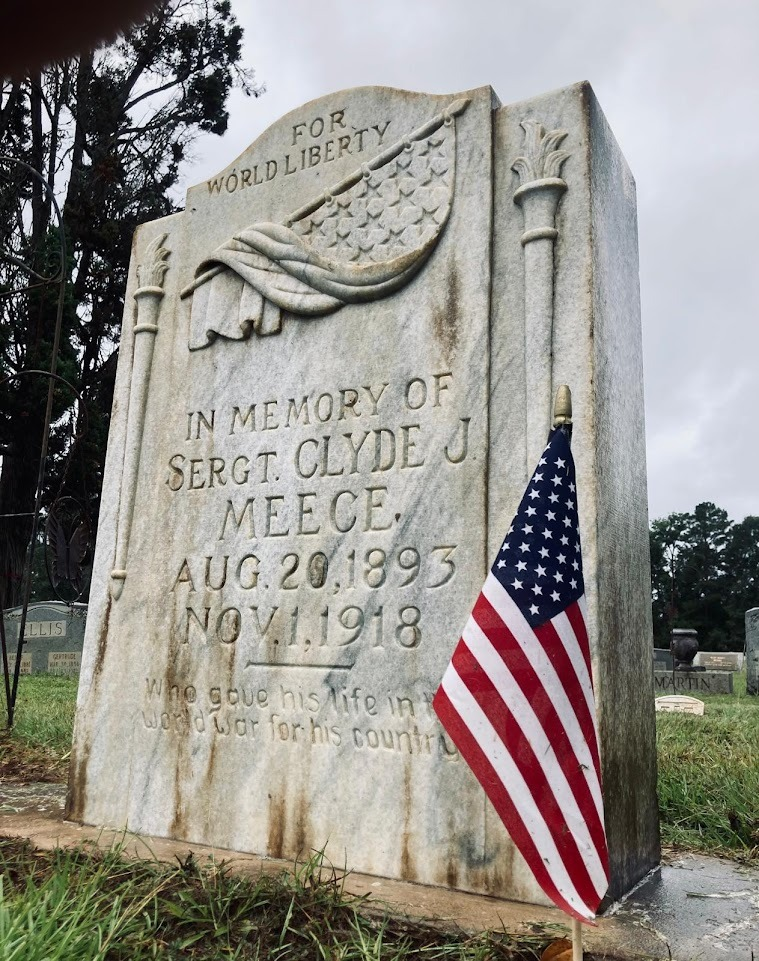
The epitaph on his headstone reads as follows:
“Who gave his life in the world war for his country”
This was one of the more painful and difficult stories that I have researched. He was a handsome young man who lost his life at the age of 25, defending his country.
Since I first wrote this narrative about Clyde John Meece, I’ve discovered some additional information. Clyde’s company was involved in the final allied push, the Meuse-Argonne offensive which began on September 26, 1918, and lasted until the Armistice was signed on November 11, 1918, a total of 47 days. It was the deadliest campaign in American history, resulting in over 26,000 soldiers being killed in action (KIA) and over 120,000 casualties. The U.S. was only involved in WWI for approximately 19 months.
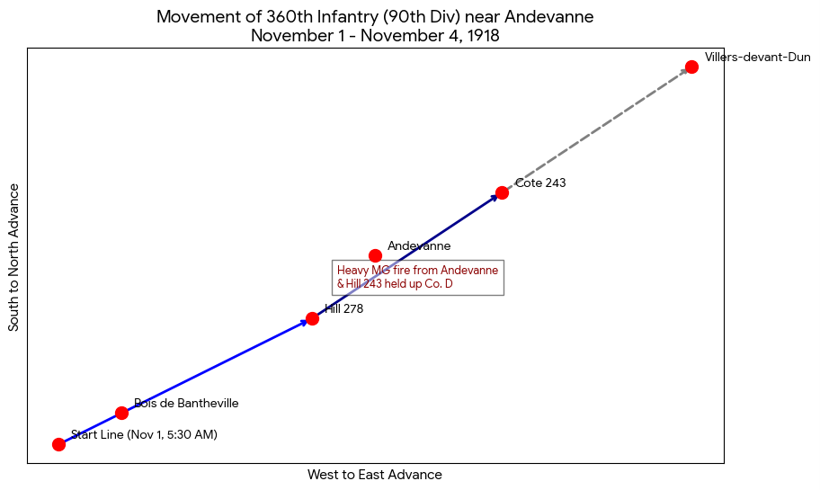
The Army Medical Department (AMEDD) described November 1, 1918 as follows: “On November 1, at 5.30 a. m., the general attack for which our troops had been preparing during the previous few days was launched. The line of departure was approximately from east to west, a point on the Meuse about 1 km.(0.6 mile) southeast of Brieulles-sur-Meuse, thence along the Meuse to a point opposite Liny-devant-Dun, thence northwestwardly, south of Clery-le-Grand to a point approximately 500 meters (545 yards) north of Aincreville, thence following the ridge just south of Ruisseau de Cheline, including Bourrut, passing just south of La Grande Carre Ferme.
The 90th Division, on the left, was the attacking division; the 5th Division, on the right, was to hold its front, meanwhile pushing out strong patrols to develop the enemy’s main line of resistance and seize any ground made possible by the advance of the 90th Division. The attack progressed in accordance with the scheduled arrangements. At 7.05 a. m. Clery-le-Grand was captured and troops of the 90th Division entered Bois d’Andevanne. The right regiment of the 90th Division reached its objective, but the left regiment encountered heavy machine-gun and artillery fire in Andevanne and was forced to halt. By the end of the day the corps line was roughly the line of the corps objective; that is, the ridge north and east of Andevanne, thence generally southeast to the position of the right flank of the morning.”
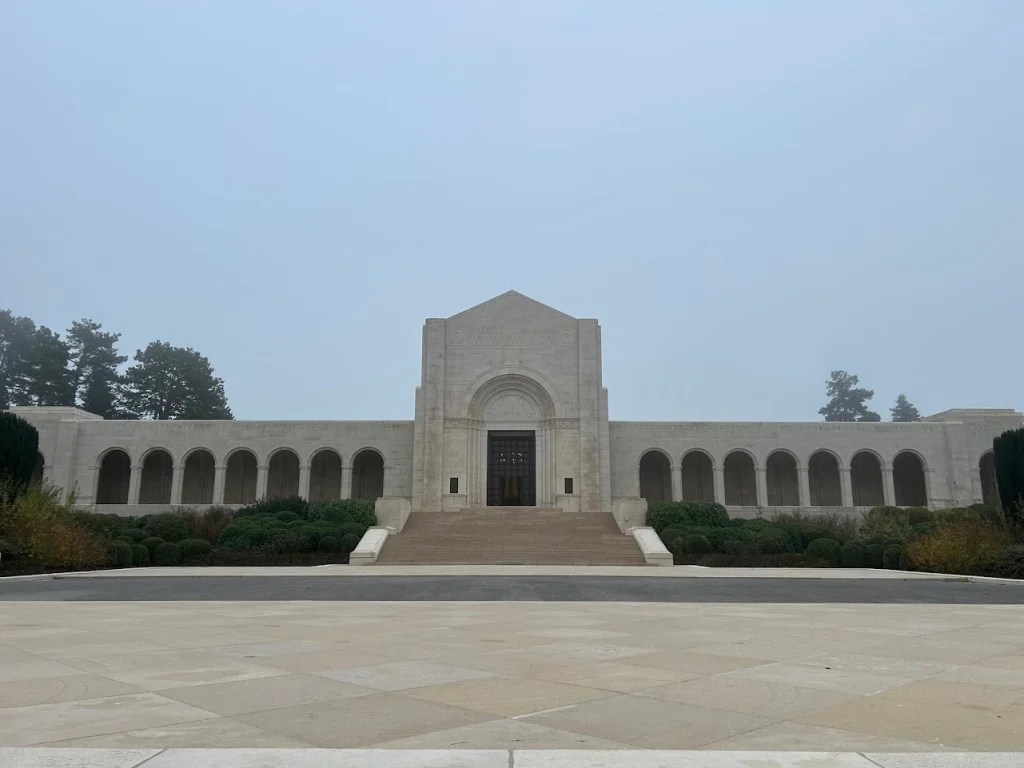
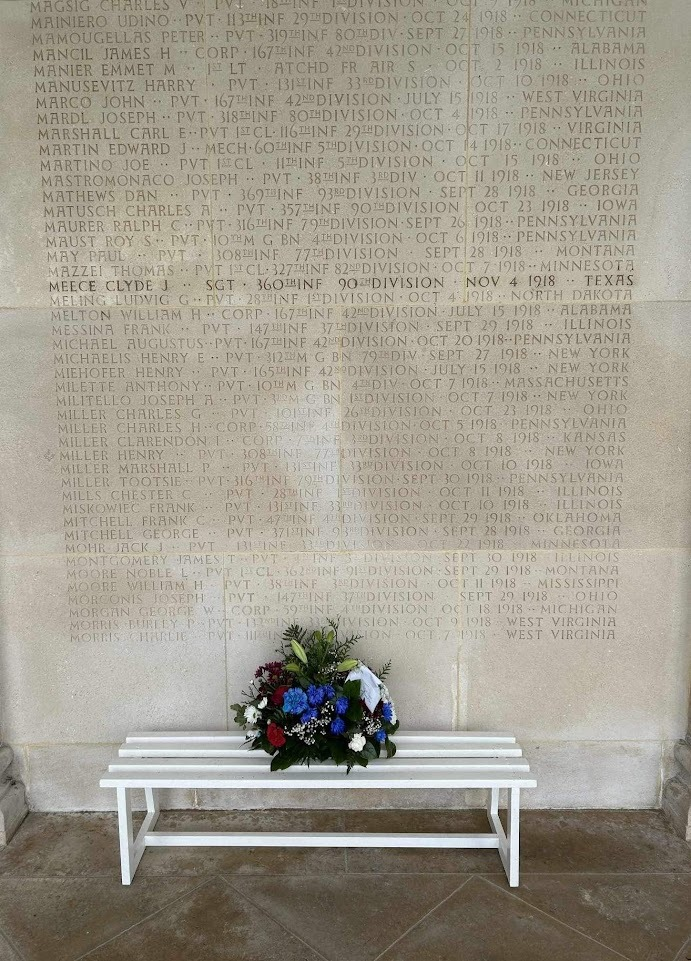
According to the headstone located at Bold Springs Cemetery in Bold Springs, TX, Clyde died on November 1st, 1918. The Tablets of the Missing at the Meuse-Argonne American Cemetery in Romagne-sous-Montfaucon, France reports Clyde’s death as being November 4th, 1918. Above the panels, a prominent message reads: “The names here recorded are those of American soldiers who fought in this region and whose earthly resting place is known only to God.”
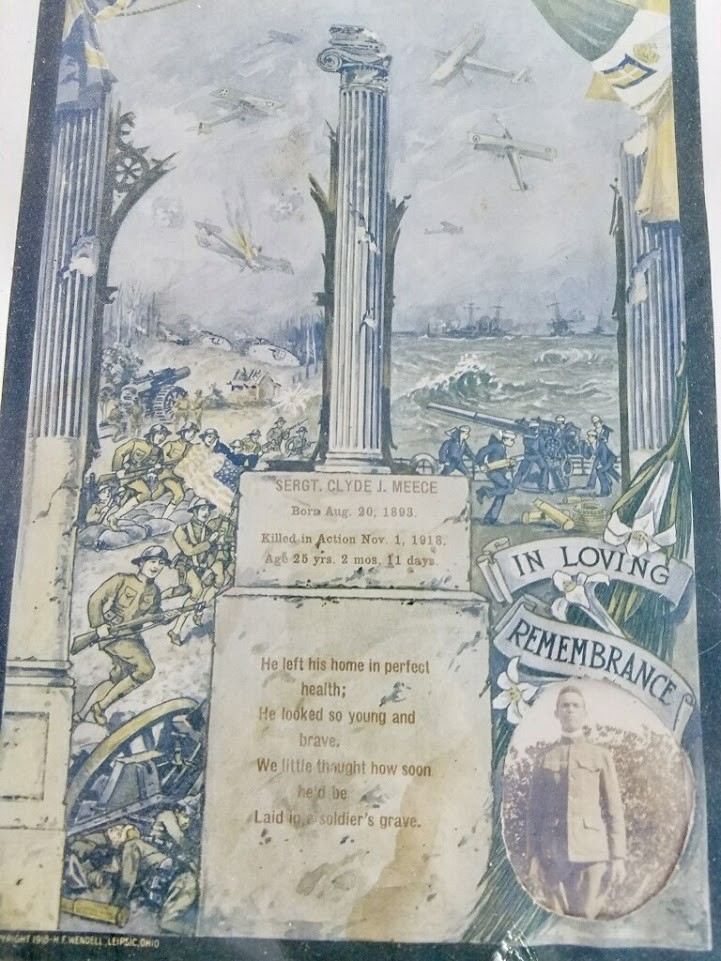
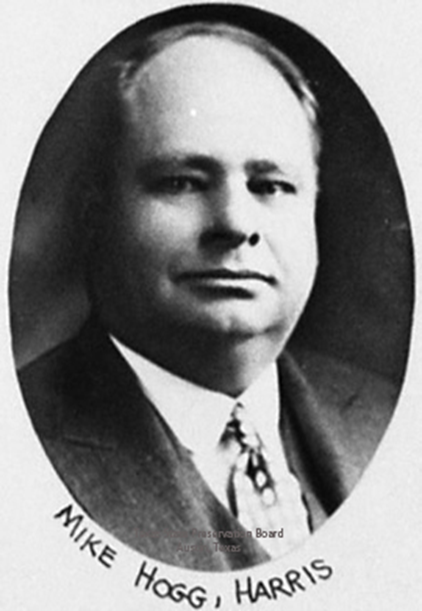
As a supplement to the original story, I discovered an article from the Houston Chronical dated February 9, 1919. Clyde’s parents received a letter from Captain Mike Hogg of Company D, 360th Infantry, telling them of the heroic death of their son, Sergeant Clyde J. Meece at Andevanne on November 1, 1918. Captain Hogg writes: “I am sure you would be comforted to know a few things about your son, Clyde. He made the supreme sacrifice early Tuesday morning, November 1, in the last “push” of the war. He was killed near Andavanne, a small town in the Meuse River Valley. His burial took place the next morning with religious services by our chaplain. The company had not gone very far that morning before Clyde and two other sergeants were hit by machine gun bullets and instantly killed. They were all at the head of their men leading them into the face of a most terrific machine gun fire. They never wavered and all died at their post of duty.”
Dead soldiers were most often buried at or near the battlefield, especially when they were in the midst of battle. Monroe and Danielle must have found some solace in knowing that Clyde died alongside his comrades and that he received a proper Christian burial. According to the 90th Infantry Division Association “Heavy fire from east of Andevanne was encountered and, just as darkness fell, it was necessary for the battalion to stop and reorganize. Captain Gustave Dittmar and Lieutenant Lonus Reed of Company C and Captain Mike Hogg of Company D, as well as Lieutenant Robert K. Campbell, had been wounded prior to this reorganization.”
Captain Mike Hogg (1885-1941) would go on to become a member of the 40th and 41st Texas Legislature, businessman and civic leader in Houston, TX. He was the son of the 20th Governor of the State of Texas, James Steven Hogg, who served two (2-year) terms. This two-year term limit was established by the Texas Constitution of 1876. It wasn’t until a constitutional amendment was passed in 1972 that the gubernatorial term was extended to the current four years. He was the first Texas Governor to have been born in the state.
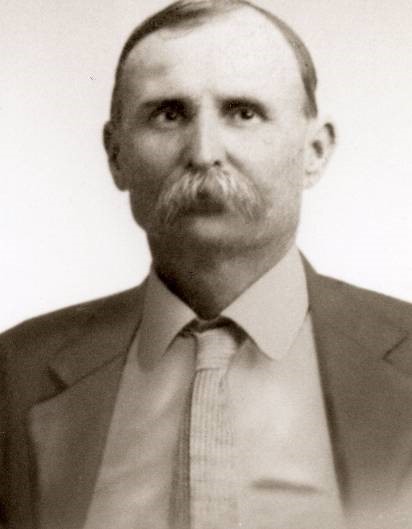
I read a story that Gary Davis, a local historian from Livingston, TX, had written. In the narrative Gary published a photo of Clyde John Meece. I sent him the following email:
I couldn’t help but notice the picture of Clyde John Meece. Back on November 9, 2024 Lynda Evans (whom I believe is your mother-in-law) sent me the following email along with that picture and several others. Lynda Evans: “I will send name and pics of cemetery in France where the MIA wall is. Trish Thomas puts flowers there every year for Uncle Clyde and her uncle who were killed just days before they were to come home. Both from Livingston. Claude was found Clyde MIA There are some here.”
I replied as follows: “I’m assuming that the 1st photo (the one in question) is her Uncle Claude. It does not look like Clyde based on the photo that I’ve seen. It took a little searching but Ruby Mae Courtney Echols is the daughter of Jasper William Courtney and Helen Marie Meece. She was a pretty woman. It’s amazing that she lived so long and that her Father died at 41 from appendicitis.” Lynda then replied: “Roy Thomas not Claude.” I then asked who Roy Thomas was, but I never received a reply.
The photo that I was referring to was a photo of Clyde on horseback that I discovered on Ancestry. An additional photo that Lynda sent me was some sort of memorial to honor Clyde. I don’t see a resemblance to the photo she sent me and the one that you used in your narrative.
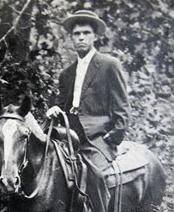
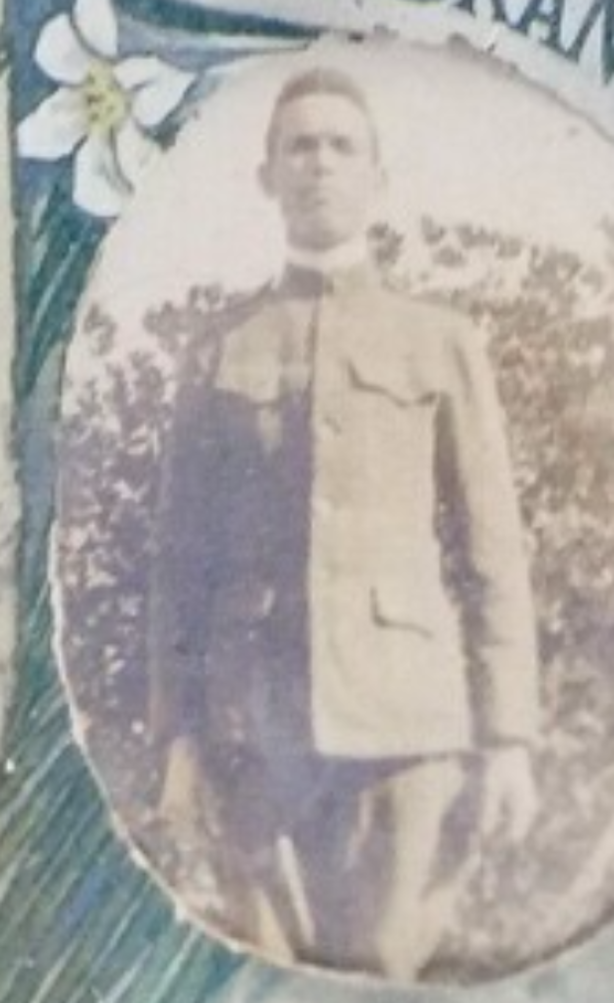
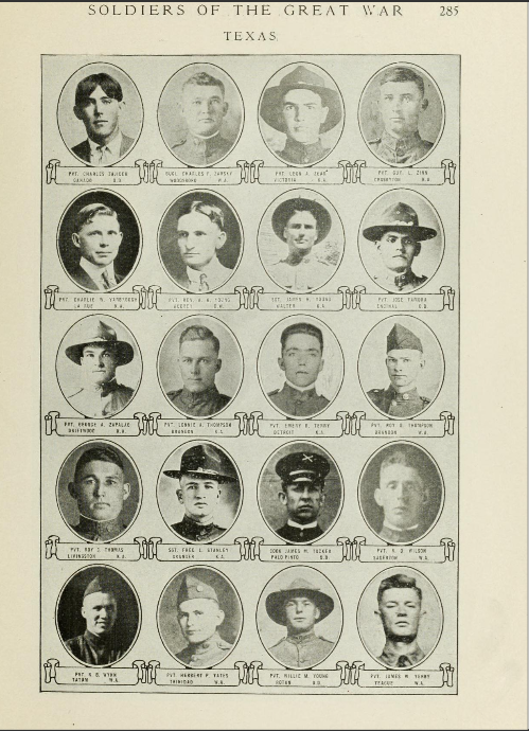
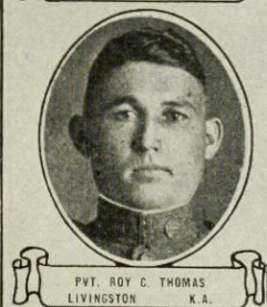
I found an additional photo yesterday when I was searching through Soldiers of the Great War Volume 3. Soldiers of the Great War is a three-volume memorial set published in 1920 by editors W. M. Haulsee, F. G. Howe, and A. C. Doyle. It is a comprehensive registry of American soldiers who gave their lives during World War I. The reference book is organized by state and features photographs, names, ranks, and causes of death. Once again, and maybe it’s me, I don’t see the likeness.
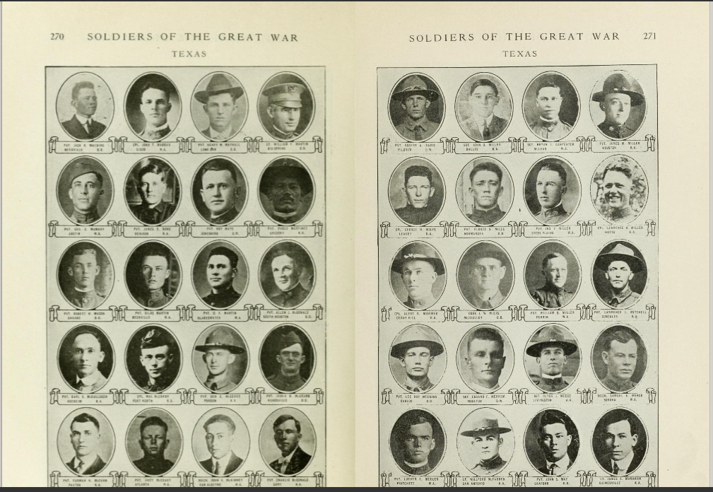
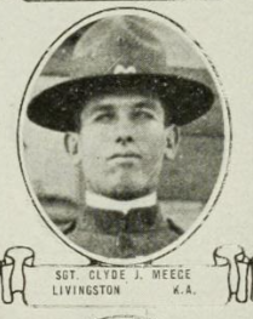
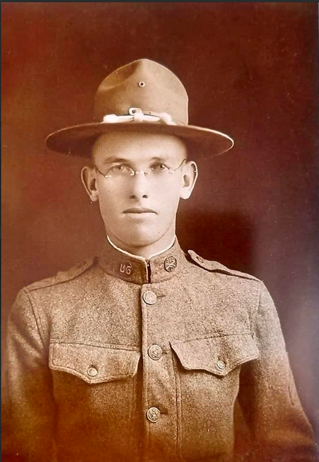
While I was looking through the Soldiers of the Great War, I discovered Private First-Class Roy C. Thomas from Livingston, TX. He also served in the United States Army with the 360th Infantry Regiment, 90th Division. His date of death was also reported as November 4, 1918. Roy was born on December 27, 1893. His remains were recovered however, and he was laid to rest at the Meuse-Argonne American Cemetery in Romagne, France. His final resting place is located at Plot F, Row 23, Grave 34.
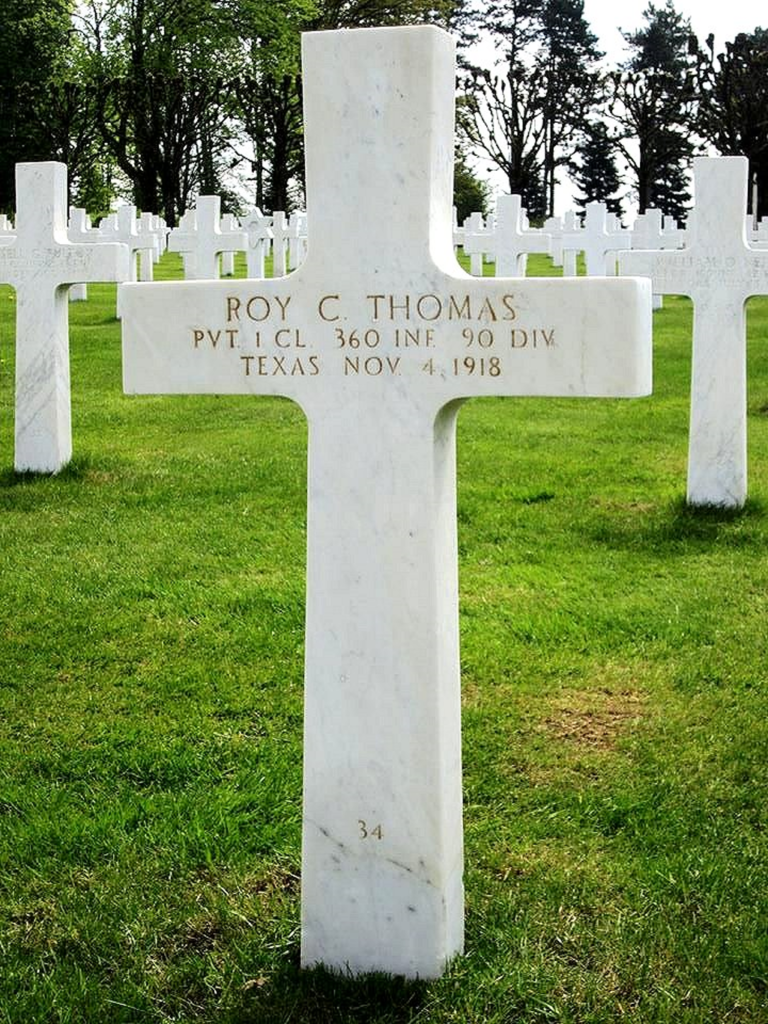
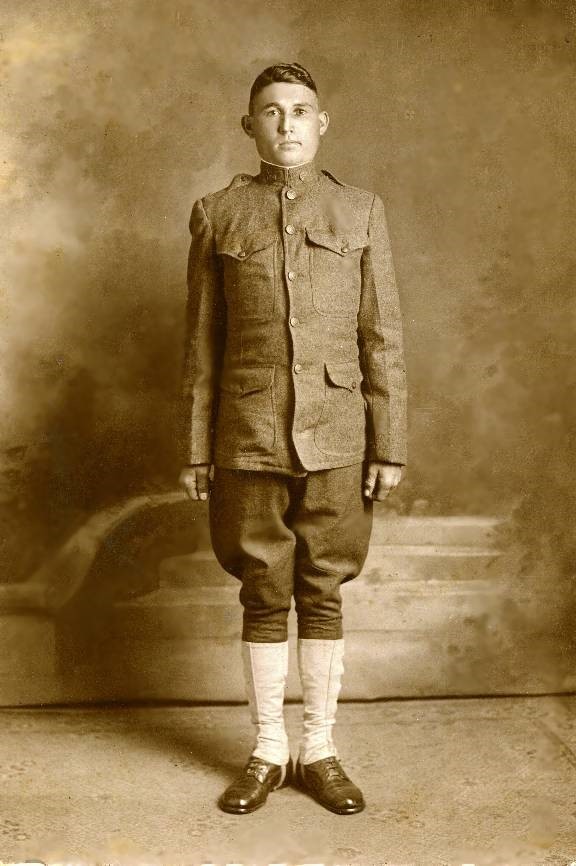
The term “Gold Star” emerged during WWI when families hung service banners with a blue star for every deployed relative. If the service member died, the star was changed to gold. The U.S. Congress passed the Gold Star Mothers and Widows Pilgrimage Act in 1929. The government paid all expenses to send approximately 6,650 eligible women to European military cemeteries. Out of 6,693 total women who made the journey, only 128 were from Texas. While searching through the List of Mothers and Widows of American Soldiers, Sailors and Marines Entitled to Make a Pilgrimage to the War Cemeteries in Europe, I found no representatives from Polk County.
Sylvia Henrietta Bowlus Thomas did visit Roy’s grave, apparently at her own expense.
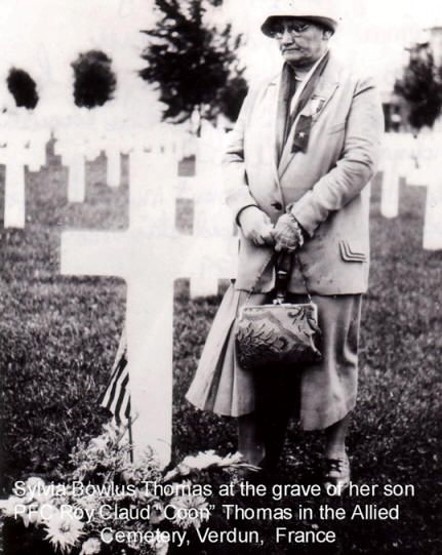
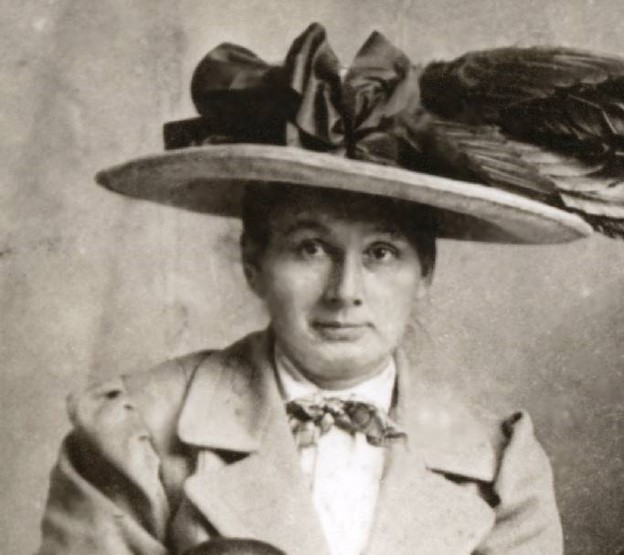
Sylvia Henrietta Bowlus Thomas was born in Sandusky County, Ohio in 1870 and she died in 1937 in Houston, Harris County, Texas. She is buried in Oakdale Cemetery located in Marston, Polk County, Texas. Her husband, James Henry Thomas, was born on January 2, 1859 in Liberty County, Texas and he died on March 21, 1931 in Marston, Polk County, Texas. He is also buried in Oakdale Cemetery located in Marston, Polk County, Texas. I discovered mentions of the two of them in the Polk County Enterprise but nothing of significance. According to Lynda, it is Trish Thomas, a relative, that places flowers at the memorial and the grave every year.
Ernest Hemingway said “Every man has two deaths, when he is buried in the ground and the last time someone says his name. In some ways men can be immortal.” Our guide at Hollywood Cemetery in Richmond, VA, told us that the second death occurs when people stop visiting your grave. A person’s memory and legacy can live on as long as they are kept alive in the thoughts and actions of the living. In Christianity there are three kinds of death. Spiritual death in which man is separated from God. Physical death where there is a separation of man’s soul from his body. And finally, a second death when man is separated from God in the lake of fire forever.
I can now attest to the fact that Clyde John Meece has not yet suffered a second death.