“I have always been proud of my service in the Confederate Army, believing that it was my duty, also a privilege to respond to the call to my country’s defense.”
T.F. Meece
The purpose of the camps was to provide support and recognition for former soldiers, to preserve the Confederate cause and its history and to foster a sense of community and shared identity among veterans. The objectives of these organizations included burying and commemorating dead soldiers, caring for cemeteries, and providing aid to widows, orphans, and indigent veterans.
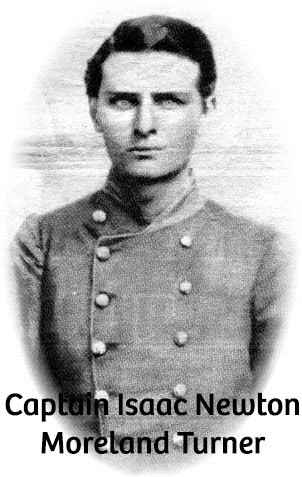
Isaac Newton Moreland (Ike) Turner was born in Putnam County, Georgia. His father, J.A.S. Turner, was a plantation owner with Texas land holdings in Polk and Liberty Counties. The Turner Family moved to Texas prior to the outbreak of the Civil War.
Theophilus Franklin Meece (T.F.) was a member of the Polk County Flying Artillery organized by Captain Ike Turner and his uncle Robert W. Hubert. This took place in May or early June of 1861. Robert’s sister, Martha Evaline Hubert, was married to Ike’s father Joseph Algernon Sidney Turner. They were mustered in as Company K, 5th Texas Infantry, but they retained their nickname, “Polk County Flying Artillery,” throughout the war. All of Turner’s younger brothers, William, Joseph, and Charles had joined the Company.
Captain Turner was the youngest officer of his rank in Hood’s Brigade, T.F. was only 21 years old. Turner was able to procure (2) six-pounder cannon, through his father, and they began to drill as a light artillery unit. These cannons were first used in the Mexican American War. They were capable of firing a 6.1 lb. cannonball approximately 1,523 yards, as well as canister or spherical case shot (shrapnel). During the Civil War, spherical case shot, also known as shrapnel, was a common artillery projectile used against infantry and cavalry formations. It consisted of a thin metal casing filled with lead or iron balls and a small bursting charge, designed to explode in mid-air and scatter the balls over a wide area. This created a shotgun-like effect, devastating enemy ranks at ranges up to 500 yards.
Captain Turner’s father, Joseph Algernon Sidney Turner, was born in December of 1808 in Putnam County, Georgia. He had himself served as Captain to a company of Georgians that accompanied Zachary Taylor to Mexico in 1846. He was clearly a very strong influence on his son. After all, these young soldiers were mostly farmers with absolutely no military experience. These were exciting times for these young men. They were full of optimism.
The Company failed to get service as artillerist and eventually accepted an opportunity to go to Virginia as an infantry unit. The Company assembled in Livingston, TX on Tuesday 9/3/1861 where Captain Turner was presented with a handsome flag (typically the Stars and Bars) during an address by the Honorable John L. Henry. Turner, in response, “promised to bring back heroes as husbands and sweethearts” for the noble women being left to cheer. Soldier dinners and entertainment were arranged for the entire Company prior to their departure.
Turner had led his troops through 16 battles, mostly in Virginia, and following the loss of all field grade officers at the Battle of Antietam he was elevated to Major. He had previously been wounded at Seven Pines, Virginia on May 31st, 1862 and at Second Manassas, VA on August 30th, 1862.
On April 14th, 1863 Captain, Isaac “Ike” Newton Moreland Turner was killed inside Fort Huger near Suffolk, VA. He was struck by a ball from a sharpshooter from across the river. He was carried to a field hospital where he died the following day. Ike’s last words, whispered to one of his brothers still in Company K, were a request: “If you can, please take me home to my mother, for I fear that she will worry so about me.”
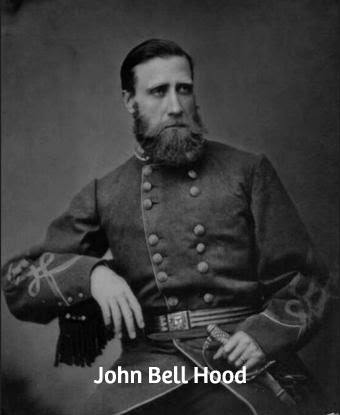
General Hood was reported to have said “he would sooner have lost any officer in his command of four brigades.” Hood lamented his death and considered Turner a gifted outpost officer of “preeminent qualities”.
On the same day that Ike Turner died his father began a letter to family in Louisiana expressing his weariness and disillusionment with the war. “We have had an excess of Freedom, which the masses in all ages have not been able to bear, and now we have an excess of despotism, north & south. There is no worse despotism than to be swallowed up in a military vortex. It is my opinion that a people that has the privilege of the ballot box can secure more liberty by their votes than they can by any other means. When we gain our independence, which I am in hopes we will do, we have not secured our freedom. A heavy, and I may say, enormous debt hangs over us, a large standing army which both the north & south will have to or will keep up, will destroy our liberties. The south particularly will have to become a military people in order to maintain her independence, and history shows that a military people can not have much freedom….”
Joseph goes on about the fact that he has been unable to find an overseer and that there aren’t any competent ones available. An overseer was a person, typically a white man, who supervised the labor of enslaved people on a plantation. They were responsible for maximizing productivity and ensuring enslaved individuals worked diligently under the direction of the plantation owner. Overseers often held significant power over the enslaved and could inflict physical punishment.
His son Joseph A. Sidney Turner Jr. had been wounded in the thigh in the Battle of Antietam and he was preparing to return to Virginia. William Hubert “Bill” Turner had been discharged due to disease and physical disability, and he was working on his uncle Bob’s plantation. Charles Hines Turner had enlisted and had left for Virginia just two weeks prior to this letter. Sadly, he would die from disease (chronic diarrhea) in 1865. Chronic diarrhea, often caused by dysentery, was a major killer during the American Civil War, contributing to more deaths than combat. Unsanitary conditions, contaminated water and food, and lack of understanding about disease transmission led to widespread outbreaks. It’s quite likely that Joseph and his wife Evaline would not find out about Ike’s death for quite some time. There was no formal reporting, on either side, for sickness, injury or death.
Joseph would complete the letter with “If I understand the meaning of the word Christian, it is a follower of Christ. Did Christ, his Apostles & followers fight each other or even other people. No. Did they encourage resistance to the powers that be. Far from it… These reflections or opinions you will consider as rather novel or startling, as coming from me, but this war has upset nearly every old settled opinion I ever had.” Not exactly a supporter of “The Lost Cause”.
With the war raging around them, it was impossible to return his body to Texas. Capt. Turner’s brother, Charles, took his body by train to be buried at the family’s former plantation “Turnwold” (meaning Turner’s field) near Milledgeville, Georgia. Turnwold is among the most historic plantations in Georgia. Family legend maintained that it was Capt. Turner’s wish to be buried in his family’s cemetery in Texas. In 1994 his remains were disinterred and transported from Georgia to Polk County, Texas and buried amongst his family members.
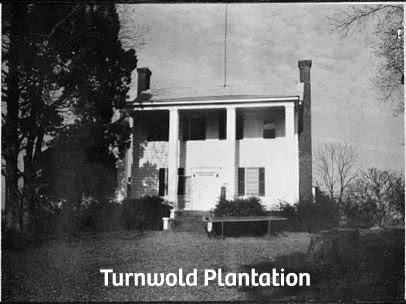
Joseph’s older brother, William (“Honest Billy”) Turner and his family would continue to own and operate the Turnwold Plantation. His son, Joseph Addison Turner, was a writer, editor, publisher, lawyer, and planter. He is best known for publishing the “Countryman”, a weekly newspaper produced from his Putnam County plantation during the Civil War. Turner was a staunch advocate for slavery and the Confederacy. He used the “Countryman” to voice his pro-Confederate views through articles and editorials. In June of 1865 Union officials placed Turner under military arrest for “publishing disloyal articles.”
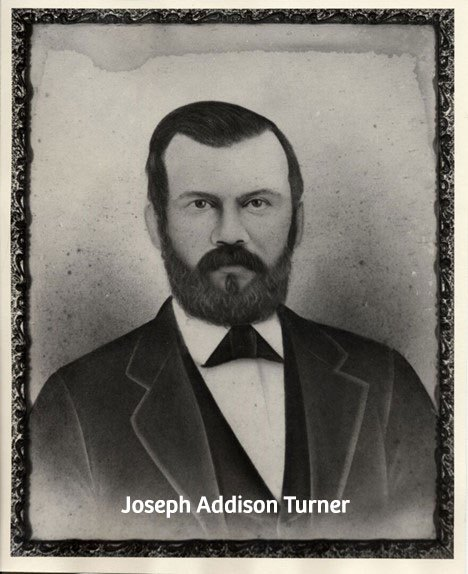
In March of 1862 Turner hired an Eatonton native, Joel Chandler Harris, as an apprentice and typesetter for the “Countryman.” He would go on to become an American journalist best known for his ‘Uncle Remis’ and ‘Brer Rabbit’ stories.