The Texas Brigade would train just outside of Richmond until mid-November when the units would move to positions just outside of Dumfries, VA, alongside the Potomac River. The men began constructing their winter quarters in January of 1862. The 1st Texas camped near Quantico Creek at “Camp Quantico.” T.F.’s 5th Texas took up position a little to the north along Neabsco Creek at “Camp Neabsco” and the 4th Texas camped just south of Powell’s Run at “Camp Hood.”
The relatively severe winter weather of northern Virginia was especially difficult for the men from Texas. Many of them had never experienced snow, let alone long harsh periods of freezing weather. T.F. had lived in Spring Hill, TN, just south of Nashville, so he was somewhat accustomed to the winter weather. Loneliness and homesickness prospered in the camps during these long winter months.
Fighting was limited to periodic skirmishes during their winter encampment. Confederate commanders favored the Texans as scouts both for their familiarity with rough frontier terrain as well as their ability to shoot and track. The Texans excelled in these pursuits, and soon became “a terror to the enemy.”
Their greatest foe was, by far, devastatingly widespread disease, sickness, and epidemics. On 11/20/1861, 47 men from Company K, (T.F.’s unit) were sick in a Richmond hospital. On 12/31/1861, only 5 soldiers were present, out of an assigned strength of 73. From October 11th, 1861 through December 31st of 1861 T.F. was reported as sick in camp on four different occasions, according to the attached Muster Roll Cards.
The 5th Texas seemed to be the hardest hit of all of the Confederate regiments. At one point, no more than 25 were fit for duty in the entire regiment, which consisted of approximately 800 men. Unfortunately, disease took many of these Texans, before they ever fired a shot in battle. That first winter the regiment lost 261 men due to sickness. 137 died and 124 were discharged or permanently furloughed. Thirty men in Company K alone died of yellow fever in the first six months of their enlistment.
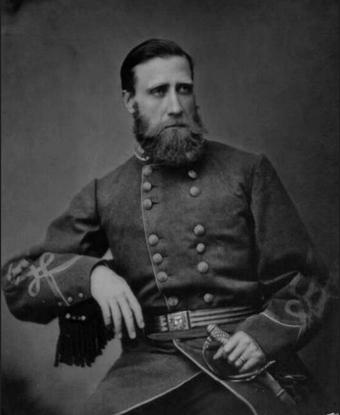
John Bell Hood
Louis Trezevant Wigfall resigned his commission as Commander of the Texas Brigade to take a seat in the Confederate Congress. Wigfall was well known in Texas. He was widely credited with Sam Houston’s defeat for the governorship in 1857. He firmly believed in a society led by the planter class based on slavery and the chivalric code. John Bell Hood was promoted to brigadier general on March 8, 1862, and four days later he was formally assigned to command the Texas Brigade. Upon this assignment, this unit was known as “Hood’s Texas Brigade.” Consequently, John Bell Hood came to command the combined forces of the Texans in what was soon to be designated the “Army of Northern Virginia.”
This is an account of the battles that Theophilus Franklin Meece (T.F.) fought in. On February 10th, 1862 T.F. would receive a promotion from 2nd Corporal to 5th Sergeant. On December 11th, 1862 he was promoted to 4th Sergeant. Both of his brothers, Calvin and James, would eventually join Company “K” Fifth Texas Regiment Volunteer Infantry. Calvin enlisted on April 29th, 1861, in Livingston, Texas, as a private in Company B, 1st Texas Infantry. Calvin had transferred from Company “B” 1st Texas Infantry on March 1st, 1863. James was recruited on March, 21st, 1863 in Livingston TX. I’m guessing that T.F. recruited both of his brothers to Company “K”, a decision he would later regret for the rest of his life.
The first real action for the Texas Brigade came on May 7th 1862 at Eltham’s Landing. McClellan’s Union troops were attempting to cut off the Confederate retreat towards Richmond, VA during the Peninsula Campaign. “Hood’s Texas Brigade” was successful in stopping this rear action or flanking maneuver. The battle resulted in 194 Union casualties 48 Confederate casualties. This event was considered more of a skirmish than a battle.
The Battle of Seven Pines was a part of the Peninsula Campaign. The battle ended inconclusively, with both sides claiming victory. During the Battle of Seven Pines, the Texas Brigade was instructed to support Longstreet’s command. Although the rest of Brigadier General William Henry Chase Whiting’s division was heavily engaged with considerable casualties, the Texas Brigade sat mostly idle during the battle and had just 10 casualties.
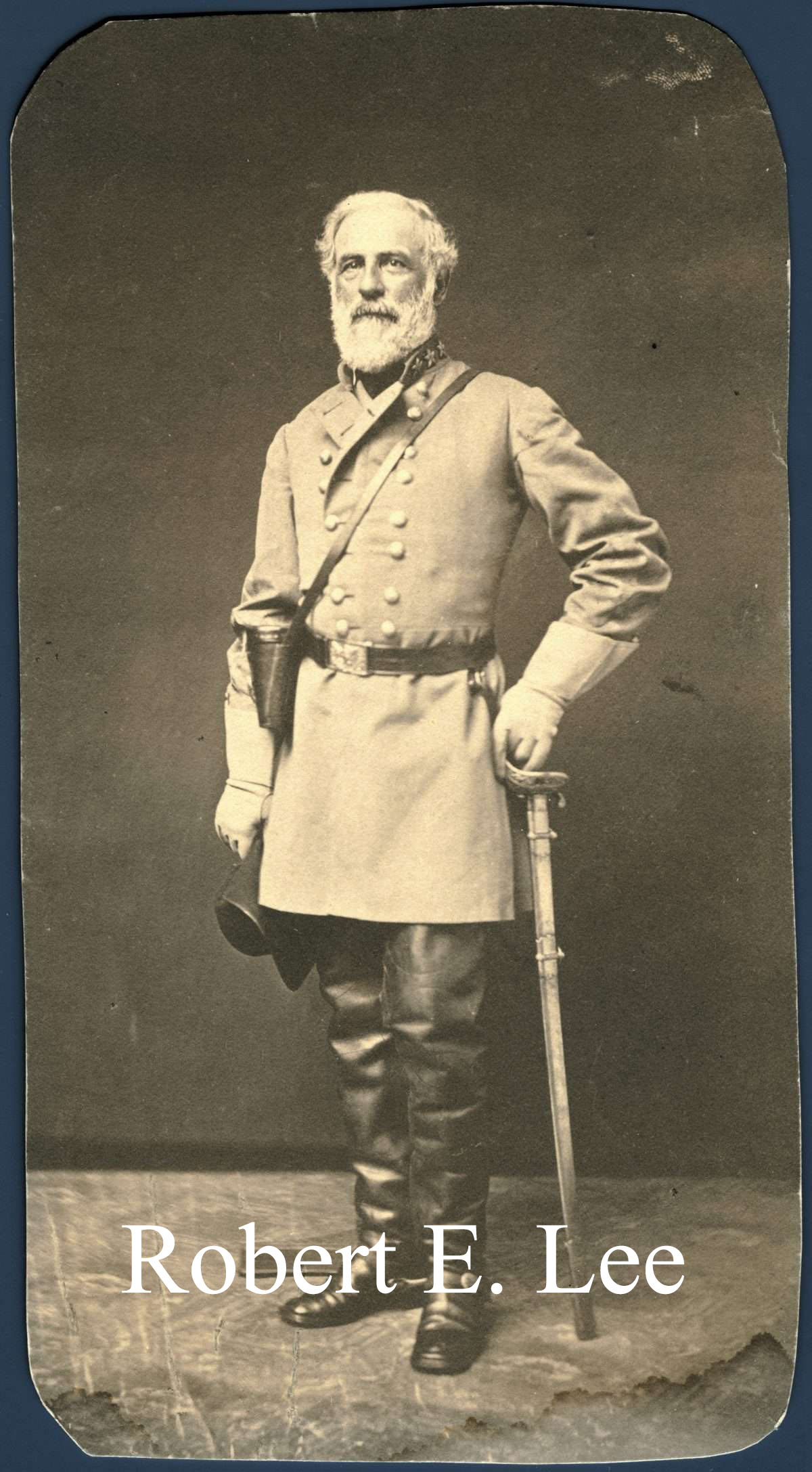
The most historically significant moment of the day occurred, when Joseph Eggleston Johnston, Commander of the Army of Northern Virginia, was struck in the right shoulder by a bullet. This was immediately followed by a shell fragment that hit him in the chest. He fell unconscious from his horse with a broken right shoulder blade and two broken ribs and was evacuated to Richmond, VA. Robert E. Lee took command of the Army of Northern Virginia in June of 1862.