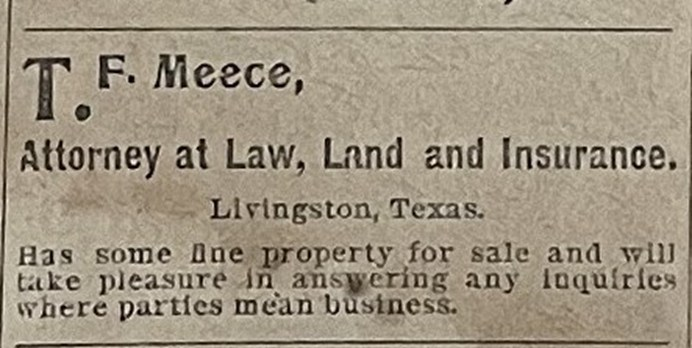
Following his various stints as a public servant T.F. sold insurance through numerous companies. He was also described as a real estate broker and abstractor. A real estate broker facilitates real estate transactions, like buying and selling homes, while an abstractor researches and summarizes the ownership history of a property to create an abstract of title. He was also labeled an attorney at law, land and insurance.
Intriguingly enough, T.F. represented the properties of William McLean Goodrich who was a wealthy New York land speculator from Poughkeepsie, New York. William McLean Goodrich moved to New Orleans, LA as a child in 1850. He eventually became a partner in a law firm that his father founded. He ultimately returned to Poughkeepsie, New York where he died on January 19th, 1881 at the age of 74.
In April 1881, the Houston, East & West Texas Railroad extended its line from Urbana in San Jacinto County, across the Trinity River and into previously unsettled timberland of Polk County, to a point approximately two miles from the river. The railroad contractor named this first Polk County railroad stop, Goodrich Station, in honor of William M. Goodrich, who owned the land. In the end, the town was named after him.
It is unclear how William and T.F. met each other. They could have met one another through his real estate business, his legal practice or possibly a contact with the Houston, East & West Texas Railroad. Who knows? I’ve attached a tribute to Goodrich, which was written in New Orleans:
Death of Wm. M. Goodrich:
One by one our old citizens fall by the way. Few men wore ever better or more favorably known to the citizens of New Orleans and the surrounding country than Wm. M. Goodrich, who departed this life at Poughkeepsie, N. Y., on the 19th last. More than half a century ago he became a partner in the firm which his father founded, in conjunction with Mr. Hyde, under the widely known name of Hyde & Goodrich, and which still exists in this city under the name of its successors, A. B. Griswold & Co. Mr. Goodrich was a consistent member of the Episcopal church and for a number of years a vestryman in the church over which his brother, Rev. Charles Goodrich, presided as rector. It was greatly owing to Mr. William Goodrich’s munificence that the congregation of St. Paul’s wore enabled to build their present handsome church structure on the corner of Camp and Gaiennie streets.
As a citizen, Mr. Goodrich took the liveliest interest in the welfare of this city, even long after it had ceased to be his place of his residence. As a merchant, he has passed off the stage of life without even the semblance of a stain on his commercial name. In the trying times of the great crash of 1837 the house became heavily involved, but came out of it all with flying colors and not a dollar of indebtedness unpaid. As a churchman, he bore an unblemished character and was always a great worker. It was while ministering to the enjoyment of a mission Sabbath school which he had established in his neighborhood, at a Christmas festival, that he took a severe cold, which terminated his life. He leave a wife and three daughters, to whom we tender our most heartfelt sympathies in their great bereavement.
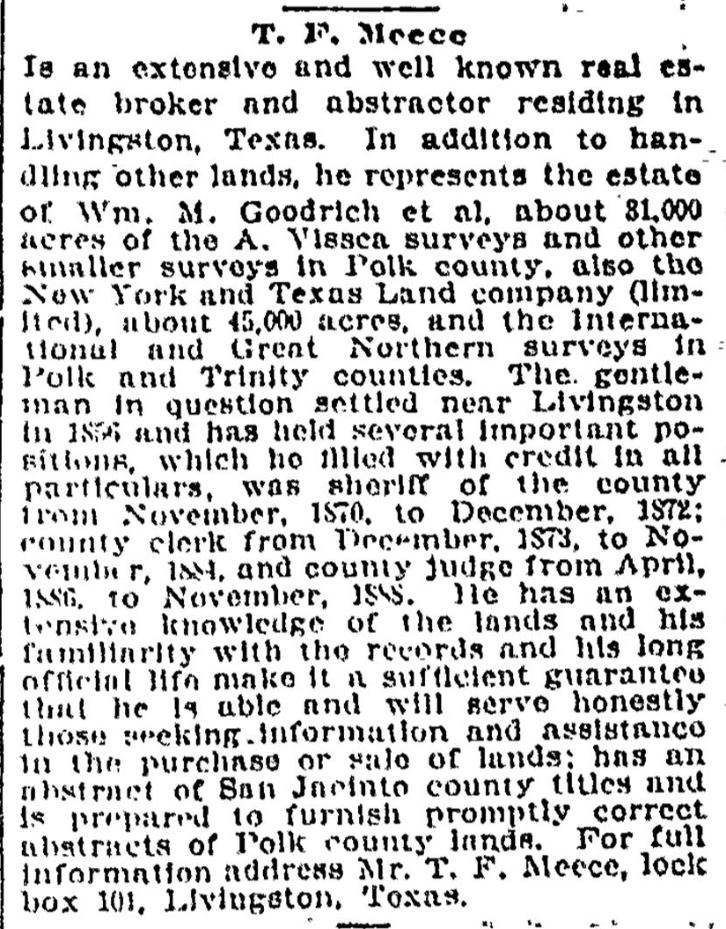
T.F. Also represented the New York and Texas Land Company. It was one of the largest privately financed land companies to operate in post-Civil War Texas. It was formed when all the land owned by the consolidated International-Great Northern Railroad Company was transferred from the Texas Land Company and deeded to (3) individuals in New York State. Perhaps, these three gentlemen had some sort of business relationship with William Goodrich. In addition to all of the local properties, T.F. had quite the real estate brokerage business.
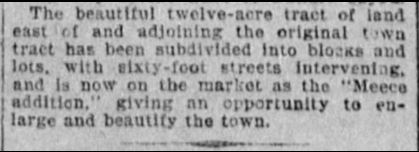
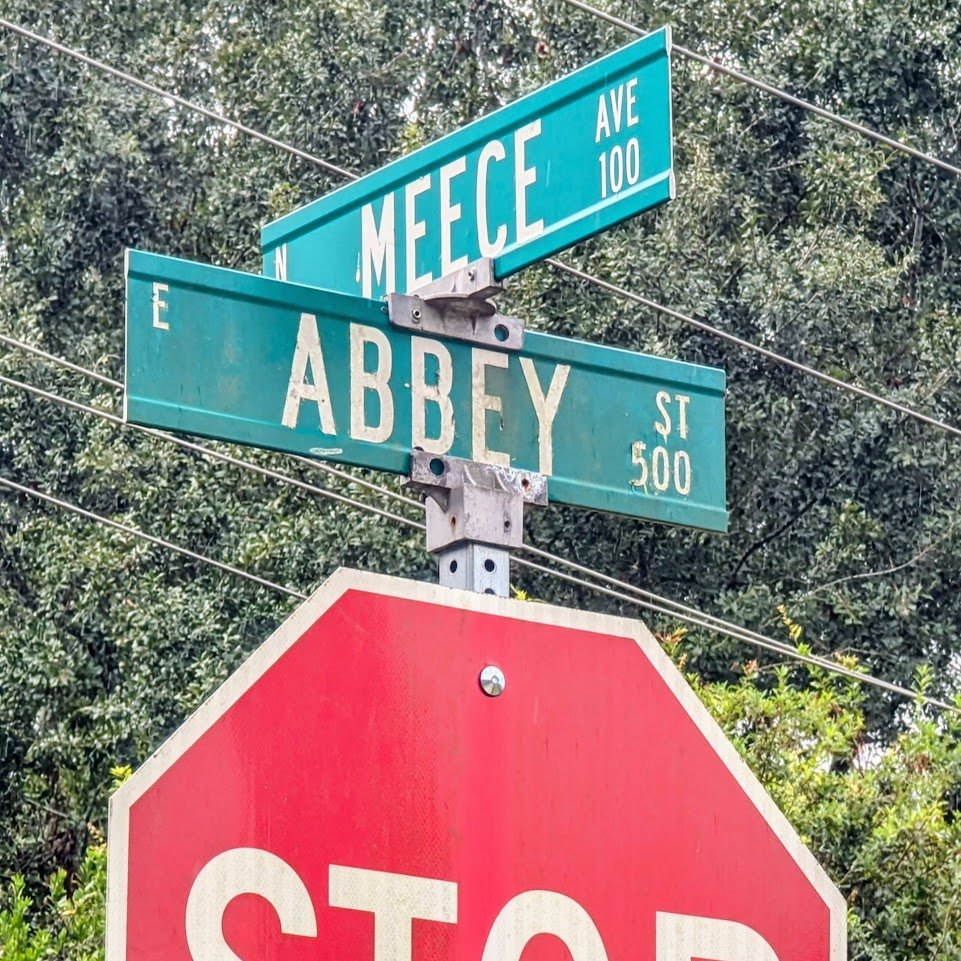
According to the attached article from the Houston Post dated March 19th, 1899 T.F. purchased this 12 acre tract with the idea of creating a subdivision called the Meece Addition. It exists today. We visited this area on Labor Day weekend of 2024. The neighborhood appeared a little sketchy. There is an old home on the corner that is advertised as a tattoo parlor. Gary Davis told me that at one time it was a nice neighborhood. He believed that the tattoo parlor was once a funeral home.
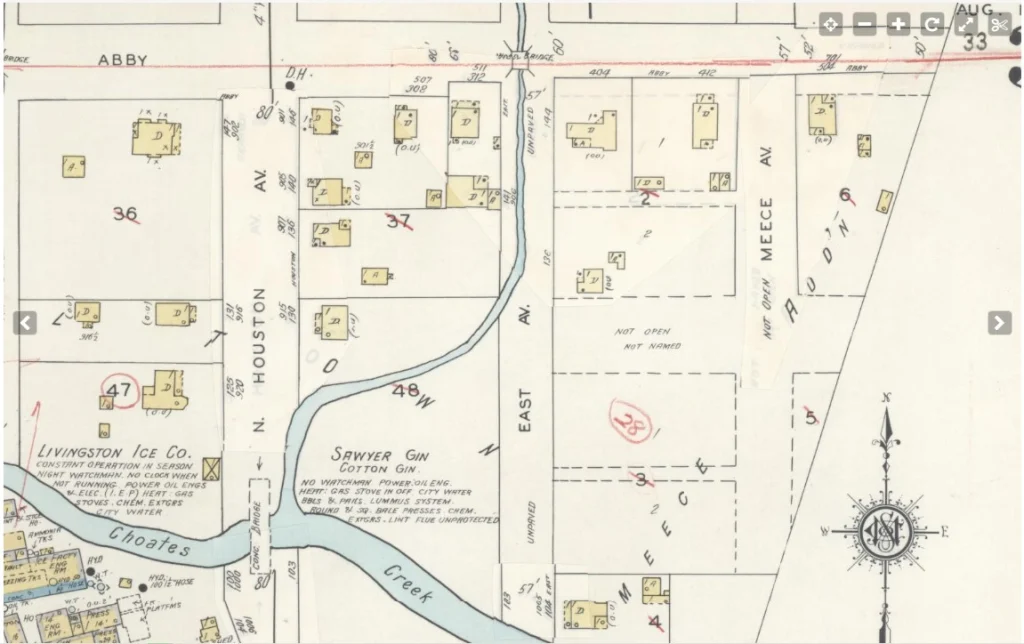
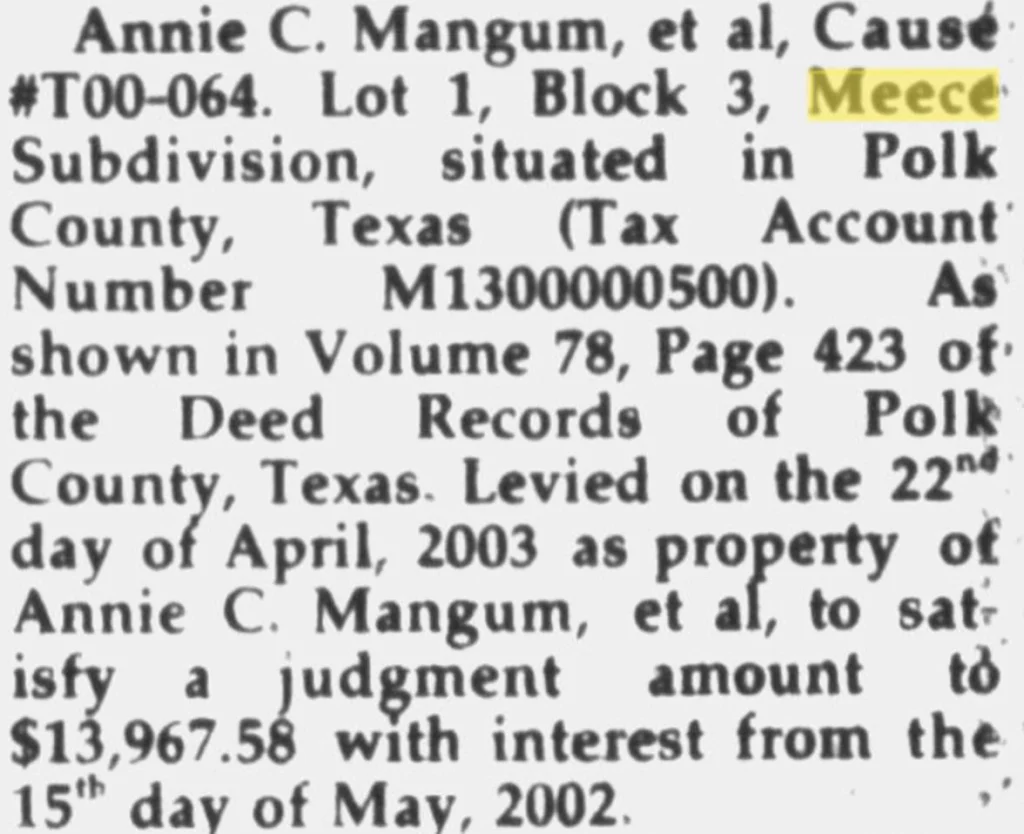
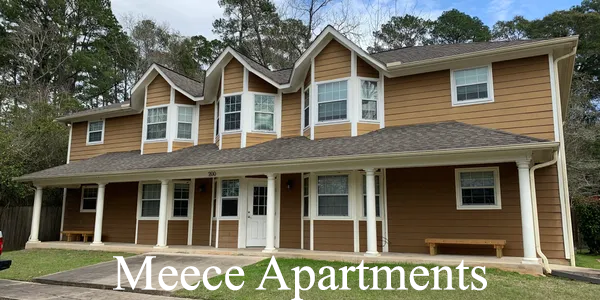
The Meece Apartments are located directly across from the tattoo parlor on Meece Avenue. The permit approving the construction of the Meece Apartments was approved by the Livingston City Council on 03/13/2008. I know absolutely nothing about the development of the Meece Addition. I found a newspaper article dated 05/11/2003 taking property from Annie C. Mangum et al, to satisfy a judgement against her in the amount of $13,967.58 with interest. This is Anne Corrine Meece, who was T.F.’s youngest daughter. She married a Mr. Thomas Milton Mangum. Annie passed away in 1954.
I had mentioned in an earlier narrative that T.F. had his own column, T.F. Meece’s Column, which was published in the East Texas Pinery. It was a weekly paper that was first published in the town of Moscow, TX. At one time Moscow was the largest town in Polk County. In its heyday, it boasted cotton gins, sawmills, saloons, a hotel, a food cannery and an architectural column factory among other businesses and shops. Moscow actually had a mule-drawn streetcar that transported people from the business district to the railroad depot.
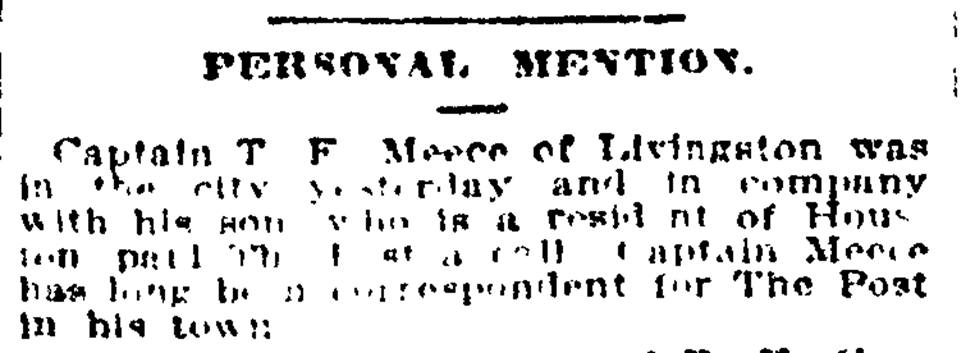
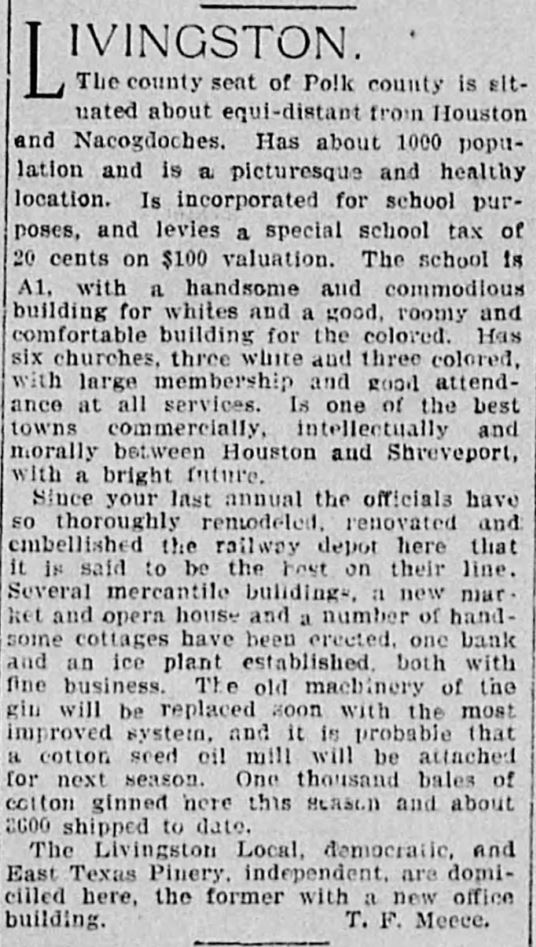
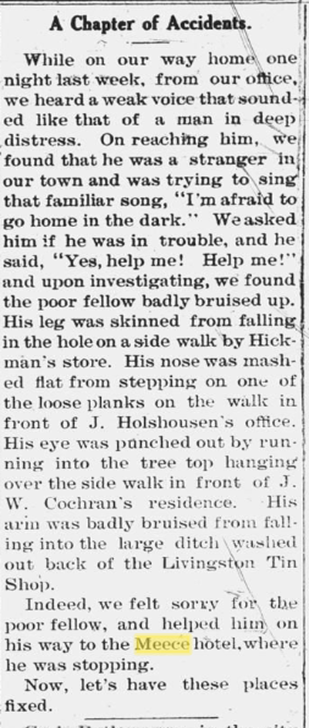
Additionally, T.F. became a local correspondent for the Houston Daily Post. He quite likely had articles printed in various regional papers such as the Dallas Times Herald, Dallas Morning News and the Galveston Daily News or Galveston Tribune. There was always something written about or by him in the Polk County Enterprise. I’ve included an article he wrote promoting the City of Livingston. It will make you want to move there.
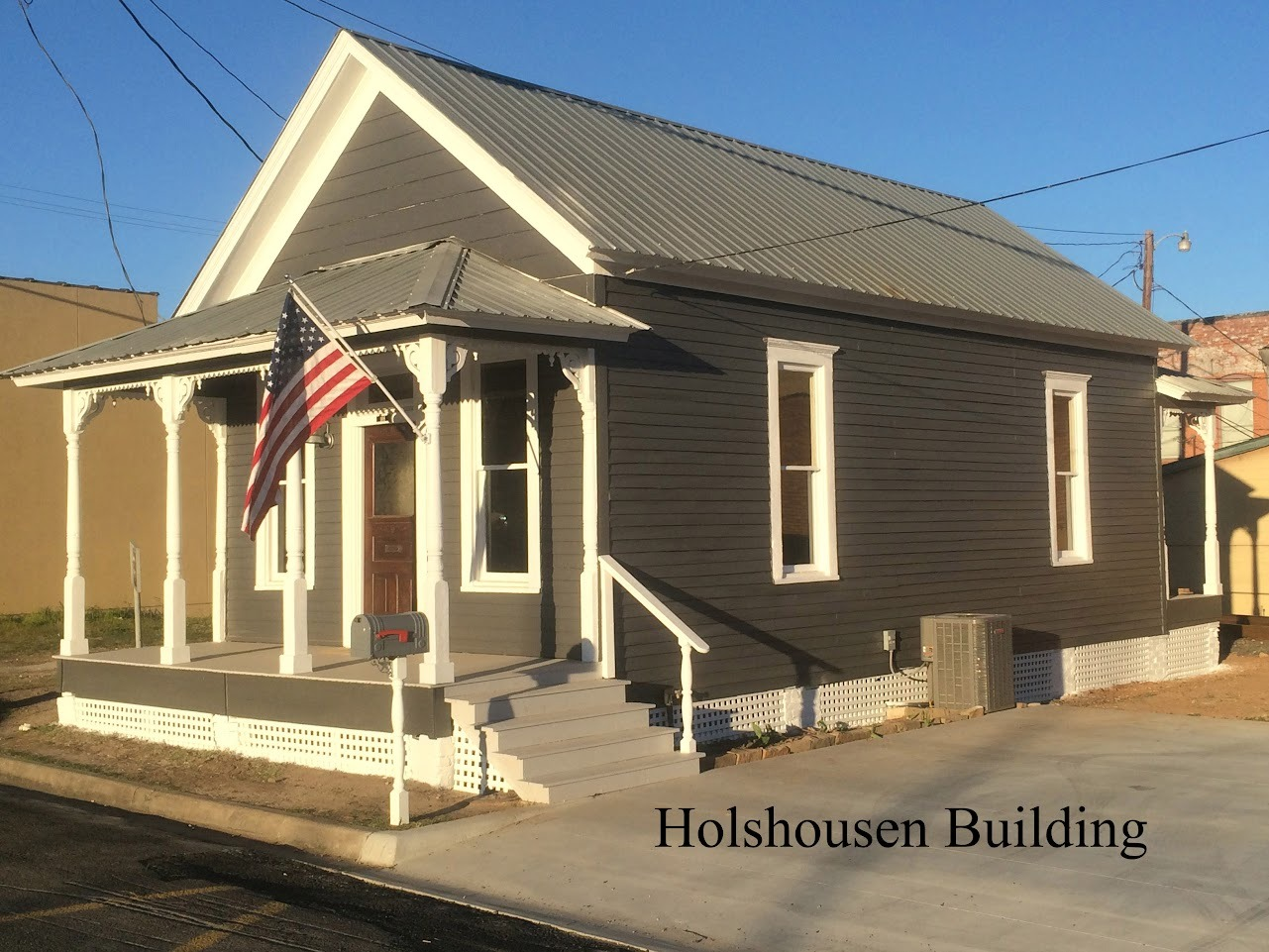
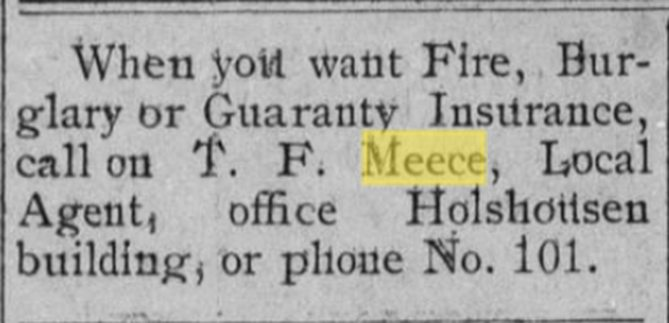
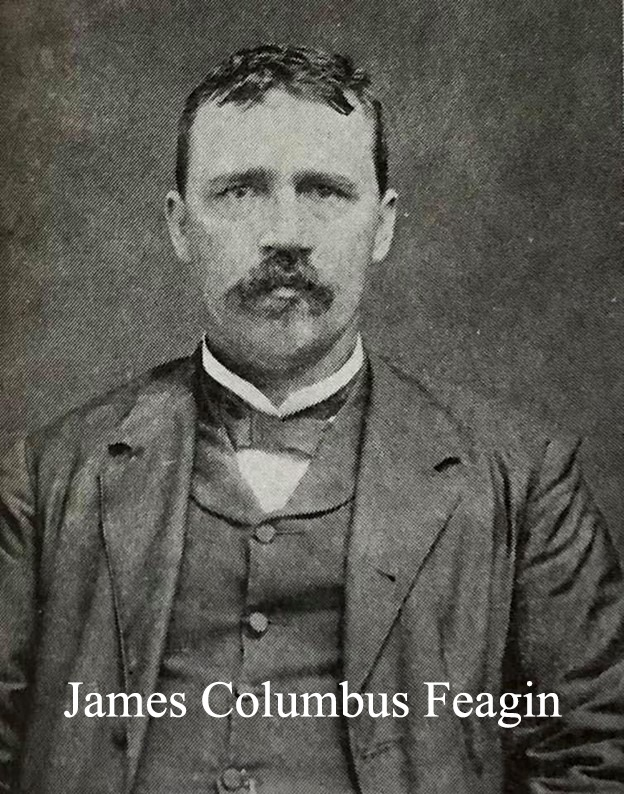
As a businessman, T.F. operated out of the Holshousen building. Claiborne Holshousen’s son Joseph was a native of Polk County, born Aug. 11, 1849. He was educated in Lexington, Kentucky. After serving as county attorney, Joe became a lawyer in February of 1871 and he was a member of the law firm of Feagin & Holshousen. He went on to open his own firm and eventually formed a legal partnership with S.H. German.
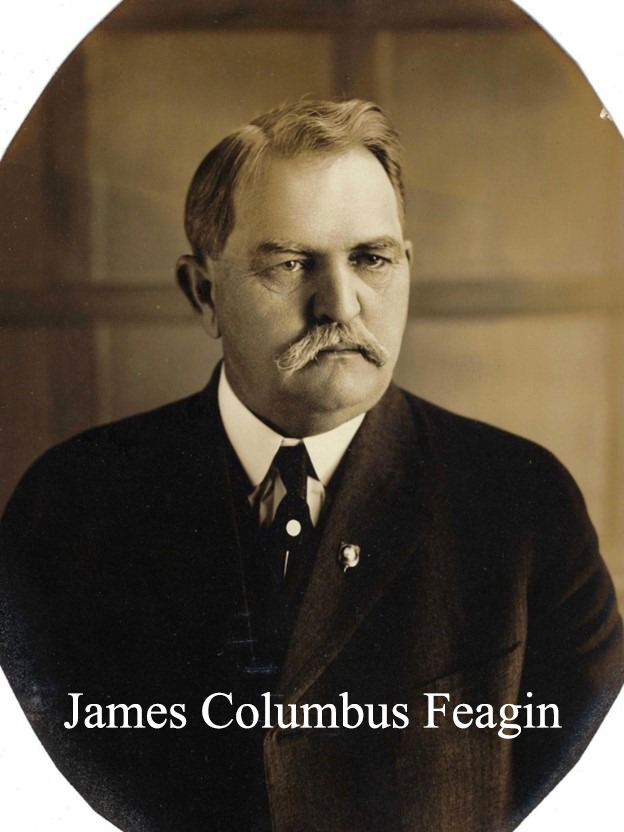
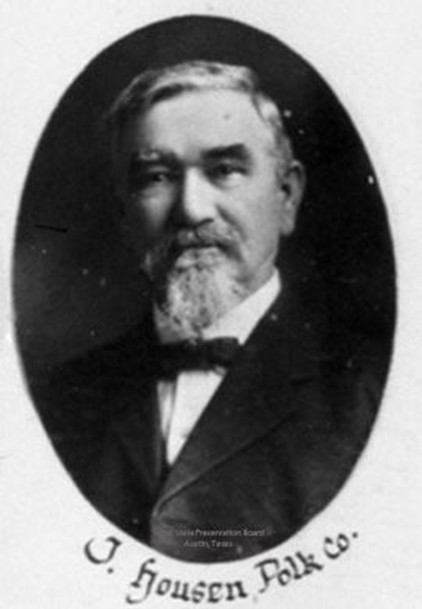
He was also trained in civil engineering and ultimately became a very prominent public figure in Polk County. He served on the school board, city council, and as county surveyor from 1870 to 1872. In 1878 he was elected county judge, a position that his father had held in the 1840s. Joe resigned from his first term, but he served another term from 1878 to 1882 and a third term from 1898 to 1902. In 1906 he was elected to the 31st Texas State Legislature. He also served as a member of the Board of Directors for Citizens National Bank of Livingston and he was a Vice-President of the First National Bank. He died on April 7th, 1915 at the age of 65.
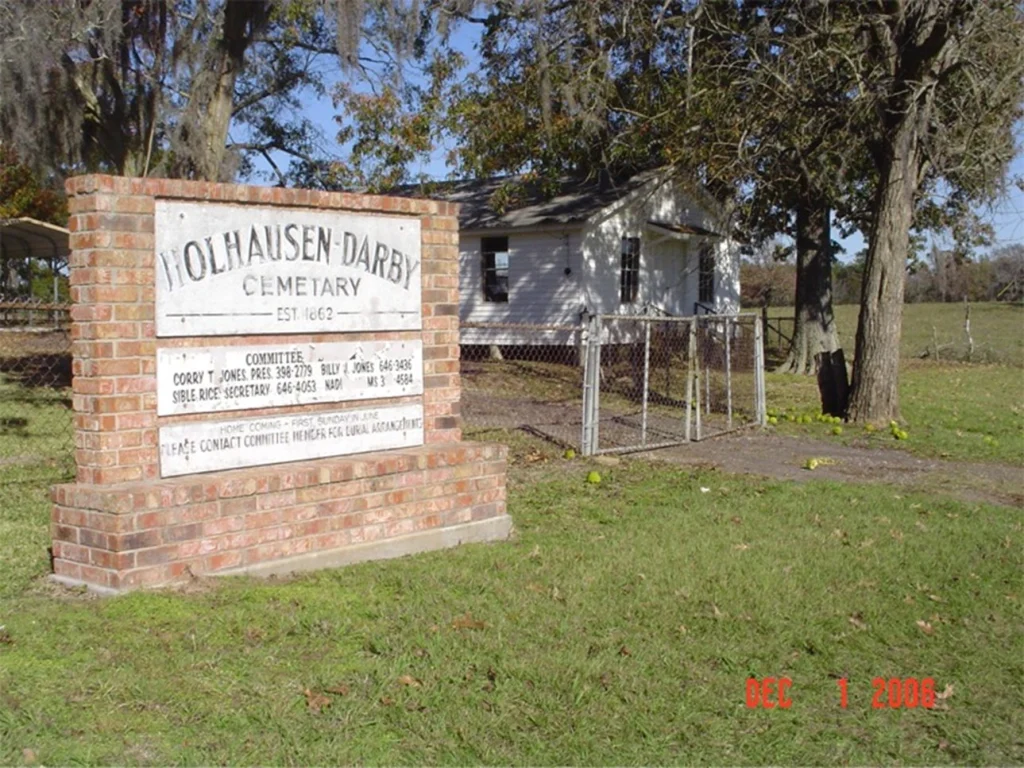
His father Claiborne was famous in his own right. He was a veteran of the Texas Revolution, and he was one of a group of men instrumental in organizing Polk County in 1846. He became the County’s first Chief Justice (County Judge). He died on April 25th, 1889 and he is buried in the Holhausen Darby Cemetery. Don’t ask??? You would think that they would have gotten the spelling correct when the cemetery sign was first installed.
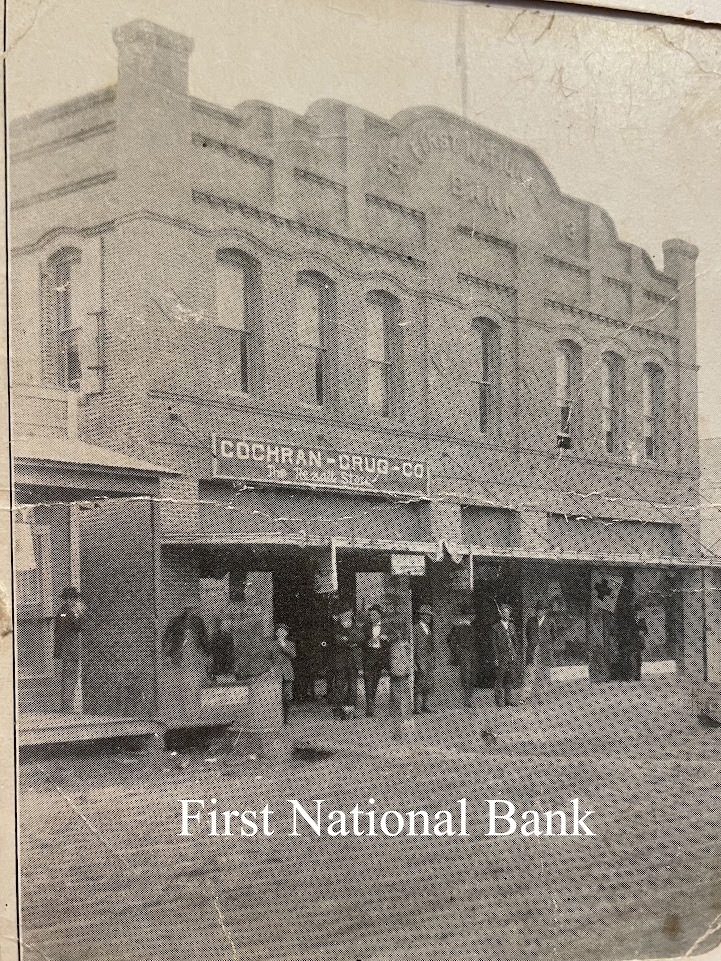
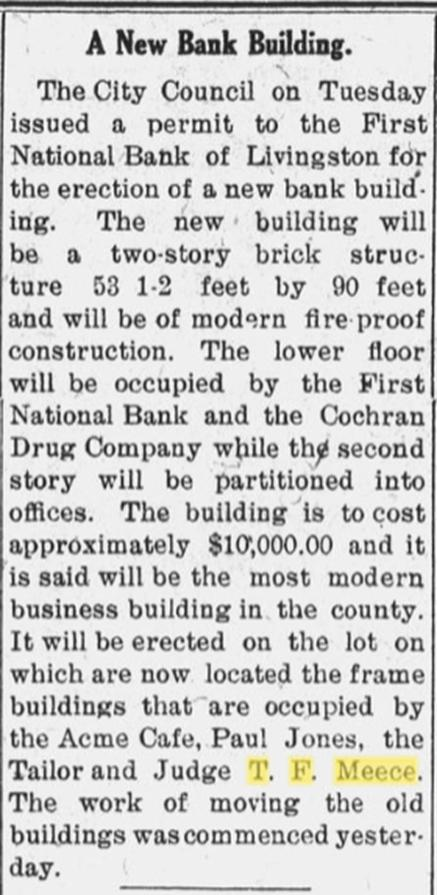
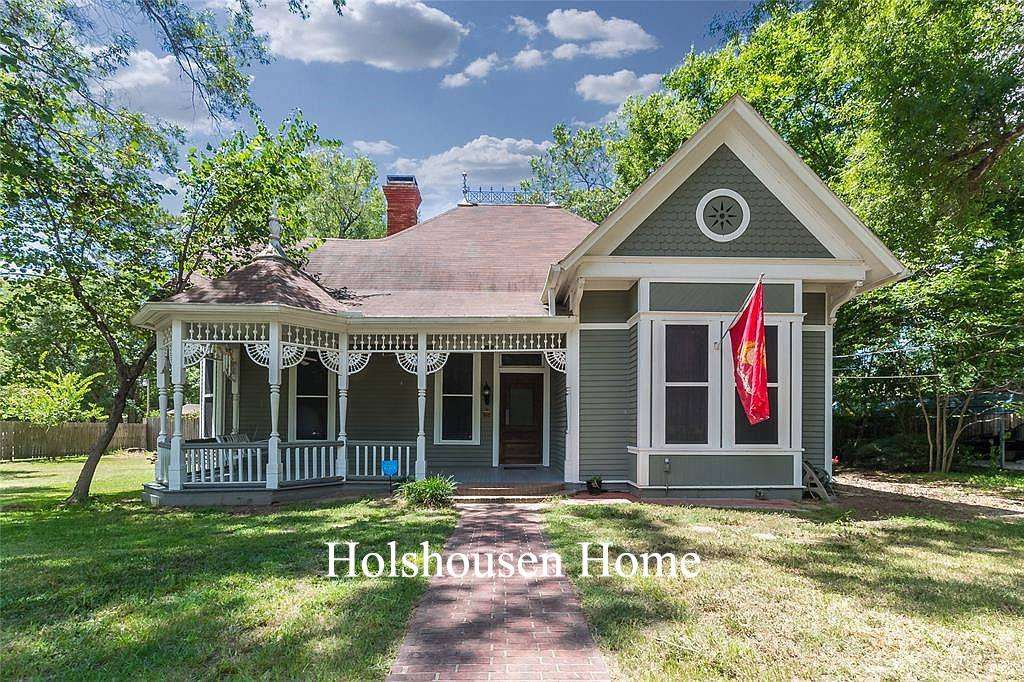
It is believed that Joe operated out of his namesake building as well. At that time the Holshousen Building, which still exists today, was located on Block #15 Lot#3. In the attached article entitled “A New Bank Building”, which was dated 07/13/1913 the Holshousen Building was being moved to make way for a new bank building. The Holshousen Building is currently located at 408 N Jackson Avenue. Amazingly enough Holshousen’s home is still intact. The house was originally located at 721 N Beatty, but it was moved to its present location, 725 Oakhurst, by rolling it on pine logs.
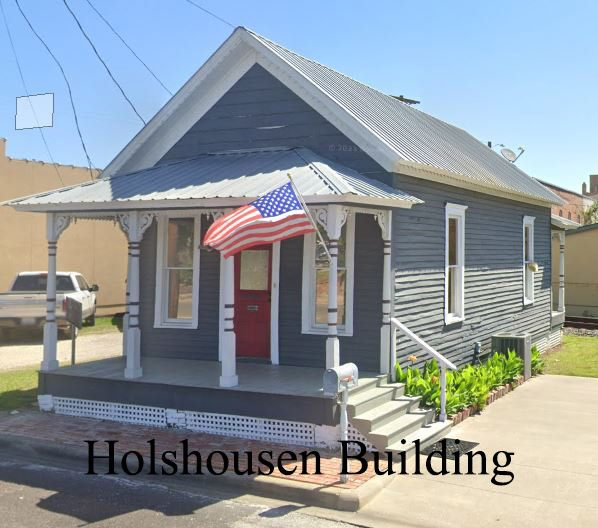
The Holshousen Building was remodeled by and is currently owned by local historian, Mr. Gary Davis. He’s done a wonderful job. The City of Livingston and Polk County should be grateful to Gary for the restoration and preservation of a building that has such cultural and historical significance. Unfortunately, kids today have little interest in history and tangible links to the past.
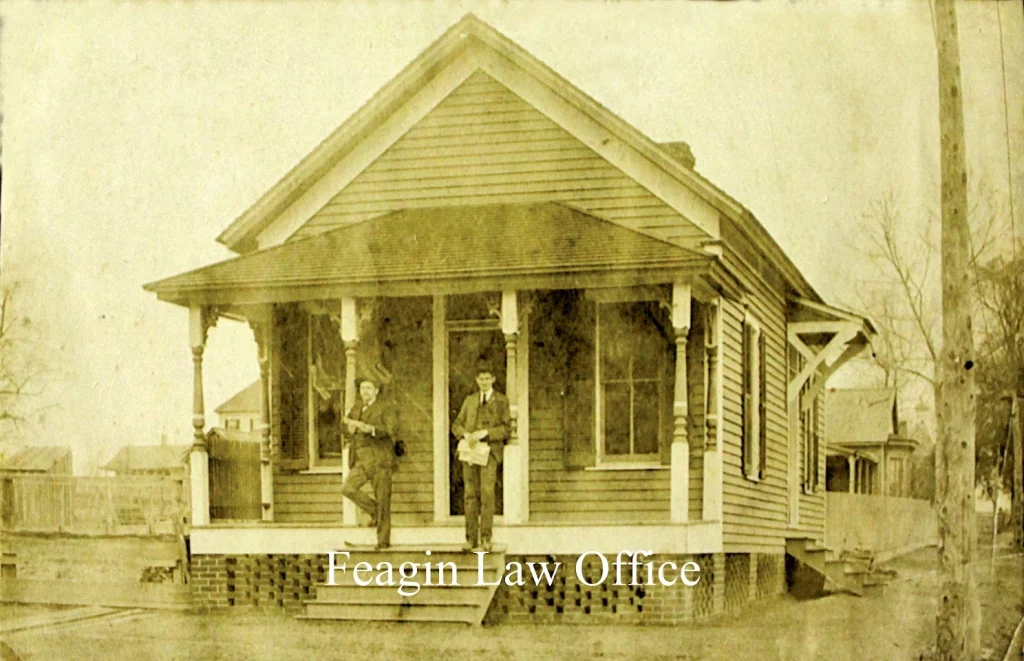
A very similar, if not identical building, was the building housing the law practice of J.C. Feagin. Holshousen and Feagin were once law partners. Feagin’s building was located on Block #4. If I’m not mistaken, that’s Feagin on the front porch. According to Gary, these buildings were built after the 1902 fire, they did not have bathrooms and they each contained two offices that are mirror images of one another with two identical porches, front and back.