The Long Journey Home
Terms of Surrender
Headquarters Armies of the United States
Appomattox C H Va Apl 9th 1865.
Gen. R. E. Lee,
Comd’g C. S. A.
General,
In accordance with the substance of my letter to you of the 8th inst., I propose to receive the surrender of the Army of N. Va. on the following terms, to wit;
Rolls of all the officers and men to be made in duplicate, one copy to be given to an officer to be designated by me, the other to be retained by such officer or officers as you may designate. The officers to give their individual paroles not to take up arms against the Government of the United States until properly exchanged, and each company or regimental commander to sign a like parole for the men of their commands.
The arms, artillery, and public property to be parked and stacked and turned over to the officers appointed by me to receive them. This will not embrace the side-arms of the officers nor their private horses or baggage. This done officers and men will be allowed to return to their homes, not to be disturbed by the United States authority as long as they observe their parole and the laws in force where they may reside.
Very respectfully
U. S. Grant
Lt. Gen
Some soldiers never returned home. They resettled wherever the winds would take them. Some, fearing arrest or prosecution, fled the country. Some used the time to see the country. They traveled north to visit Washington DC, New York, Baltimore, the Natural Bridge, etc. Some curiously wanted to visit the trenches constructed by the Union during the Siege of Petersburg. Most wanted to go home. All grappled with the transition from military to civilian life.
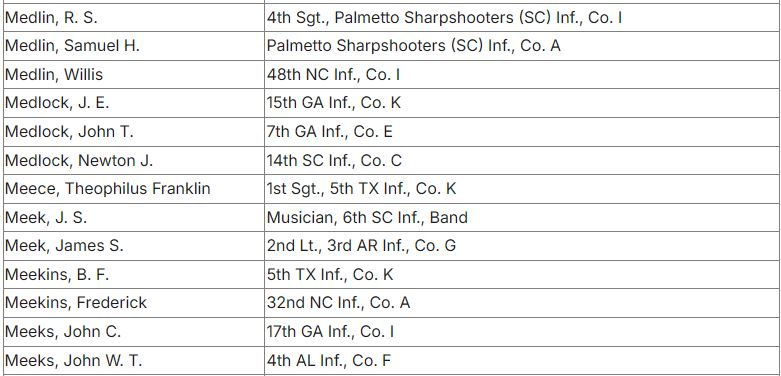
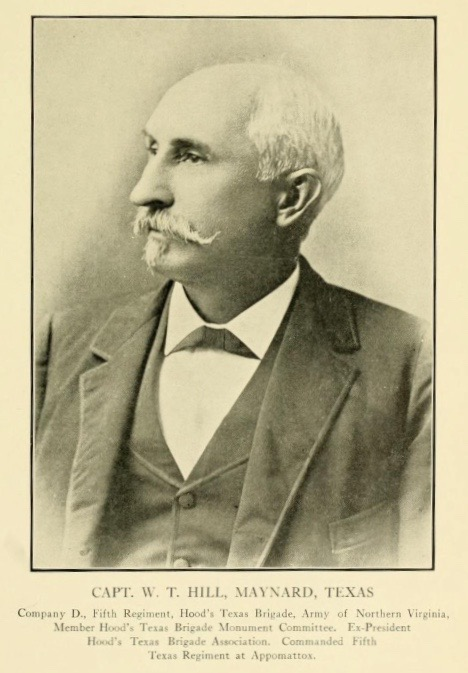
The Civil War was over. It was time for Theophilus Franklin (T.F.) Meece and his fellow Texans to head home. T.F. wrote in one of his many biographies, “surrender returned home via New Orleans-Galveston in June, 1865”. Captain William Traylor (W.T.) Hill, who served in Company “D”, commanded the 5th Texas Infantry Regiment. He was promoted to captain on August 23, 1862. He initially served as a 1st lieutenant under Captain Robert M. Powell in Company D. He was wounded at Gettysburg and again at the Wilderness. He was paroled at Appomattox on April 12, 1865, as Commander of the 5th Texas Infantry Regiment. Major William H. “Howdy” Martin, who served in Company “K”, commanded the 4th Texas Infantry Regiment. Together, they would lead approximately 300 soldiers home to Texas.
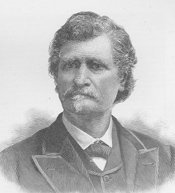
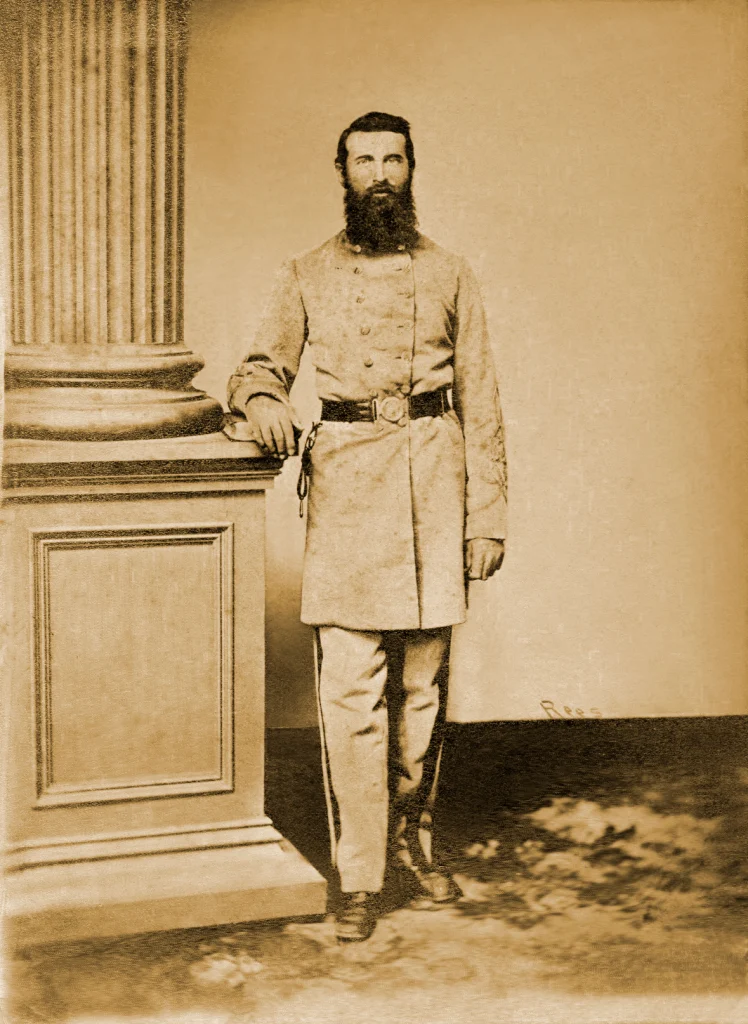
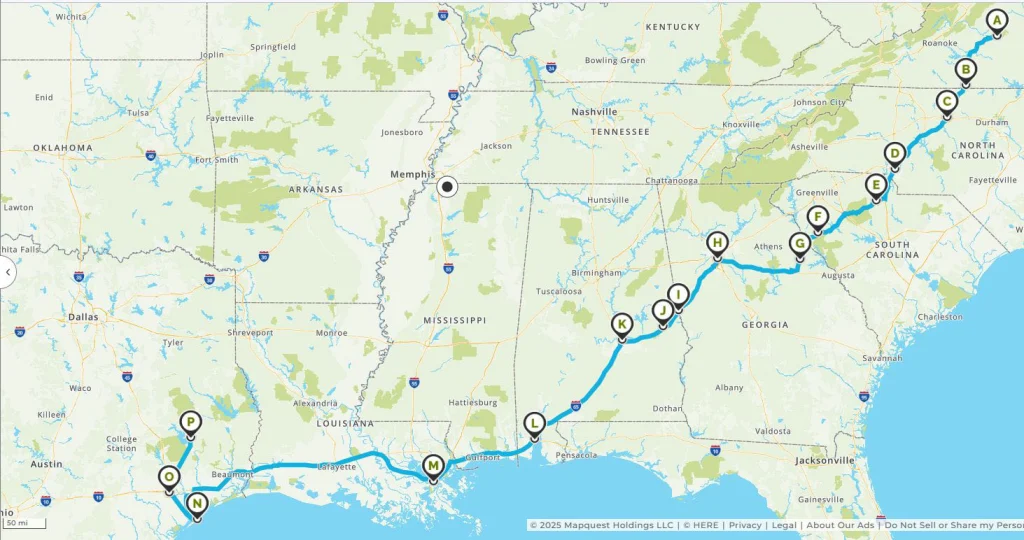
The intent was to travel by train from Danville, VA, through Morgantown, WV and on to Atlanta, GA. These plans were waylaid by the destruction of tracks by Federal troops, at many different places, along that route. I didn’t realize this, speaking of Morgantown, WV, but West Virginia did not become a State until June 20th, 1863. West Virginia was a part of Virginia but broke away after Virginia’s secession vote to leave the Union.
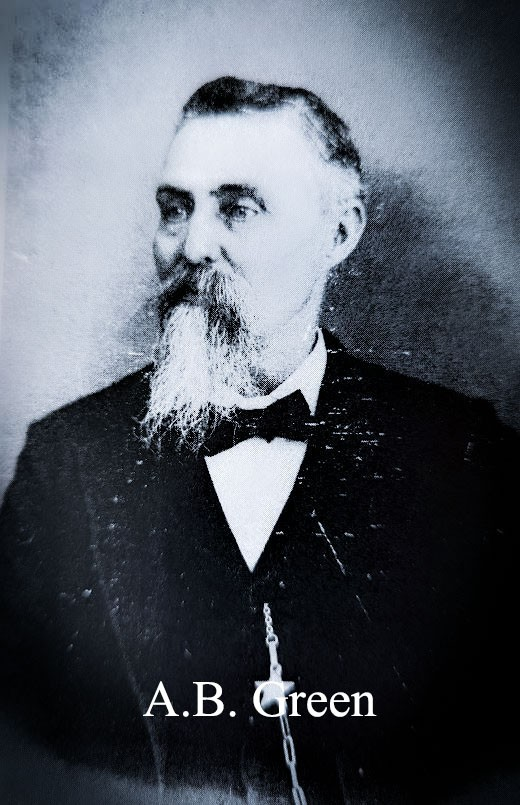
The Texans departed for Danville, VA on Thursday April 13th, 1865. The distance between Appomattox and Danville was approximately 88 miles. T.F. was very familiar with this area. When he returned from Texas to join his company T.F. wrote “On my way back I walked nearly 300 miles before reaching transportation and had to walk from Danville, Va., to Petersburg after defending the railroad bridge across the Staunton River.” On the 14th they reached Nowlan’s Mill, a grist mill located on Falling Creek, which was basically due north of Danville. Clean water and corn meal were plentiful, so they remained there the rest of the day. This also allowed any stragglers or injured soldiers to catch up to the main body. The group soon realized that traveling in such large numbers would make finding food and suitable campsites very difficult. A number of small groups, including A.B. Green, splintered off and went their own way.
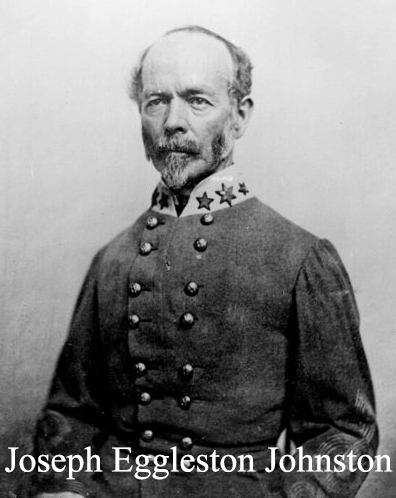
Once they departed Danville, they travelled to Greensboro, NC, which was approximately 45 miles away. Outside of Greensboro they met a group of Texans, from the Army of Tennessee, that had just surrendered to General William T. Sherman at Durham Station. It was called the Bennett Place Surrender, which was the largest surrender of Confederate troops in the war. General Joseph E. Johnston surrendered his army to General William T. Sherman there on April 26, 1865. A member of this group was Moses B. George who was familiar to some of the troops of Appomattox. He was the General Hood’s Quartermaster in Virginia. Surprisingly enough, he still had his cow, which he had brought with him at the onset of the war in 1861. Even more astonishingly was the fact that it was still producing milk. The Texans were thankful for that.
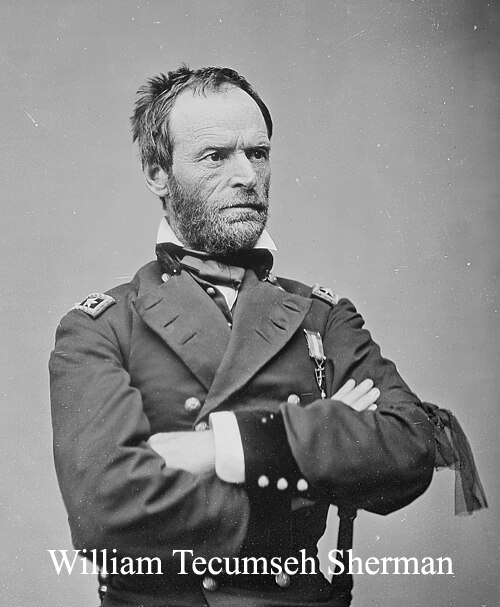
Next, it was on to Charlotte, NC, which was approximately 92 miles away. When the Texans reached Charlotte, just as they had in Danville & Greensboro, the Confederate soldiers raided Confederate warehouses. Once they arrived in Charlotte they discovered that President Jefferson Davis, John H. Reagan, Postmaster General of the Confederacy, and other members of the Congress and Cabinet were there. Reagan was also appointed Secretary of the Treasury towards the end of the war. Major William H. “Howdy” Martin, as senior officer of the Texans provided the Confederate officials with details of the surrender at Appomattox.
Martin also advised the group that he had an ample number of blank Federal parole forms in his possession. A portable printing press was set up at Appomattox and almost 30,000 parole passes were printed. Some of the parole slips for high-ranking Confederate officers were signed by U. S. Army officers, but slips for most Confederate soldiers were signed by their commanding officers. Reagan requested a sufficient number of parole forms to distribute them to the Confederate officials.
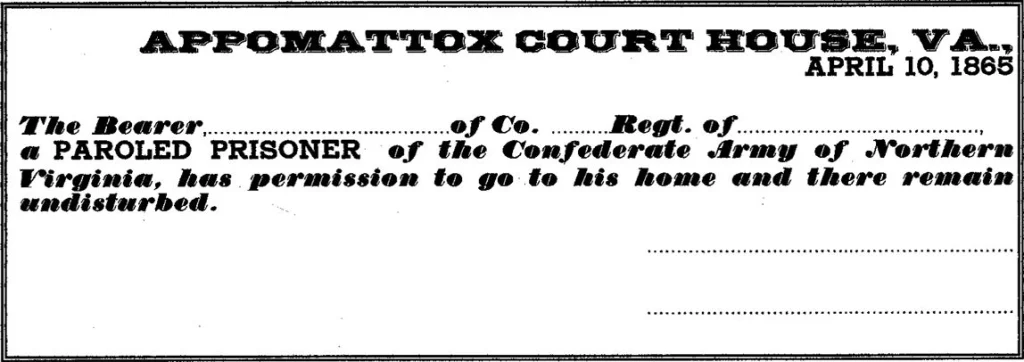
Among those who received a blank Federal pardon form was Louis T. Wigfall. He was a Senator from Texas who was appointed, a political appointment to be sure, to command the Texas Brigade of the Army of Northern Virginia at the outset of the war. He was replaced by John Bell Hood. Not only was he credited with Sam Houston’s defeat for the governorship of Texas in 1857, he also carried on public and conspiratorial campaigns to strip President Jefferson Davis of all power and influence. He reportedly masqueraded as a Private during his return to Texas.
Stephen Mallory was another Cabinet member to receive a parole form. Mallory was the Secretary of the Navy for the Confederate States of America during the Civil War. He served in President Jefferson Davis’s cabinet from 1861 until the end of the war in 1865. He and several of his colleagues in the cabinet were imprisoned and charged with treason. President Andrew Johnson would eventually grant him parole and he returned to Florida. According to the terms of his parole, he was not allowed to hold elective office.
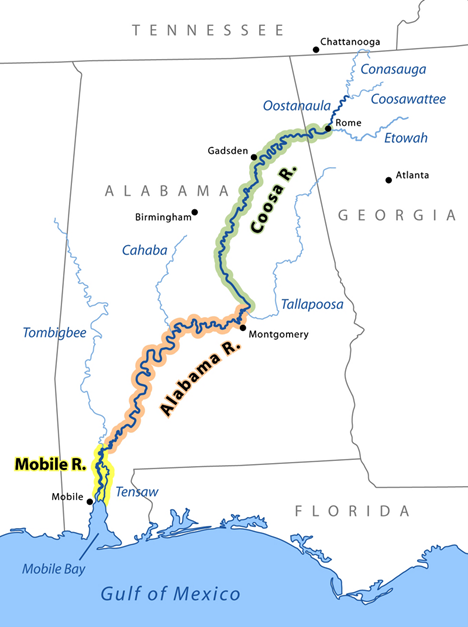
The Texans would continue their trek through Chester, SC, Abbeville, SC, Washington, GA, Atlanta, GA, West Point, GA, Auburn, AL and finally to Montgomery, AL. A portion of Hill’s group would arrive in Montgomery on Sunday May 7th, 1865, roughly (24) days from when they departed Appomattox. (400) plus Texans would arrive over the course of the next week. The troops were assigned temporary quarters in a large two-story building just outside of downtown Montgomery.
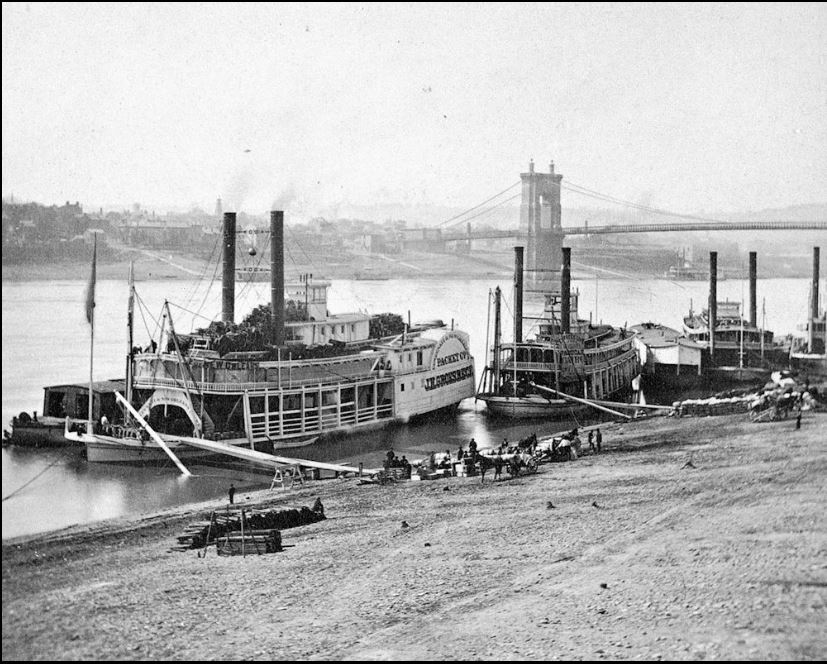
On Thursday May, 11th 1865 the men boarded the steamer Groesbeck. The steamer was fully loaded with supplies from Mobile, so the soldiers had to unload the vessel before departing to Mobile. To their dismay the Texans were ordered ashore at Selma, AL, by Union officers, to make space for a regiment of United States Colored Troops (USCT). “We protested, of course, and bitterly, against what some of our men denounced as a regular ‘Yankee trick,” wrote Captain W.T. Hill of the 5th Texas, “but our protest was unheeded, and we had to wait at Selma until the next day.”
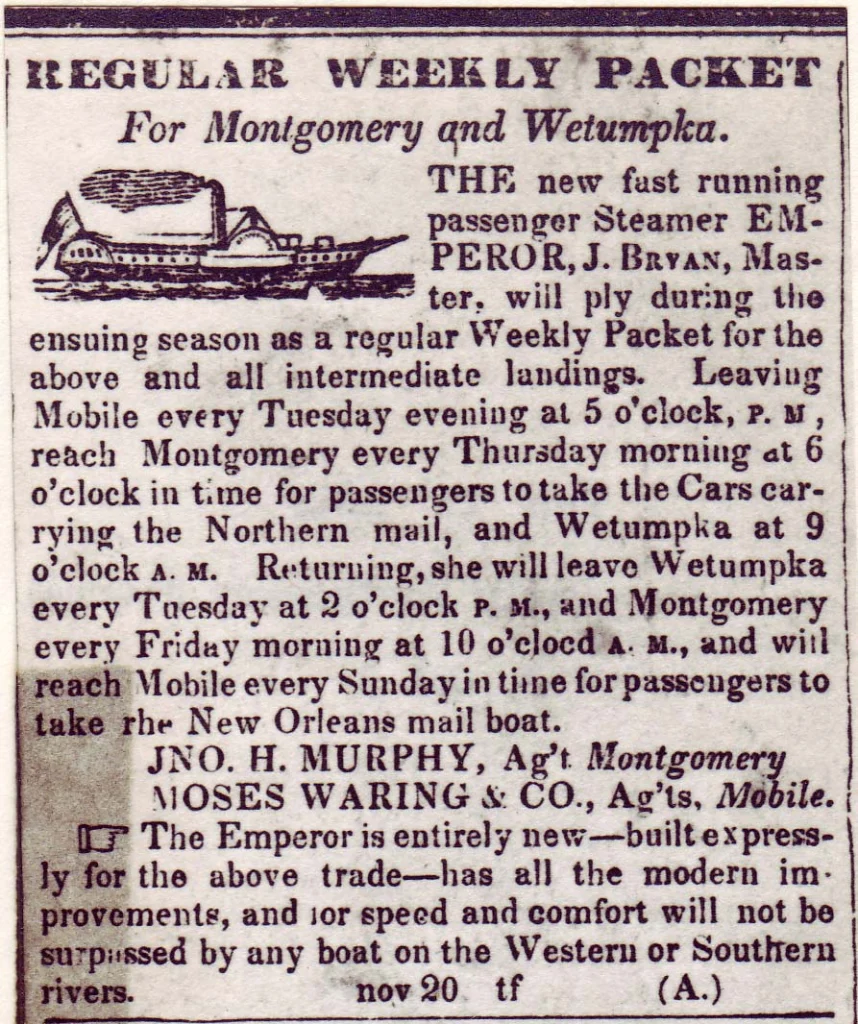
After a second days layover, the Texans boarded the steamer Lockwood and proceeded to Mobile, AL. After the Civil War, the Steamer Lockwood was involved in a significant disaster on the Mississippi River (see article).
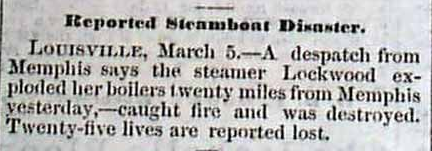
Explosion and Sinking: On March 7, 1866, the steamer Lockwood exploded and burned about eighteen miles below Memphis, Tennessee. Twenty people were killed and twenty-five injured in the incident. The steamboat was valued at $60,000 and was not insured.
Less than a year earlier, on April 27th, 1865, the boilers on the steamboat Sultana exploded and the boat sunk. The Sultana was transporting 1,950 paroled Union prisoners of war from the notorious Confederate prison Andersonville. 1,195 of the 2,200 passengers and crew died. The steamboat was only designed to hold 376 people. To this day, it is the deadliest maritime disaster in U.S. history. Unfortunately, the news of the disaster was overshadowed in the press by the end of the Civil War, the assassination of President Abraham Lincoln and the killing of his assassin, John Wilkes Booth, just the day before.
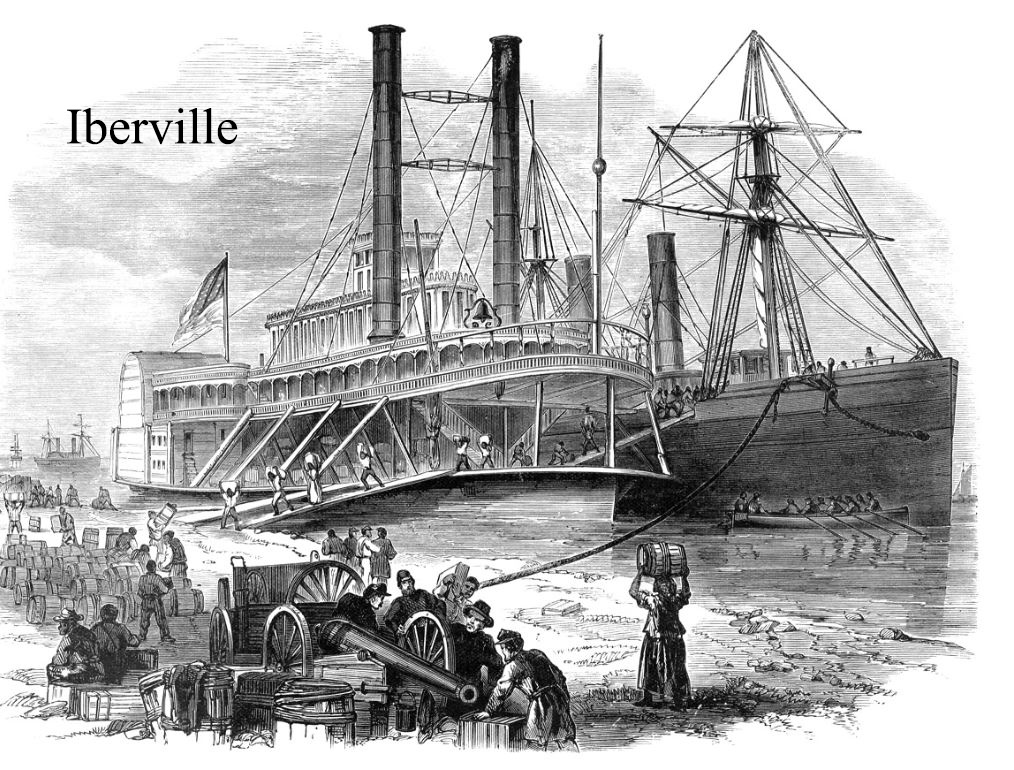
Once they arrived, the Texans enjoyed (5) relaxing days in the city. On Thursday May 18th, 1865 they departed Mobile for New Orleans on the steamer Iberville (see photo at the top of page). The Iberville almost capsized on Lake Pontchartrain but the Texans arrived safely in New Orleans the following day.
The Iberville, a sidewheel packet boat, was built in New Albany, Indiana in 1859 at the Humphrey & Dowerman Shipyard. Most famously, the steamboat Robert E. Lee was built there in 1866. I worked at Jeffboat Shipyard in Jeffersonville, IN, which is only (6) miles from New Albany. I never realized that there was a shipyard in New Albany. The Iberville was seized by the Union during the Civil War and pressed into service as a transport vessel. The Iberville experienced several encounters during its service as a Union transport, including running the gauntlet of Confederate batteries and guerrilla attacks. Later in the war, during the 1863 Siege of Port Hudson (Louisiana), the Iberville served as a hospital ship. After a fire, the Iberville was laid up in New Orleans in 1866. The Iberville was rebuilt and continued to operate, primarily on the New Orleans-Bayou Sara route. Bayou Sara is located on the Mississippi River, north of Baton Rouge.
As soon as the Texans departed the vessel they were met by the local Provost Marshal. During the Civil War, the Provost Marshal served as the Union Army’s military police, responsible for maintaining order among soldiers and civilians. They were placed in a large cotton shed with no amenities for nine days. While there, the Texans were guarded by USCT (United States Colored Troops) troops. The USCT soldiers attempted to forcibly cut the brass CSA (Confederate States of America) buttons from the Texan’s shirts. The Texans either removed or concealed the buttons themselves. Considering the circumstances, it had to be a very humbling and humiliating experience. You couldn’t think of a worse way to begin Reconstruction. If the loss of the Civil War hadn’t sunk in, I’m certain that it did that particular day. Captain Hill felt that “it was a slight that was intentionally demeaning.”
On Monday May 29th, 1865 the Texans boarded the steamer Hendrick Hudson on their final leg home. On Tuesday May 30th the Hendrick Hudson ran aground at the mouth of the Mississippi River, otherwise known as the Head of Passes. Sedimentation has always been an issue there. The Corps of Engineers keeps a dredge or dredges there on a regular basis to keep the channel at a 45’ depth. The Texans were stranded there for two days, in their cramped quarters, while two tugs attempted to refloat the steamer. On Wednesday May 31st another steamer by the name of “Exact” picked up the stranded passengers. It was described as a filthy, poorly maintained transport. The heat, humidity and the stench forced the men out of the ship’s hold and on to the deck. That sudden movement and shift in weight to one side of the vessel almost caused it to capsize.
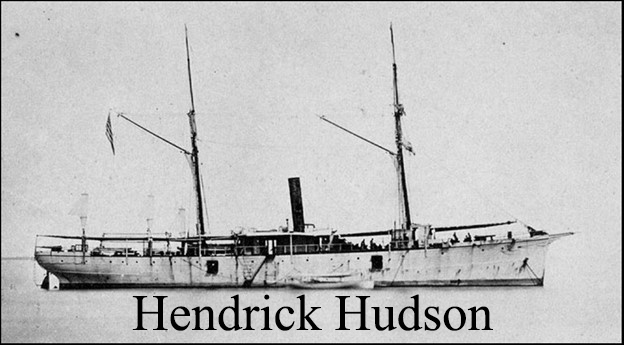
Keep in mind, these vessel were smaller than a standard river barge. A standard hopper barge is either 195′ or 200′ in length and 35′ wide. The hull is rectangular and flat. The beam of the steam-powered propeller ships was narrower and the shape of the hull included round-bottom displacement hulls or V-shaped planing hulls. This would have certainly affected the stability of the vessel it were overloaded to one side or the other. These vessels were designed to operate in the open waters of the Gulf of Mexico, yet they were small enough to operate on the inland waterways.
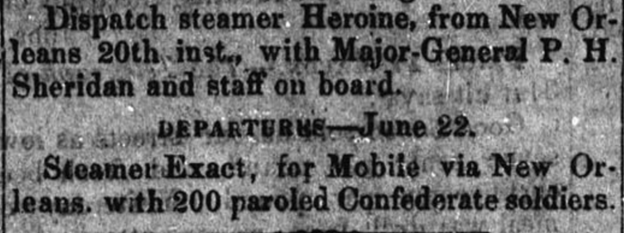
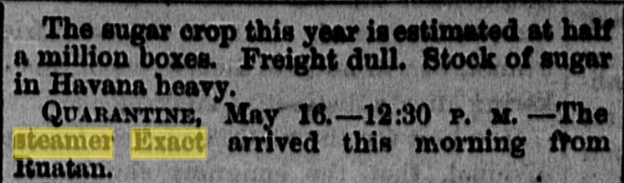
The New York Times had an article that stated “The schooner Saragaway has arrived at Quarantine from Ruatan, with twenty-seven passengers of the wrecked steamer Exact.” The following “Camp & Field” articles are part of a series of 78 columns published in the Holmes County (Ohio) Republican newspaper between February, 24 1881, and August 17, 1882. The articles were written about 20 years after the Civil War by Cpl. Theodore David Wolbach of Company E. Unfortunately, I was unable to find a photograph of the Exact. I’m assuming that it was a vessel similar in style to the Hendrick Hudson.
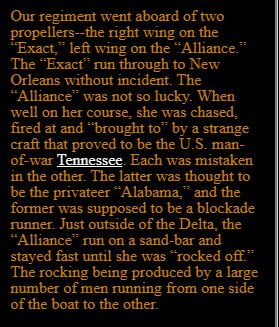
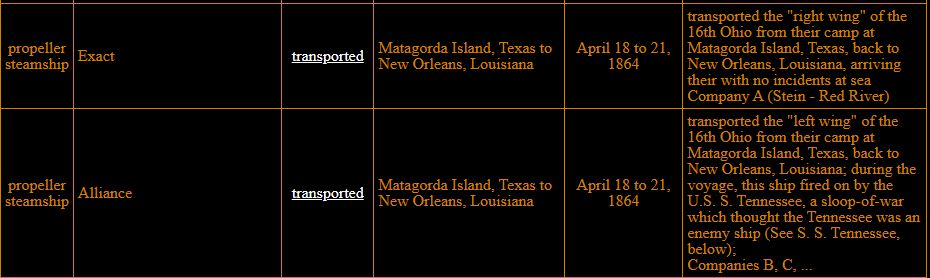
The “Exact” reached Galveston on Friday June, 2nd, 1865, the very day that General Edmund Kirby Smith, commander of the Army of the Trans-Mississippi, surrendered the last significant Confederate army to the Federals in that very same city. It had been nearly eight weeks since Robert E. Lee’s surrender at Appomattox. Smith immediately left the country for Mexico and then to Cuba, to escape potential prosecution for treason.
The captain of the “Exact had to navigate slowly through the Federal blockade fleet. Initially, they were not allowed to berth. Later, they were allowed to dock and they became the first civilian vessel to enter the port following the surrender. I’m positive that the Texans were overjoyed to be back on Texan soil. Some of them had not been back in four years. A delegation of Galveston’s prominent citizens were on hand to welcome them home. The group informed them that the citizens of Houston expected all of them to attend a series of dinners and balls welcoming them home that same evening.
Maj. Gen. Edward R. S. Canby, commander of the Federal Department of the Gulf, refused to allow the returning Texans the use of a Buffalo Bayou steamer to Houston. Buffalo Bayou is a slow-moving river which flows through Houston in Harris County, Texas. It flows approximately 53 miles east through the Houston Ship Channel into Galveston Bay and the Gulf of Mexico. The grateful citizens of Galveston arranged for an old railroad engine and some dilapidated flat cars to transport the Texans to Houston. Galveston, Houston and Henderson Railroad (GH&H) railroad built a bridge spanning Galveston Bay in 1860. The trip was approximately 50 miles. Not the most comfortable, considering they were riding on old flat cars. The convoy was named the “Homecoming Special.”
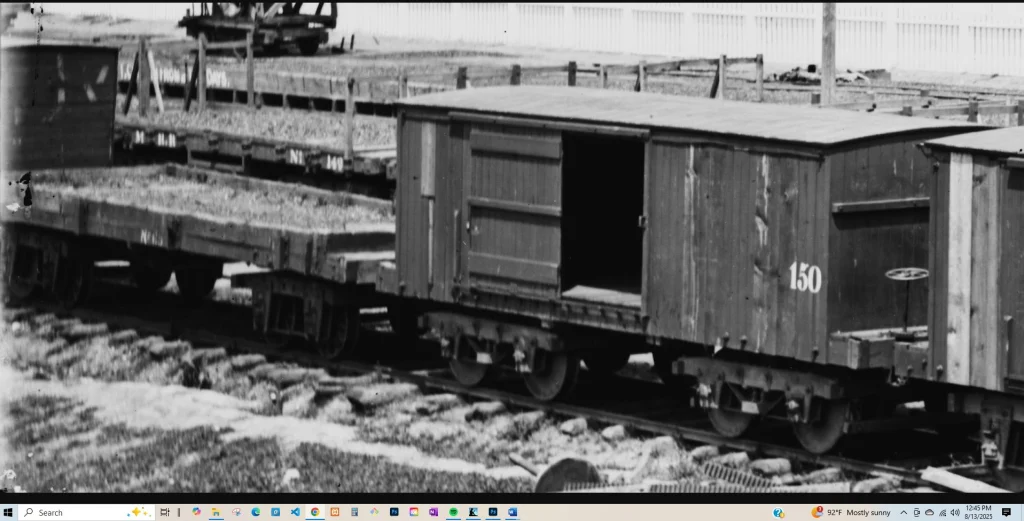
Their reputation preceded them. The exploits of Hood’s Texas Brigade were so well known that a large group of citizens were there to greet them when they arrived in Houston, even though it was midnight. The celebration continued on June 3rd and the group finally disbanded the following day to return to their respective homes. The trip home for T.F. would take another 10 to 14 hours by wagon or stagecoach. Livingston was approximately 74 miles from Houston. There were no railroad connections at that time and there were no paved roads. Upon arriving in Texas, Hill wrote “There let us drop the curtain, for the great drama was over.”
In total, T.F. traveled approximately 1,487 miles over the course of 52 days.
Appomattox Court House to Danville – 80.33 miles
Danville, VA to Greensboro, NC – 44.99 miles
Greensboro, NC to Charlotte, NC – 92.43 miles
Charlotte, NC to Chester, SC – 49.64 miles
Chester, SC to Abbeville, SC – 86.64 miles
Abbeville, SC to Washington, GA – 49.58 miles
Washington, GA to Atlanta, GA – 112.68 miles
Atlanta, GA to West Point, GA – 80.30 miles
West Point, GA to Auburn, AL – 30.42 miles
Auburn, AL to Montgomery, AL – 54.76 miles
Montgomery, AL to Mobile, AL – 169.9 miles
Mobile, AL to New Orleans, LA – 143.59 miles
New Orleans, LA to Galveston, TX – 367.55 miles (486 nautical miles – 559.29 miles)
Galveston, TX to Houston, TX – 50.02 miles
Houston, TX to Livingston, TX – 74.09 miles
Total Miles – 1,487.32