Introduction:
Over Labor Day weekend of 2024, my wife and I travelled to Livingston, TX. Livingston is located in Polk County, TX. A local historian by the name of Gary B. Davis wrote a wonderful article about the founder of Livingston entitled Moses L. Choate and his influence in the formation of Polk County, Texas.
The primary purpose of the trip to Livingston was to meet my great-grandfather Theophilus Franklin Meece. I knew absolutely nothing about him. My father, Louis H. Meece, never mentioned him. For that matter, he spoke very little about his family and their history. By all accounts he was known as T.F., not Theophilus or Theo. He was born on June 11th, 1840 in Maury County, TN. He was born to William Carrol Meece and Hannah Bennett Fields Meece. At the time of birth William was 25 and Hannah was 34. William was described as being a farmer in the 1850 United States Federal Census. I’ve discovered a number of biographies of T.F. during my research and I’ve included those here.
There is some confusion as to whether he was born just outside of Spring Hill or Columbia, TN. Only 11.5 miles separate the two. His mother Hannah grew up in Santa Fe, TN, which is only 11.6 miles from Columbia. T.F. would, later in life, join Hood’s Texas Brigade in the Civil War. Ironically, Hood would lose his final battles of the war, without the Texas Brigade, at Spring Hill, Franklin and finally at Nashville, TN. Not only that, the National Confederate Museum and the Sons of Confederate Veterans General Headquarters, known as “Elm Springs” would be located in Columbia, TN. What are the odds???
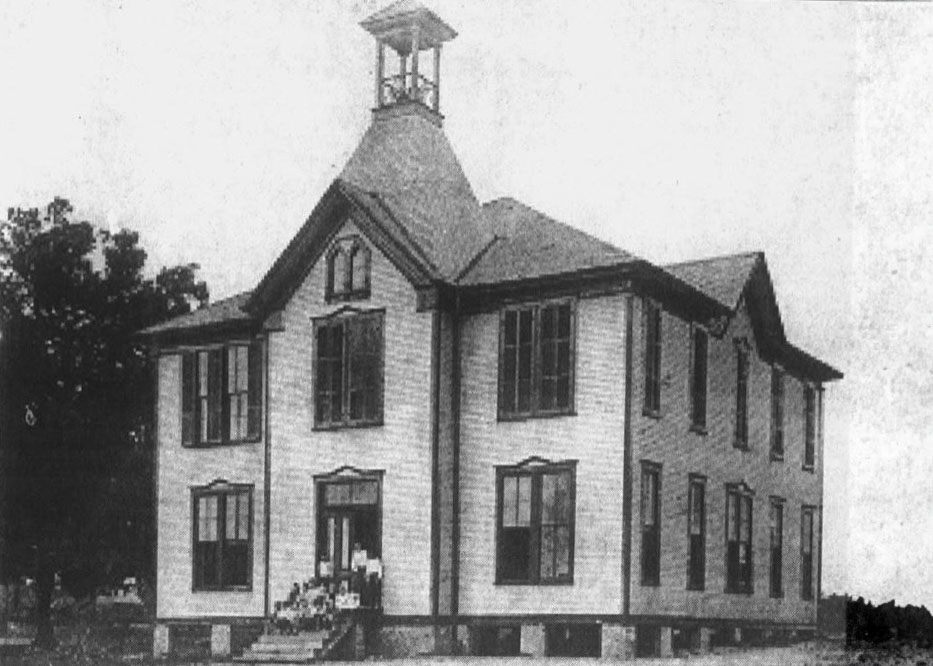
T.F. Meece was 15 years of age when his parents decided to move to Livingston, TX. He was educated at the Livingston Academy, which was located on the 1st floor of the Trinity Masonic Lodge #14. In 1846 the entire building was moved from Swartwout, TX to the corner of Church and Houston in Livingston, TX. This coincided with the naming of Livingston as the county seat of Polk County. Local masons not only provided and maintained the building but they also paid tuition for students whose parents couldn’t afford it. I can only assume that the rest of the Meece clan attended school there as well.
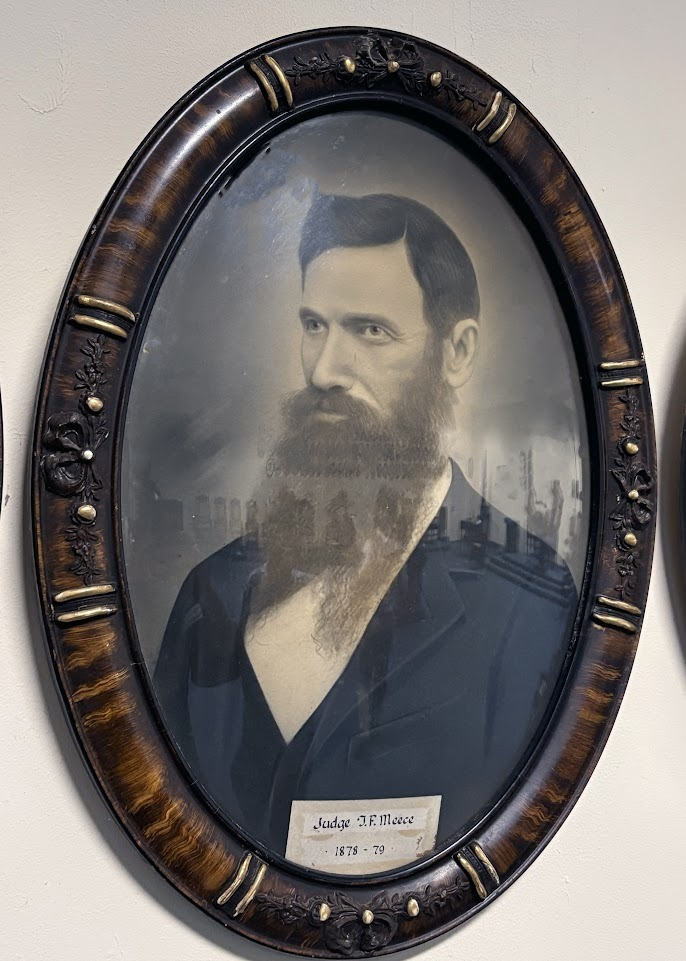
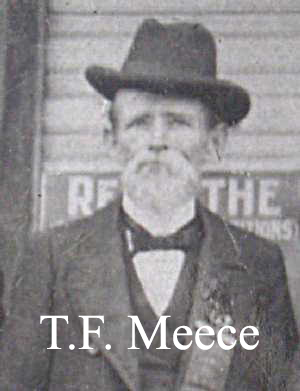
Ironically, my 2nd great-grandfather, William Carrol Meece, and my great-grandfather, T.F., would eventually become members of the Trinity Lodge #14 of the Masonic Order. T.F. was actually Worshipful Master in 1878 and 1879. The photograph above hangs in the Trinity Masonic Lodge #14 today.
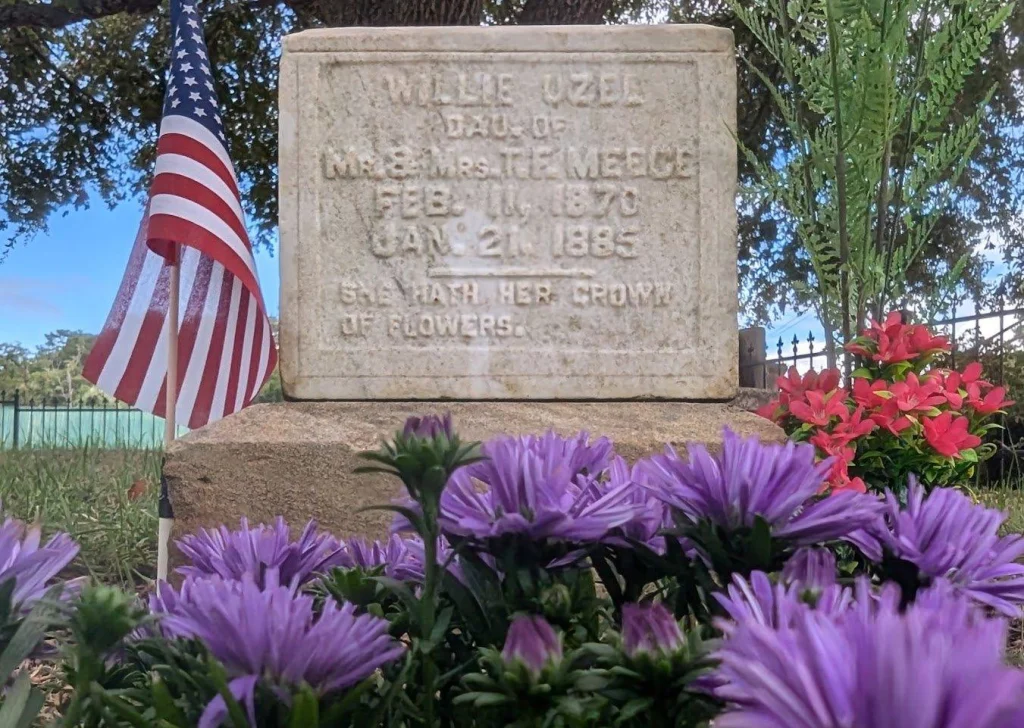
What’s even more ironic is the fact that when the school was relocated to Livingston it was positioned on the same lot where the Old City Cemetery sits today. This is where T.F., his wife Amelia and their daughter Willie are buried. The Polk County Memorial Museum sent me a plot map of the Old City Cemetery on an Excel spreadsheet. Plot map One and plot map two, both show the grave locations of T.F., his wife and their daughter.
While attending school T.F. worked on his Father’s farm in Colita and, according to the 1860 Census, he was a carpenter’s apprentice. In that same year, T.F. worked for about a year as a merchant’s clerk in a business house in Livingston.
Texas declared its secession from the Union on February 1, 1861 and joined the Confederate States on March 2, 1861. The Civil War began on April 12th, 1861. On September 9th, 1861, at the age of 21, T.F. Meece enlisted in the Confederate Army as First Corporal of what would become Company K, Fifth Texas Infantry, Hood’s Brigade.
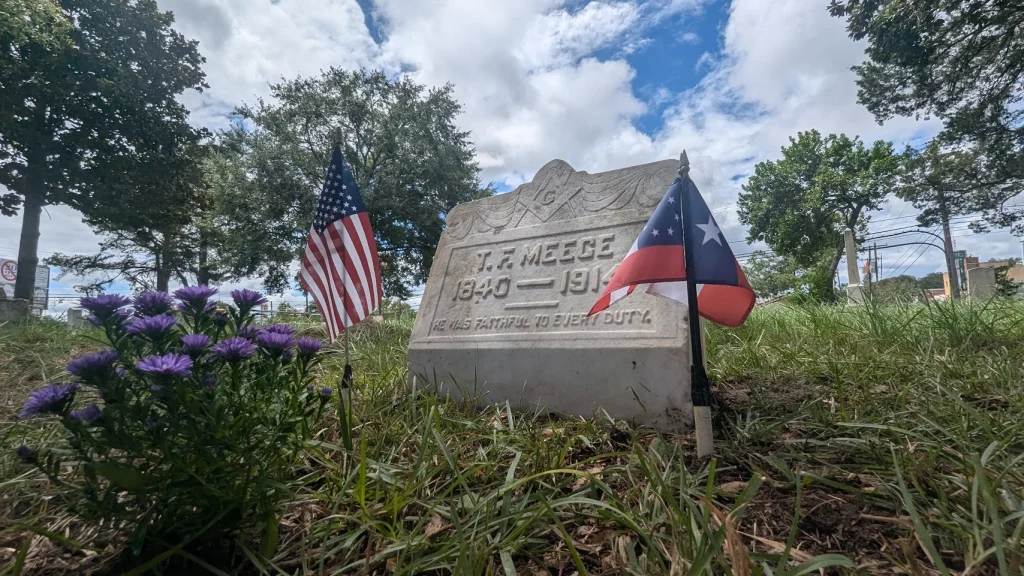
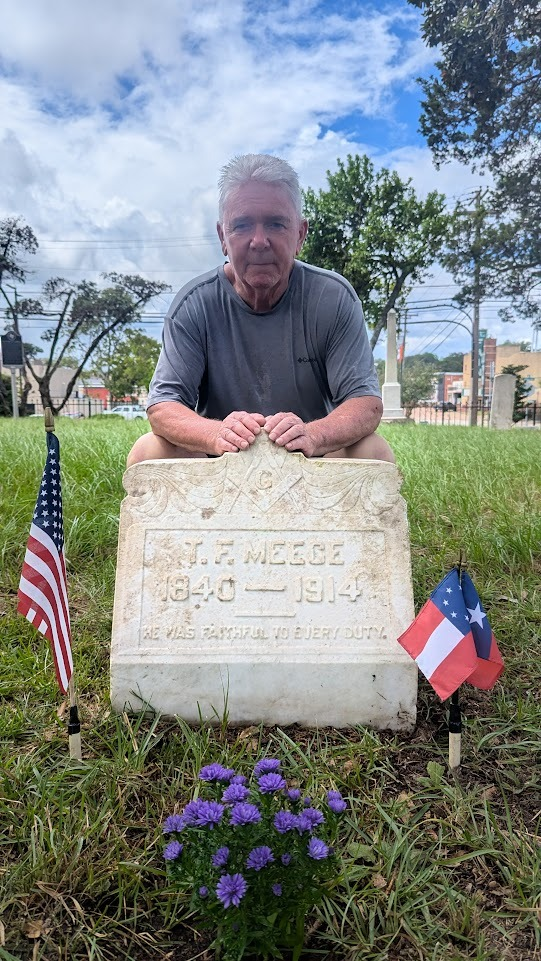
We cleaned the headstone with D/2 Biological Solution and cleaned the footstone plaque with mild soap. At his grave site we posted the original Confederate Flag (Stars & Bars), the Texas State flag and, of course, the United States Flag. We planted purple mums and we repositioned his headstone so that it was square with both Amelia’s headstone and his footstone. We also raised and leveled his footstone and plaque by pouring a 50lb. bag of crushed stone underneath.
The application for the footstone was obtained by Roger Merritt Meece, T.F.’s nephew. He was the son of Monroe Dawson Meece, who was the youngest brother of T.F. Roger owned the Livingston Drug Co. in downtown Livingston. Once again, the local historian, Gary B. Davis, has provided a very thorough narrative titled The History of the Livingston Drug Company. Both he and his son, Roger Monroe Meece, were pharmacists. The address from the application, where Roger lived at the time, is a home that still exists today (see photo).
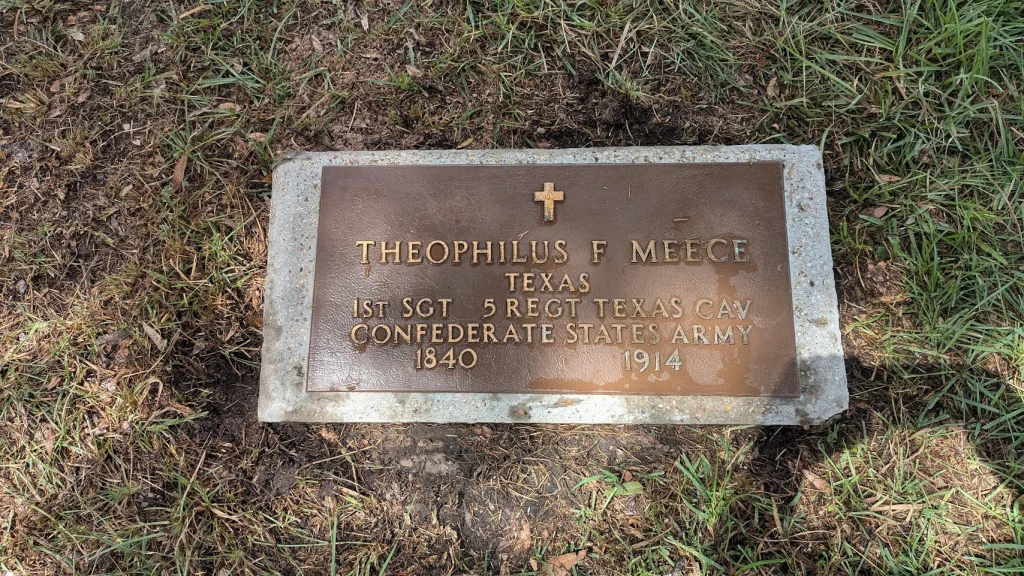

It’s a little surprising to me that Roger would be the one to file the application for the footer or marker. T.F.’s headstone bears the Masonic symbol and there were no other indicators that he served in the Confederacy. Perhaps he obtained the marker for his father’s grave, Monroe Dawson Meece, at the same time. By the time he filed the application on July 1st, 1964, Brown Meece, my grandfather, was the only child of T.F.’s still alive.
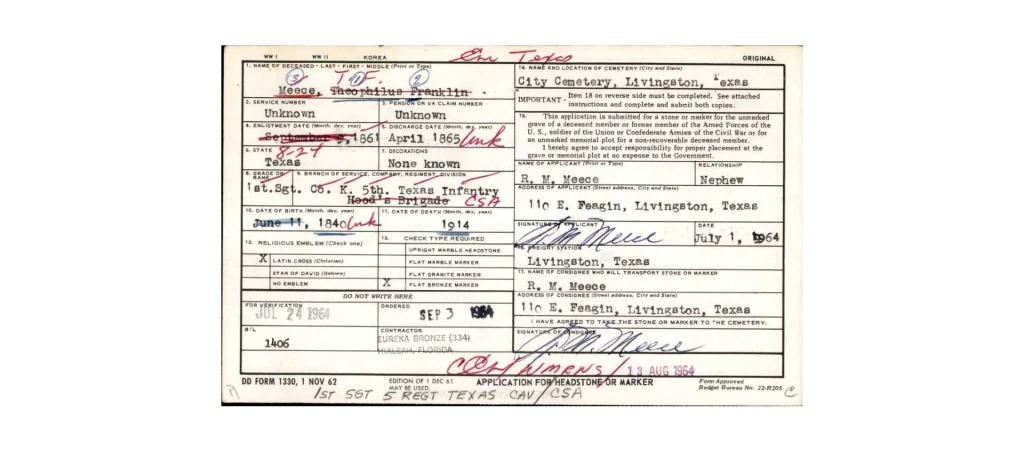
The federal government first became involved in permanently marking Confederate graves in 1906. That year, Congress authorized the furnishing of headstones for Confederate soldiers who died in federal prisons and military hospitals in the Union states, and they were buried near their places of confinement. In 1929, Congress expanded this authorization to include Confederate soldiers buried in unmarked graves in any location, both national and private cemeteries.
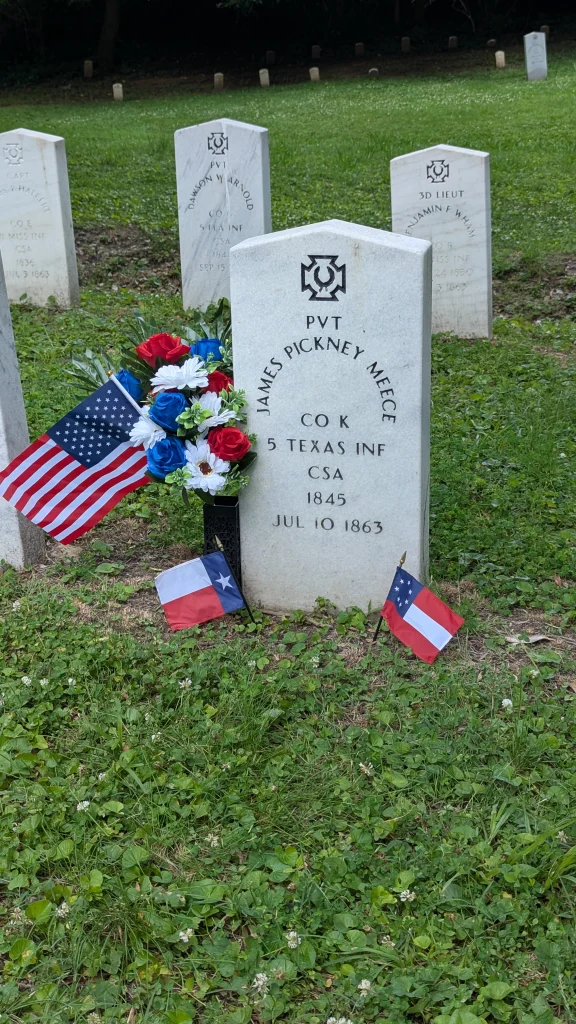
If you look at the headstone of James Pickney Meece, T.F.’s brother, you will note the inscription of the Confederate Cross of Honor or the Southern Cross of Honor. You will also notice that the headstone is pointed instead of rounded. It is said that this was done to prevent those damn Yankees from sitting on the headstones (lol).
I found a conversation between Laura Peace, formerly Laura Meece, and Pat Lary, formerly Patricia Ann Meece, on genealogy.com. Laura was the daughter of Roger Monroe Meece and Patricia was the daughter of Thomas Epperson Meece. I’m wondering if my sister Patrice Ann Meece was named after Patricia Ann Meece, who was born on March 3rd, 1926. Their conversation was as follows:
“My grandfather, Theophilus Franklin Meece, was the brother of M.D. Meece who married Mrs. Allie McCrary. I have a copy of death certificate of M.D. Meece b 24 June, 1847, died 3 May 1926 in Livingston, TX. Also their marriage license. Allie received a pension for his service in the confederacy. He served Texas State Militia, J. W. Dunnam’s Company, CSA. buried Bold Springs Cemetery, Bold Springs Community, Polk Co., TX. They were the sons of William Carroll and Hannah Bennette Fields Meece. They were born in Maury Co., TN and moved to Livingston, TX in 1856. I have traced the Meece family back to 1741 when they came to Pennsylvania from Germany on the Ship St. Mark. My father was Thomas Epperson Meece, son of T.F. Meece. Hope this helps.”
Pat Meece Lary
“WOW!!! What a small world! I pulled out my baby book this evening just to see, if by chance, I was related to an “M.D. Meece”. YES – He’s my great grandfather!! His full name was Monroe Dawson Meece. I have letters from him dating back to 1907. In fact, my mother didn’t know Allie’s last name so now, thanks to you, I can fill it in – 29 years later! So that must mean we are related as well – cousins 3x removed? I would absolutely love to have more information about our family tree if you have it! (By the way, my dad, Roger Monroe Meece, was 46 when I was born so I am probably the youngest of your cousins!) Do you live in the Livingston area? I am anxious to hear from you!”
Your Newly Found Cousin – Laura (Meece) Peace
Pat,
“Yes, my grandfather, then my dad, had a chain of drug stores -Meece Drugs (5 of them I think). I would love to have a copy of the picture of the drug store. I have very few memories of the drug store because I was very small – a toddler in fact – when we lived there. My dad would have turned 76 this coming August. He’s been gone since 1986. I live in Tulsa now but most of my family is in Houston. I have 3 siblings from my dad’s first marriage – Duane(53), David(49) and Roddy Joyce(46). In fact, I hope to see Duane this week because I am going home for the holiday. Have a great week and I hope we get to chat soon!”
Laura
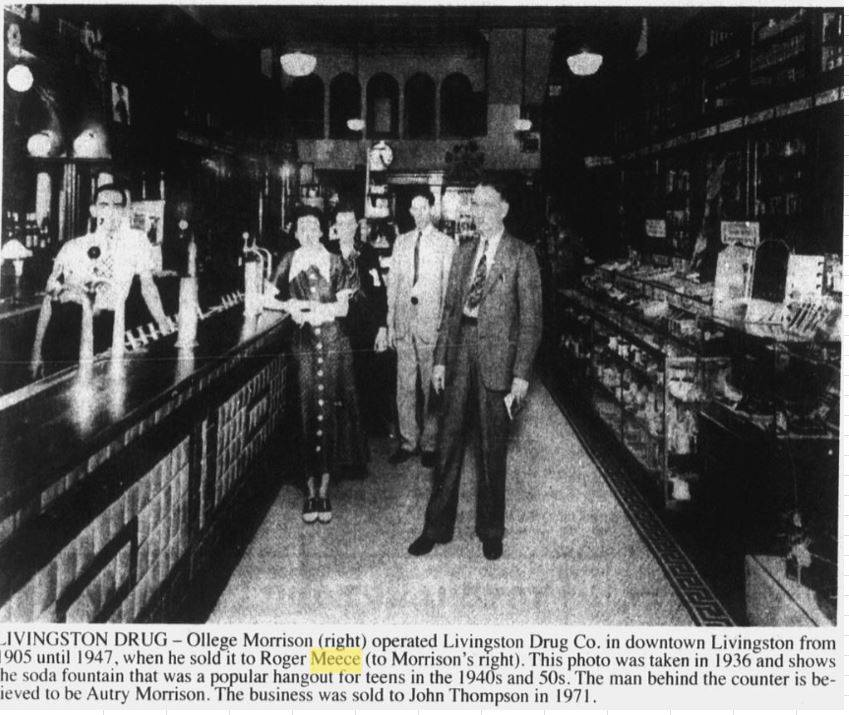
The only drugstore that I’m aware of is the Livingston Drug Co. I’m not disputing Laura’s account, I simply haven’t found any evidence of a chain of Meece Drugs. It was purchased by Roger Merritt Meece in 1947 and sold to John Thompson in 1971. It later became the Out to Lunch Café and it is currently owned by the Ruby Cattle Company. The building is located at 413 N Washington Avenue. We, by happenstance, walked into the building when we visited downtown Livingston. For some reason the interior looked familiar to me and then I spotted the original of the attached photograph in a glass case. That’s when we identified the building as the Livingston Drug Co. building. If we had bothered to look up, prior to entering the building, we would have seen the name etched into the façade.
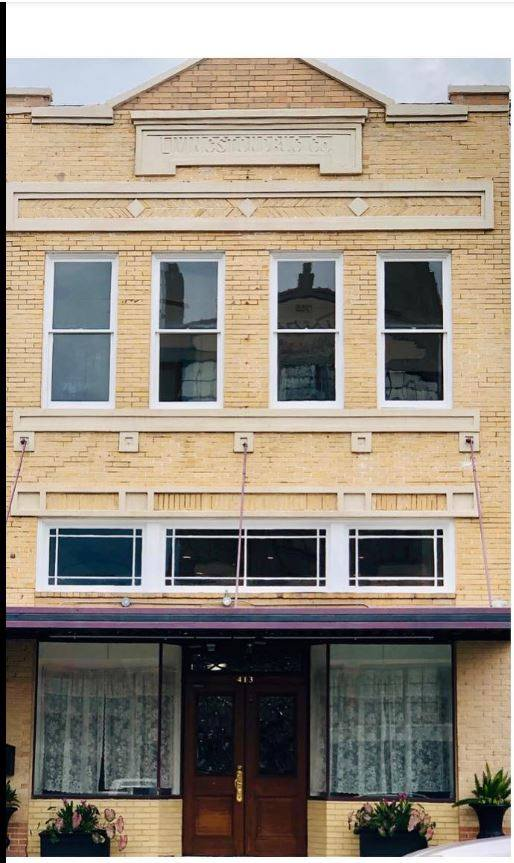
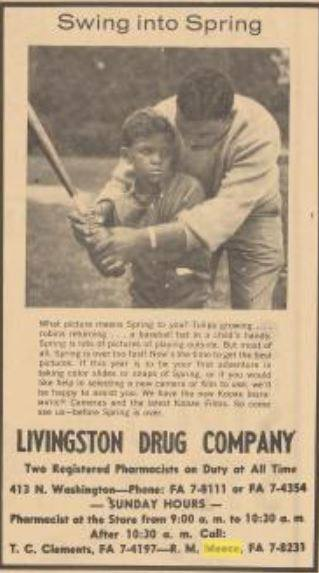
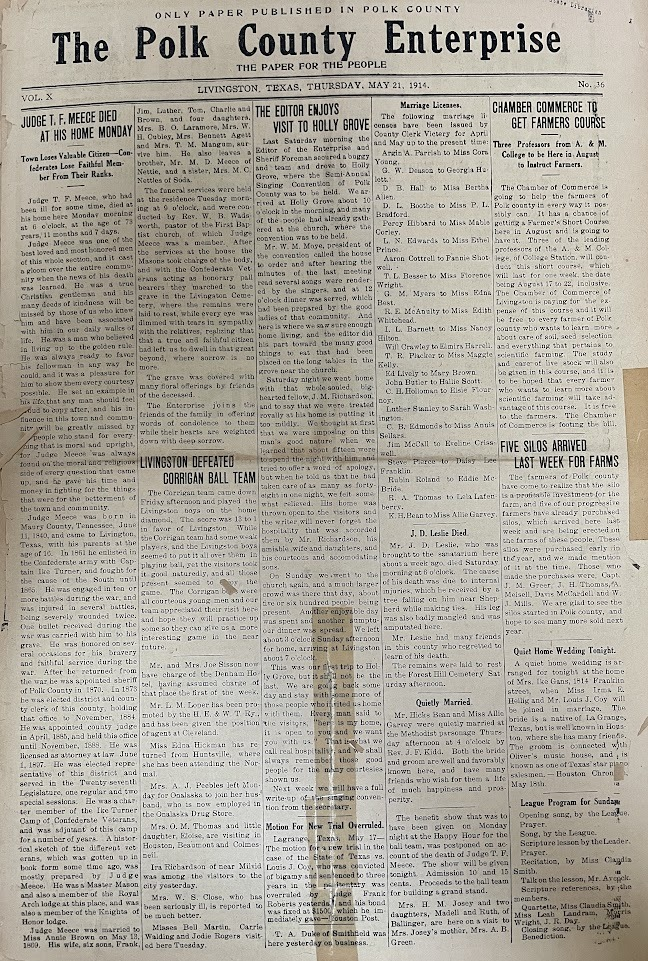
I’ve transcribed T.F.’s obituary, which was published on the front page of the Polk County Enterprise on May 21st, 1914.
JUDGE T. F. MEECE DIED AT HIS HOME MONDAY
Town Loses Valuable Citizen – Confederates Lose Faithful Member from Their Ranks
Judge T. F. Meece, who had been ill for some time, died at his home here Monday morning at 6 o’clock, at the age of 73 years, 11 months and 7 days. Judge Meece was one of the best loved and most honored men of this whole section, and it cast a gloom over the entire community when the news of his death was learned. He was a true Christian gentleman, and his many deeds of kindness will be missed by those of us who knew him and have been associated with him in our daily walks of life. He was a man who believed in living up to the golden rule. He was always ready to favor his fellowman in any way he could, and it was a pleasure for him to show them every courtesy possible. He set an example in his life that any man should feel proud to copy after, and his in fluence in this town and community will be greatly missed by people who stand for everything that is moral and upright, for Judge Meece was always found on the moral and religious side of every question that came up, and he gave his time and money in fighting for the things that were for the betterment of the town and community.
Judge Meece was born in Maury County, Tennessee, June 11, 1840, and came to Livingston, Texas, with his parents at the age of 16. In 1861 he enlisted in the Confederate army with Captain Ike Turner and fought for the cause of the South until 1865. He was engaged in ten or more battles during the war, and was injured in several battles, being severely wounded twice. One bullet received during the war was carried with him to his grave. He was honored on several occasions for his bravery and faithful service during the war. After he returned from the war he was appointed sheriff of Polk County in 1870. In 1873 he was elected district and county clerk of this county, holding that office to November, 1884. He was appointed county judge in April, 1885, and held this office until November, 1888. He was licensed as attorney at law June 1, 1897. He was elected representative of this district and served in the Twenty-seventh Legislature, one regular and two special sessions. He was a charter member of the Ike Turner Camp of Confederate Veterans and was adjutant of this camp for a number of years. A historical sketch of the different veterans, which was gotten up in book form some time ago, was mostly prepared by Judge Meece. He was a Master Mason and also a member of the Royal Arch lodge at this place, and was also a member of the Knights of Honor lodge.
Judge Meece was married to Miss Annie Brown on May 13, 1 1869. His wife, six sons, Frank, Jim, Luther, Tom, Charlie and Brown, and four daughters. Mrs. B. O. Laramore, Mrs. W. H. Cubley, Mrs. Bennett Agett and Mrs. T. M. Mangum, survive him. He also leaves a brother, Mr. M. D. Meece of Nettie, and a sister, Mrs. M. C. Nettles of Soda.
The funeral services were held at the residence Tuesday morning at 9 o’clock, and were conducted by Rev. W. B. Wadsworth, pastor of the First Baptist church, of which Judge Meece was a member. After the services at the house the Masons took charge of the body, and with the Confederate Veterans acting as honorary pall bearers they marched to the grave in the Livingston Cemetery, where the remains were laid to rest, while every eye was dimmed with tears in sympathy with the relatives, realizing that that a true and faithful citizen had left us to dwell in that great beyond, where sorrow is no moгe. The grave was covered with floral offerings by friends of the deceased.
The Enterprise joins the friends of the family in offering words of condolence to them while their hearts are weighted down with deep sorrow.
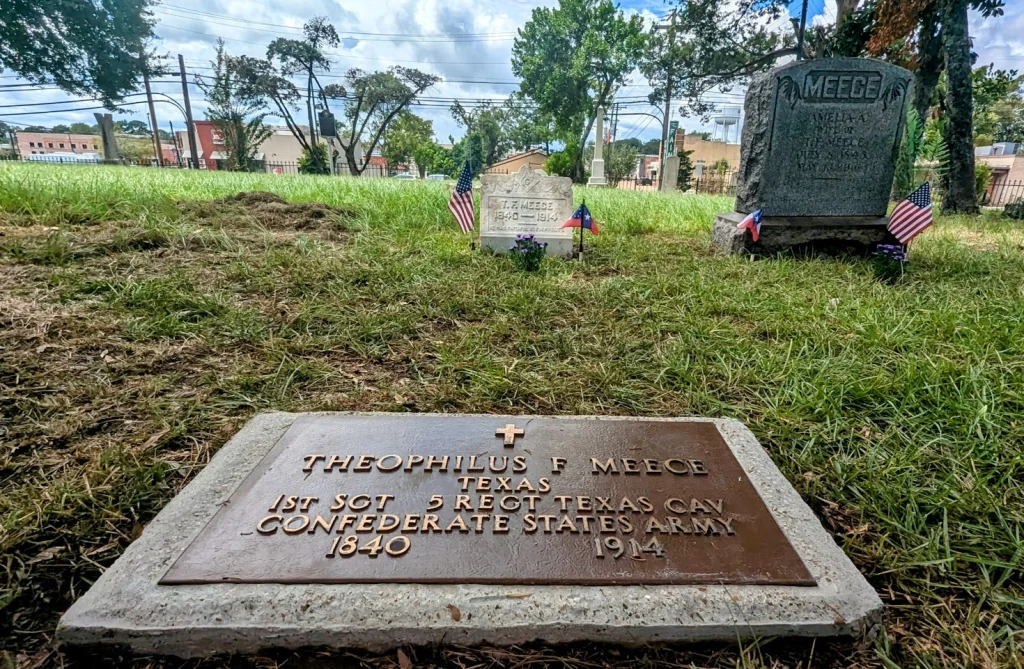
T.F. returned to Livingston, TX in June of 1865, just in time for his 25th birthday. The optimism, once prevalent at the onset of the Civil War, was gone. The Civil War had a devastating impact on the Texas economy. I’m sure that T.F. had a sense of these changes since he returned home several times during the war. These trips home were prompted by the numerous injuries that he had suffered, as well as his capture at, and parole following, Gettysburg.
The Confederate currency was worthless, further exacerbating the financial woes of the State. T.F. was paid $17.00 per month for his service in the Confederate Army. The currency, known as the Greyback (vs. the Greenback), was not backed by hard assets. It was simply a promise to pay the bearer, after the war, based upon the very optimistic prospect of Southern victory and independence.
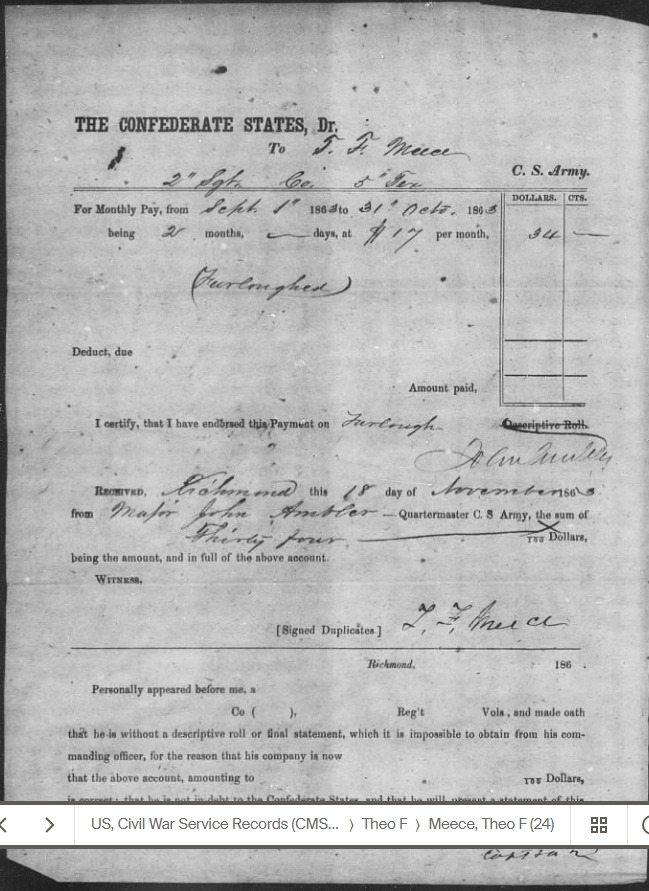
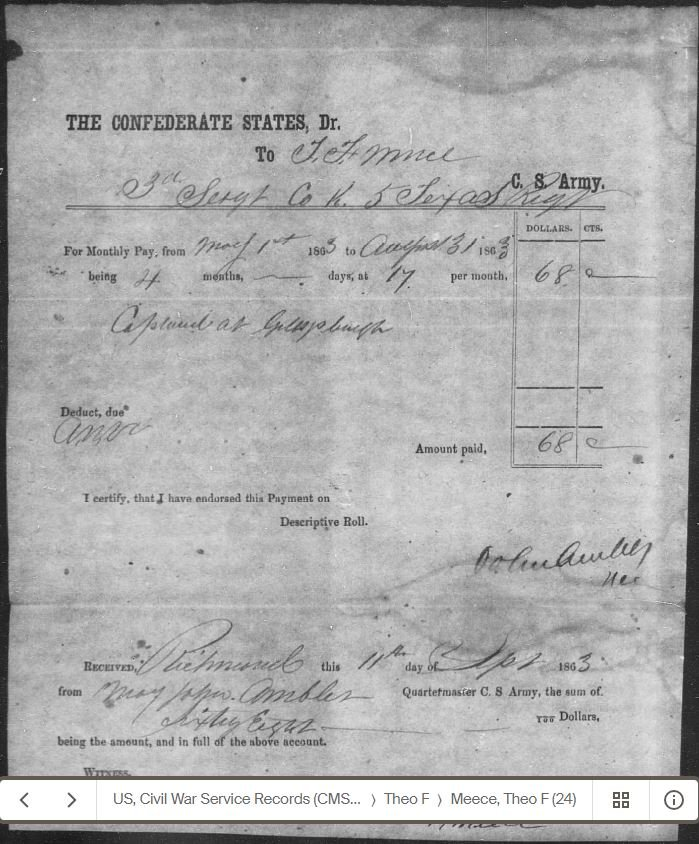
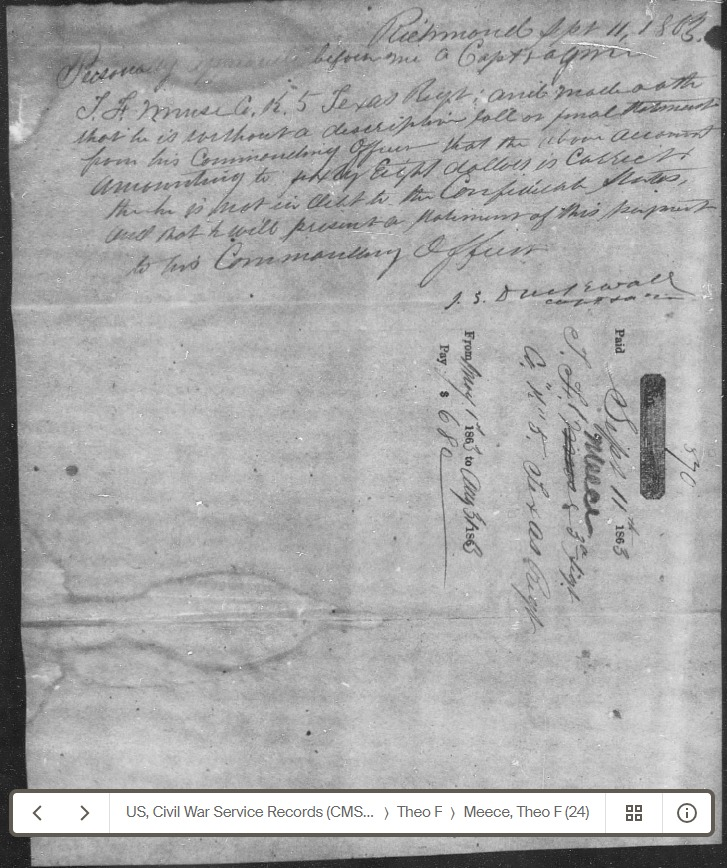
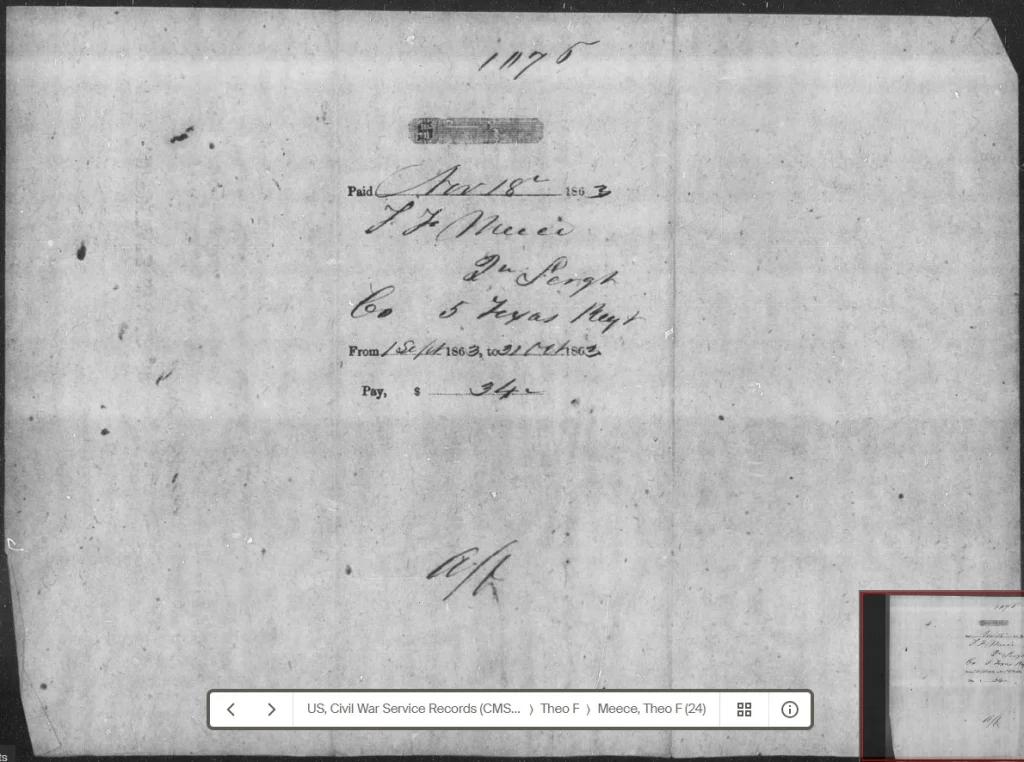
Reconstruction, which lasted from 1865 until 1877, was a period of turmoil and uncertainty for the South. The 13th, 14th, and 15th amendments to the Constitution, known as the “Reconstruction Amendments”, ended slavery in the United States, ensured birthright citizenship, as well as due process and “equal protection of the laws” under the federal and state governments, and expanded voting. Texas wasn’t officially readmitted to the United States until March of 1870. It was one of the last of the former Confederate states to reenter the Union. This was directly tied to its reluctance to change.
Obviously, the cotton industry, which was the State’s primary source of income, suffered due to the end of slavery. This was true in Polk County as well. Agriculture production also decreased sharply. Products such as wool, sugar, molasses, corn and sweet potatoes were common in the nineteenth century. Livestock became a steady source of income through the turn of the century. The lumber industry and the establishment of the railroads, in particular the Houston, East and West Texas Railway did much to lessen the financial impact of the post-Civil War era in Polk County.
T.F. resumed work as a merchant’s clerk at a local business house as well as working on his father’s farm and continuing the carpenter apprenticeship. At some point in time The City of Livingston Texas portrays him as: Barber: T.F. Meece under Additional Early Businesses.
T.F.’s father William C. Meece had purchased 1,100 acres of land on August 9th, 1859 for $350.00. The property was described as being located two miles NNE from Livingston on the road leading to Moscow. That road today is US-59 N. The purchase was completed with two promissory notes, co-signed by C.J. Fields. Calvin J. Fields was the brother of Hannah Fields Meece, William’s wife. Apparently, William lacked the necessary collateral to secure the promissory notes himself.
On October 28th, 1866 T.F.’s Mother Hannah B. Fields died at the age of 61. According to T.F.’s biographer, she “…died at the Polk County, Texas home.” William would eventually remarry a woman by the name of Nancy C. Burroughs on January 18th, 1869. Nancy died on November 17th, 1902 and she is buried in the Burroughs Cemetery located in Onalaska, Texas, which is in Polk County.
Sometime between the 1860 and 1870 United States Federal Census T.F.’s oldest brother John died. My best guess is that it happened sometime between 07/30/1860, when the census was taken, and 09/03/1861 when T.F. departed for duty in the Civil War. I can find no record of his service in the Confederacy or news of his death. I was able to find a multitude of records about his brothers. Similarly, I’ve been unable to identify where William, Hannah and John were buried. They are either buried at the Old City Cemetery in Livingston or they are buried on the farm. There are 167 visible tombstones and at least 65 unmarked burials, with more than 70 grave sites destroyed over the years in the Old City Cemetery. It is my belief that they were buried on the farm.
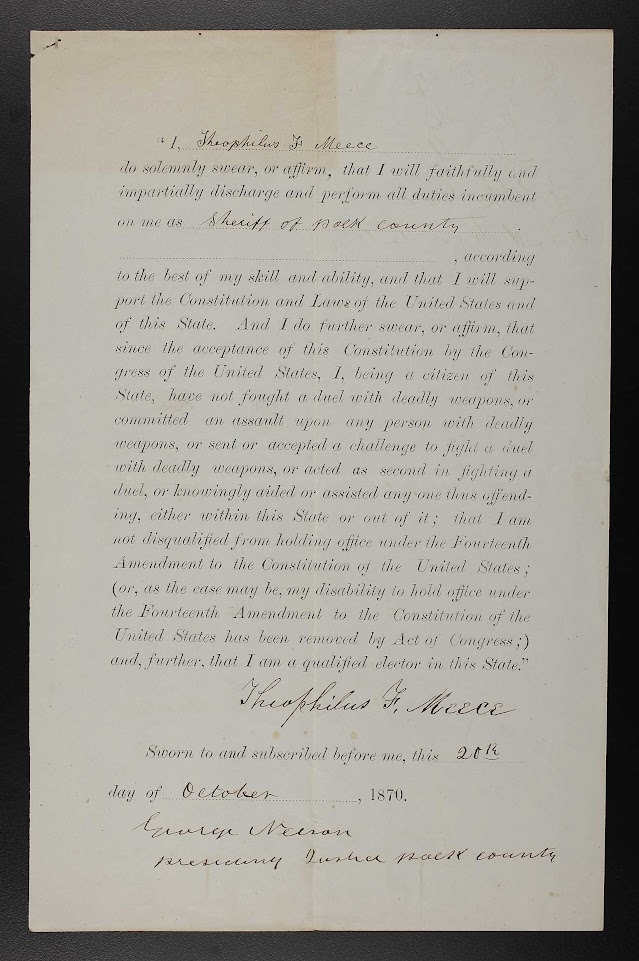
On May 15th 1869 T.F. married Amelia Antoinette Brown. Their first daughter, Willie Uzell Meece was born on February 11th, 1870. According to the 1870 United States Federal Census, T.F. described his occupation as M Mechanic. I assume this meant machine or maintenance mechanic. Perhaps, he worked for the railroad or for one of the sawmills at the time.
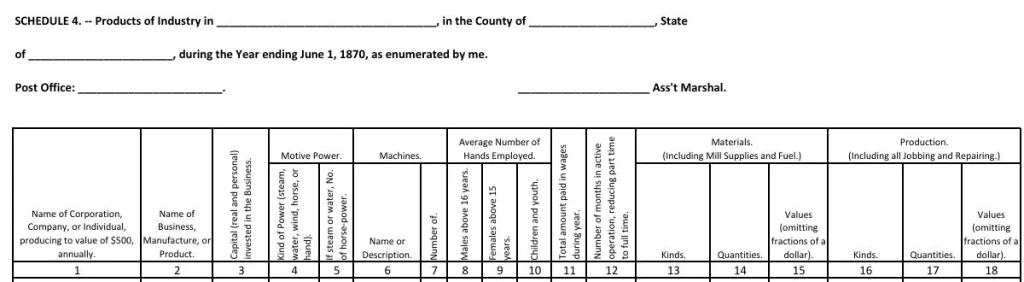
Gary B. Davis, the Livingston historian, recently discovered a document titled Schedule 4.-Product of Industry for the year ending June1, 1870. It was stamped by the Census Office on November, 3rd 1870. It looks very similar to a federal government census document. It appears that T.F. owned and operated a cabinet and wagon shop. In the 1870s, a wagon shop was a place where skilled craftsmen built and repaired horse-drawn vehicles, often incorporating a blacksmith shop for metalwork. Considering his carpentry apprenticeship, it makes sense that he would also build cabinets. Sawmills, gristmills, blacksmiths, tanyards (tanneries) and wagon shops were quite prevalent at that time in Polk County.

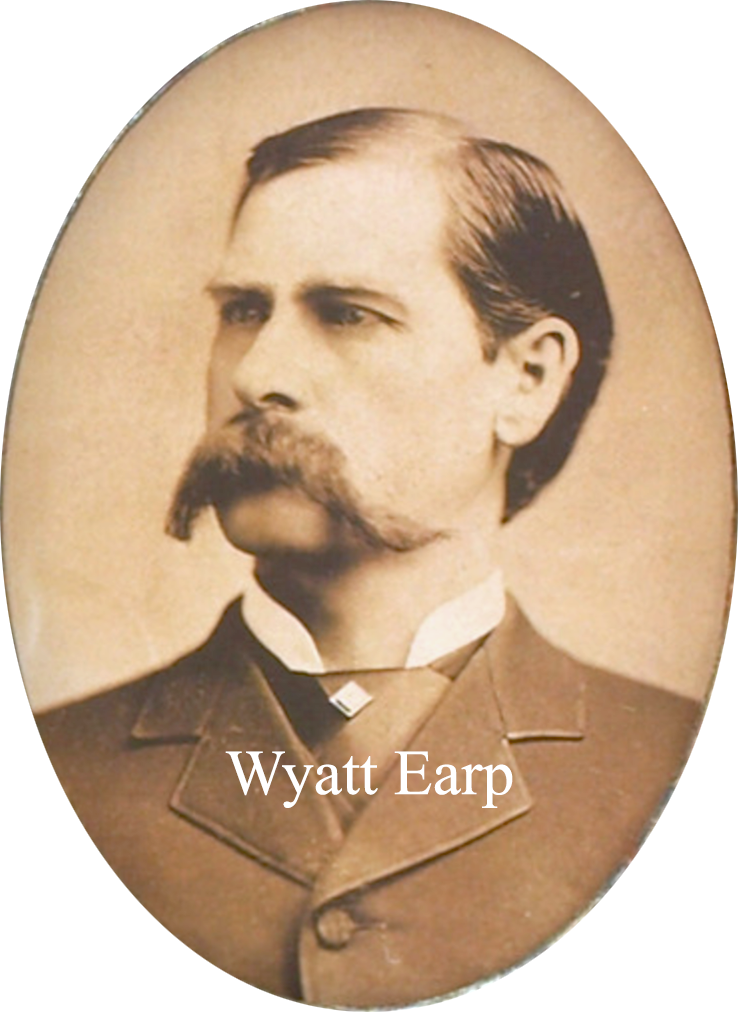
In 1871 T.F. would complete the two-year term of G.W. Barfield as Polk County Sheriff. I’m not sure why he was unable to complete his term. I’m guessing that T.F. was appointed, versus being elected, to this position. In 1872 T.F. was elected to the position of Polk County Sheriff and he served a two-year term. As a kid my Uncle Dick, Richard Charles Meece, told me that T.F. arrested Doc Holiday. According to Uncle Dick, Doc Holiday was arrested, prior to his notoriety and friendship with Wyatt Earp, on some mundane charge such as public drunkenness or drunk and disorderly.
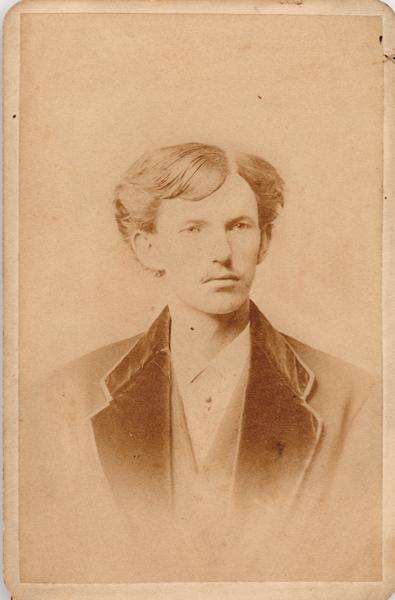
Shortly after beginning his dental practice Holiday was diagnosed with tuberculosis and he was only given a short time to live. Both his mother and adopted brother died from consumption or tuberculosis. All of these factors contributed to Holiday’s reputation as a heavy drinker. His doctor advised him to move out West to a dryer climate.
He moved to Dallas, TX in 1873. Unable to continue his dental practice, he turned to gambling as a means of support. Dallas, TX is approximately 214 miles from Livingston, TX. The Houston and Texas Central Railway (H&TC) reached Dallas in 1872, and the Texas and Pacific Railway (T&P) connected to Dallas in 1873, forming a major rail intersection. Livingston was also reachable via packet boat on the Trinity River.
I can’t speak to that particular year (1873) but there was a time when Livingston was truly the wild wild west. In 1902 at least a dozen saloons and a couple of stores that sold whiskey by the jug were destinations for the sawmill workers on Saturday nights. Drunken brawls were frequent and the situation would denigrate to the point where side arms were randomly fired throughout the town. The sort of environment, and the money that the sawmill workers would bring to town on payday, might have attracted someone like Doc Holiday.
Was this story simply a creation or a figment of someone’s imagination? Who Knows??? I’m assuming that this tale was told by Richard’s father, Brown, who was T.F.’s youngest son. Perhaps, one of Brown’s siblings told Richard this story to further his fantasies about the wild west. I know that, as a child, it piqued my interest and I still remember it 60 years later.
I’ve done my best to logically explain whether or not there was a possibility that this event occurred. I offer absolutely no proof. I have nothing in writing to substantiate the claim, but one can always dream. I have to confess, my Uncle Dick also told me that there was a statue of T.F. Meece in the State Capital. To my knowledge, this is not true. There is however a composite photograph of the 27th State Legislature, including a photo of T.F. Meece, in the House Chamber gallery on the East wall.
On March 1st, 1872 T.F. would purchase 49 acres of land from his father William for $300.00. Based on my research this was T.F.’s first property purchase in Polk County. Prior to that purchase, I’m assuming that T.F. and his family lived on his father’s farm, if not in the same house. His sister Minerva Caroline “Carrie” had married Stephen Joseph Nettles on January 31st, 1861 and moved away. His only remaining brother, Monroe Marshall Dawson Meece, still lived on his father’s farm.
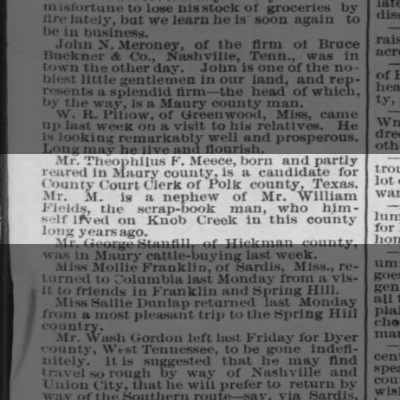
In 1874 T.F. Meece was elected Polk County Clerk. Records show that he was elected Polk County Clerk in 1874, 77, 78, 80, 82 & 1884. An article announcing his candidacy appeared in a newspaper in Columbia, TN (Maury County) on February 18th, 1886. He held that position until 1886 when his fellow soldier and friend A.B. Green was elected County Clerk.
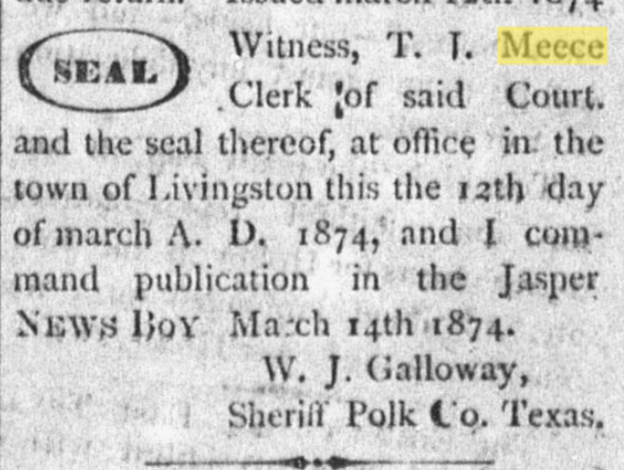
While County Clerk, T.F. and his wife Amelia would welcome their daughter Mattie Minerva Meece September 6th, 1875. James Henry Meece was born on September 17th, 1877. Bennett Amelia Meece was born on September 6th, 1879. Luther Marshall Meece was born on October 12th, 1881. And, finally, Thomas (Tom) Epperson Meece was born on February 11th, 1884. Clearly, this was a joyous and very busy time in the lives of the Meece family. Unfortunately, the patriarch of the family, William Carroll Meece, died on December 11th, 1881.
In general, the County Clerk in 2025 serves as a vital link between the public and the county government, acting as the recorder of public records, custodian of vital statistics, and chief elections officer, while also issuing marriage licenses and serving as clerk for the county and commissioners courts. I don’t know how much these duties have evolved over the years.
Fortunately, the Parental Consent to Marry & Marriage License Applications for Polk County, Texas 1851-1899 have been saved. These requests for marriage and confirmation of age were transcribed from official records during T.F.’s tenure as Clerk. The requests were very simple in nature and rife with misspellings. Many of the petitioners “signed by mark X” meaning it was signed by a person unable to write their name, which is then witnessed and often notarized, serving as their signature. Obviously, those that could write at some level were spelling according to sound. Clearly basic literacy was still an issue in the late 1800’s.
It appears that the employer would petition, on behalf of the “colored” or “freedman”, for their marriage license. The price for the license ranged between $1.50 and $1.60. The following excerpts were transcribed from the original records:
December 14, 1880
Mr. T. F. Meece Co. Clerk
deare Sir
if Samuel Rhoden calls on you for lisons to marrey my daughter Laura Belle let him have them and all will be wright with me.
Yours
E. Gray
Lucretia A. Gray
January 5, 1882
This is to Certify that my Daughter Fannie Hays is sixteen years old and I have given my Consent for her to marry Henry Arlington.
Becky Hays (by her mark-X)
Witness J. J. Canon
Moscow, Texas Oct. 27, 1881
Mr. Meece County Clerk
Dear Sir,
One of my hands has asked me to procure a license for him & has left the money with me to pay for it—as it is silver I will send it to you by hands of Mr. McKinnon of the first person I see going to Livingston—The man is a freedman named James Alford—the woman named Sow? Hill—both are of age—Please Send license by mail tomorrow evening as they want to marry Wednesday.
Oblige Your Friend
R. A. Smalley
The following article was written in a local newspaper and depicts the difficulties of verifying one’s identity and age in 1876.
Better hitched to a mule than a bride
Farmer was upset when his best field hand wed
In 1876 James B. McConico, who lived near Dallardsville, was a lad of about 19, but to most of the community, he was mature young man who had come of age in mind and physique if not in years. So when he and his chosen love applied for a marriage license, county clerk Theophilus F. Meece assumed he was of the legal age of 21 and did not hesitate in issuing a license.
In December that year, James and one Miss Sallie A.C. Davis were married by a local justice of the peace. This came as a great shock to James’ father.
Dick McConico was not a rich man. He owned no real property and each year he scraped by with a mortgage on his upcoming sugar cane сгор, about three acres. James’ work on the place was vital to his operation.
When McConico’s son got married, his old man sued. He complained that by that marriage, he had been robbed of the present and potential use of his son’s labor. (Apparently the son’s married state gave him a legal status that enabled him to rebuke his father’s authority.)
Control of his son was very important, as McConico’s lawyer went on to explain that his client had been “entirely deprived of his potential control in shaping and directing his said minor son’s present and future conduct and actions.”
Not only did the old man not like such rebellion, in his eyes it was un- thinkable and tragic. The damages he claimed against the county clerk included not only loss of his son’s services, worth $300 a year, but also injury to McConico’s mental well-being.
Besides that, McConico had included support from his son as an integral part of his old age retirement plan.
James’s father complained to the court that before this marriage took place “I had intended to raise and educate him for future usefulness and aspirations becoming his station in life, that he might be the pride of my declining years, and my support in old age.”
But now those plans were dashed. He had lost control over his son, and it was all the county clerk’s fault.
“The plaintiff alleges,” wrote his lawyer, James E. Hill, “that he is the head of a family, a married man, about sixty years of age, having a wife, who together with plaintiff have raised, nurtured and educated a large family of children who have at all times honored, loved and respected their parents and have ever been obedient to their wishes, until the wrongful act of the defendant, who caused his minor son James B. to rebel against parental control and admonition.”
McConico also was concerned about the damages to his son, that is, in saddling him with a wife before he had lived long enough to acquire good sense. At least that’s what the following quote seems to say:
“The defendant’s wrongful act has encumbered his [McConico’s] minor son with a family, and the anxieties and cares thereto incident, before his arrival at the age of maturity. manhood and reason.”
As a result, said the distraught McConico, he had “greatly suffered in mind, which said mental suffering now exists, and will necessarily continue through plaintiff’s life.”
That lifelong suffering, decided McConico, had a price on it. He figured $2,000 ought to make him feel better.
But county clerk Meece argued that in the first place, James B. looked every bit of 21 years and more. (Remember, they didn’t have drivers licenses or other I.D.’s to prove one’s age. And birth records would not exist in Texas until 1903.)
In the second place, said Meece, James B.’s labor was not worth the $300 a year that his father claimed. He felt that a more reasonable figure would be half that. Besides, added Meece, the old man hadn’t lost his son’s services; he had learned that the boy was still living and working on his father’s place.
And also, he argued, James B. had been accepted in the community as a grown man, McConico knew that James and Sallie were considering marriage, and he knew that to do so they would have to get a marriage license. So if McConico had any objections to their getting hitched, he should have said so!
Finally, Meece said that he felt that by enabling the young couple to be wed, he had actually done the boy a good deed: “The plaintiff’s son married into a family of as much respectability as any in the country. The young lady that the son married is a lady of respectability, intelligence and refinement, and is one who in every way is calculated to render the son happy in his married life.”
But in the no-nonsense legal atmosphere of the courtroom, the son’s happiness was not an issue.
The key factor in the jury’s decision, as instructed by the judge, was whether or not McConico actually sustained any damages. That might be questionable today, but after listening to several witnesses, the jury had no doubt about it. A resounding Yes, he had been damaged.
But not damaged as much as he claimed. The court set a limit of $200, and the jury awarded McConico $160 for his troubles.
This writer was not able to find whatever happened to the elder McConico. By one record, he was still in the county in 1882.
And as far as is known, James and Sallie McConico lived happily ever after. Years later, in 1896 when Sallie sold her family’s old homestead, the couple were living in Angelina County and were still husband and wife.
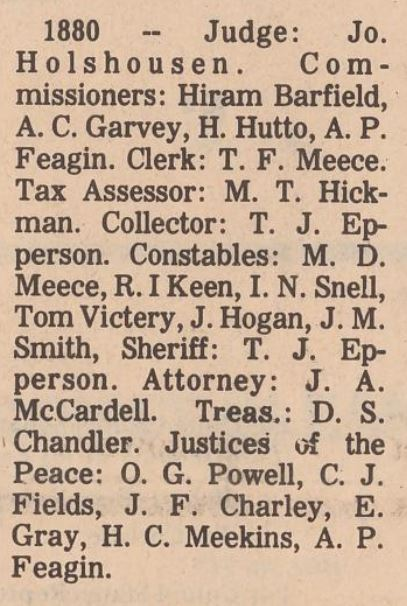
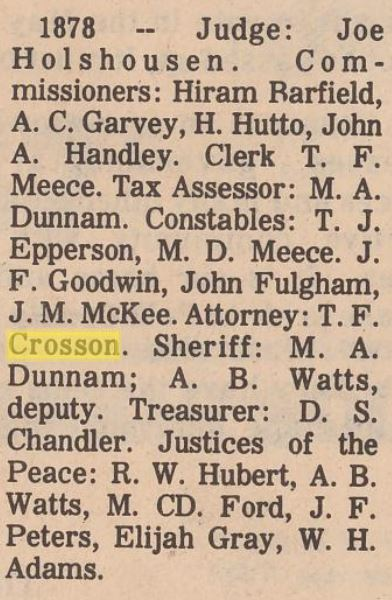
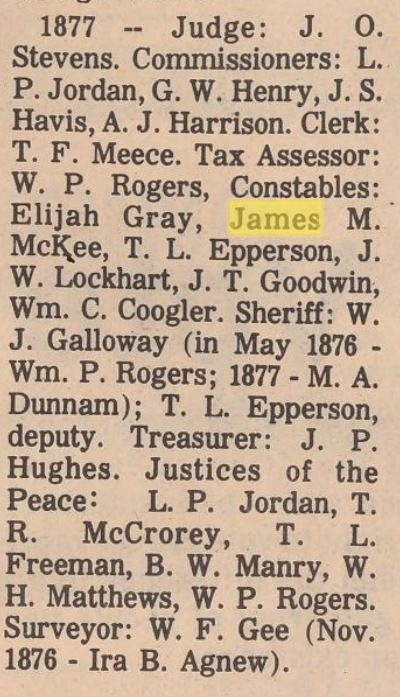
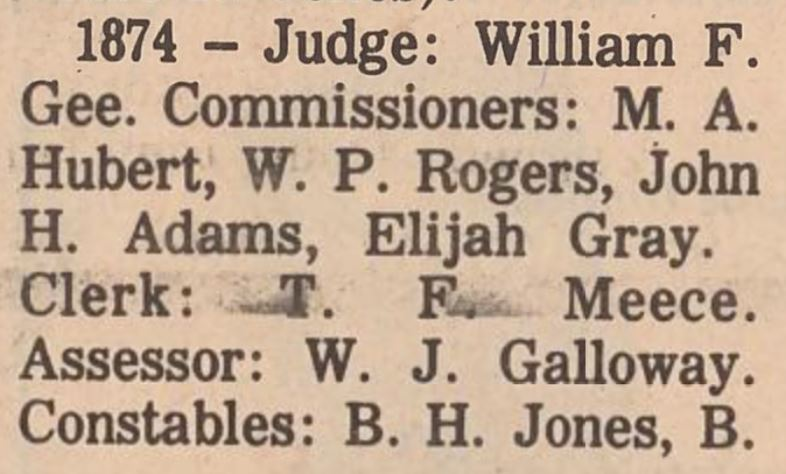
“There was one Livingstonian who has the distinction of holding seventeen positions in his life, three of which were county offices, one a state office and one an office in the Baptist Church. This man was T. F. Meece, born to William C and Hannah B. Meece in TN in 1840 and came to Livingston with his parents in 1856.” This is a passage from The History of Polk County Texas by Emma R. Haynes in 1937, (23) years after T.F. died.
In 1937, Emma R. Haynes, a schoolteacher and librarian, authored the first history of Polk County, Texas. Her work, based on extensive research and personal interviews, chronicles the county’s history from 1846 to the 1930s.There were several errors in her depiction of T.F. Meece but I believe this portrayal of his work ethic was accurate.
In my mind, the one outlier in his career path was his stint as a barber. I did not foresee that as a possible occupation. Was this something that he picked up at home or possibly something he learned as a soldier in the Confederate Army? You would have to believe that T.F. had some physical limitations, caused both by the number of and types of injuries he suffered during the Civil War. Clearly, he was a very industrious individual who did whatever it took to provide for himself and, most importantly, his family.
According to the U.S. Register of Civil, Military and Naval Service 1863-1959 for T.F. Meece 1883 > Volume 2 under The Postal Service pg. 773, T.F. was a Clerk in Post-Offices and he was paid $90.00 compensation per annum. This was yet another unexpected finding. The Postmaster at that time was Mr. Walter Demetrius Willis and he was paid $406.76 per annum. Willis would serve in this capacity for 24 years.
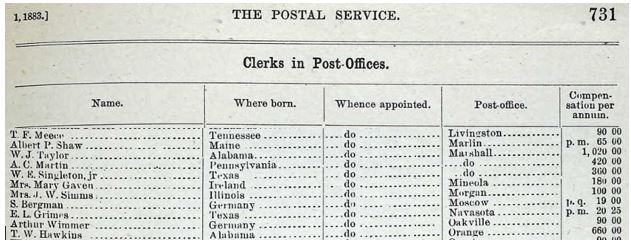
I do not know if T.F. worked additional years, before or beyond 1883, as a Postal Clerk. He held this position while he was the Polk County Clerk. Were these positions somehow interconnected or was this simply supplemental income? In 1880, a county clerk in Texas likely earned a salary in the range of $500 to $800 per year, though this could vary based on the size and population of the county. The real average annual wage in 1880 was around $375.00 per annum.
At some point during his tenure as Polk County Clerk T.F. began studying law. At that particular time, most people became lawyers by “reading law,” which meant apprenticing under an established lawyer, studying legal texts independently, and performing clerical tasks in the lawyer’s office. They were essentially learning on the job rather than attending a formal law school, which was still uncommon at the time. After completing their apprenticeship, they would then sit for a bar exam to be admitted to practice law.
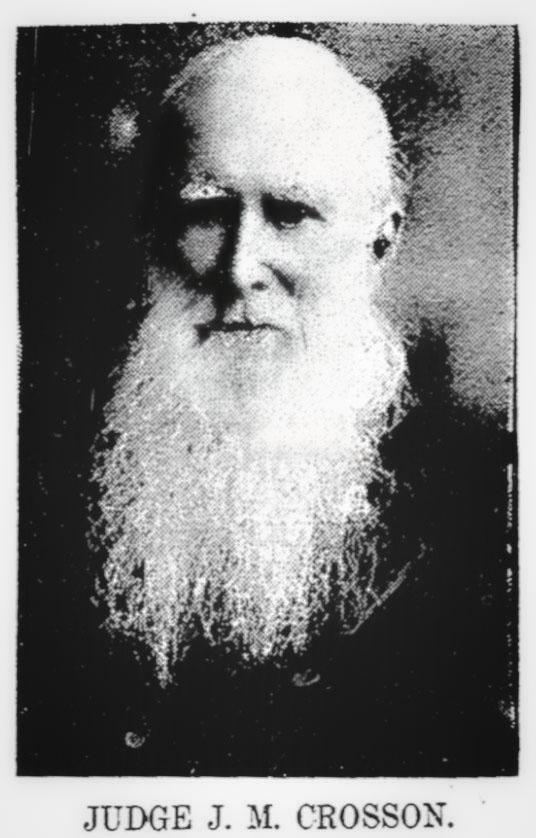
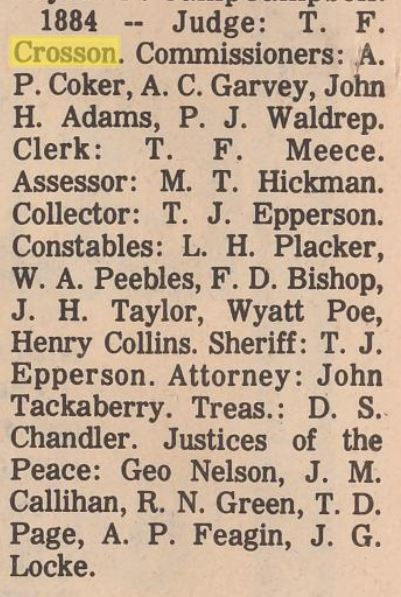
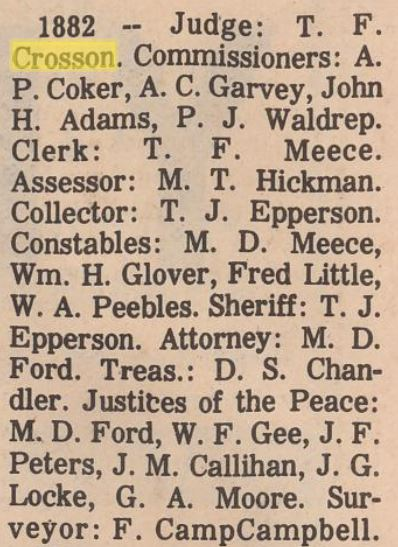
According to the Roll of Attorneys Licensed to Practice in the Supreme Court of the State of Texas, T.F. became an attorney in 1897 and he was licensed to practice in the Supreme Court of the State of Texas on August 10th,1901. It is my belief that T.F. apprenticed under Judge James Murray Crosson and/or his son. Thomas also studied law under his father and became an attorney in 1877. Thomas resigned from the office of County Judge in 1885 when he and his family moved to the town of Ballinger, TX in Runnels County.
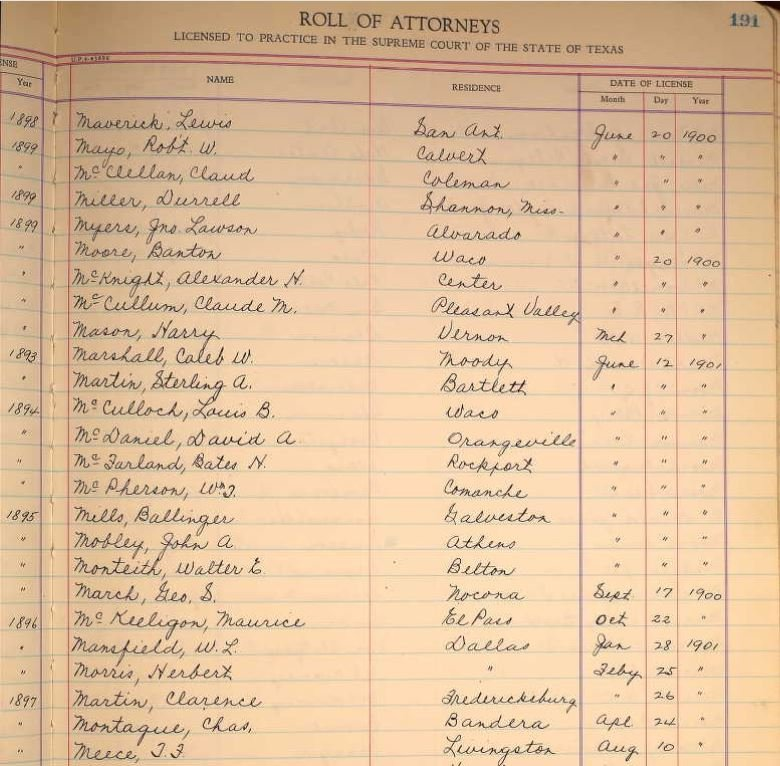
Interestingly, Judge James Murray Crosson was elected District Attorney, a position that Thomas held as well, in 1866 and “served with ability until removed by military authorities because an impediment to reconstruction, when he again resumed the law and continued therein until 1901, when he retired to private life and moved with his family to Ballinger, TX.”
Many people don’t realize this, but Livingston was the Headquarters for the Federal Army of Occupation 5th Military District with Co. A 15th Infantry and Co. B 6th Cavalry stationed there between 1867 and 1868. In another excerpt from The History of Polk County Texas, Emma R. Haynes Speaks of a young girl whose father had been killed in the Civil War. She “had to pass the Yankee Camps” but the school children were not bothered. She remembers that the soldiers were mean to their men. They were encamped in Livingston for about two years.”
On March 13th, 1882 an application, addressed to Judge Thomas T. Crosson, was filed by the citizens of Livingston to have the town incorporated. When a town is “incorporated”, it means it has been legally established as a municipality, granting it the power to govern itself and provide services to its residents. This involves a formal process where the town gains a charter from the state, creating a local government with defined powers and responsibilities. The document was signed by T.F. Meece as well as his father William Carrol Meece. At the time, the town had approximately 200 citizens.
Upon the retirement of Judge Thomas T. Crosson in 1885, Theophilus Franklin Meece was appointed county judge of Polk County. T.F. then ran for that same office in the elections of November 5th, 1886 and won the position by 3 votes, serving till 1888. Evidently, the candidate did not have to be a licensed attorney with experience in the legal profession, either through practicing law or serving as a judge. In 1886, a county judge in Texas earned a salary of $1,000.00 to $1,500.00 per year. The salary might have been supplemented by fees earned from court cases and other judicial duties.
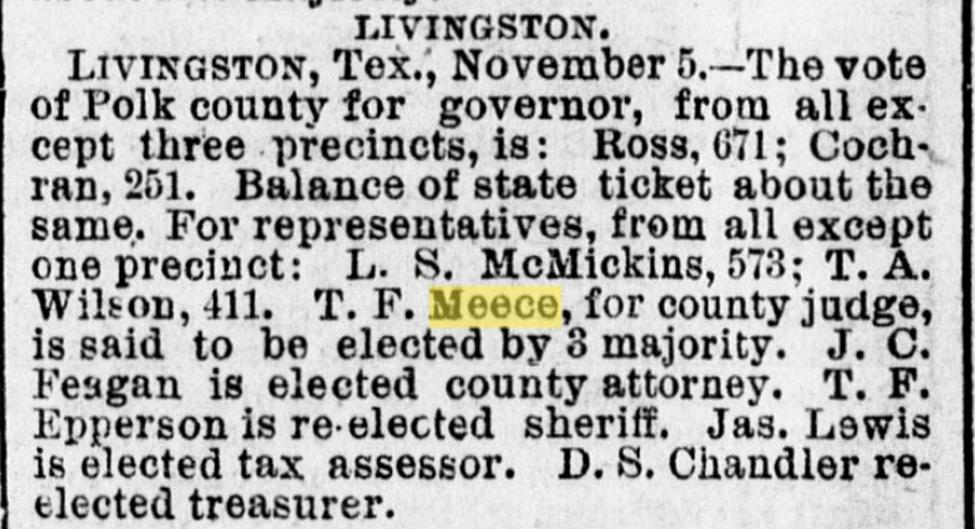
In his spare time T.F. was elected, by The Democracy of Polk County on August 11, 1874, as a delegate to the Congressional District Convention, to meet at Nacogdoches, TX on the first Tuesday in September, 1874. On May 12th, 1888 T.F. was nominated as a delegate to the Fort Worth delegation by The Democracy of Polk County.
“On motion of Judge T. F. Meece, resolved, that we endorse the course of the National Democratic administration and favor the renomination and election of President Cleveland.” In the 1888 election, Cleveland ran against Benjamin Harrison, winning the popular vote but losing the electoral college and therefore the election.
In the 1892 election, Cleveland defeated Harrison in both the popular vote and electoral college, returning him to the White House. He was the first Democrat to win election to the presidency after the Civil War and the first U.S. president to serve nonconsecutive terms. He was both the 22nd and 24th U.S. President. If you are thinking that this sounds somewhat familiar, you would be correct. Donald J. Trump was the 45th President of the United States and he is now the 47th President following the 2024 election.
On December 20th of 1884 T.F. was elected by the Livingston Lodge of the Knights of Husbandry as an officer, Vice-Dictator, for the calendar year 1885. “Knights of Husbandry” referred to the Order of the Patrons of Husbandry, commonly known as the Grange, a social and agricultural advocacy organization founded in 1867 to promote the economic and social well-being of farmers. The Grange aimed to improve the lives of farmers by promoting social interaction, advocating for fair prices and practices, and lobbying for legislation that would benefit the agricultural sector. The Grange played a significant role in advocating lower railroad rates (leading to the Granger Laws), rural free mail delivery, and other initiatives that improved the lives of farmers and rural communities.
A railroad meeting was held at the courthouse in Livingston on July 4th, 1877. The purpose of the meeting was to appoint committees, in each precinct of Polk County, to obtain additional donations for the purpose of securing a road to the towns of Livingston and Moscow on behalf of the Houston, East and West Railway Company . The chair appointed the following committees: For Livingston precinct Dr. J. H. McCardell, T. F. Meece and J. E. Hill. The central committee consisted of the following gentlemen: J. M. Crosson, J. P. Kale, T. F. Meece, Dr. J.H. McCardell and J. E. Hill. Perhaps, this is when T.F. first thought of owning a hotel, the Meece Hotel, directly across the railroad tracks from the H.E. & W.T. Railroad Depot.
In August of 1887, after more than thirty years of sharing a building with other denominations, Livingston Baptist Church purchased city block #41 from Mrs. Patience Watts and Mrs. Susan Hunt, with the owners contributing $25 of the $75 purchase price. The Baptists met in the Presbyterian Church until the building was completed early in 1888. D. W. Jackson, former missionary in Tryon Association, was pastor, and other church leaders were M. B. Stone, S. J. Andress, Andrew Peters, T. F. Meece, Joe Peters, and E. V. Doyle. Patrick Henry Bilbro, a resident of Colita, became the minister following Jackson. P. H. Bilbro also pastored churches at Jones Prairie and Colita. In 1890, Livingston Baptist Church had 60 members. T. F. Meece was the church clerk, and J. F. Peters and M. B. Stone were deacons.
Not to forget the farm, “Mr. T. F. Meece, Livingston, Polk Co., TX, writes on May 4th, 1880: I sowed Alfalfa in August last, or September, with turnips and black winter oats, all in drills. The ground was previously well prepared and well manured. Procured a fine stand of oats, turnips, and clover, all of which grew finely until the 24th of December, when we had a “Norther” of such severity as to kill the oats, and injure the turnips and other vegetation. The clover was not checked, is now in full bloom, and presents a sightly appearance. I am well pleased with it.” A sample of alfalfa in bloom, showing a very luxuriant growth, accompanied this letter.” On June 8th, 1877 “Mr. T. F. Meece has sent us a specimen of his sweet corn, which he planted about the middle of March. The ear is fully matured.”.
My 2nd great-grandfather, William Carroll Meece, and my great-grandfather, Theophilus Franklin Meece, were both members of the Trinity Lodge #14 of the Masonic Order. T.F. was Worshipful Master in 1878 and 1879. He attended the Livingston Academy shortly after his family moved from Tennessee in March of 1856. The school trustees were allowed to use the lower floor of the Masonic Lodge for school purposes. Ironically, the lodge was located at the site of the Old City Cemetery, which is where he, his wife and daughter are buried. This is a photograph of T.F. (above) that hangs in the Trinity Masonic Lodge #14 today. It took me several months to obtain a photograph of it but it was well worth the time and trouble.
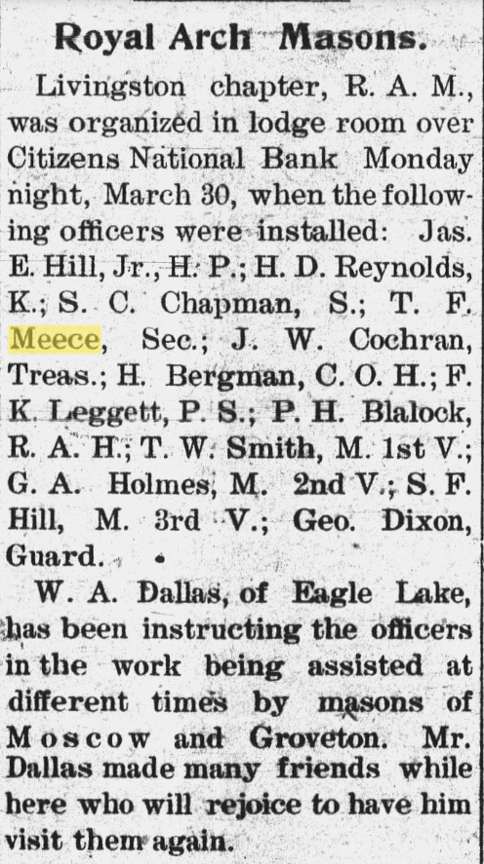
In addition to his freemasonry membership in the Trinity Lodge #14 of the Masonic Order, T.F. was also High Priest of the Royal Arch Chapter No. 295. The way I understand it, Freemasonry, also known as Craft Masonry, generally refers to the first three degrees (Entered Apprentice, Fellowcraft, and Master Mason) within the fraternity. Royal Arch Masonry, on the other hand, is a degree or order within Freemasonry that is often considered the completion of the Master Mason degree. The Royal Arch degree explores the spiritual side of Freemasonry, delving into the nature of God and the candidate’s relationship with Him. On top of all of this, T.F. was also a member of the Knight of Honor lodge, which has no affiliation with the aforementioned groups.
In August of 1878 a group of parents signed a petition to create a school community in the town of Livingston. T.F. was one of the signatories petitioning on behalf of his daughter Willie who was 9 and George who was 7. Calvin J. Fields, Hannah Bennett Fields’ brother, also signed the document on behalf of his son Thomas W. Fields who was 16 at the time.
In the midst of all of this, the Meece family would suffer their greatest loss. Their 14 year old daughter, Willie Uzell Meece, would pass away on January 21st, 1885. It is unknown what she died from but smallpox, tuberculosis and yellow fever were prevalent diseases back then. Other than that, we know nothing else about Willie. This heartbreaking tragedy would be followed by the birth of Charles Stewart Meece on February 19th, 1887 and the birth of Anne Corrine Meece on October 14th, 1889. It’s difficult to imagine the juxtaposition of the grief they felt at the loss of Willie and the joy they felt at the birth of Charles and Anne.
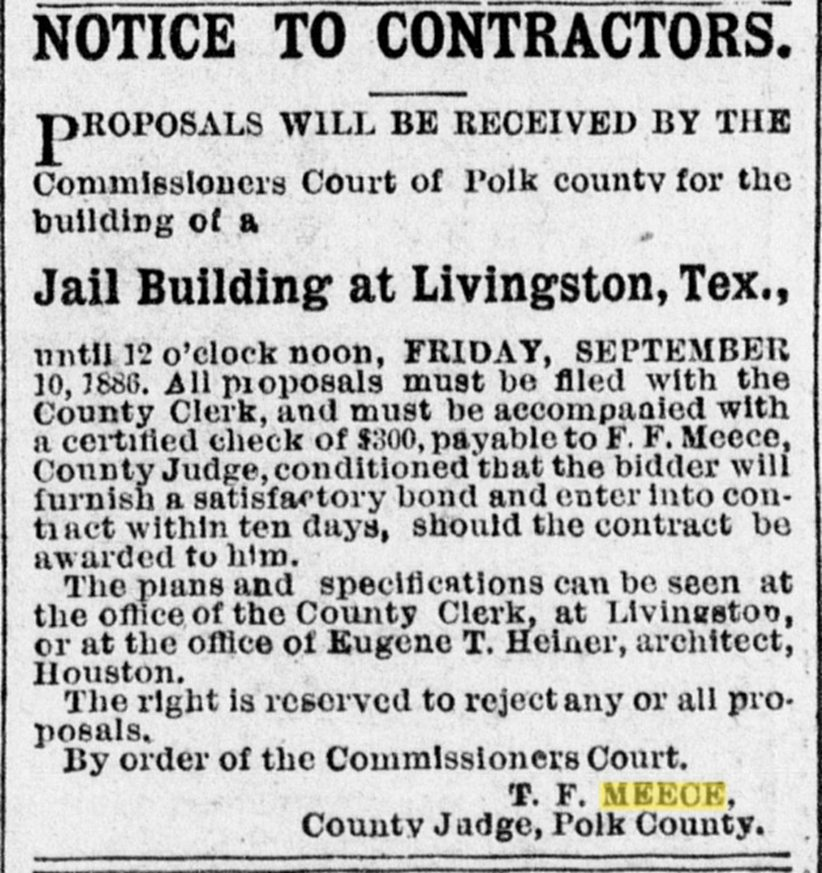
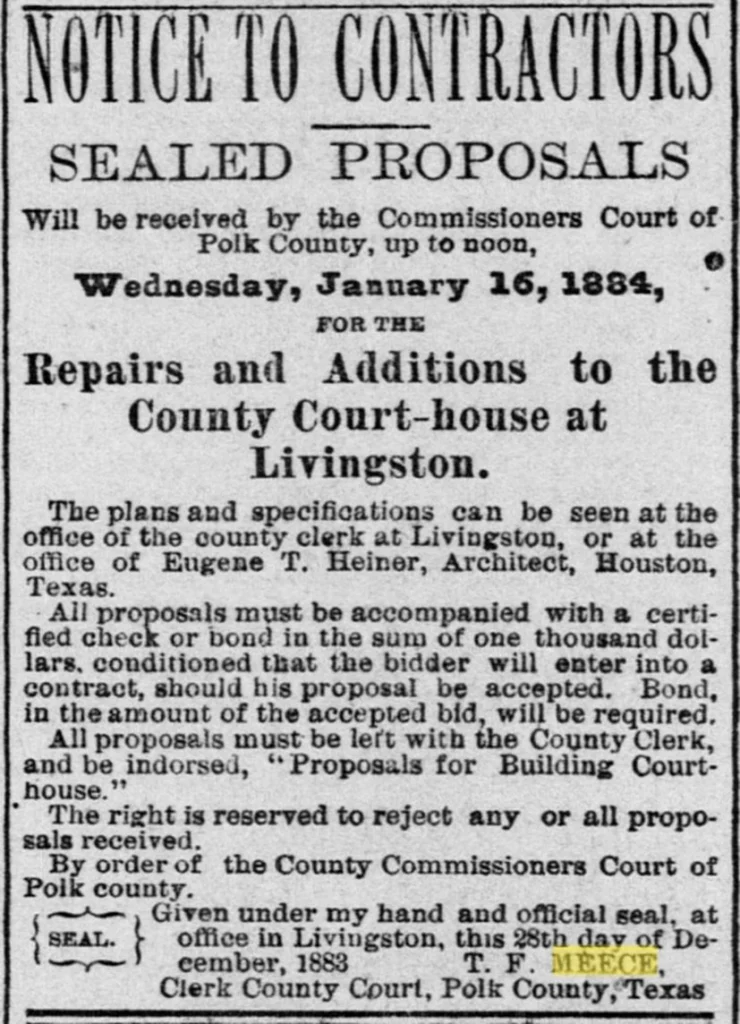
While Polk County Clerk and County Judge, T.F. would administer two fairly significant projects. One called for the repairs and additions to the County Courthouse in January of 1884. The second project was for the construction of a jail building in September of 1886.
The Houston East and West Texas Railway Company reached Livingston, TX in the fall of 1887. The company’s initials were said to stand for “Hell Either Way Taken.” On December 30th, 1887 T.F. purchased the Meece Hotel and the northern one fourth of Block 10 for $650.00. On January 25th, 1888 he purchased an additional portion of that same block for $160.00. The location of Block 10 is identified on the Sanborn Map Company map. These maps were created to allow fire insurance companies to assess their total liability in urbanized areas of the United States.
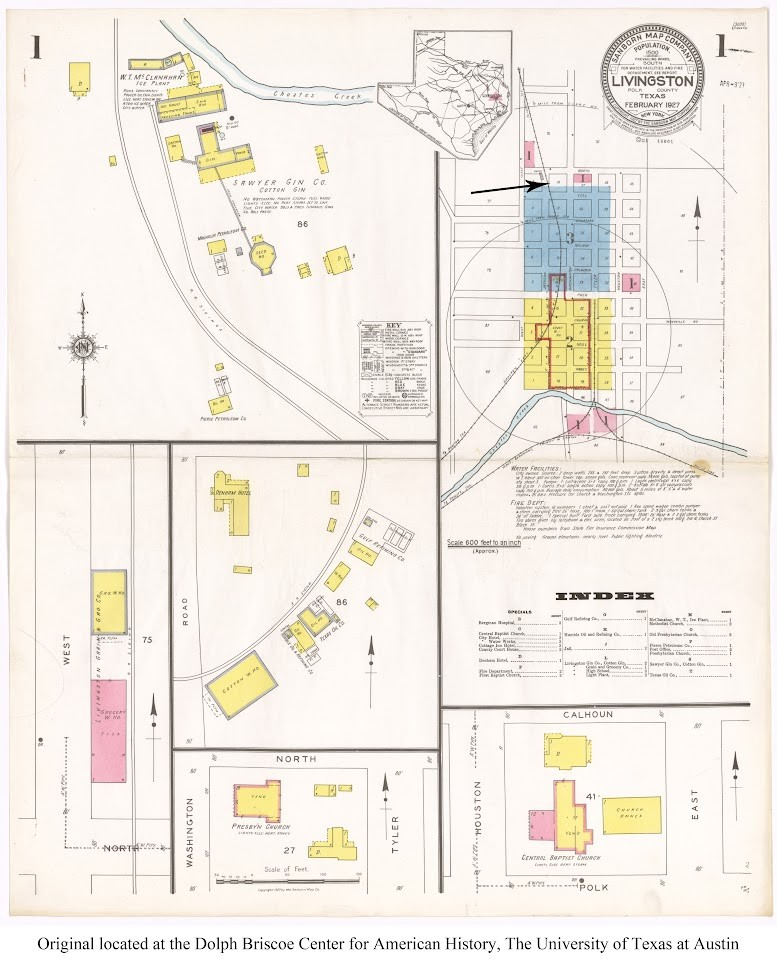
The Meece Hotel was first associated with T.F. Meece in 1888 when a Polk County Newspaper described him as a merchant, land agent and owner of the hotel. T.F.’s first mention of the hotel was in an article in the East Texas Pinery dated 09/15/1892. It was an advertisement under T.F. Meece’s Column. The East Texas Pinery was a weekly newspaper first appearing in 1882 and operating until 1898.
The following is an article published in the East Texas Pinery on Thursday, August 2nd, 1894:
T. F. Meece’s Column
T. F. MEECE.
LAND and GENERAL AGENT, Livingston, Polk County, Texas. Will buy, sell, lease or rent lands, pay taxes; redeem from tax-sales; furnish abstract, correct reports of value, location, etc. Will also write deeds, mortgages or other instruments; negotiate loans, collect claims, register and collect jury or county warrants.
Pine, Cypress, Walnut and the hard timbers a specialty.
Persons wishing to purchase or lease lands on the A. Viesca surveys can do so by calling on or addressing me at Livingston, and all persons occupying any part of same without proper authority will please correspond with or see me at once.
Buy improved implements and save labor and time, as well as double and treble your products, The best cultivators and planters can be had by applying to me, cheap for cash or on fall time at reasonable prices. Payment to be secured by proper lien.
2759 acres Geo. W. Toliver survey, in the southern portion of the county, several small improvements on tract, title good, terms to suit purchaser.
1230 acres Joseph Morgan league, on and near railroad, 3 miles south pf Livingston, heavily timbered with pine, white, etc.,
300 acres N. D. Labodie, 2 miles east of Phoenix, title good, terms easy.
810 acres Isaac H. Pate league, on Menard’s creek, about 7 miles east of Livingston, improved, title complete.
160 acres Isaac Parker league, pear railroad, 5 miles south of Livingston, good timber, title good, cheap for cash.
320 acres-R. B. Honnay survey on Menard’s creek, 19 miles south of Livingston, title perfect.
1000 acres John Lindsey league. fine timber, on Long King creek, 5 miles north of Livingston, regular chain of tile, terms and prices reasonable.
558 1-2 acres Thomas Burris, league, being in the southwest portion of survey fronting on Trinity River, title good, terms easy.
Parties wishing to purchase cheap lands should correspond with me as I have several tracts offered at low figures, cash or part cash, with interest on time payment.
Those wishing to save time and labor in putting in and cultivating their crops can do so by purchasing a strictly first-class corn and cotton planter, which they can do by calling on or addressing me at Livingston.
All planters guaranteed to do better work and more of it in a day than three men and horses can do with the old style of planting in same time.
I am agent for some of the best Insurance companies in the United States and also the largest in England. Great care is taken in writing up policies so that no trouble is had in the adjustment of losses and damages. The following is the list of companies I represent, and would be glad to correspond with parties desiring policies.
East Texas of Tyler, Hibernia of New Orleans, Sun Mutual of New Orleans, Western Home of Sioux City Iowa, Liverpool, London & Globe, and solicitor for The Fire Association of Philadelphia.
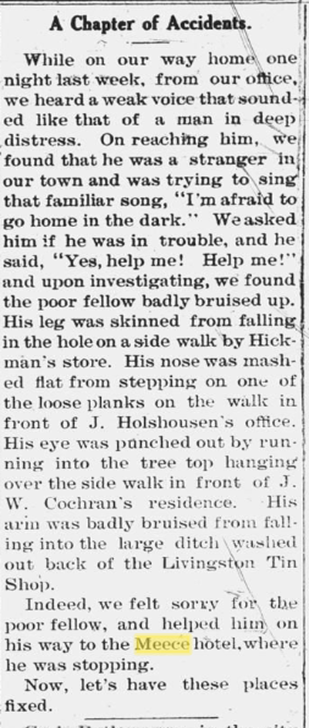
The Meece Hotel is just opposite the depot, where travelers and passengers could get a hot meal at any hour, the best the country affords at reasonable prices.
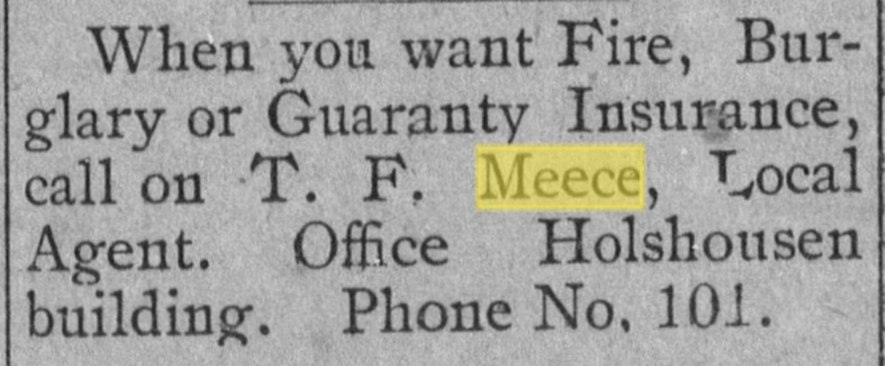
A separate advertisement for the insurance business read as follows:
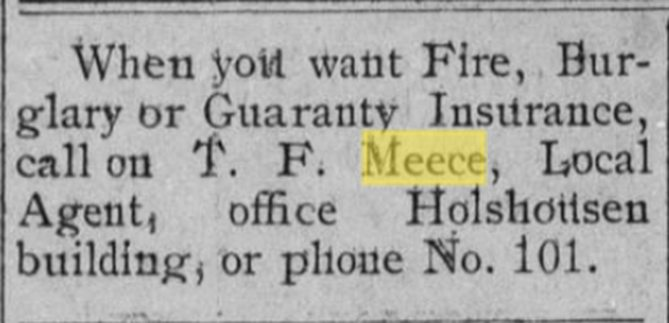
When you want Fire, Burglary or Guaranty Insurance, call on T. F. Meece, Local Agent. Office Holshausen building. Phone No, 101.
Apparently, a local journalist took issue with T.F.’s Column and published this rebuttal:
The local contributors to the Pinery could have been anyone who could pen a few interesting words, and often they were politicians with a platform to promote. The Pinery carried a column by T.F. Meece called simply “Meece’s Column”, which was a listing of real estate on the market. Politicians would write an item to explain some current issue as he saw it, without the intervention of an objective, disinterested journalist.
On the other hand, he received ringing endorsements from the paper:
T. F. Meece
No man in Polk County has been more intimately associated with the history and affairs of the county and for a longer time than Judge Meece. He has served the county in a number of official positions, including county judge, county clerk, sheriff and representative, and in every capacity proved himself to be an efficient public servant and worthy of the trust and confidence of the people. Judge Meece is at present engaged in the real estate and insurance business, and no one is better prepared to furnish information regarding the lands of Polk County and conditions prevailing here than he is. Those who contemplate investments would do well to correspond with him.
JUDGE T. F. MEECE
A Well-Known Real Estate and Insurance Agent.
If any town is to progress and develop as it should it is highly essential that its citizenship should include a capable and reliable Real Estate and Insurance agent. Livingston has such a man in the person of Judge T. F. Meece.
Judge Meece is one of the pioneer citizens of Polk County and is widely known as a high toned, honorable gentleman, worthy of any trust imposed in him. He is thoroughly familiar with land values in this section and can render valuable service to those who desire to buy or sell real estate. He is also an Insurance Agent and represents some of the strongest and most reliable Fire Insurance Companies of the world.
In addition to Judge Meece’s calling as a Real Estate and Insurance Agent, he is a licensed attorney and is particularly well versed in the laws pertaining to Real Estate, to which branch his practice is mainly confined.
He is an affable, courteous and accommodating gentleman, and a thoroughly progressive citizen who supports enthusiastically and courageously any cause which he is convinced will inure to the benefit of his town, County and people.
On the local front, T.F. and Amelia produced their youngest and final child, Brown Louis Meece, my grandfather. He was born on September 27th, 1891. In total they produced (11) offspring.
According to The Hays County Times And Farmers’ Journal (San Marcos, Tex.), Ed. 1 Friday, February 20, 1903, T.F. was reported to have cancer at the front of his ear.
T.F. was elected representative of the Thirty-fifth District and served in Twenty-seventh Legislature, one regular and two special sessions. The Hon. Theophilus F. Meece of Livingston represented, in the Twenty-seventh Legislature, the counties of Polk and San Jacinto, which compose the 35th legislative district. In his race for the Twenty-seventh Legislature, he was nominated without opposition and without solicitation on his part, but he was opposed in the general election by a Populist candidate, whom he defeated by 501 votes. The regular session lasted from 01/08/1901 to 04/09/1901. The two special sessions lasted from 08/06/1901 to 09/04/1901 and from 09/05/1901 to 10/01/1901 respectively.
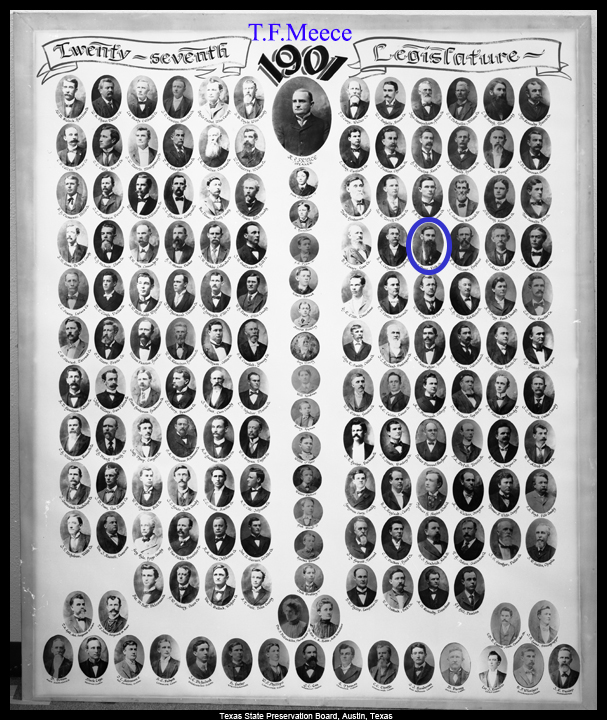
T.F. was on the House Committee on Irrigation, House Committee on Judicial Districts, House Committee on Penitentiaries, House Committee on Railroad Commission and the House Committee on Roads, Bridges and Ferries. “Mr. Meece possesses much positiveness of character, but is yet of a quiet and unobtrusive disposition, and at the close of his two years’ service in the capacity of representative, his record will show to his constituents that they have chosen well.”
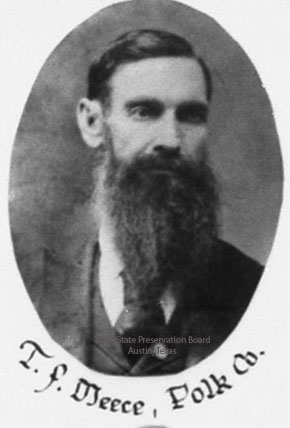
T.F. shared a desk, and sponsored legislation with, a gentleman by the name of Robert Reuben Williams. Williams was also a member of the 33rd and 34th Legislatures. It does not appear that either one of them, as freshman House members, proposed any sort of groundbreaking bills. True to form T.F. co-sponsored a bill regulating liquor sales. The Houston Daily Post took T.F. to task publicly in an article entitled Omissions of the Legislature. Surprisingly enough, T.F. stated that he did not regard Williams as capable of filling the office of Governor of the State of Texas in a later election. The City of Livingston agreed and his opponent, Thomas Mitchell Campbell won the election, serving two terms.
In 1890 the Democratic representative convention of the Second district, Polk and San Jacinto counties, convened in Livingston on August 7th. L. F. Gerlach was elected chairman and T. F. Meece secretary. T.F. was elected County Chairman for a term of two years to the Democratic County Convention in May of 1896. He represented Polk County as President under the State Bureau of Immigration of Texas. In November of 1903 T.F. was appointed to a committee of the Commercial Club to study a rail connection between the Houston East and West Texas Railway Depot and a proposed sawmill East of and near town.
Livingston Commercial Club met.
“The Livingston Commercial Club (Chamber of Commerce) met Thursday, Oct. 1, 1908 at the courthouse. It was one of the most interesting sessions that has been held since the organization of the club. A. M. Turnbull was elected an honorary member of the club. Motion prevailed that the chair appoint a committee to secure the listing of lands for sale with the Commercial Club. C. A. Noblitt, T. F. Meece and S. H. German were appointed on the committee.”
I’m not sure how much commercial farming T.F. did, obviously, he farmed for subsistence to feed his family. After the Civil War, Southeast Texas’s agricultural market transitioned from a slave-based plantation system to one dominated by tenant farming and sharecropping. Farmers faced challenges such as falling prices, rising costs, and high interest rates, making it difficult to make a living. The expansion of railroads played a significant role in connecting Southeast Texas to markets, facilitating the transport of agricultural products. This helped to ease some of the financial challenges.
In 1880 T.F. spoke of growing crops of alfalfa, black winter oats, turnips and corn. Much of it was destroyed by a winter storm. Alfalfa is a major source of nutrients for a wide variety of animals but “pasture bloat” (gas) can cause serious health issues. It’s a highly productive crop and it can be used as a cover crop in crop rotations because it helps retain key nutrients in the soil. It also helps to prevent soil erosion.
In 1896 his son James sent a trial shipment of radishes by express to Denver, CO, Lincoln, NE and Nebraska City, NE. They packed them in barrels ice to preserve them in good condition while enroute to their destination. This was done in the hope of opening a new industry in Polk County. The same was true of experimental tobacco crops.
According to an article published in a local paper in March of 1898:
“Considerable talk of experimenting with the tobacco industry is being indulged in by our people who are tired of raising 5c cotton, and probably quite a lot of the finer grade tobaccos will be planted, many believing that the soils here will be very fine for its growth. (The price of cotton soared from 10 cents a pound in 1860 to $1.89 a pound in 1863 & 1864 due to the Civil War.) This week’s “Local” contains a letter from H. H. Craig, of Kansas City to T. F. Meece, of this place, proposing to furnish seed and pay half the expenses of cultivating an acre of fine grade tobacco as an experiment, and will make such arrangement with several farmers. Mr. Craig has some land in this county and thinks that tobacco, fruit and vegetable gardening as a diversity will greatly assist in developing our county.”
On January 8th, 1898 T.F. would lease 640 acres from Mrs. Mary Montgomery for pasture purposes only. The term of the lease was for one year in the amount of $32.00. Payment was required every (6) months in the amount of $16.00. It would appear that T.F. was moving away from agriculture and towards raising livestock. Cattle and cotton production dominated farming operations throughout the remainder of the 19th century. It also seems that T.F. did not retain his father’s farm of 1,100 acres. Perhaps it was sold and the money distributed to the three remaining children. It may have been deeded to his 2nd wife Nancy Burroughs. I have discovered a total of (102) property transactions made by T.F. Meece. I have only reviewed a fraction of those. I am sure that the Polk County Clerk’s Office will be more than happy if they never hear from me again.
As an aside, and quite likely a hobby, T.F. would compete in the Auditorium Exhibit in Houston, TX under the sugar and tobacco exhibits presenting two Japanese persimmons in December of 1987. On October 29th, 1908 the local paper printed the following:
A Large Persimmon
“Judge T. F. ‘Meece presented to us last week a Japanese persimmon that eclipses anything in the persimmon line we have seen. It weighed 1 1-4 pounds and measured 13 inches in circumference. The tree from which it grew is in Judge Meece’s yard. This shows that the finest fruit can be raised in this section.”
A dispute arose over representation in the State meetings of the Baptist Church. The old plan favored equal representation in the State Assembly and the new plan was based on contributions to the missions. The Livingston Baptist Church, which would become the Central Baptist Church, favored the new plan. Those who held to the old plan met and organized the First Missionary Baptist Church, which would eventually become the First Baptist Church of Livingston, on September 25, 1904. Reverend Phil H. Bilbro was the supply pastor. Brethren Doyle, Meece and Stone were named deacons. T.F., Amelia, Annie and Brown were charter members.
Sometime between the start of the First Baptist Church of Livingston in 1906 and T.F.’s death in 1914, he presented the church with a silver decanter for communion services. My family initially attended the Bethel Baptist Church, reportedly the oldest church in Polk County, when they first arrived from Tennessee. The church is still in operation today adjoining the Bold Springs Cemetery where many of my relatives are buried. The Pastor is Brother Harold Isaacs. He has been a big help with my research.
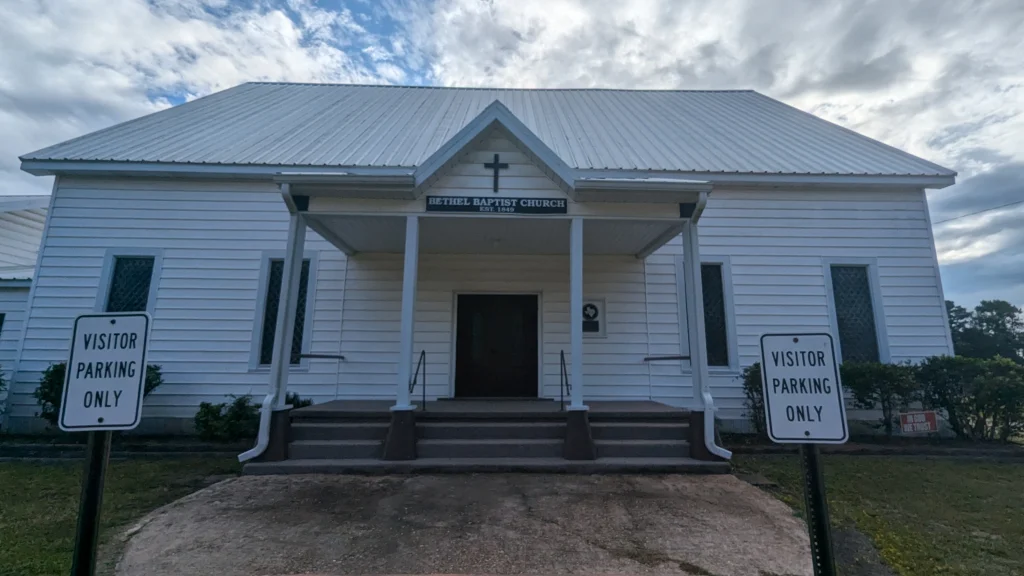
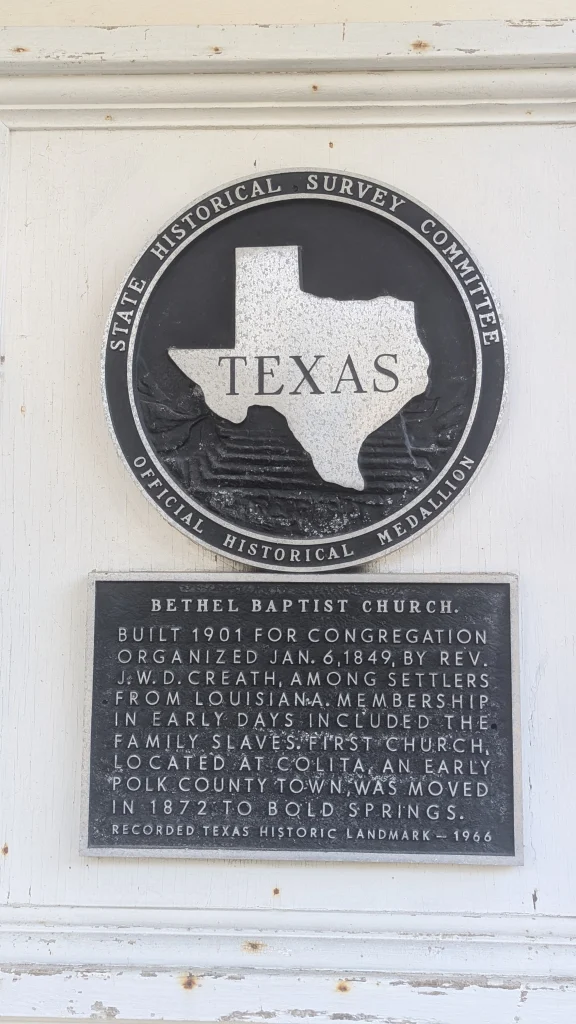
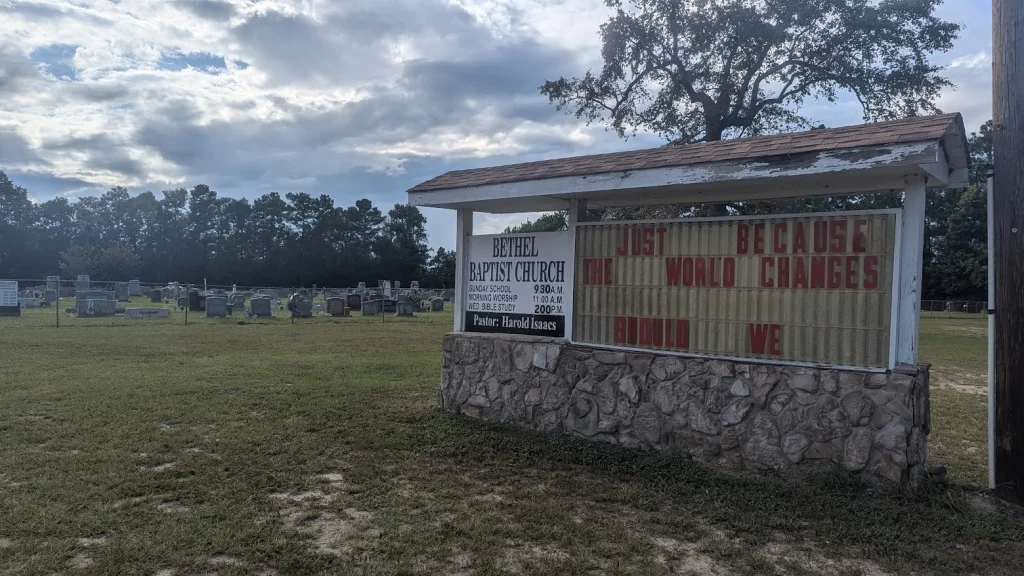
Initially the Baptists shared a church, prior to the split, erected under the auspices of the Methodists in the 1870’s, which was built on the lot of the Old Livingston Cemetery. My great-grandfather T.F., his wife Amelia Antoinette Brown Meece and their daughter Willie Uzell Meece are buried there in the Old City Cemetery.
Following his various stints as a public servant T.F. sold insurance through numerous companies. He was also described as a real estate broker and abstractor. A real estate broker facilitates real estate transactions, like buying and selling homes, while an abstractor researches and summarizes the ownership history of a property to create an abstract of title. He was also labeled an attorney at law, land and insurance.
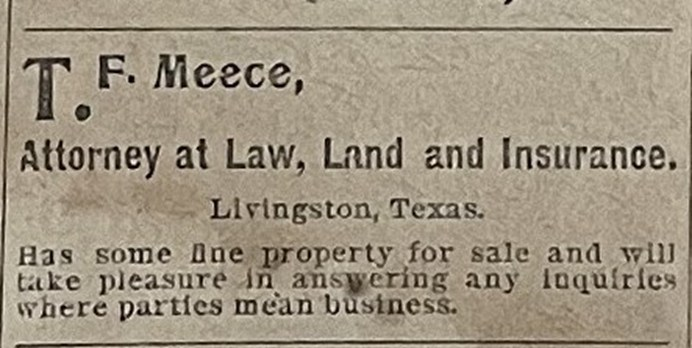
Intriguingly enough, T.F. represented the properties of William McLean Goodrich who was a wealthy New York land speculator from Poughkeepsie, New York. William McLean Goodrich moved to New Orleans, LA as a child in 1850. He eventually became a partner in a law firm that his father founded. He ultimately returned to Poughkeepsie, New York where he died on January 19th, 1881 at the age of 74.
In April 1881, the Houston, East & West Texas Railroad extended its line from Urbana in San Jacinto County, across the Trinity River and into previously unsettled timberland of Polk County, to a point approximately two miles from the river. The railroad contractor named this first Polk County railroad stop, Goodrich Station, in honor of William M. Goodrich, who owned the land. In the end, the town was named after him.
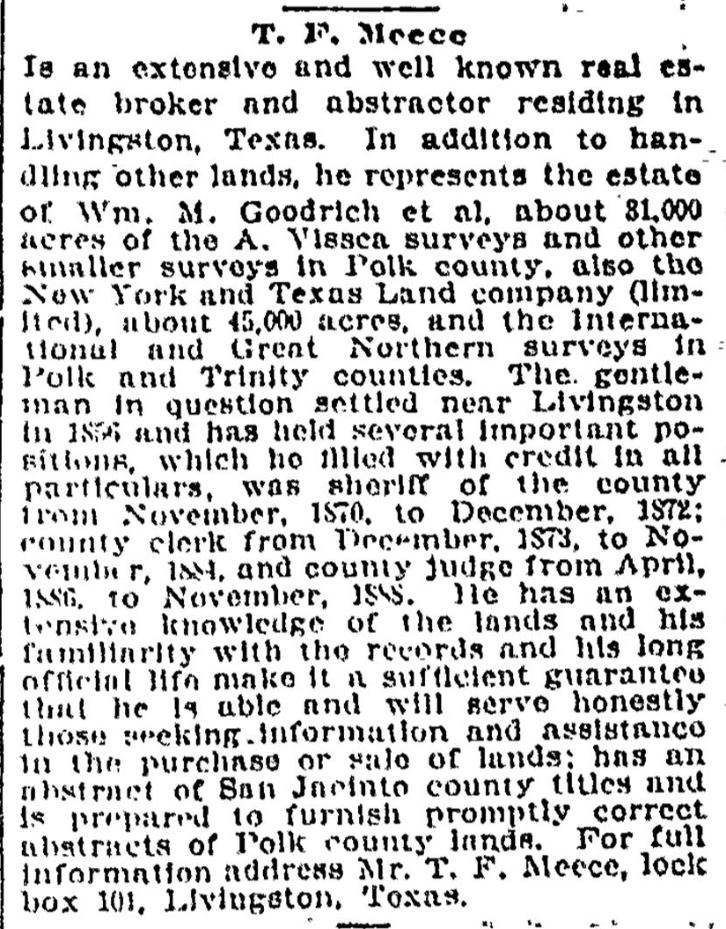
It is unclear how William and T.F. met each other. They could have met one another through his real estate business, his legal practice or possibly a contact with the Houston, East & West Texas Railroad. Who knows? I’ve attached a tribute to Goodrich, which was written in New Orleans:
Death of Wm. M. Goodrich:
One by one our old citizens fall by the way. Few men wore ever better or more favorably known to the citizens of New Orleans and the surrounding country than Wm. M. Goodrich, who departed this life at Poughkeepsie, N. Y., on the 19th last. More than half a century ago he became a partner in the firm which his father founded, in conjunction with Mr. Hyde, under the widely known name of Hyde & Goodrich, and which still exists in this city under the name of its successors, A. B. Griswold & Co. Mr. Goodrich was a consistent member of the Episcopal church and for a number of years a vestryman in the church over which his brother, Rev. Charles Goodrich, presided as rector. It was greatly owing to Mr. William Goodrich’s munificence that the congregation of St. Paul’s wore enabled to build their present handsome church structure on the corner of Camp and Gaiennie streets.
As a citizen, Mr. Goodrich took the liveliest interest in the welfare of this city, even long after it had ceased to be his place of his residence. As a merchant, he has passed off the stage of life without even the semblance of a stain on his commercial name. In the trying times of the great crash of 1837 the house became heavily involved, but came out of it all with flying colors and not a dollar of indebtedness unpaid. As a churchman, he bore an unblemished character and was always a great worker. It was while ministering to the enjoyment of a mission Sabbath school which he had established in his neighborhood, at a Christmas festival, that he took a severe cold, which terminated his life. He leave a wife and three daughters, to whom we tender our most heartfelt sympathies in their great bereavement.
T.F. Also represented the New York and Texas Land Company. It was one of the largest privately financed land companies to operate in post-Civil War Texas. It was formed when all the land owned by the consolidated International-Great Northern Railroad Company was transferred from the Texas Land Company and deeded to (3) individuals in New York State. Perhaps, these three gentlemen had some sort of business relationship with William Goodrich. In addition to all of the local properties, T.F. had quite the real estate brokerage business.
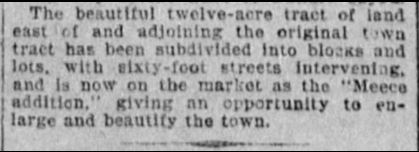
According to the attached article from the Houston Post dated March 19th, 1899 T.F. purchased this 12 acre tract with the idea of creating a subdivision called the Meece Addition. It exists today. We visited this area on Labor Day weekend of 2024. The neighborhood appeared a little sketchy. There is an old home on the corner that is advertised as a tattoo parlor. Gary Davis told me that at one time it was a nice neighborhood. He believed that the tattoo parlor was once a funeral home.
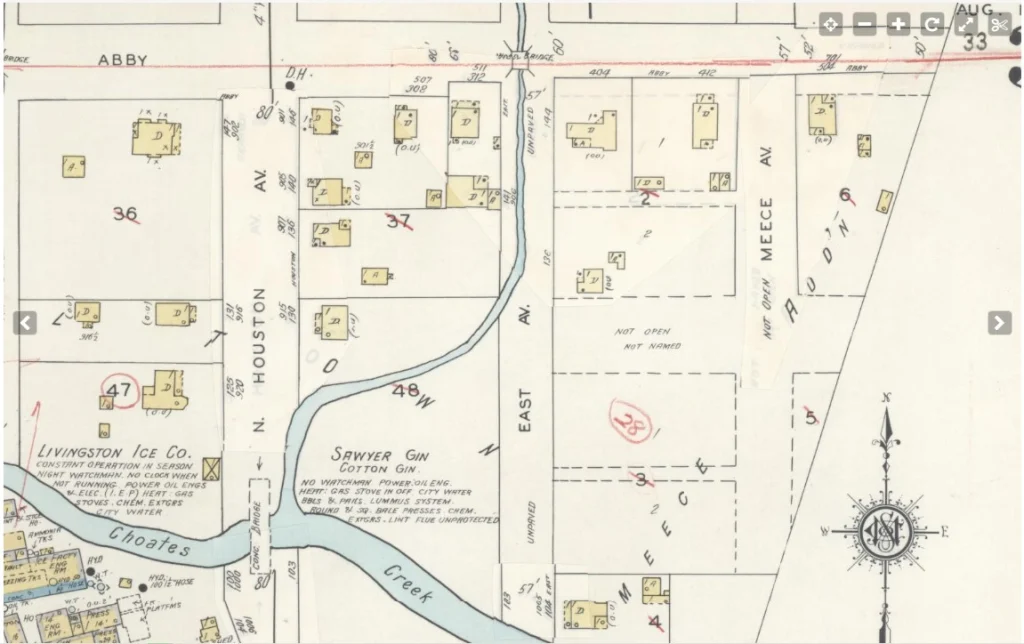
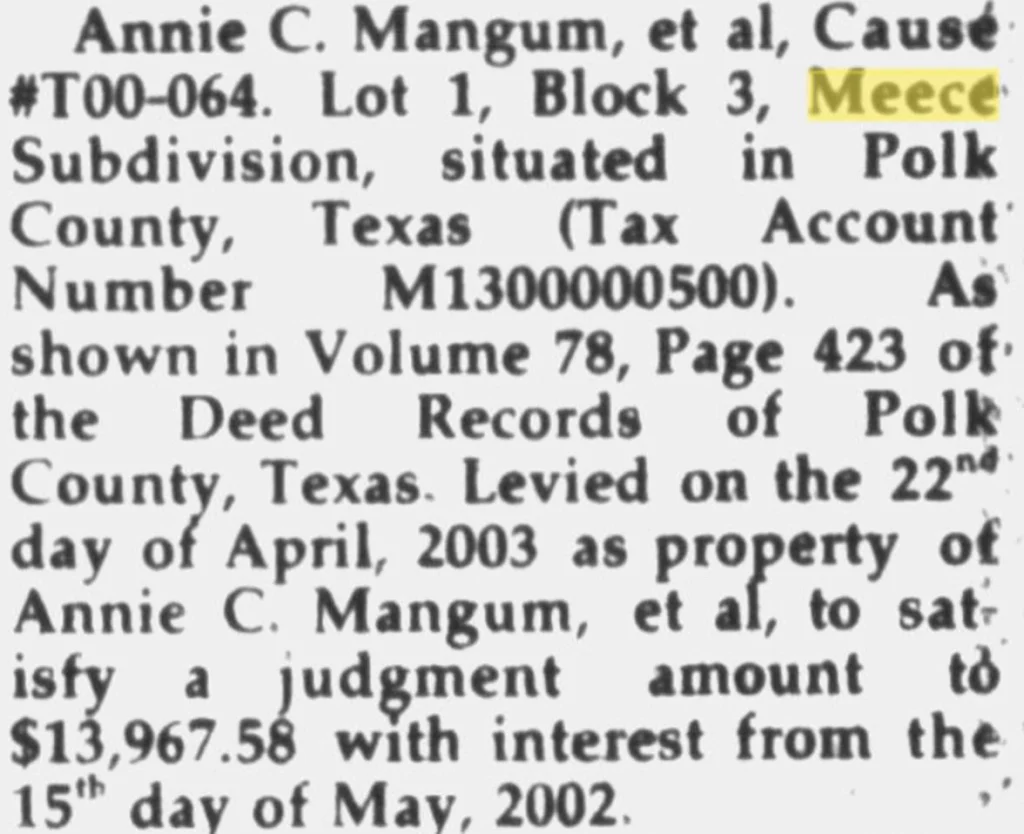
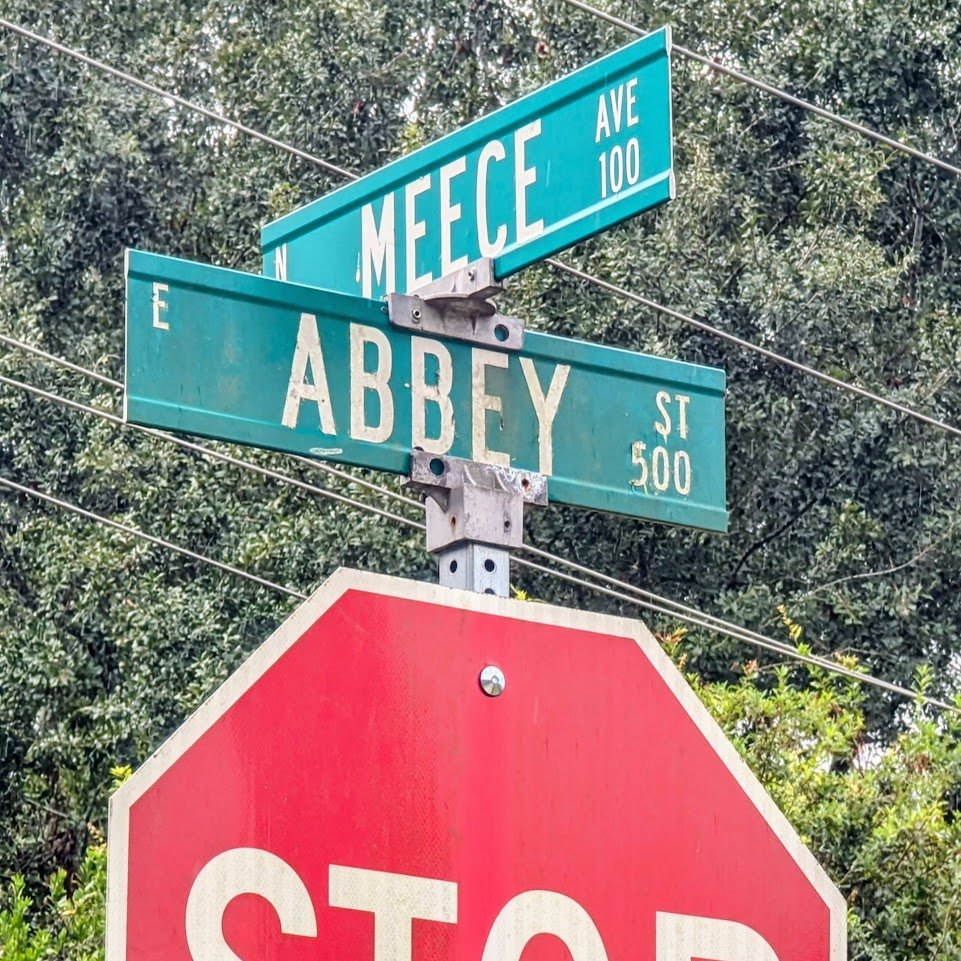
The Meece Apartments are located directly across from the tattoo parlor on Meece Avenue. The permit approving the construction of the Meece Apartments was approved by the Livingston City Council on 03/13/2008. I know absolutely nothing about the development of the Meece Addition. I found a newspaper article dated 05/11/2003 taking property from Annie C. Mangum et al, to satisfy a judgement against her in the amount of $13,967.58 with interest. This is Anne Corrine Meece, who was T.F.’s youngest daughter. She married a Mr. Thomas Milton Mangum. Annie passed away in 1954.

I had mentioned in an earlier narrative that T.F. had his own column, T.F. Meece’s Column, which was published in the East Texas Pinery. It was a weekly paper that was first published in the town of Moscow, TX. At one time Moscow was the largest town in Polk County. In its heyday, it boasted cotton gins, sawmills, saloons, a hotel, a food cannery and an architectural column factory among other businesses and shops. Moscow actually had a mule-drawn streetcar that transported people from the business district to the railroad depot.
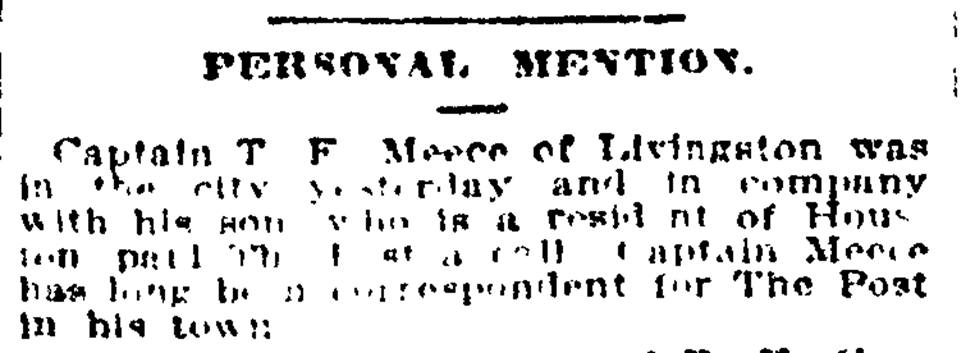
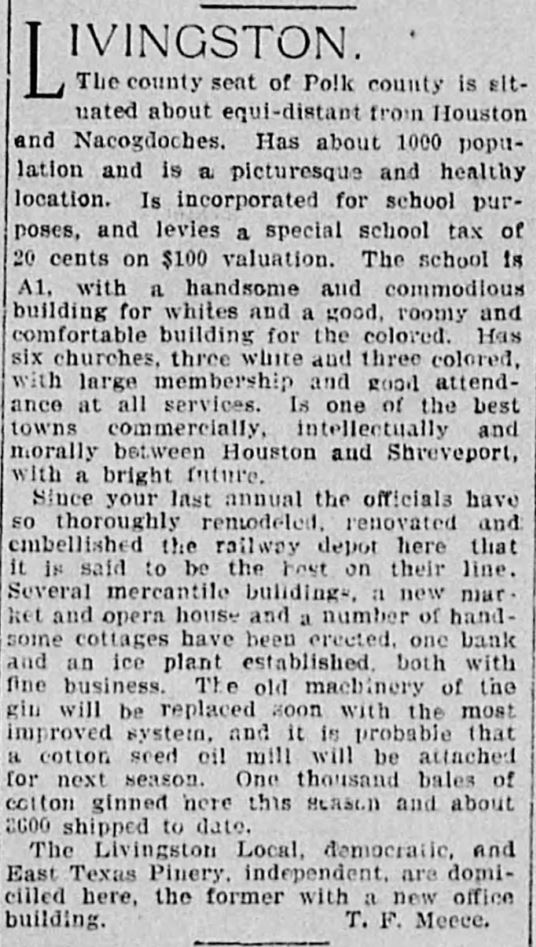
Additionally, T.F. became a local correspondent for the Houston Daily Post. He quite likely had articles printed in various regional papers such as the Dallas Times Herald, Dallas Morning News and the Galveston Daily News or Galveston Tribune. There was always something written about or by him in the Polk County Enterprise. I’ve included an article he wrote promoting the City of Livingston. It will make you want to move there.
As a businessman, T.F. operated out of the Holshousen building. Claiborne Holshousen’s son Joseph was a native of Polk County, born Aug. 11, 1849. He was educated in Lexington, Kentucky. After serving as county attorney, Joe became a lawyer in February of 1871 and he was a member of the law firm of Feagin & Holshousen. He went on to open his own firm and eventually formed a legal partnership with S.H. German.
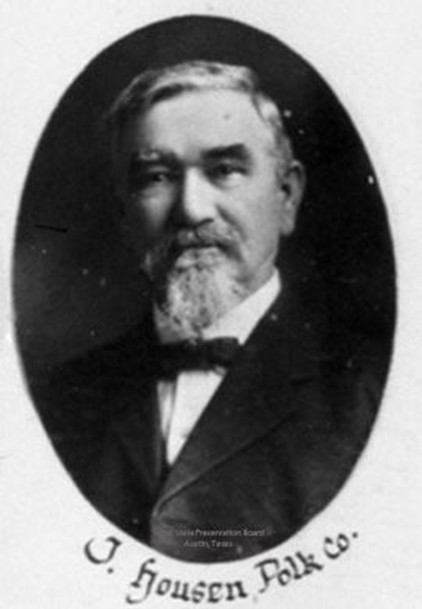
He was also trained in civil engineering and ultimately became a very prominent public figure in Polk County. He served on the school board, city council, and as county surveyor from 1870 to 1872. In 1878 he was elected county judge, a position that his father had held in the 1840s. Joe resigned from his first term, but he served another term from 1878 to 1882 and a third term from 1898 to 1902. In 1906 he was elected to the 31st Texas State Legislature. He also served as a member of the Board of Directors for Citizens National Bank of Livingston and he was a Vice-President of the First National Bank. He died on April 7th, 1915 at the age of 65.
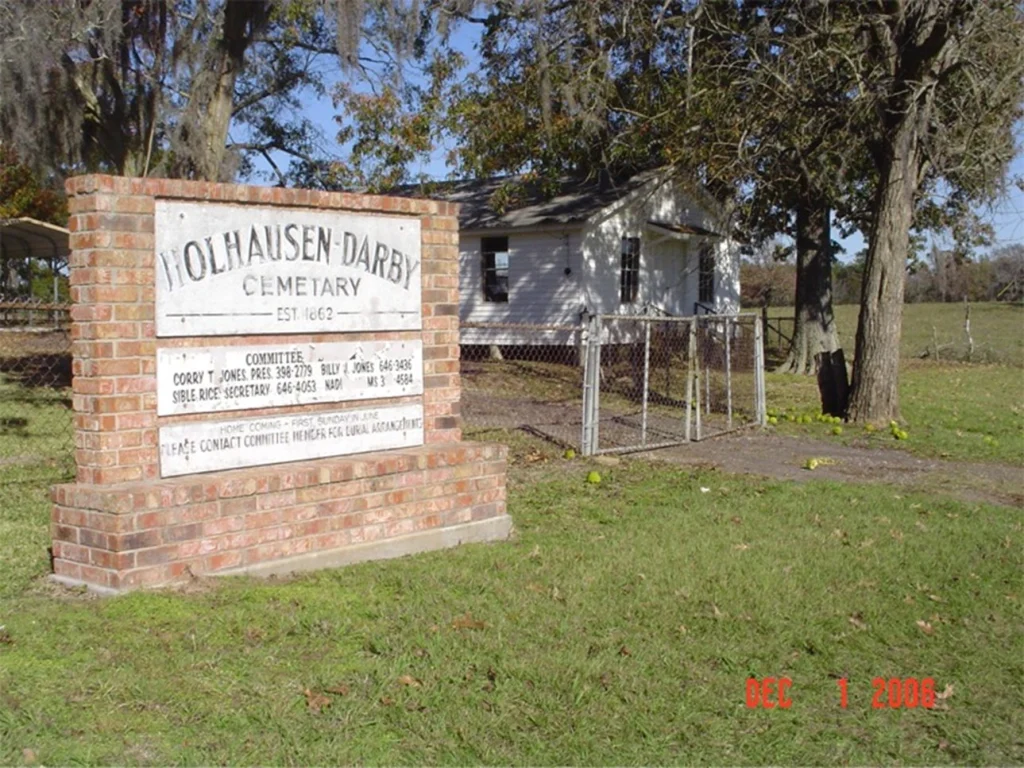
His father Claiborne was famous in his own right. He was a veteran of the Texas Revolution, and he was one of a group of men instrumental in organizing Polk County in 1846. He became the County’s first Chief Justice (County Judge). He died on April 25th, 1889 and he is buried in the Holhausen Darby Cemetery. Don’t ask??? You would think that they would have gotten the spelling correct when the cemetery sign was first installed.
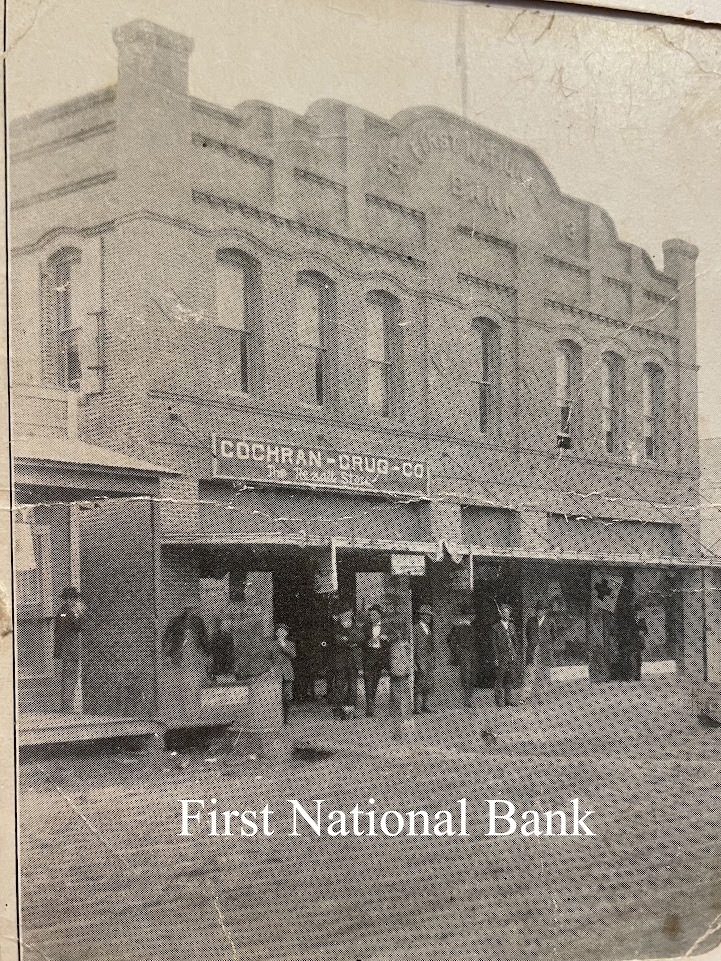
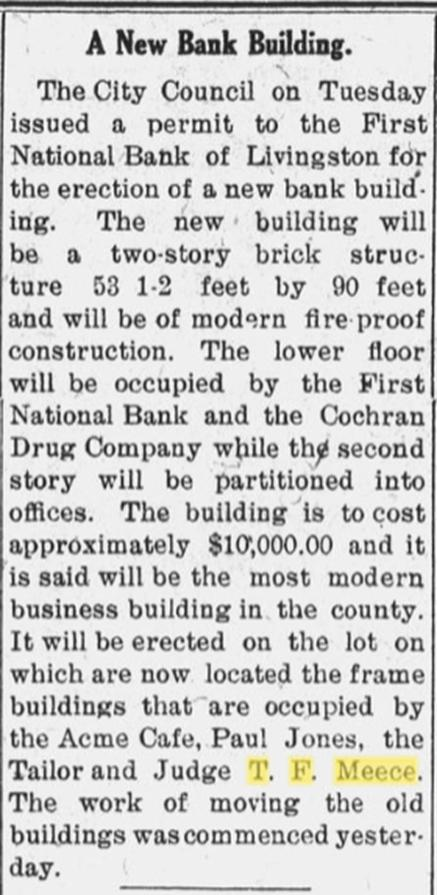
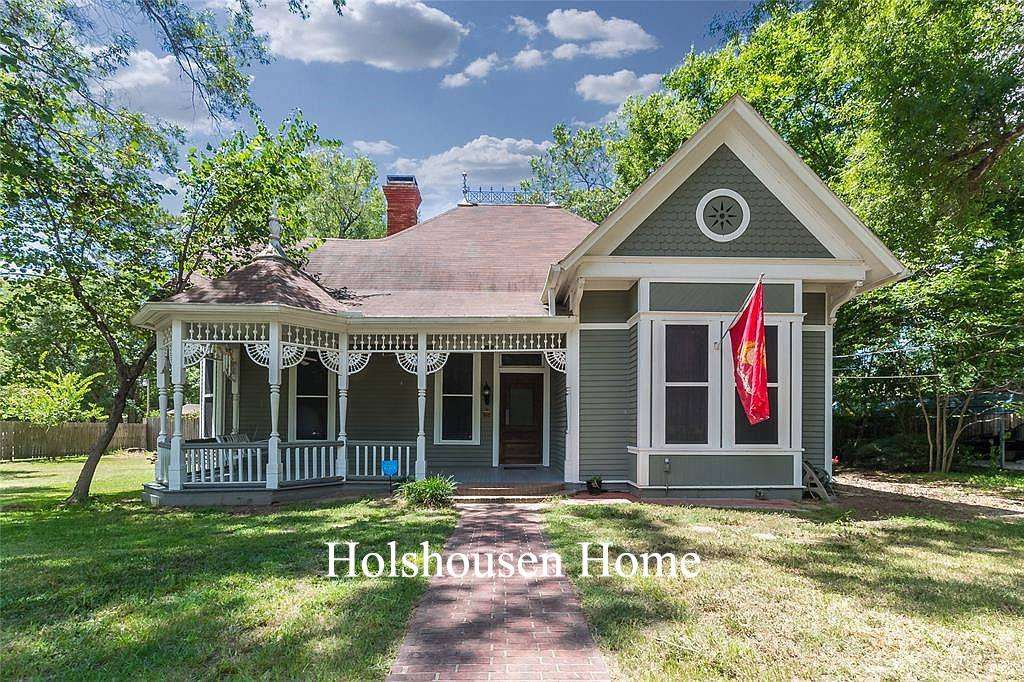
It is believed that Joe operated out of his namesake building as well. At that time the Holshousen Building, which still exists today, was located on Block #15 Lot#3. In the attached article entitled “A New Bank Building”, which was dated 07/13/1913 the Holshousen Building was being moved to make way for a new bank building. The Holshousen Building is currently located at 408 N Jackson Avenue. Amazingly enough Holshousen’s home is still intact. The house was originally located at 721 N Beatty, but it was moved to its present location, 725 Oakhurst, by rolling it on pine logs.

The Holshousen Building was remodeled by and is currently owned by local historian, Mr. Gary Davis. He’s done a wonderful job. The City of Livingston and Polk County should be grateful to Gary for the restoration and preservation of a building that has such cultural and historical significance. Unfortunately, kids today have little interest in history and tangible links to the past.
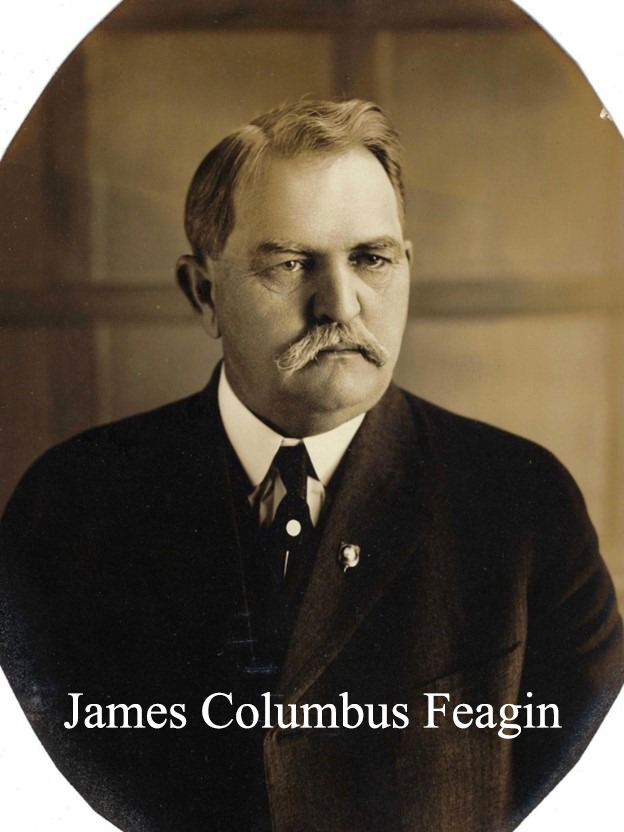
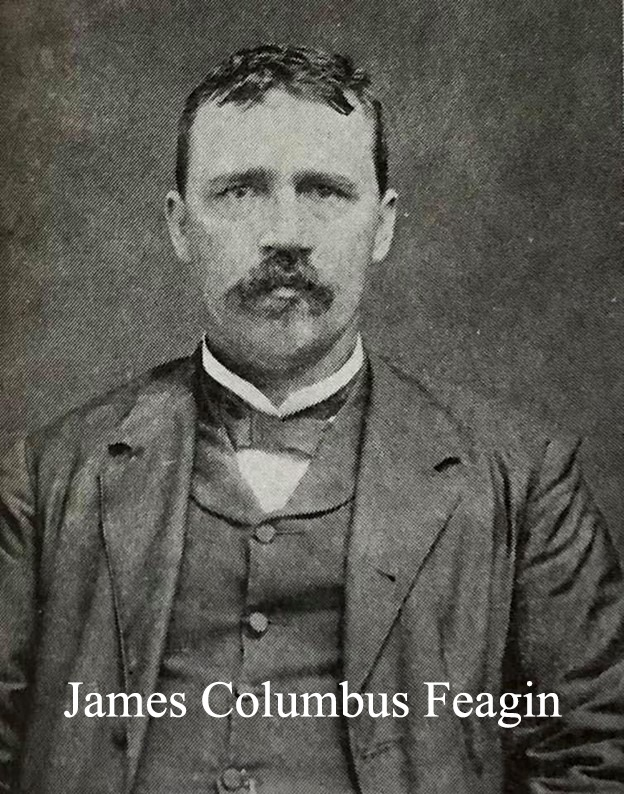
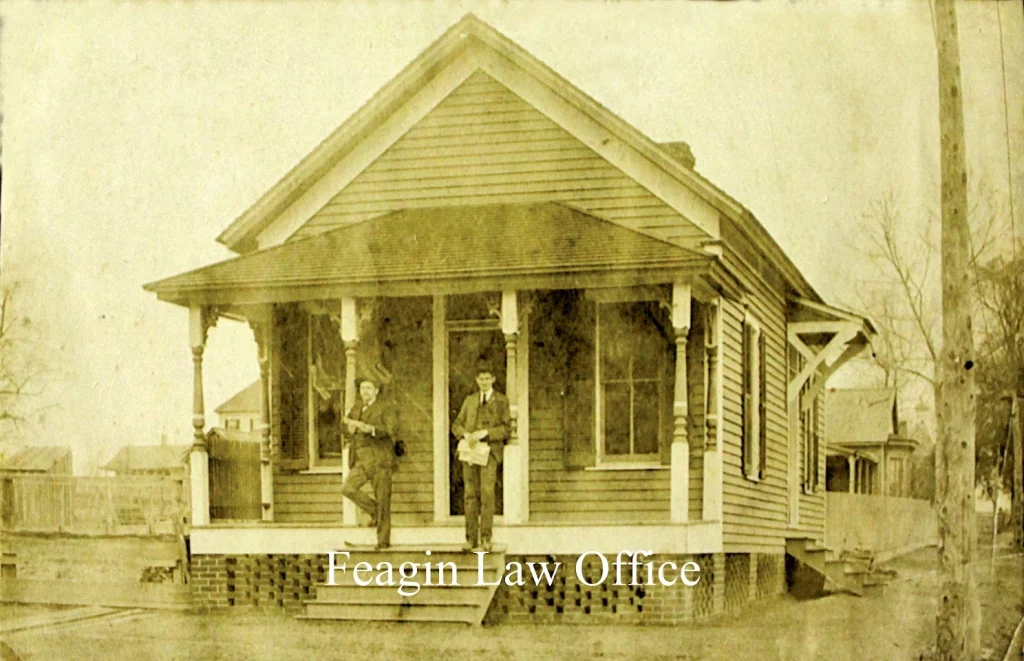
A very similar, if not identical building, was the building housing the law practice of J.C. Feagin. Holshousen and Feagin were once law partners. Feagin’s building was located on Block #4. If I’m not mistaken, that’s Feagin on the front porch. According to Gary, these buildings were built after the 1902 fire, they did not have bathrooms and they each contained two offices that are mirror images of one another with two identical porches, front and back.
From a professional standpoint it appears that my great-grandfather was very active up until the time of his death in May of 1914. He was still operating out of the Holshousen Building in July of 1913 when it was relocated to make room for the new First National Bank building.
Throughout 1913, he was actively involved with the Ike Turner Confederate Veterans Camp No. 321, the Daughters of the Confederacy, the sale of the book he coauthored The Historical Polk County Texas Companies and Soldiers Organized in and Enrolled from Said County in Confederate States Army and Navy 1861-1865, the Royal Arch Masons meetings and various trips to Corrigan, Moscow and Lufkin. In addition to receiving a multitude of guests to their home in 1913, T.F. and Amelia hosted the wedding of their youngest daughter Anne (Annie) Corrine Meece to Thomas Milton Mangum.
T.F. even found the time to pen a letter to the editor of the Polk County Enterprise published on April 24, 1913 entitled “A good Roads Letter”.
A Good Roads Letter.
Livingston, April 21, 1913.
Editor Enterprise:
Finding that there is some opposition to the proposed bond issue for good roads in Justice Precinct No. 1, the only means of raising money for making such roads, inasmuch as a special tax therefor cannot be levied for less area than the county, I beg to offer a few suggestions for consideration of those so opposing.
According to report some think Livingston will be the chief beneficiary of such movement, hence their opposition.
It is true Livingston will be largely benefitted by good roads, but the country voter, the farmer and trucker, will receive an equal, if not greater benefit in proportion to the amount of taxes they will have to pay under such bond issue, and the building of such roads.
In the very bad condition of the roads now, particularly in wet seasons, the country voter, the farmer and trucker, as well as those of other pursuits, can only reach their market or trading point with great difficulty, and at times not at all.
With such bonds the money can be had to make good roads throughout the precinct, all parts of it, and not to Livingston as asserted by some of the opposition, so that all will be equally helped thereby.
An instance in point, Menard creek bottom is practically impassable three months or more, at the season in which farm products, cotton, corn and early vegetables, should be marketed.
Grade up said road, put in sufficient bridging for overflow waters, grade the road thence to east line of said precinct, and to Livingston, cut down the high hills between said creek and Livingston, filling in the low places between said hills, and a team that will now pull one bale of cotton, making the trip in a day; will easily bring four bales or more, and make the trip in less than half the time now consumed.
The benefit to the tax payers on or near said road will be largely to their advantage, when the difference in conditions is properly considered, and other portions of the precinct will experience similar relief in the matter of travel and tonnage.
With taxable values of two and a half million dollars, and two hundred thousand dollars bonds issued, a tax must be levied that will produce fifteen thousand dollars to pay interest and create a sinking fund.
Seventy cents on the hundred dollars valuation will make seventeen thousand, five hundred dollars, being all sufficient if properly collected to make such payments, and all costs of collection, and at such rate the tax payer who owns and renders one thousand dollars worth of property will pay seven dollars per year on said bonds, which will be easily offset by saving the three additional trips necessary to bring in the four bales of cotton, or other produce, that he can haul with the improved roads, as compared to the present conditions.
The money for such road building will be under the general supervision of the county commissioner’s court, and if properly handled and a competent man put in charge of the work, farmers and others with teams and wagons can do work enough to more than pay all the taxes that they will have to pay during the life of such bonds.
Some object to such bonds for reason that with good roads property values will increase, making their taxes burdensome. This is error, as with a valuation of five million dollars, thirty-five cents per one hundred dollars will produce the same amount that the seventy cents raises on half that amount, the interest and sinking fund being no greater because of such increased value of property.
Any improvement that materially benefits Livingston must assist in the upbuilding of the country surrounding it, while anything that improves and develops the surrounding country must unavoidably prove advantageous to Livingston. The interest of the one is the interest of the other.
The welfare of each being mutual, the citizens of both should act in unison, and not adversely, the one should gladly assist in improving and building up the other.
Let us hope that the voters of the precinct generally, as well as the town, will strive to act in harmony and build up and develop the best Interest of all. Let’s celebrate the anniversary of Texas independence by absolving ourselves from the miserable roads of today, the heaviest tax that the farmer as well as the general user of such roads endure under present conditions.
T. F. Meece.
The cause of my great-grandfather’s death is unknown. On February 20, 1903, there was a newspaper report that he had cancer in front of his ear. At that time, skin cancer treatment was largely palliative and often ineffective, relying on early, crude attempts at radiation. Overall survival and cure rates were low, with highly unpredictable outcomes and a frequent rate of recurrence for malignant growths. I don’t know whether this had anything to do with his death. This was more than likely caused by his exposure to the elements during the Civil War. I’ve been treated for skin cancer on multiple occasions and there is no doubt in my mind that it was caused by exposure to the sun when I lived in Puerto Ordaz, Venezuela.
On August 22, 1912, the local newspaper reported that Mattie Minerva Meece Cubley was in Livingston caring for her father T.F. His son and my grandfather, Brown Louis Meece, had just departed for Korea to work for the Oriental Consolidated Gold Mining Company on July 14, 1912. The Polk County Enterprise reported in his obituary that he “had been ill for some time.” Once again, I don’t know if this particular illness had anything to do with his death.
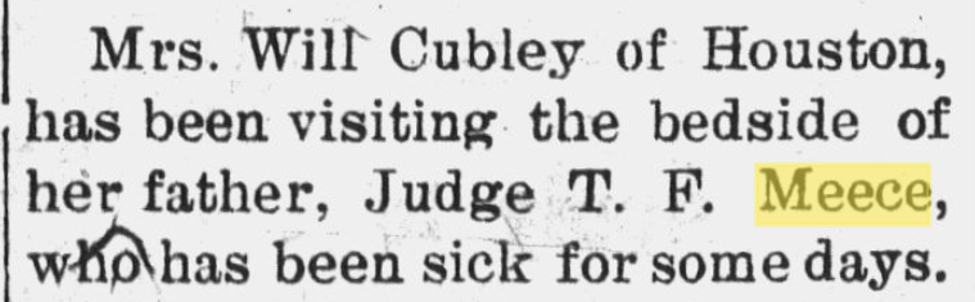
I can say it no better than the author of his obituary which was published on the front page of The Polk County Enterprise.
“Judge Meece was one of the best loved and most honored men of this whole section, and it cast a gloom over the entire community when the news of his death was learned. He was a true Christian gentleman, and his many deeds of kindness will be missed by those of us who knew him and have been associated with him in our daily walks of life. He was a man who believed in living up to the golden rule. He was always ready to favor his fellowman in any way he could, and it was a pleasure for him to show them every courtesy possible. He set an example in his life that any man should feel proud to copy after, and his in fluence in this town and community will be greatly missed by people who stand for everything that is moral and upright, for Judge Meece was always found on the moral and religious side of every question that came up, and he gave his time and money in fighting for the things that were for the betterment of the town and community.”