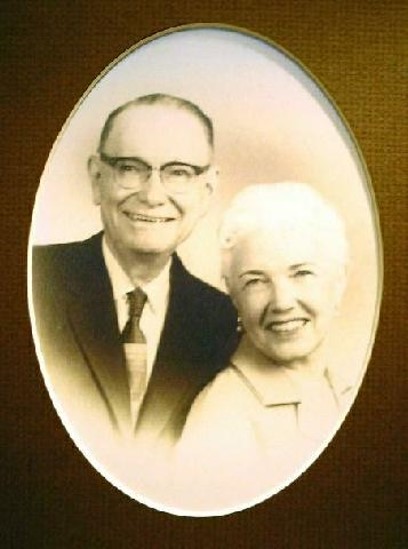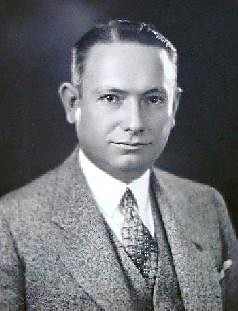
Brown Louis Meece, my grandfather, was born in Livingston, TX on September 27, 1891. He was the youngest child of Theophilus Franklin (T. F.) Meece and Amelia Antoinette Brown Meece. T. F. was 51 years old and Amelia was 46 at the time of his birth. He was one of 11 children which included Willie Uzel Meece (deceased), George Franklin Meece, Mary Inez Meece, Mattie Minerva Meece, James Henry Meece, Bennett Amelia Meece, Luther Marshall Meece, Thomas Epperson Meece, Charles Stewart Meece and Anne Corrine Meece. George Franklin Meece, the eldest, was 19 years old at the time of Brown’s birth.
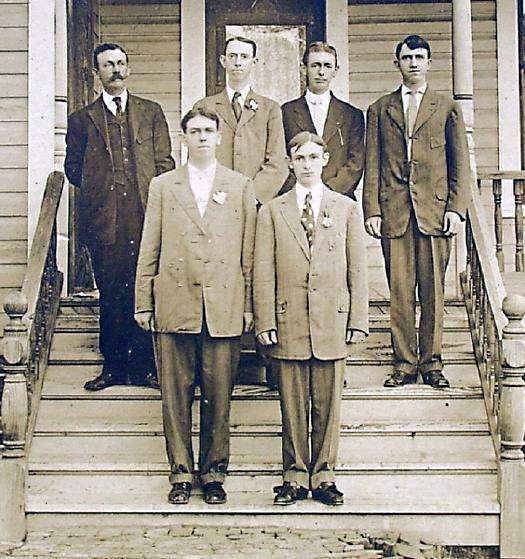
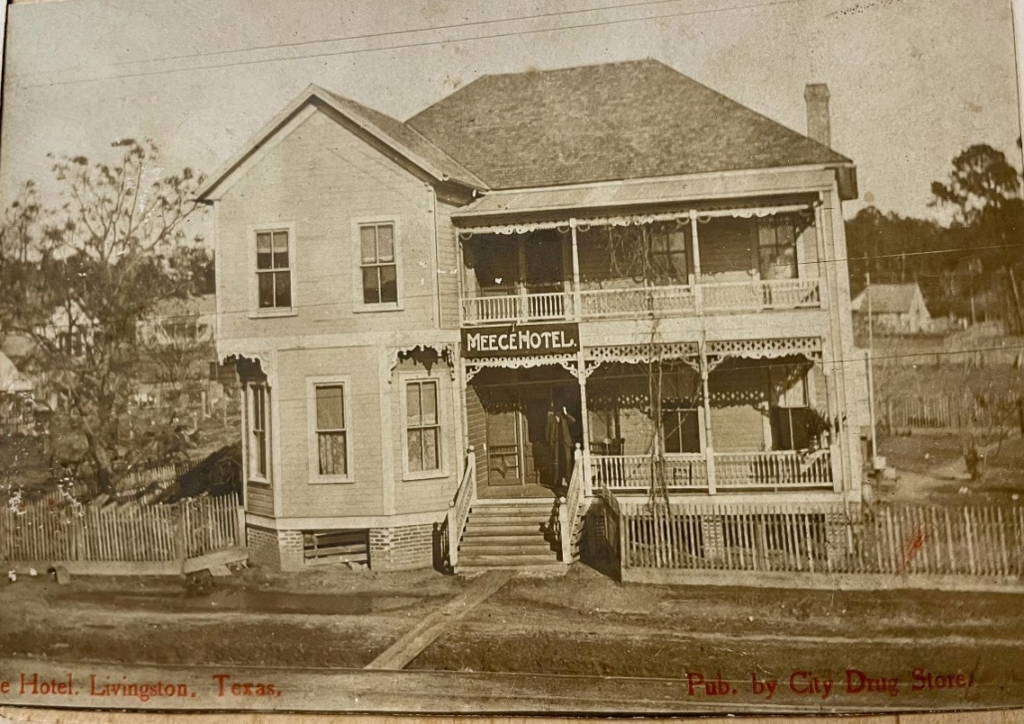
Brown’s father T. F. was educated at the Livingston Academy, which was located on the first floor of the Trinity Masonic Lodge #14. The school opened in 1849 and closed in the late 1880s. On April 25, 1888, The Public Free Schools of Livingston purchased property from Mary Brown Shotwell to erect a schoolhouse. Mary Brown Shotwell was the sister of my great-grandmother Amelia Antoinette Brown Meece and the same Mary Brown Shotwell that sold the hotel to T. F. Meece (Meece Hotel).
The first structure built on the lot was a large two-story wooden building with a water well in the back. When the well went dry two boys were chosen each day to haul water to the school from a nearby house using a bucket. They used a broom stick to carry the bucket between them. Classes were held from 8:00 a.m. to 5:00 p.m. The usual starting age for school was nine but that varied depending on the students’ circumstances at home. Some families alternated, allowing one or more to attend school while the others remained at home to help on the farm.
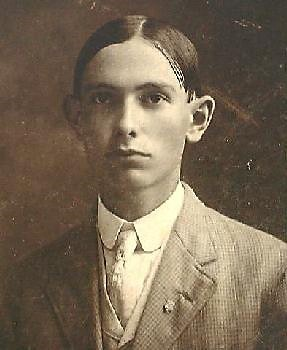
The playground was divided by a fence to separate the boys from the girls. This sort of gender segregation also extended to the classroom. There was no playground equipment, so the students would play games such as “Pop the Whip”, “Red Rover” or softball using a board for a bat. Many of the students had to walk long distances to school. The students would maintain the cleanliness of the classrooms. Prior to 1901 the teachers were paid $35.00 for four months. Following 1901 the salary was raised to $50.00 for a seven-month term. Corporal punishment was the law of the land, so disciplinary issues were kept to a minimum. The parents were issued report cards for their children at a cost of two cents each.
As a pre-teen or tween (11 years old) Brown joined a club called the Happyhammers, which was sponsored by The Houston Post. The ground rules for the club were as follows:
THE CLUB.
The Happyhammers are the young people (white children) who read the Youth’s Department of The Houston Post. There are no fees or charges of any kind connected with the club. Boys and girls who read The Post may be enrolled as active members by sending name, age and address. It is the object of all Happyhammers to “hammer happiness where and whenever possible.” Hence the club name and motto.
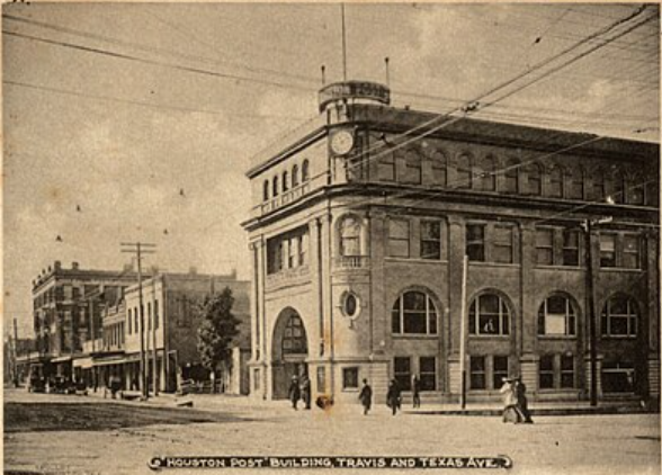
At the age of 14 Brown wrote the following: Livingston, Texas-Dear Happyhammers: Here I come again with a letter to the page after being silent for about two years. Our little town is progressing very nicely now, three brick business houses having been built since the town burned, and another one will be built in a short while. As I see that no one has described Livingston I will try to describe it: There are three drug stores, ten general stores, two blacksmith shops, one Jewelry shop, one tin shop, one bank, one hardware store, one telephone exchange, five doctors, nine lawyers, two insurance agents, two real estate agents, two beef markets, two hotels, two railroads (using same depot), a court house, Jail and post- office ice factory, gin and grist mill, brick yard, and four saw mills situated near around. There are three painters and a school house here also. I was in Houston several weeks ago and went around to The Post building; it is certainly a beauty. Well, I will close. With Love to Mrs. Fosters and the Haps. A true Happyhammer,
Brown Louis Meece.
Brown’s depiction of Livingston echoes his father’s (T.F.) description of Livingston that he wrote for the Texas Siftings in 1895. Texas Siftings was a popular humor weekly that was published in New York and London. The publication, originally established in 1891, was known for its witty commentary and satire, covering both American and international news. As for Brown’s trip to Houston at such a young age, he would routinely travel alongside his father, by rail, to Corrigan, Lufkin, Moscow, Houston, Galveston, etc. This was commonly reported in the local newspaper, the Polk County Enterprise.
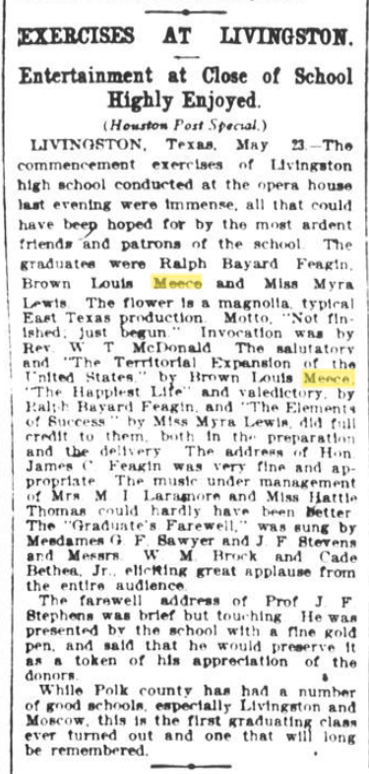
Livingston High School (grades 9 & 10) was initiated in 1906. By 1905 most urban high schools consisted of four grades: freshman, sophomore, junior and senior. Rural schools and southern schools lagged behind their counterparts in the north. The first high school graduating class of 1908 consisted of the following students:
- Myra Lewis Green became a teacher in Livingston as well as Raymondville, TX which is located in the southernmost tip of the state.
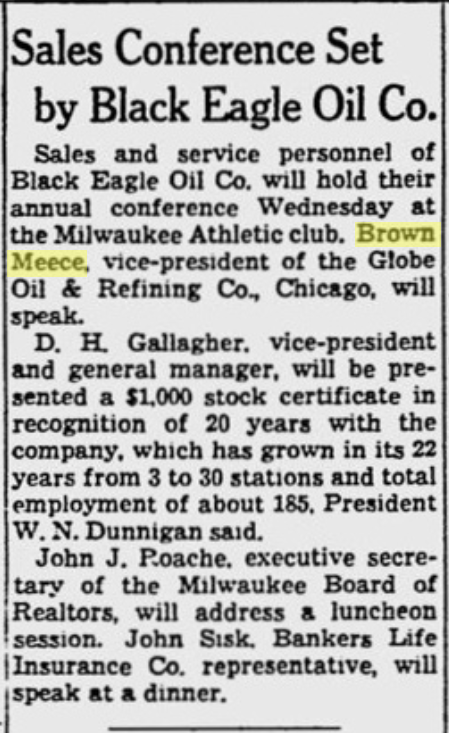
- Brown L. Meece who graduated from Texas A. & M. and became a vice-president for the Globe Oil Company and Sinclair Oil Company in Chicago, IL.
- Ralph Feagin who was a graduate of the University of Texas who became a lawyer working in Houston, TX and later became an executive vice-president of Electric Bond and Share Company in New York City, NY. He later returned to Houston as a partner in the law firm Baker, Botts, Andrews and Wharton.
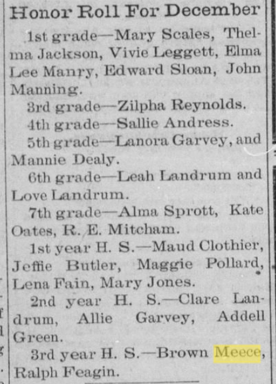
That it! Three students in the first graduating class. It appears that they all did well, considering the fact that they came from such a small town and high school. The high school commencement ceremony was held at the Livingston Opera House. Brown was mentioned in numerous articles in the local paper as having a perfect attendance record and making the Honor Roll each and every month.
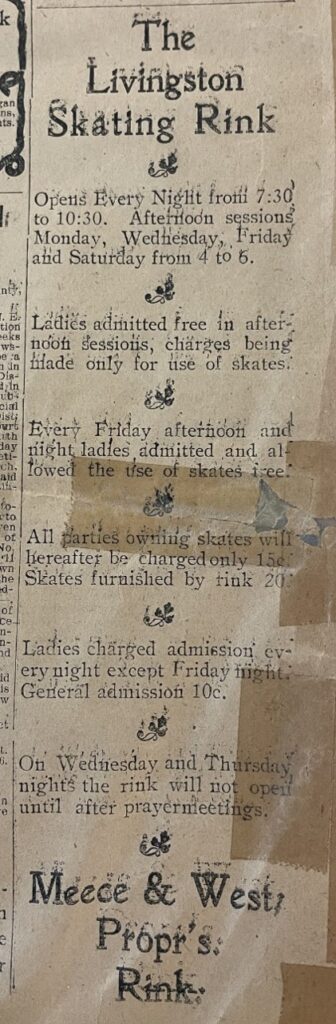
Interestingly enough, the Livingston Opera House was at one time the Livingston Roller Rink, which was co-owned by Brown’s brother, Luther Marshall Meece, and W. L. West. Luther sold his interest in the roller rink to West. West built a 550-seat opera house, replete with stage, electric lights and heating. He maintained the roller rink as it was a very popular pastime in Livingston. The Opera House brought plays, road shows, lectures, minstrel shows and vaudeville to Livingston. West was also the owner and editor of the local newspaper, the Polk County Enterprise.
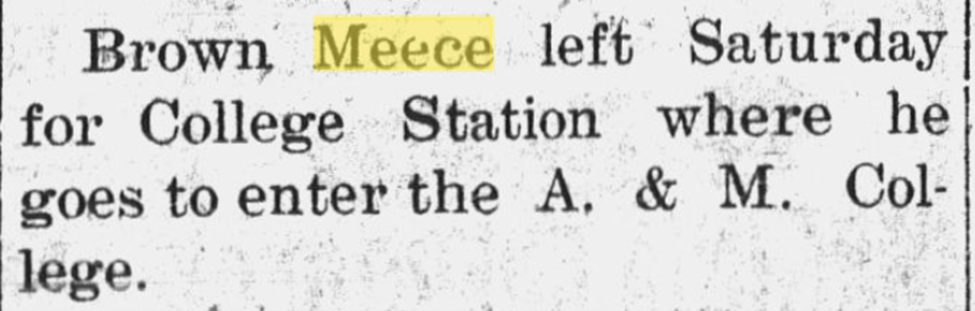
Brown enrolled in Texas A & M on Saturday September 19, 1908. College Station, TX, the location of Texas A & M, is approximately 65 to 70 miles from Livingston, TX. It was first known as the Agricultural and Mechanical College of Texas when it was established in 1876 as the state’s first public institution of higher education. The A & M today serves as a reminder of the university’s beginnings in the agricultural and mechanical fields. The Houston and Texas Central (H&TC) Railroad made regular stops here for incoming and outgoing college students and faculty. The H&TC Railroad conductor’s announcements, referring to this stop as “College Station,” gave rise to the name of the surrounding community.
I was always told that my dad wanted to go to A & M but for some reason my grandfather wouldn’t allow it. My dad spoke to me about enrolling in the Maritime Academy, but I was hell bent on getting out of the house and away from my parents. If I had only known…
In a letter dated March 21, 1949, from my grandfather to my father, I discovered the following: “One thing I want to make very clear to you is that you were not forced to go to Notre Dame, neither are you being forced to stay there. At no time did you ever express a desire to go to any other school. On several occasions I asked you whether or not there was any other school that you preferred and you always indicated you wanted to go to Notre Dame. With your class standing, your record in High School and your grades in Notre Dame, it would not be too difficult to transfer you to some other school or if you feel that you don’t want an education, it might even be possible to let you leave school and try your hand outside for awhile. I will think a long time before I will agree to that and I am happy that in our telephone conversation you indicated that you did not have any such thought, but to the contrary, want to continue on at Notre Dame until you have finished your College education.
Frankly I don’t know that I blame John for wanting to go back to the University of Washington. That is where in all probability he will make his home and I feel very strongly that a person is much smarter to identify himself with the leading school in the area where he hopes and expects to live than he is to go to some school in another area. For sentimental reasons I would have liked to have you go to Texas A&M but I never even gave a thought to it due primarily to the fact that I feel that your lifetime ahead is much more likely to be in Chicago than in any area where Texas A&M Graduates would have any real value through Alumnae factors.
I have never been sold too much on Yale, Harvard or Princeton particularly in view of the people I have met from Harvard who have been in my book the leading communistic influence in Washington through the Roosevelt-Truman period. I have not seen so much of that in the case of Yale or Princeton but neither have I ever seen too much indication to believe that either of them had more to offer than Notre Dame, Michigan, Illinois or other Mid-western schools could not equal or excel.
Wharton School of Commerce of the University of Pennsylvania has always been considered one of the finest of that type in the country. In all probability you could transfer there but several of my friends in Chicago have told me recently that under Dean McCarthy, they consider the Notre Dame School of Commerce the equal in every respect of any school anywhere in the U.S. I have always hoped that conditions would be such that you could finish at Notre Dame and then could take post-graduate work either at the University of Pennsylvania or if you want to in the Graduate School of Business Administration at Harvard University. Every appearance is that post-graduate students in business administration at Harvard don’t seem to get the communistic angle that their law students encounter and it definitely seems to be the last word for post- graduate work. Those things are definitely possible and probable if you keep up the work which you are capable of doing and forget about these moody spells which you seem to encounter entirely too often.“
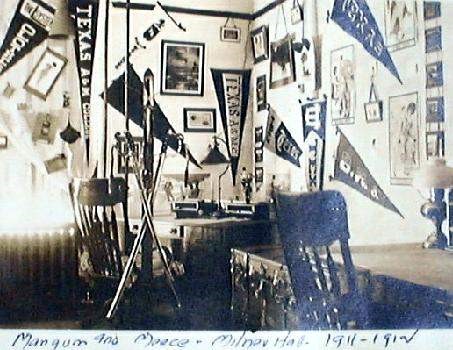
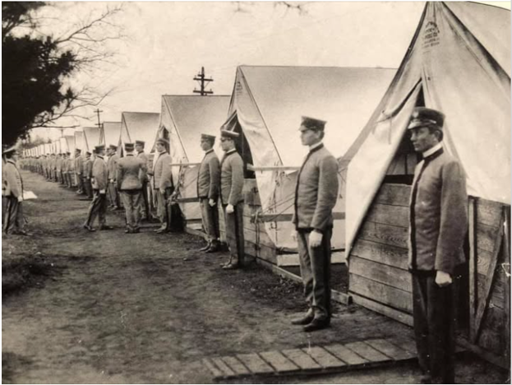
My grandfather clearly had a dorm room, based on the photograph below, but according to my father he lived in a tent for a portion of enrollment at Texas A & M. Reportedly, enrollment exceeded dormitory capacity, and a tent city was used from 1908 until 1912 or 1913 to house students. The tent colony was named “Camp Milner” after the University President Milner.
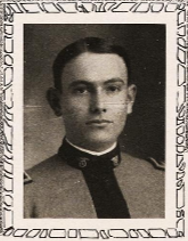
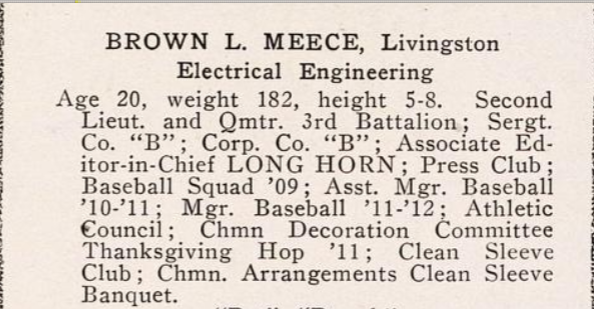
Brown Louis Meece was described in the 1912 edition of the Longhorn Yearbook as being 20 years old, 5’ 7” tall and he weighed 182 pounds. The average height for an American man in 1912 was approximately 5 feet 8.25 inches. The average weight range for men was between 145 and 150 pounds. Men in 1912 were significantly lighter than today’s average of nearly 200 pounds. A semi-satirical yearbook review of my grandfather revealed the following:
“Pot” “Dough”
“Pot has the notable distinction of acquiring, besides his education, an enormous girth since his arrival here four years ago from the piney woods of East Texas. His waddle down the main walk has become as familiar a sight as that of Old Glory floating in the breeze. He is a charter member of the celebrated Clean Sleeve Club and his only bad habit is that he spends too much of his time riding the Interurban, thus causing his roommate to spend many lonesome hours in solitude. Otherwise “Pot” is one of the best known and liked that there is among us, and our hopes are that his share of success in life will be full measure.”
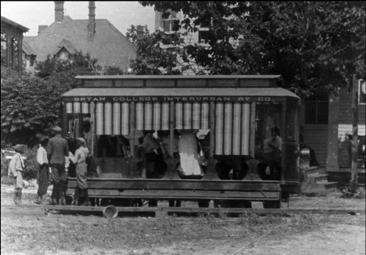
From 1910 to 1923, the Bryan-College Interurban Railway was a trolley line that connected Bryan, TX to the Texas A&M College. The trolly followed a route along College Avenue, which still connects Texas A&M University to Historic Downtown Bryan, Texas. The trolly ride from Bryan took 30 minutes, and the cost to ride was fifteen cents roundtrip. Its reliability was often called into question, particularly in its early years when it was propelled along its tracks by an underpowered gasoline engine.
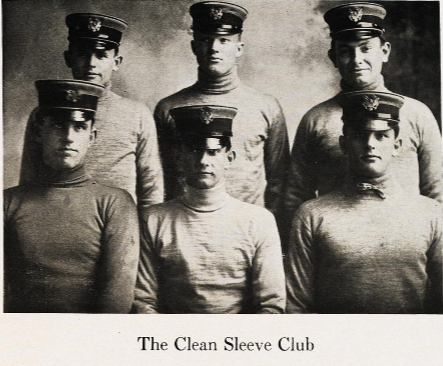
I can only imagine that the reference to the Clean Sleeve Club is satirical as well. It is clearly a club identified in the yearbook, but there is no reference as to its purpose. In a military context, a “clean sleeve” is a slang term for a soldier without experience as symbolized by the absence of a deployment patch on the right sleeve. A “clean sleeve” is military slang that has been used at various academies, including West Point, to refer to someone who is not a leader and has no rank insignia. The term signifies a lack of distinction, rather than a specific club or organization.
Brown graduated with a bachelor’s degree in electrical engineering. He was a second Lieutenant and Quartermaster of the Third Battalion which consisted of Companies “I”, “K”, “L” & “M”. He was both a Corporal and Seargent in Company “B”. Brown was a member of the Press Club as well as Editor-in-Chief of the Long Horn. The name of the yearbook was changed in 1929 to the Longhorn. He was Chairman of the Decoration Committee Thanksgiving Hop; member of the Clean Sleeve Club (as mentioned earlier) and Chairman of Arrangements for the Clean Sleeve Banquet. It appears that the Clean Sleeve Club was really a thing.
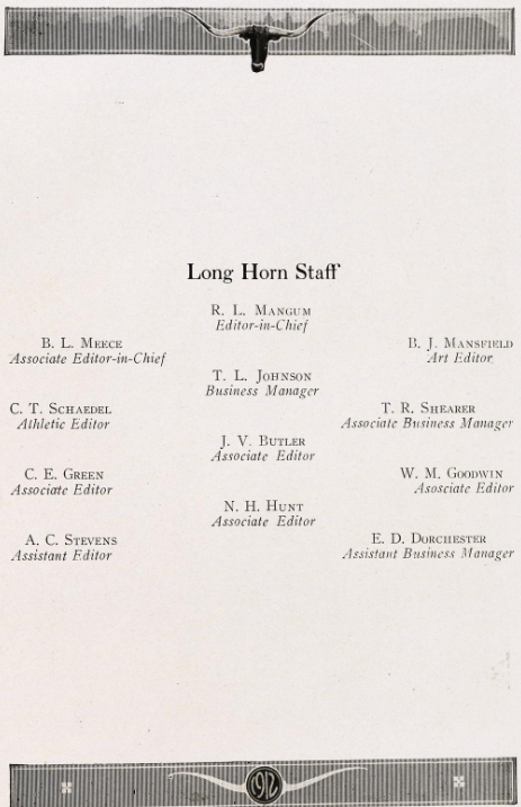
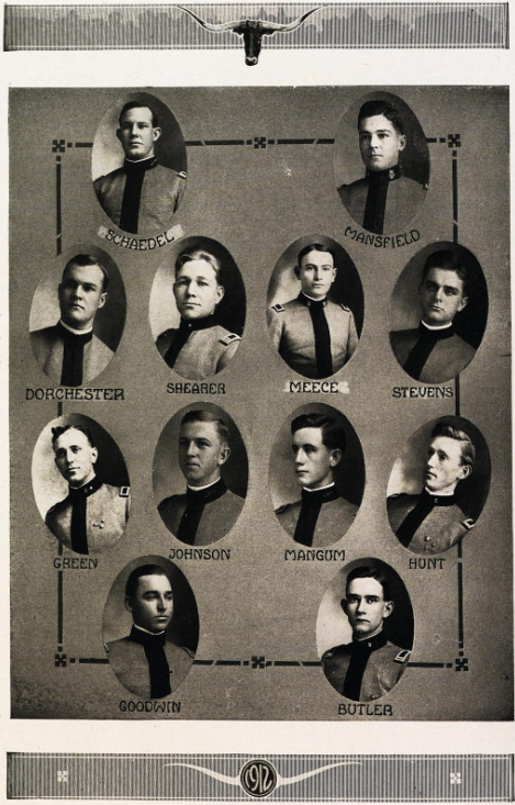
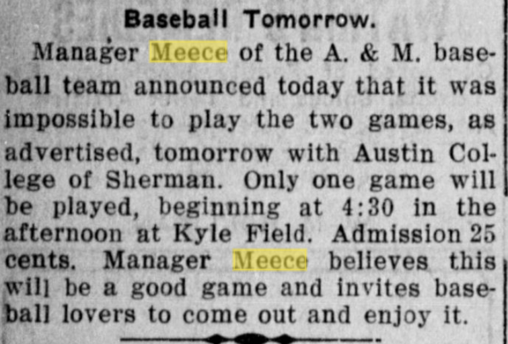
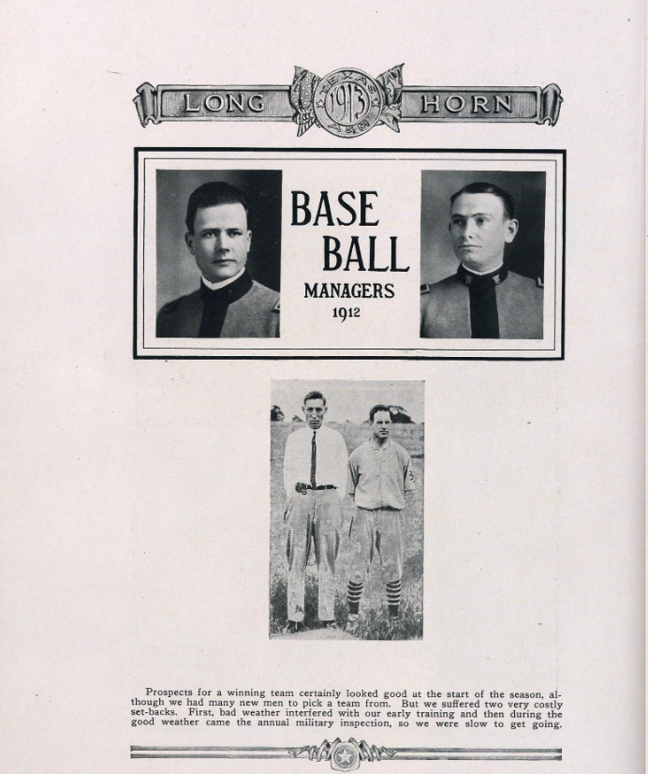
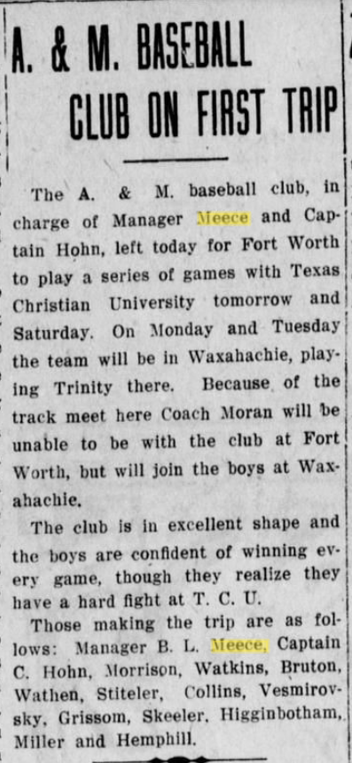
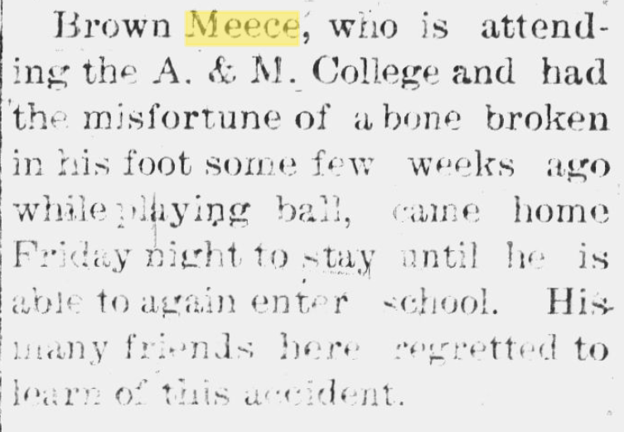
The one thing that my grandfather was especially proud of during his college years, was his participation in baseball. He was a member of the Texas A&M baseball squad in 1909. According to a newspaper article published on March 24, 1910, Brown broke his foot while playing baseball at school. He was a member of the Athletic Council; Assistant Manager of the 1910-1911 squad and Manager of the 1911-1912 baseball team. Brown was Captain and played in right field for the Livingston baseball team as a kid. His passion for baseball probably stemmed from his older brother, James Henry Meece, who was 14 years his senior. James was elected Chairman of the Baseball Committee, in Palestine, TX, whose job it was to solicit funds for a ballpark. Palestine, TX is a small town approximately 104 miles, or 1 hour 47 minutes, northeast of Livingston, TX. It appears that he both founded and managed the Palestine team.
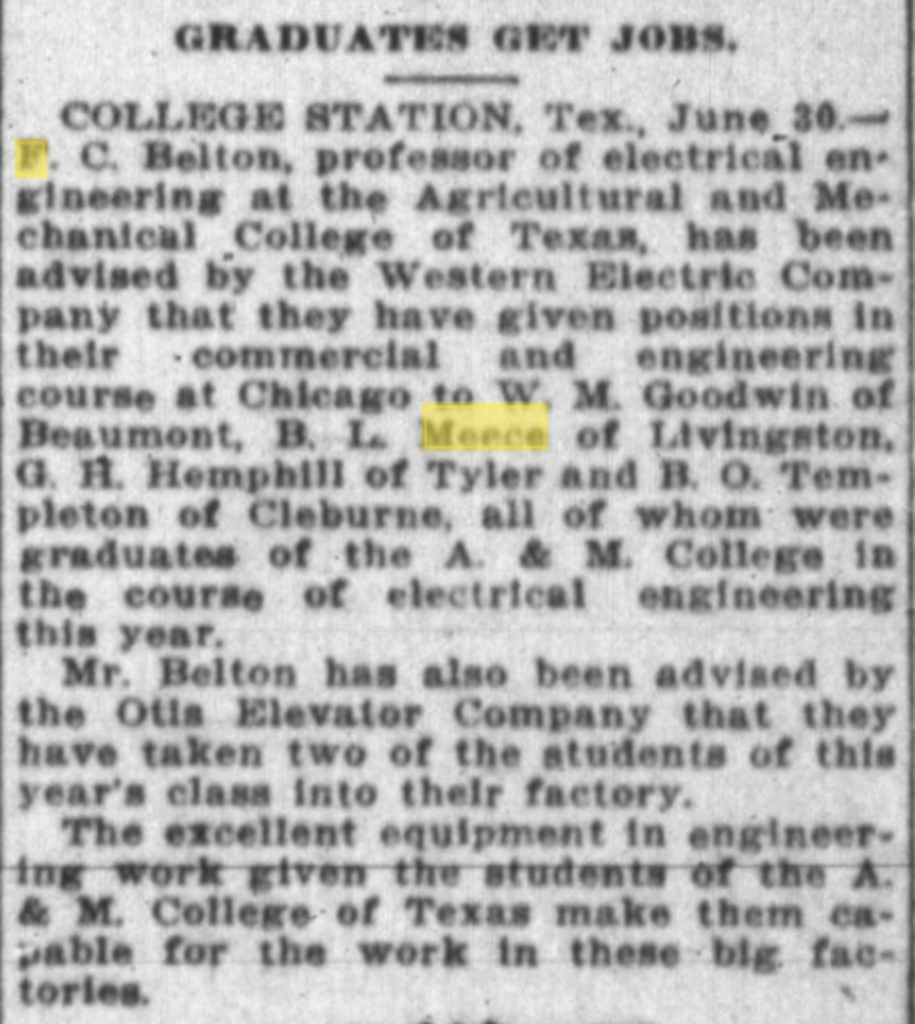
Academically, Brown did well at A&M. On July 1, 1912. F. C. Belton, professor of electrical engineering, announced that Brown, one of four students, had been awarded positions in the commercial and engineering courses of the Western Electric Company located in Chicago, IL. Western Electric Co., Inc. was an American electrical engineering and manufacturing company. It was a subsidiary of the AT&T Corporation and was the primary manufacturer, supplier, and purchasing agent for all telephone equipment for the Bell System from 1881 until 1984, when the Bell System was dismantled. American Telephone and Telegraph Company was co-founded by Alexander Graham Bell.
In a letter dated June 21, 1950 Brown wrote: I used my engineering training comparatively little along the lines that I was trained but there has never been a job I have held over the years in which Mathematics in particular has not enabled me to push ahead of people I started. out with. Even so, I have always felt that had I taken Law as my Dad wanted me to instead of Engineering, that it would have fitted into my own abilities much better than Engineering.
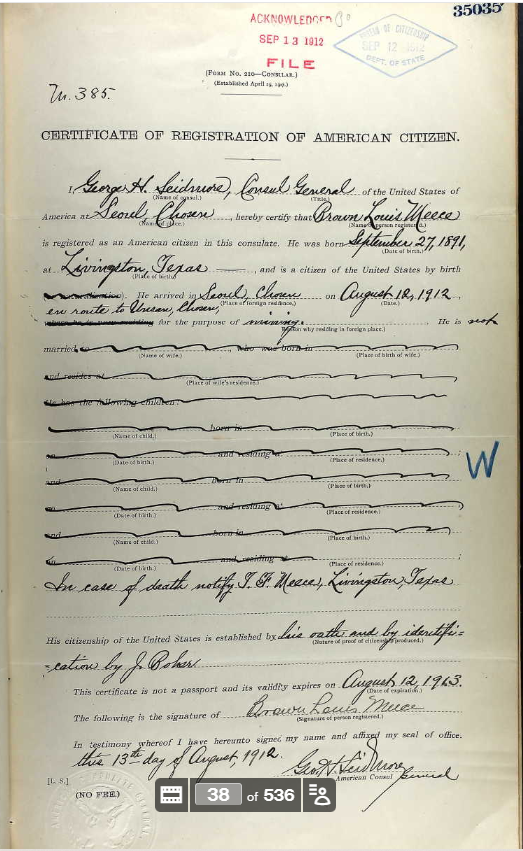
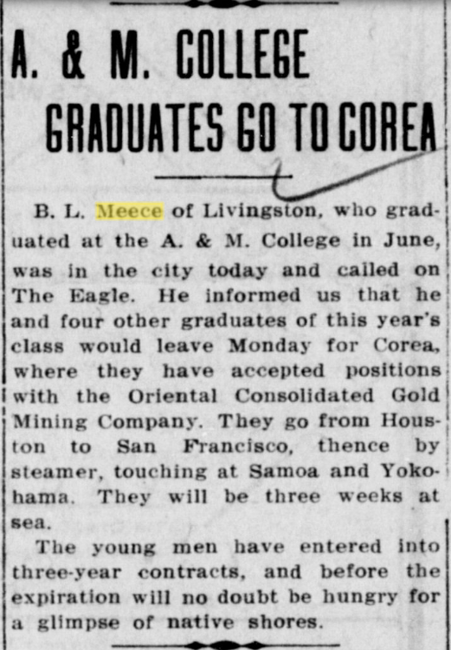
On July 12, 1912, Brown informed The Eagle, The Bryan-College Station Eagle, that he and four other students from A&M had accepted positions with the Oriental Consolidated Mining Company (OCMC). They were to leave Houston, TX on Monday July 14, 1912. They would travel to San Francisco, through Samoa, Yokohama, Japan and finally to Corea (Korea). Korea was spelled “Corea” in English publications throughout the 19th century and into the early 20th century, before the spelling “Korea” became dominant around the time of Japan’s annexation of the Korean peninsula in 1910. “Joseon” (Chosen) was the name of the Korean kingdom that preceded the Japanese colonization of Korea. The North Korean regime adopted this name to evoke a sense of national identity.
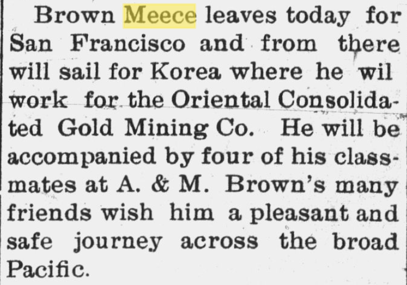
The Korean Joseon dynasty granted a concession to American businessman James R. Morse to mine for gold in the Unsan region in 1895. In 1896, Morse established the Oriental Consolidated Mining Company to operate the site. Morse, believing the mines to be unprofitable, sold the company to Leigh S.J. Hunt and Jacob Sloat Fassett, the former an entrepreneur and newspaper publisher, the latter a New York State Senator and Congressman. The OCMC introduced stamp mills, steam power, hydroelectric and cyanide plants, as well as new roads and transportation to Korea.
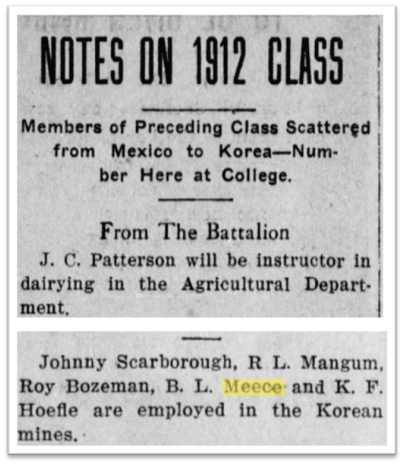
Most of the early Western mining engineers and supervisors were from Columbia City, Indiana, the hometown of the OCMC’s founder, Leigh Smith Hunt. Hunt, wanting men that he could trust, hired young graduates from the local high schools and colleges, promising them good wages if they would agree to serve three years at the mines. Brown Louis Meece obviously fit the bill. Brown arrived in Seoul on August 12, 1912, 29 days after departing Houston, TX.
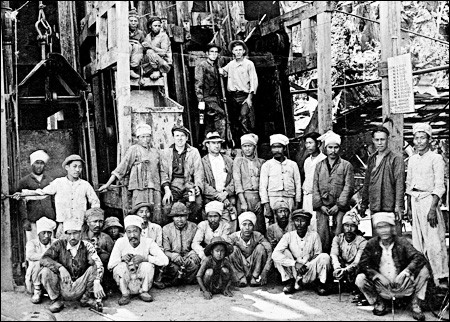
These mines were located in the mountainous region north of Pyongyang and were, for the most part, inaccessible except for small paths that clung to the sides of the mountains. My father told me that Brown had traveled through the mountains of Korea by mule. I never imagined that it was North Korea that he was talking about. It would take nearly ten days to reach the gold mines just north of Pyongyang. Pyongyang is located to the southwest of Unsan County, with Unsan being approximately 60 kilometers (37 miles) northeast of the North Korean capital. The journey was described as a “long, arduous, and often dangerous trip to and from the gold mines.” The Americans would arrive in the port of Busan, travel by train to Seoul and then walk and travel by horseback or mule to the mines. In terms of distance, Pyongyang is approximately 128 air miles, as the crow flies, from Seoul.
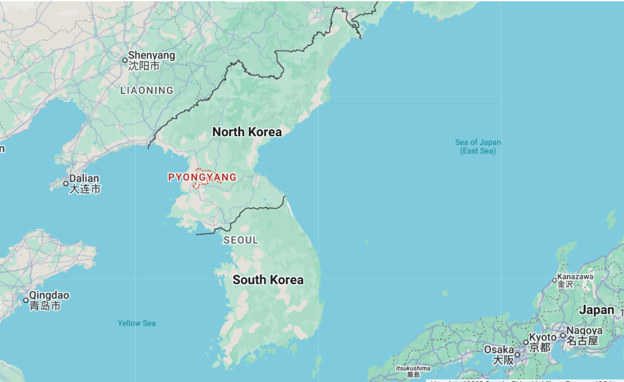
Today, there are no direct commercial flights, trains, or overland routes from Pyongyang to Seoul for civilians, as travel requires special permission due to the political division between North and South Korea. While physical road infrastructure exists, there are no open roads for public travel between Pyongyang and Seoul. The heavily militarized border (DMZ) is closed, and North Korea has recently destroyed, mined, and blocked inter-Korean road links, making direct travel impossible as of 2024-2025. In the early 1900s, OCMC established a company town called “Little America” near the mines to house American managers and engineers and their families. The graves in the little cemetery located in Bukjin or “Little America”, for those who could never return to their homes in America, have been forgotten and probably lost to time.
A former Bukjin resident, future Nobel laureate Charles Pedersen, recalled efforts to make the town feel as “American as possible”. In 1910, Herbert Hoover, who would later become the U.S. president, visited the Unsan site while working as an engineer for a Chinese gold-mining company. According to historian Robert Neff, Hoover skipped out on a large bar bill at the OCMC bar.
The Korean people were described as “semi-barbarous” and unfit to rule themselves. The Korean miners were considered cheap, efficient, experienced, and easily teachable. The western miners were provided with Korean servants for cooking and cleaning. One of the Californian miners stated that the Koreans “in fact are like slaves for us.” During their rule over Korea, the Japanese imperial government forcibly mobilized Koreans for labor, with conditions comparable to slavery. Once OCMC began operations, mining done by locals without permission was made illegal. The inability to pan for gold and extreme poverty gave rise to theft. Corporal punishment or “judicious whipping” was considered prudent, and it was commonly used to discipline the Koreans.
The mines operated 24 hours a day, every day but one, July 4th. Every year, the OCMC celebrated America’s independence with a festival of dinners, picnics, firework displays and sporting events for both the Western and Korean miners. In the early 1910s, the OCMC started a regular baseball championship as part of their Fourth of July activities. The games were spirited, with a great deal of good-natured teasing between the two mining teams. These teams consisted of the “Outside Team” and “Inside Team”, so named because of their locations within the mining community. I can only imagine that Brown played a major role in organizing these activities. The company sold its concession to the Nippon Mining Company in 1939 after more than 40 years of business in what is now North Korea.
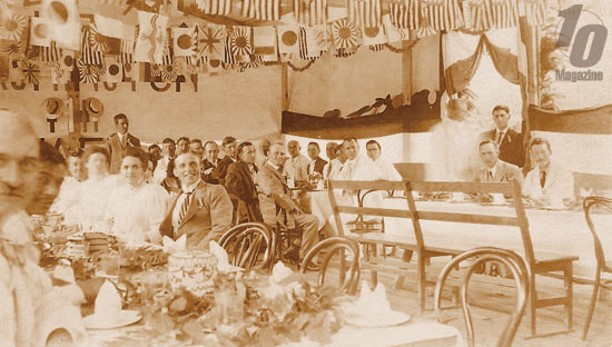
Baseball was introduced to Korea around 1905, primarily credited to American missionary Philip L. Gillett, who taught the sport to students at the YMCA in Seoul. YMCA stands for the Young Men’s Christian Association, an organization founded in London in 1844 to provide spiritual, physical, and social support for young men during the Industrial Revolution. While 1905 is considered the official introduction, some records suggest the sport was played as early as 1894–1896, with it quickly gaining popularity as a symbol of modernity, later evolving into a form of cultural resistance during the Japanese occupation. You would have to believe that the Oriental Consolidated Mining Company and its employees had something to do with baseball’s introduction into North Korea.
Brown would return to the United States, via Vancouver, British Columbia, Canada on April 23, 1914. This was no coincidence. He returned home when he was notified that his father was very ill. Brown initially signed a three-year employment agreement with Oriental Consolidated Mining Company (OCMC). I can only assume that both parties mutually agreed to terminate the agreement.
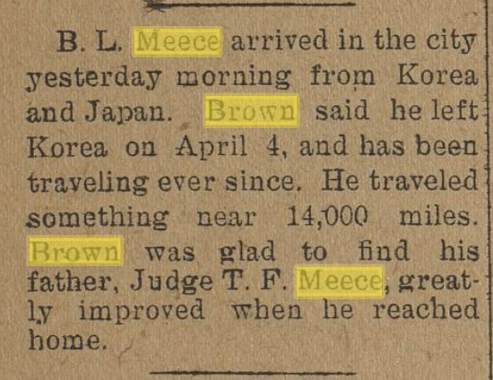
Over the years I’m sure that OCMC had experienced many such family emergencies and sudden departures. I would imagine, based on the distance, isolation, living conditions and hazardous traveling conditions, that employee turnover was naturally high. Although initially it seemed like a great adventure, many of the Indiana college graduates vowed that they would never take such risks again.
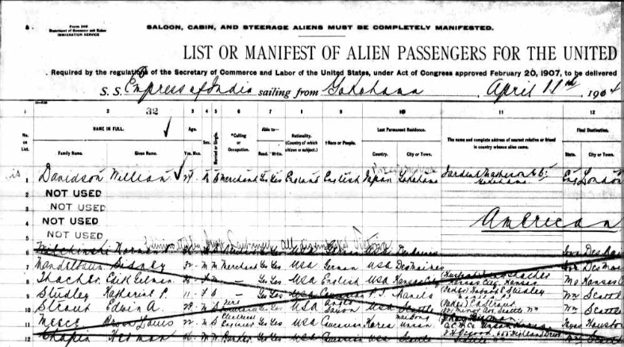
According to an article in the local paper, Brown arrived in Livingston on Wednesday May 6, 1914. He said that he had departed Korea on Saturday April 4, 1914, and that he had traveled some 14,000 miles. He also stated that his father’s health had greatly improved by the time he arrived home. A separate article also spoke about the improvement in T.F.’s health. Unfortunately, Theophilus Franklin (T.F.) Meece would pass away just 12 days later on May 18, 1914.
I found myself in a similar circumstance back in 2003. At that time, I was living in Puerto Ordaz, Venezuela. I was employed by Global Materials Services as Vicepresidente and Director of Foreign Operations for Global Materials Services Venezuela. I was nearing the end of my contract and preparing to return to the U.S. My father, Louis H. Meece, had called me on a couple of occasions and mysteriously told me, without explanation, that I needed to get home soon. Honestly, I was a little perturbed because I still had a lot of things to do before my departure. The next thing I knew, the CFO of American Commercial Barge Lines, a company my dad worked for, was calling to advise me that my father was in very poor health. Once I returned to Jeffersonville, IN, my father was dead within a week of my arrival.
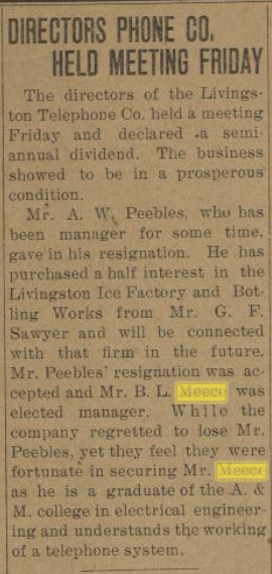
Brown would stay in Livingston for the next 1 ½ years spending time with family and friends. He accompanied his mother Amelia to Houston, TX, to visit relatives for several weeks. He was not idle, however. This is a trait that he picked up from his father. On May 16, 1915, Brown was elected secretary and reporter for Livingston baseball team. He would write numerous articles in the Polk County Enterprise as the Sporting Editor. On July 9, 1914, he was elected Manager of the Livingston Telephone Company, the same company that T.F. helped found and he was also one of the original shareholders.
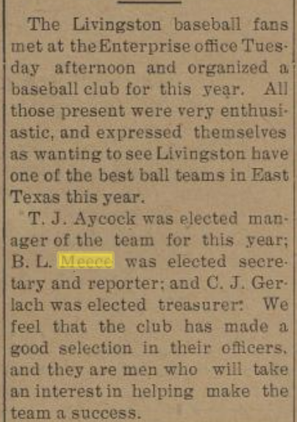
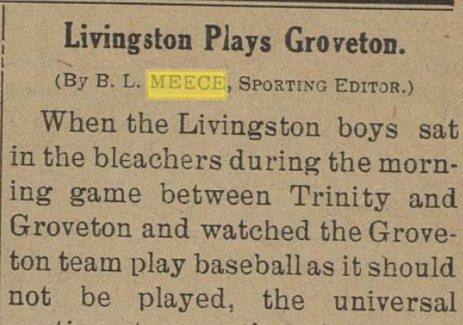
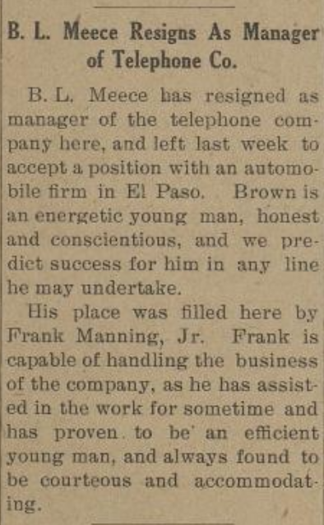
Alas, I believe Brown grew bored of small-town life and, from a professional standpoint, he was looking for something more challenging. On October 7, 1915, Brown resigned as Manager of the Livingston Telephone Company and accepted a position with an automobile firm in El Paso, TX. I don’t think that car salesman had the same connotation that it does today (lol).
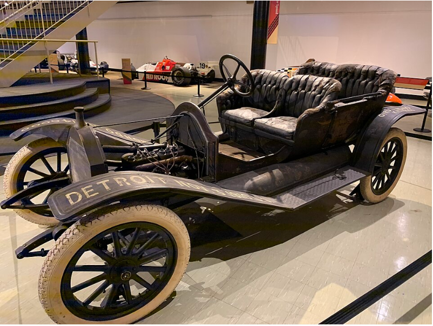
The automobile was still a relatively new concept. The first automobiles appeared in Texas in 1899, but they were still novelties. The Ford Model T wasn’t built until 1908 and the Hupmobile came out in 1909. The automobile didn’t take off until the 1920’s when automobiles became more affordable and the infrastructure (roads and gas stations) was improved. I’m not sure exactly which firm he joined. Tri-State Motor Company was a Ford dealership which opened in 1912. The Lone Star Motor Company sold Hupmobiles from the Hupp Motor Company and there was also a business by the name of El Paso Auto Sales Company, amongst others.
The Hupp Motor Car Company, founded in Detroit in 1908 by Robert “Bobby” Hupp and partners, produced the popular “Hupmobile” from 1909 to 1939. Known for durable, affordable, and innovative cars (like the Model 20), the company struggled against major competitors and the Great Depression, finally ceasing production after the failed launch of the 1939 Skylark.
Much ado about nothing. On January 13, 1916, just three months later, Brown accepted a position as a clerk with American Smelting and Refining Company, or ASARCO in Matehula, San Luis Potosi, Mexico. This assignment wasn’t without dangers. On January 11, 1916, sixteen to eighteen American ASARCO employees were killed and mutilated by Pancho Villa’s men near the town of Santa Isabel, Chihuahua. This was just two days prior to my grandfather’s hiring! News obviously traveled at a slower pace in the early 1900s. I wonder if he knew about the massacre at the time of his hire. Eventually, Brown would become a Smelter Foreman in the El Paso facility.
According to the 1910 United States Census, Brown’s brother James Henry Meece was living in El Paso Texas. He was 32 years of age and employed as a stockman in the hardware business. He and his wife Vivian were renting a residence. At that time, they had two children, Hermine and Rutherford. They also had a lodger living with them, a man by the name of David E. Cowan. Unfortunately, James would pass away at the young age of 47 on June 5, 1925. According to the death certificate he died from shock related to a gangrenous gallbladder. At the time, he was a Manager for the Galbraith Lumber Company in El Paso. The Foxworth-Galbraith Lumber Company, which was established in 1901, is still in existence today.
As you will recall, it was quite likely that it was James who piqued Brown’s interest in baseball. Prior to El Paso, TX, James and his family were living in Palestine, TX which is approximately 100 miles north of Livingston, TX. James was employed as a stenographer. He was Secretary and Manager of the Palestine Baseball Association team. He was also the author of one of the most unusual want ads that I’ve ever seen.

Luther Marshall Meece was also a resident of El Paso, he lived there with his wife, Jenny Bell McCrory Meece, for 44 years. He was a lumber broker, and he owned his own business, Meece and Meece. At one time, he was a salesman for the Texas Company which would eventually become Texaco. As I mentioned at the beginning of the bio, Luther owned the roller rink, which would eventually become the opera house, in Livingston, TX. He is buried in Restlawn Memorial Park in El Paso, TX. With the exception of George Franklin Meece, it appears that the other four brothers remained fairly close to one another.
The El Paso facility was built by Robert Safford Towne in 1887 with the financial backing of the Kansas City Consolidated Smelting and Refining Company (KSARCO). The facility processed lead and copper ores from mines in Mexico and the American Southwest. The community that grew up around the plant and housed the employees was called Smeltertown, TX.
The American Smelting and Refining Company was founded in 1888 by Henry H. Rogers, William Rockefeller, Adolph Lewisohn, Robert S. Towne, Anton Eilers, and Leonard Lewisohn. In 1899 KSARCO and several other corporations were merged into the newly organized American Smelting and Refining Company. In April of 1901, the Guggenheim family gained control of the company. ASARCO eventually controlled 90% of the U.S. lead production. During the 1920s ASARCO was the largest mining operator in Mexico, with twenty-four different units.
In 1917, white (Anglo) employees and managers of the smelter in El Paso typically resided in a segregated upper section of the company town known as El Alto, situated in the hills above the smelter. The Mexican workers lived in the lower, crowded section (El Bajo), Anglo staff occupied separate, higher-elevation housing, often in homes provided by the company or in the nearby developing areas of West El Paso.
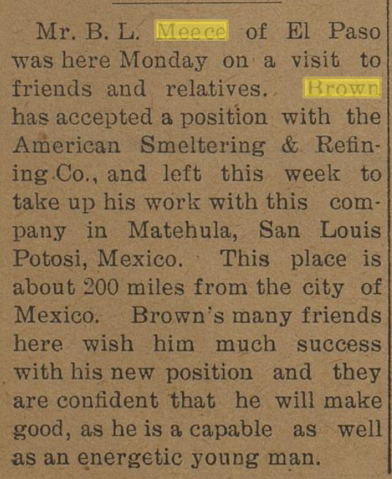
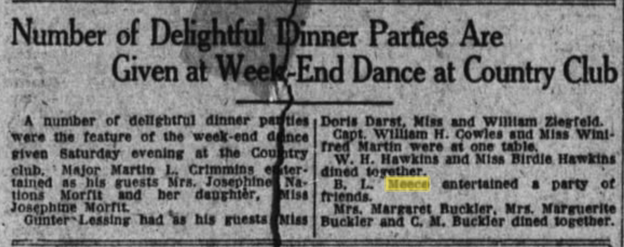
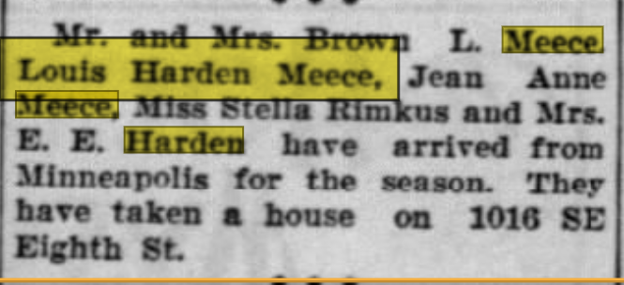
In addition to company housing, some white managers and employees lived in the expanding residential areas of the Upper Valley or near the El Paso Country Club area. According to the information that I’ve unearthed, Brown lived in the smelter rooms of the University Club. I have not located the University Club, but I assume that it was some sort of social club. He attended several dances and parties at the El Paso Country Club, so I’m assuming that it was somewhere in that area. The El Paso Country Club was founded on April 25, 1906 and it’s considered one of the finest country clubs in the southwest.
The company town, often called Smeltertown, was a rigid, racially segregated community designed to keep white management separated from the Mexican workforce. Some of the employees lived in Ciudad Juárez and crossed the border into El Paso to work at the ASARCO facility. The 1917 Bath Riots occurred in January of 1917 at the Santa Fe Street Bridge between El Paso, Texas and Ciudad Juárez, Chihuahua, Mexico
Mexicans crossing the border were required to take delousing baths and be vaccinated. Reports of nude photographs of women bathers and fear of potential fire from the kerosene baths led Carmelita Torres to refuse to submit to the procedure. Denied a refund of her transport fare, she began yelling at the officials and convinced other riders to join her. After three days, the discontent subsided, but the disinfections of Mexicans at the U.S. border continued for forty years. Reports had also circulated that bathers might be set on fire, as had happened the previous year when gasoline baths at the El Paso City Jail had resulted in the death of 28 inmates when a cigarette ignited bathers.
Brown held this position, with ASARCO in Mexico, from January of 1916 until July of 1917. On Thursday May 18, 1916 the Polk County Enterprise published the obituary of Amelia Antoinette Brown Meece reporting that she had died on Saturday May 13, 1916. She died in her home on Saturday afternoon at approximately 2:15 pm at the age of 70 years 10 months and 5 days. According to the paper, “Her health had not been good for some time, and she took suddenly ill Friday.” Due to the suddenness of her death, Brown was unable to attend the funeral.
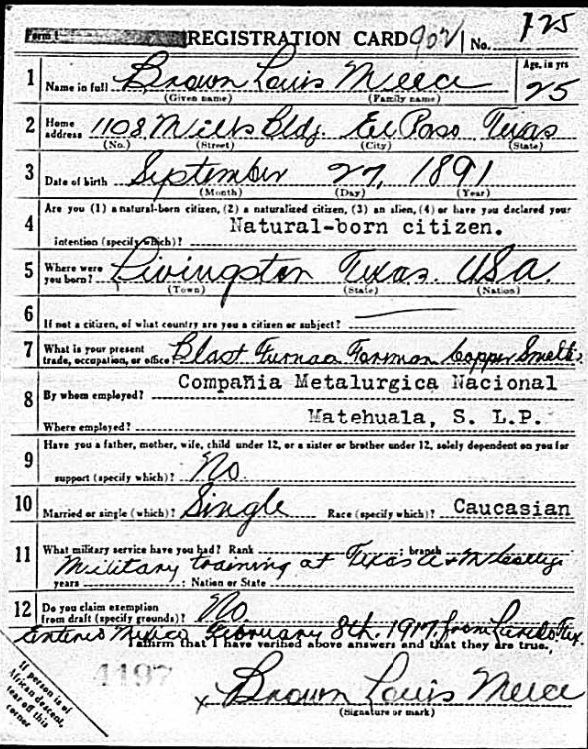
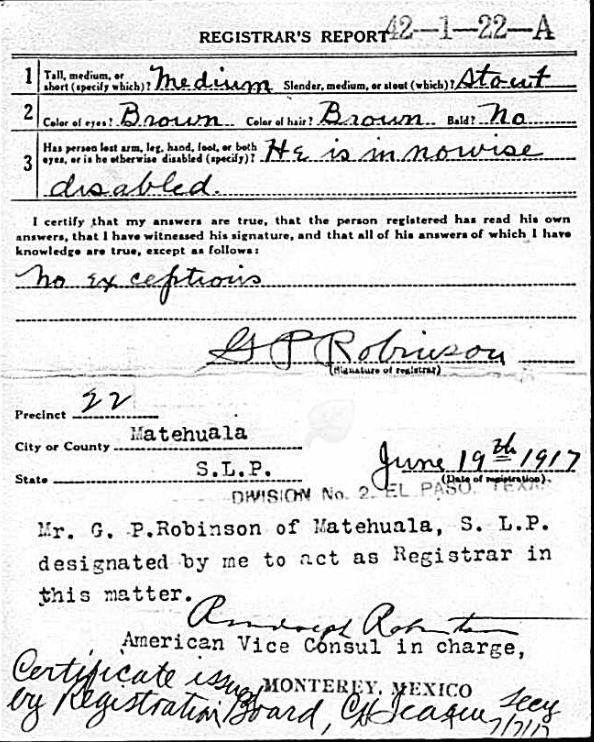
According to his World War I Draft Registration Card, Brown was a Blast Furnace Foreman in a copper smelter located in Matehuala, which is a city located in the state of San Luis Potosi. His military training at Texas A & M was noted. He entered Mexico on February 8, 1917 from Laredo, TX. He was assigned to Division No. 2 El Paso, Texas.
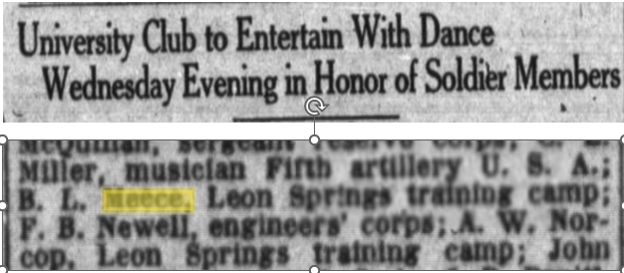
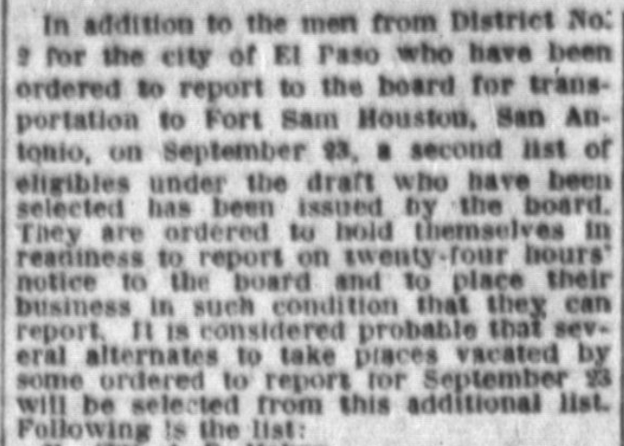
According to this article, Brown was stationed at the Leon Springs training camp. Camp Bullis, located in the Leon Springs area northwest of San Antonio, Texas, is a 28,000-acre military training reservation established in 1917. It serves as a primary, year-round field training site for U.S. Army, Air Force, and Marine Corps units, including medical training for personnel from Brooke Army Medical Center. It hosted the First Officers’ Training Camp in 1917 during World War I. The site was chosen for its varied, rugged terrain, which is ideal for combat training, situated near present-day San Antonio. According to the following article, Brown was ordered to report, as part of District No. 2, to Fort Sam Houston, San Antonio on September 23, 1917.
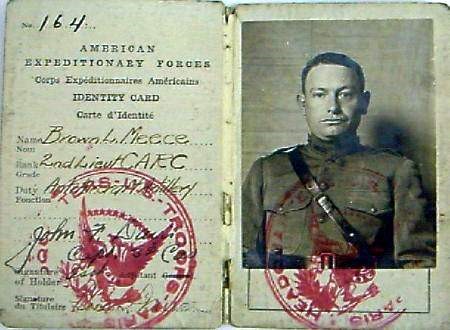
World War I began on July 28, 1914. The United States didn’t get involved until it declared war on Germany on April 6, 1917. Brown was a 2nd Lieutenant in the American Expeditionary Forces Battery “A” 65th Artillery (C. A. C.) Coast Artillery Corps. In February of 1918 orders were issued for the entire 65th Artillery to muster at Fort Winfield Scott in San Francisco, CA. On March 2, 1918 the 65th Artillery sailed aboard the USS Northern Pacific to Hoboken, NJ, via the Panama Canal. They arrived on Saturday March 16, 1918. They then boarded trains for Camp Merritt in New Jersey for a brief stay.
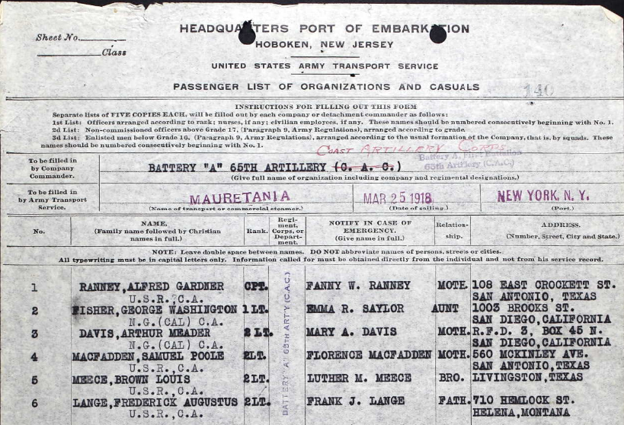
On March 23, 1918 the 65th Artillery boarded trains that would convey them to ferries which would transport them to Cunard Line dock. There they would board the RMS Mauretania. It would take two days for the 65th Artillery, 55th Artillery and 200 Red Cross nurses to board the ship. Not a single artillery piece was loaded aboard. They would have to rely on the British and French for artillery weapons.

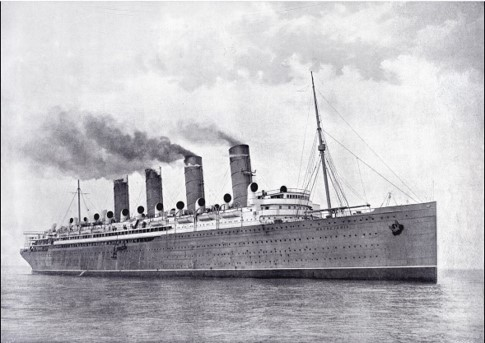
The RMS Mauretania arrived in Liverpool, England on Monday April 1, 1918. They stayed onboard the vessel overnight and disembarked on Tuesday. They boarded trains where they were transported to the American Rest Camp in Romney, England. The trip is approximately 283 miles and 5 hours by train. Two days later they marched approximately seven miles to Southampton where they boarded a steamer USS Ohio for Brest, France.
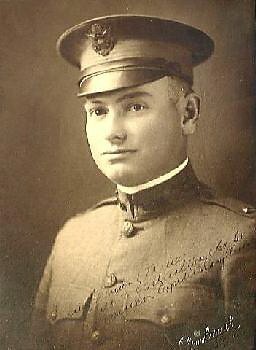
I’m sure that these men had more than enough time to ponder what would happen to them once they arrived in France. The voyage took six to seven days. Approximately 116,516 Americans died in WWI, 53,000 battle deaths and 63,000 non-combat deaths due to widespread disease (Spanish flu). The initial patriotic enthusiasm gave way to the realities of trench warfare, artillery bombardment, anxiety during the prolonged periods of static combat and chemical weapons. The term “shell shock” was coined during this war which was a term for what we call post-traumatic stress disorder (PTSD) today.
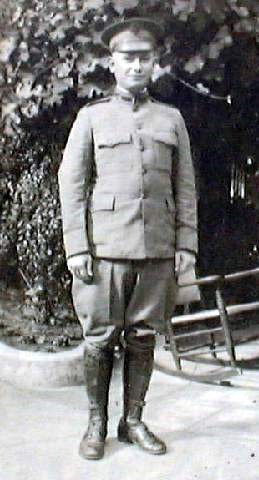
This is a newspaper article, that included the photo above, from page six of The Houston Chronicle dated Sunday August 11, 1918. You’ll note the mention “…son of the late Judge T. F. Meece of Livingston, Texas.” At one time, T.F. was a correspondent for The Houston Post, as well as other publications. The letter was written by Brown to his sister Anne Corrine Meece Mangum. Anne was born on October 14, 1889, so she was approximately two years older than Brown. According to her birth certificate, her place of birth was the Meece Hotel.
July 4 in Paris a Wonderful Day, Writes Texas Boy
“July Fourth has come and gone, and what a wonderful day it was over here,” writes Lieutenant Brown Louis Meece, son of the late Judge T. F. Meece of Livingston, Texas, to his sister, Mrs. T. Mangum of 1419 Crawford Street, Houston, under date of July 7.
“The French and English made the day a holiday,” he continues, “and it seemed that everyone vied with everyone else to see who could do more honor to the day and what it stands for. Really, sis, it was one of those really big days when history is made, and how glad I am to have been permitted to be in Paris on such a day.
“I don’t believe the English and French could have gone into the celebration so wholeheartedly had it not been for the wonderful work our troops have been doing in the Chateau-Thierry district. How the people did cheer when the boys who have survived the fighting up there came swinging along—-Infantry, field artillery and marines, all with their steel helmets on. How big and husky and determined they looked! Every man had been through a hell on earth and a Providence had willed that they should be spared. Their expression showed that there were at least a few Americans who realize what beasts we are to face and what we must look forward to before this ends.
“For the first time since the declaration of war Paris was ‘decked out’ in all her glory. All the buildings were decorated with French, English and American flags. I went into town on the afternoon of the 3d, but came back to the school that night, and then went back on the early train on the 4th, long before time for the parade. The entire route was lined with people who believed the old adage, ‘First come, first served, or, better, ‘First come, first in line.’ I walked up on the Champs-Élysées looking for a chance to get on the sideline, where I could get some pictures of the procession. Finally, I found a small place, kept open by gendarmes for crossing the champs. I walked out into the street and proceeded to take some pictures of the crowd. A gendarme saw me and invited me to stand out in front with him, telling me in English that I could stay there and get some pictures of the parade. That was exactly what I had wanted and, of course, I accepted his invitation and stayed the entire time.
“While we were waiting for the troops a number of aviators came swooping down over the crowd, doing everything that looked impossible, and very often finished a ‘stunt,’ such as loop-the-loop, not higher than an ordinary tree. Several times they actually came down lower than the treetops on either side of the champs and raced the full length of the street at that level.
“It surely was a wonderful day. I suppose the day meant more at home this year than ever before.”
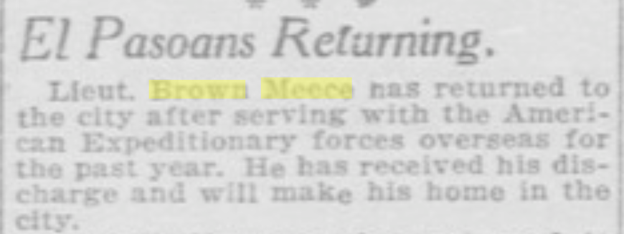
At the time of this letter Lieutenant Meece was still at the anti-aircraft school, but expected shortly to go to the front. At the school he was one of two that secured 100 per cent in examinations and was highest, or next to the highest, in the class. Prior to going to France he was in the training school at Fort Winfield Scott, California.”
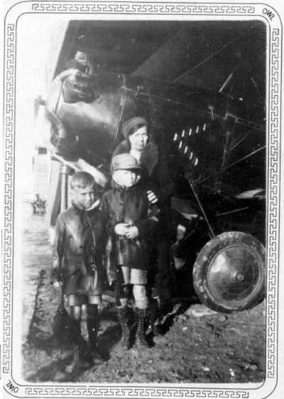
I believe that Brown had some advantages over his fellow soldiers. He received military training at Texas A&M. Nearly 50% of its graduates participated in the war. Texas A&M supplied over 2,000 officers to the Army by the end of the war. At the young age of 27 Brown had already traveled to Korea and Mexico, holding positions of authority. An electrical engineering degree requires a certain level of intelligence. It requires a strong foundation in logic, problem solving skills, mathematical abilities and analytical thinking. While this may or may not have made a difference on the battlefield, it certainly helped him prepare for what was ahead and his duties as an officer.
Brown was reassigned to the 24th Anti-Aircraft Battery, 1st Anti-Aircraft Sector. America entered the war with little or no knowledge of the science of anti-aircraft gunnery and relied on the French for training. The 24th AA Battery was made up of a Captain and a First and Second Lieutenant, with 75 enlisted men. The 1st Anti-Aircraft Battalion was under the command of Lt. Colonel H. F. Spurgin, CAC. Other officers of the Battalion were as follows:
Battalion Adjutant, 1st Lt. William R. Tower, CAC
Battalion Supply Officer, 2nd Lt. Joseph L. Ahart, FA
C. O. Headquarters and Supply Companies, 1st Lt. Klemme O. Longley, CAC
C. O. 21st AA Battery, Captain Harold N. Marsh, CAC
21st AA Battery, 1st Lt. George S. McEllory, CAC
C. O. 22nd AA Battery, 1st Lt. Joseph H. Cochran, CAC
22nd AA Battery, 2nd Lt. Arthur B. Pierson, FA
C. O. 23rd AA Battery, Captain Joseph A. Dias, CAC
C. O. 24th AA Battery, Captain Cody Mervin, CAC
24th AA Battery, 2nd Lt. Brown L. Meece, CAC
24th AA Battery, 2nd Lt. William F. Mullay, CAC
25th AA Battery, 2nd Lt. Alfred L Tower, CAC
25th AA Battery, 2nd Lt. James T. Pitts, FA
Medical Detachment, 1st Lt. Ezra J. Mitchell, MC
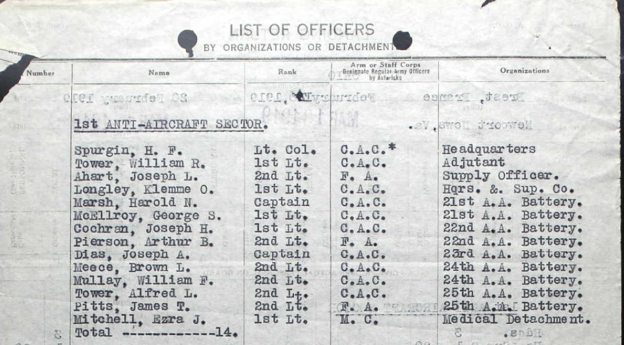
Anti-aircraft (AA) artillery was largely ineffective in World War I, primarily due to poor targeting, a lack of suitable technology, and difficulties in calculating trajectories for fast-moving aerial targets. They used modified field guns which were more of a deterrent than anything else. Brown was lucky in some respects. The 65th Artillery had to train as well. They spent 70 days training to operate and fire the British 9.2-inch Howitzers. Battery “A” (Brown’s battery) and Battery “B” saw a couple of days of action, but not much. Battery “C” and Battery “D” encountered more action, but the entire Regiment only suffered three deaths. His reassignment kept him even further away from the battlefield.
Unfortunately, Brown’s first cousin, Clyde John Meece would not be so lucky. Clyde would be killed on November 4, 1918, during the Meuse-Argonne offensive. He was reported as MIA and his body was never recovered. He died at the young age of 25, two years younger than Brown. World War I would end just seven days later. Ironically, his brother Charles Stewart Meece would die from the Spanish Flu. He contracted the Spanish Flu from returning servicemen on a train and died on Jan 23, 1919, in Artesia NM, at the young age of 31. The flu killed an estimated 675,000 Americans.
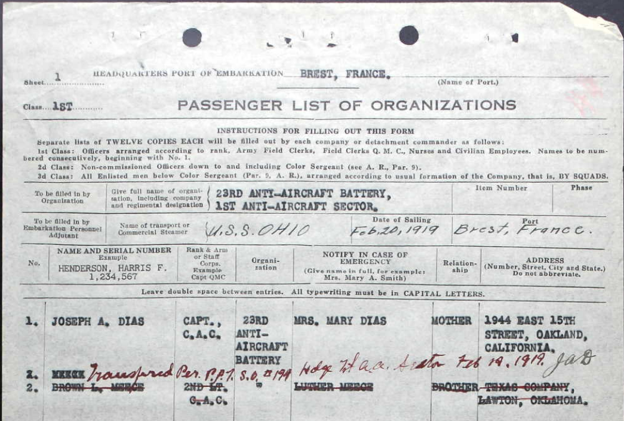
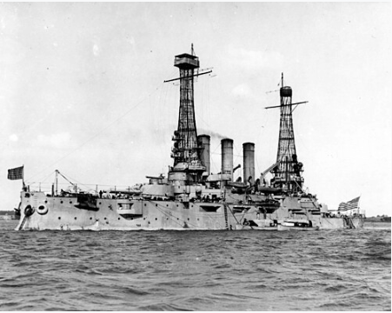
The 1st Anti-Aircraft Sector, comprised of 13 officers and 382 enlisted men boarded the battleship USS Ohio on February 20, 1919. They departed from Brest, France, and arrived in Newport News, VA, on March 5, 1919. They would stay at Camp Stuart in Virginia for a short time before moving across the country to the Presidio in San Francisco, California. During World War I, the Presidio of San Francisco served as a vital U.S. Army post, training center, and staging area for troops deploying to the Pacific. It was a major command post that, along with its sub-posts like Crissy Field, expanded rapidly to support the war effort. The 1st Anti-Aircraft Sector was demobilized in March of 1919. Brown Louis Meece returned to El Paso, TX on April 23, 1919.
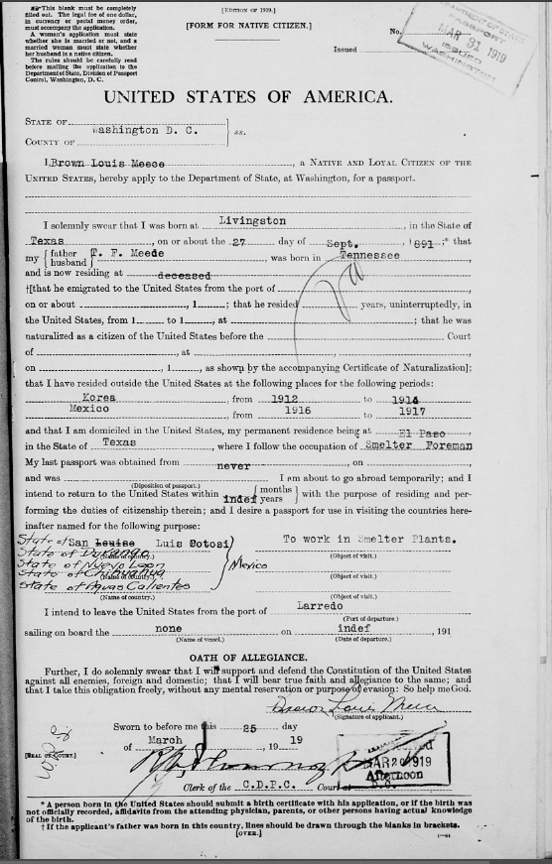
On March 25, 1919 Brown applied for and received a passport to work at ASARCO smelter plants located in the following Mexico States:
- State of San Luis Potosi
- State of Durango
- State of Nuevo Leon
- State of Chihuahua
- State of Aguascalientes
His departure point was Laredo, TX. On the passport application Brown wrote indefinite in the space for “and I intend to return to the United States within ____ months/years.” According to a later passport application, Brown worked in Mexico from October of 1919 until August of 1921. During the interim, between April and October of 1919, I assume that he worked in the El Paso plant. Based on my experience and the number of plants he intended to travel to, I’m guessing he was there in some sort of training or troubleshooting capacity.
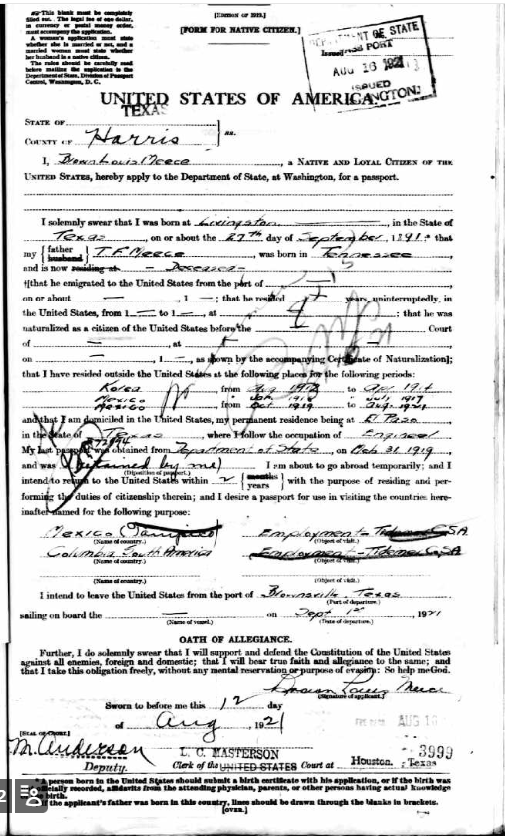
On August 21, 1921 Brown filed for another passport. In 1921, the renewal term for a U.S. passport was two years. Passports were only required for a short period, from May 22, 1918, to 1921, during and after World War I, but renewals were not standardized as they are today. Passports were not a standard requirement for U.S. citizens to travel abroad until 1941, except for brief periods during the Civil War and World War I.
This time, Brown was applying for a passport to travel to Tampico, Mexico and Columbia, South America. He identified his employer as Tidemex. News reports from the time documented the company’s activities, such as a New York Times article from 1921 mentioning the company losing a well due to water. Another report noted a vice president traveling to Mexico in 1922 to inspect its properties. The original Tidewater Oil Company, which operated independently from 1887 to 1926, is now defunct and distinct from the modern Tidewater Inc. Historically, a separate company called Tide-Mex operated as a subsidiary of the original Tidewater Oil Company in Mexico during the 1920s. The Times reported the following:
The Tidemex Company, the report says, lost the last well drilled in lot 213, Amatlan, due to water. In addition, the report states a new well at Cerro Azul Is giving 30,000 barrels daily. Well No. 5. Panuco, at 2,000 feet, brought in salt water. The report adds that a new well at Bernal, at 2,385 feet, brought in 2,500 barrels.
During the period of Mexico’s first oil boom in the early 20th century, Tampico was the chief oil-exporting port of the Americas and the second busiest port in the world. I have not found any involvement of Tidemex in Columbia in 1921. Perhaps, this was an exploratory visit. The primary oil companies operating in Columbia at that time were the Tropical Oil Company and its parent company Standard Oil.
The accompanying letter, affirming the facts stated in the passport application, was his brother-in-law Thomas Milton Magnum. Thomas was married to Brown’s sister, Anne Corrine Meece Magnum. Based on earlier research, I thought he was a schoolteacher. At the time of the application, however, he was identified as a court reporter in Houston, TX. According to the letter, Brown was on vacation, and he was filing the application “to enable him to return to his position with the Tidemex Company.”
I have been unable to identify when Brown left the employment of American Smelting and Refining Company and started working for the Tidemex Company. When Brown completed the document, he described himself as 29 years of age, brown hair, brown eyes, 5’ 7” tall and he had a birthmark on the left side of his neck.
I wondered whether my grandfather was able to speak Spanish, considering the amount of time he spent in Mexico. In a letter dated July 12, 1950 Brown wrote the following: Enroute home Jeannie (his daughter) discovered a man trying to talk to some people and sensed he was speaking Spanish. Therefore, she immediately suggested I could speak Spanish and he came over to talk to me. It developed he was a lieutenant in the Colombian Navy enroute to Minneapolis to visit his parents. After we talked Spanish enough to get started, I discovered he talked fairly good English; therefore, most of the conversation thereafter was in English. At any rate, when he got stuck on English, he tried his Spanish on me and between us we got along fairly well.
When we went in to the diner, we were laughing about our English-Spanish conversation and the fact that I was unable to remember the Spanish word for earthquake and he in turn did not know what the English word “earthquake” meant. The man next to me in the diner laughingly told me the word was “tremblor”. We discovered then that the man next to me was a Spanish interpreter in the State Department, who was in Bogota with General Marshall when the revolution broke down there. Then, to add to the sequence, I discovered that this particular fellow was a very close friend of Ambassador Kyle, who was one of my instructors at A&M and had been a schoolmate at Georgetown University with Ambassador Donnelly, who had been so nice to me when I went to Caracas, Jeannie really had a circus talking to the Colombian, giving him a short course in English while we were enroute home.
In July of 1922 Brown was living in Enid, Oklahoma and he was employed by the Champlin Refining Company as a traveling representative. Enid is the ninth-largest city in the state of Oklahoma. It is the county seat of Garfield County. In the 2020 census, the population was 51,308. The population in 1922 was estimated at between 10,000 to 15,000 residents. As a point of reference, Enid is 101 miles or 1 hour 32 minutes from Oklahoma City and 115 miles or 1 hour 43 minutes from Tulsa. Brown was reported as living in a room at the Essex Club. Social clubs would offer short-term rooms for their members in lieu of residential rentals. While living in Enid, Brown was deployed with the Oklahoma National Guard to Fort Sill on July 13, 1922 for their annual two-week deployment.
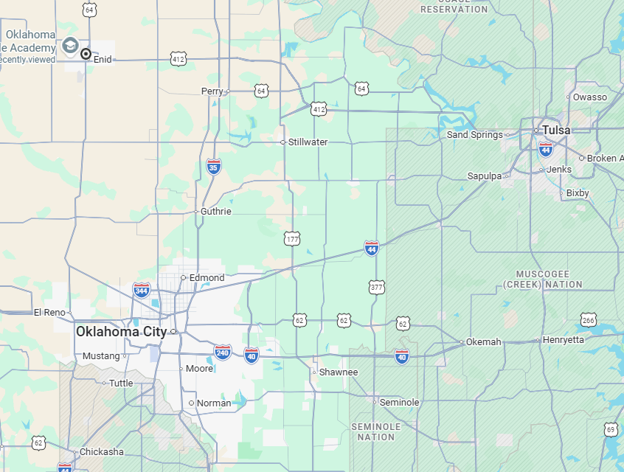
The Champlin Refining Company was an Enid, Oklahoma-based, privately-owned, integrated oil company founded by Herbert Hiram Champlin in 1917, operating refineries, pipelines, and service stations across the Midwest. The Champlin Refining Company held the distinction of being the nation’s largest fully integrated oil company under private ownership. Brown’s brother Thomas Epperson Meece was the Sales Manager at the time. I can only assume that Thomas got Brown a job with Champlin.
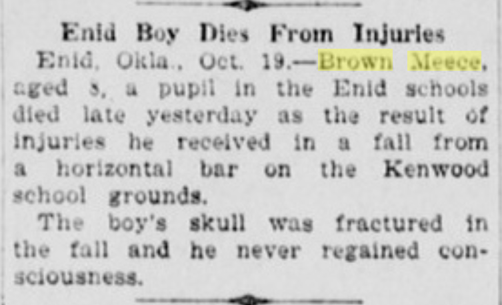
Tragically Thomas’s son, Brown Louis Meece, would die in an accident on the Kenwood School grounds in Enid, OK. He died on October 18, 1920. Brown, who was named after my grandfather, was Thomas’s only son. Sadly, Thomas and his wife, Ora Cevilla Dye Butler Meece, lost their first son, Thomas Edward Meece, shortly after birth on January 24, 1907 in Galveston, TX. At the time, Thomas was a manager for the order and sales department with Miller & Vidor Lumber Company. He was also a notary public.
In the early 20th century, Oklahoma faced significant challenges related to the resurgence of the Ku Klux Klan (KKK), which had grown in influence and violence. The Tulsa race massacre was a two-day-long white supremacist terrorist massacre that took place in the Greenwood District in Tulsa, Oklahoma between May 31 and June 1, 1921. Mobs of white residents, some of whom had been appointed as deputies and armed by city government officials, attacked black residents and destroyed homes and businesses. The event is considered one of the worst incidents of racial violence in American history.
Enid was not spared by this sort of violence. The Klan held parades through downtown Enid in 1922. At least two Black men were tarred and feathered in separate incidents by the Klan in Enid in the 1920s. Tarring and feathering was a 18th-century vigilante punishment where a victim was stripped to the waist, covered in hot pine tar, and coated in feathers. Often performed by a mob, this method was used to humiliate and cause pain, sometimes involving further beatings or being paraded through town. As recently as 1979 an 18-year-old black student was hung from a tree.
John Calloway Walton was inaugurated as the fifth Governor of Oklahoma on January 9, 1923. He was the former Mayor of Oklahoma City. In 1923, he imposed martial law in Okmulgee and Tulsa counties to curb KKK violence. On September 15, 1923, he declared “absolute martial law” across the entire state. Walton used the National Guard to stop the state legislature from meeting to investigate his administration. He threatened to use troops to shoot legislators if they assembled. The Oklahoma House of Representatives adopted 22 charges against him on October 23, 1923, including illegal use of the military, padding the public payroll, and suspending habeas corpus. On November 19, 1923, Walton was convicted and removed from office.
Martial law is the temporary, extreme measure of replacing civilian government with military authority, typically during war, insurrection, or severe natural disasters. It authorizes the military to enforce laws, impose curfews, and sometimes suspend civil liberties. While it must end when order is restored, it can result in the suspension of rights, media blackouts, and military trials.
On October 4, 1923 Brown L. Meece was appointed as Executive Officer of the National Guard in Oklahoma City, the state capital. According to the newspaper article, Brown was still employed by Champlin Refining Company, but he was now living in Oklahoma City. As Executive Officer (XO) in the National Guard Brown would have been the second-in-command. He would have been the primary staff manager, responsible for daily operations, logistics, personnel, and training to maintain unit readiness.
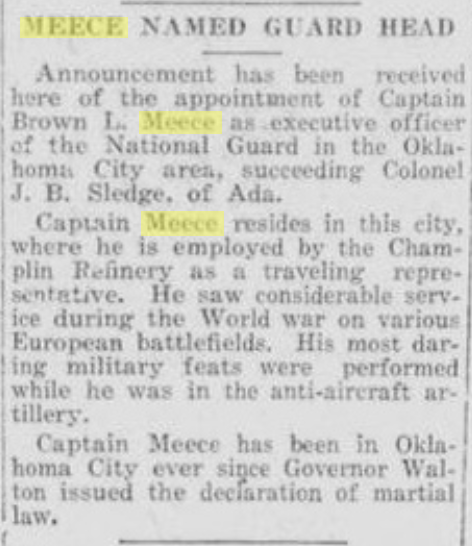
Walton’s declaration of martial law was merely a distraction to mask his political and legal woes. It had absolutely nothing to do with protecting the negro population. There were some reports that Walton was a Klan member. Talk about being caught between a rock and a hard place! Clearly, our grandfather was obligated to enforce the declaration of martial law against both the Klan and the State Legislature. Thankfully, he was not ordered to shoot the legislators. If I know him as well as I think I do, he would have refused that order.
On December 28, 1924 the Houston-Post Dispatch reported Christmas visitors to the Bryant O’Patrick Laramore home in Livingston, TX. Bryant was married to Brown’s sister Mary Inez Meece. Their daughters, Nettie Laramore and Katherine Laramore were in attendance. Guests included Luther Marshall Meece and his wife Jenny Bell McCrory of El Paso, TX, as well as Brown Meece of Omaha, NE. I’m not sure who the last guest was. At first, I thought that it might be Brown’s sister Bennett Amelia Meece. She was married to a gentleman by the name of Alfred Eggerth but they lived Pocatello, ID, not Los Angeles, CA.
Anyway, apparently Brown had moved from Oklahoma City, OK to Omaha, NE. The first entry I’ve found was from a 1925 directory of the greater Omaha area. Brown was identified as a salesman for the Quaker Petroleum Company. Their office was located at 1444 South Twentieth Street in Omaha. I found no affiliation with the Pennzoil-Quaker State Company.
He was only with Quaker for a short period of time. The next listing I discovered was from the Houston, TX area. Brown was identified as a Manager for the Atlas Petroleum Company in 1926. Atlas Petroleum Company was purchased, along with many other companies, by the American Republics Corporation. American Republics Corporation was a Houston-based Texas oil company founded in 1916 by Joseph S. Cullinan. It was formed by consolidating twenty subsidiary companies and later became a predecessor to the Sinclair Oil Corporation. Ironically, Brown would eventually become an employee of the Sinclair Oil Corporation. According to the directory, he had a room at 1525 Hawthorne Street in Houston, TX.

On November 14, 1929 Brown Louis Meece married Jessie Lucille Harden. Miss Doris Dresser was her attendant or maid of honor. Mr. Russel Allison was Brown’s best man. Brown was 38 and Jessie was 22. They were married at the Basilica of St. Mary. Brown was raised a Baptist and converted to Catholicism. Jessie’s father Charles Edward Harden passed away on August 27, 1922 when Jessie was only 15. Mr. Harden was employed as a superintendent for the Butler Brothers, a retailer and wholesale supplier in Chicago, IL. Jessie’s mother, Amelia Eggerth Harden (Gram) would eventually live with them in Chicago. As to how Brown and Jessie met, I have no idea.
In a 1931 directory Brown is listed as an Assistant General Sales Manager for Producers & Refiners Corporation (PARCO). He and Jessie lived in a house located at 408 S 2nd St in Independence, KS. My father, Louis H. Meece, was born in Independence on February 2, 1931. Brown’s movement between jobs, at this particular time, is a little perplexing given the state of the economy. The Great Depression began with the devasting Wall Street crash of 1929. The severe economic downturn would last until 1939. By March of 1933 the banking system had collapsed, nearly 25% of the labor force was unemployed, and prices and productivity had fallen to 1/3 of their 1929 levels.

The Great Depression (1929–1939) caused a severe collapse in oil demand and prices, driven by the economic downturn and a massive supply glut from new Texas oilfield discoveries. Oil prices dropped precipitously, leading to industry layoffs, bankruptcies, and government intervention. Consolidation and survival were the order of the day. While many suffered, some companies grew stronger. Sinclair Oil doubled in size, becoming the eighth largest in the U.S. by 1933. J. Paul Getty famously used the crisis to acquire cheap, undervalued oil assets, such as the Pacific Western Oil Company.
The Dust Bowl also occurred during this same period. The Dust Bowl was a devastating ecological and economic disaster that happened in the Great Plains. It was marked by severe drought and massive dust storms that choked the land, crops, and people. These conditions forced hundreds of thousands of displaced farmers to migrate west, amidst the Great Depression’s hardship. It resulted from a combination of natural drought and years of unsustainable farming practices. The Dust Bowl created widespread poverty and ecological ruin.
The states most severely affected by the Dust Bowl were Oklahoma, Texas, Kansas, Colorado, and New Mexico. The disaster particularly devastated the Oklahoma and Texas panhandles, southwestern Kansas, and southeastern Colorado, damaging roughly 100 million acres. I’m sure that Brown, based on his migration, could empathize with those individuals from Texas, Oklahoma and Kansas in particular. Approximately 2.5 million people left the affected states.
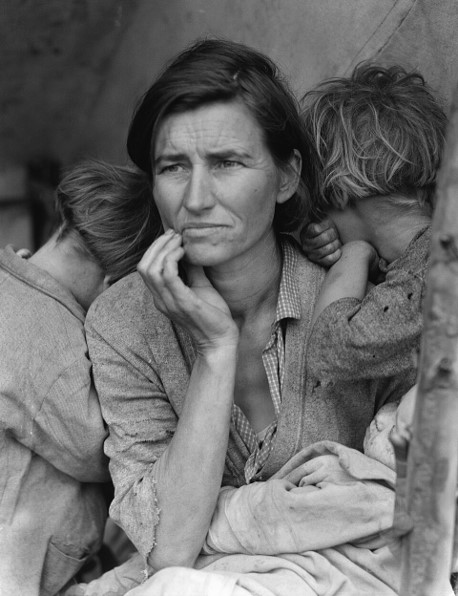
One of the most famous photographs from the “Dust Bowl” was taken by Dorothea Lange on March 6, 1936. Lange was working for the federal Farm Security Administration (FSA). It was a photo of Florence Thompson entitled “Migrant Mother”. She was a mother of seven children, and she was 32 years old.

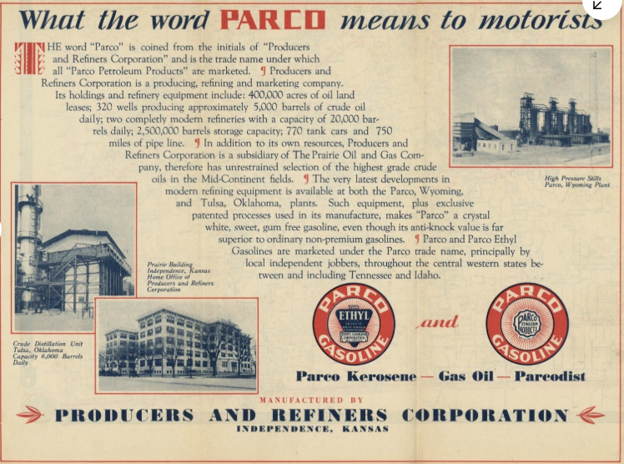
The Producers and Refiners Corporation (PARCO) was an independent oil company that built a refinery and planned company town in south-central Wyoming near Rawlins in 1923-1924. The town, designed in Spanish Colonial style, was renamed Sinclair in 1943 after the refinery and town were purchased by Sinclair Oil Corporation. They had offices in Independence, Kansas, which was a significant oil center where major companies like Prairie Oil and Gas and Sinclair Oil maintained headquarters or large offices in the 1910s and 1920s. The Producers and Refiners Corporation went into receivership and was acquired by Sinclair on April 12, 1934.
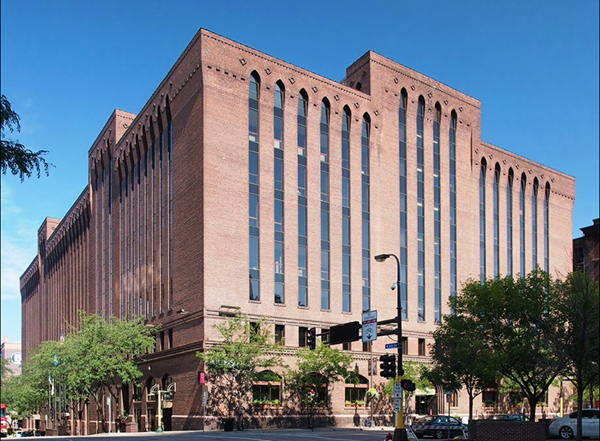
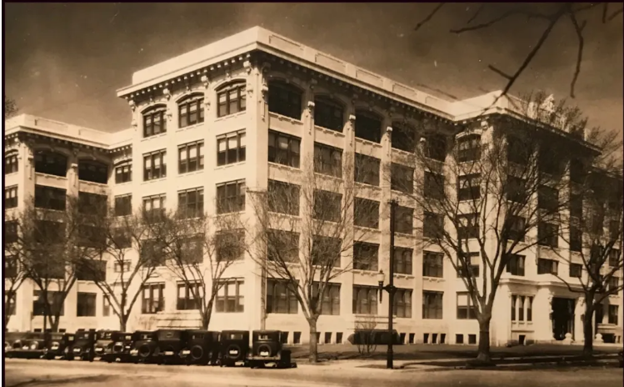
The Producers and Refiners Corporation (PARCO) had offices in the Prairie Oil and Gas Company office building in Independence, KS pictured below:
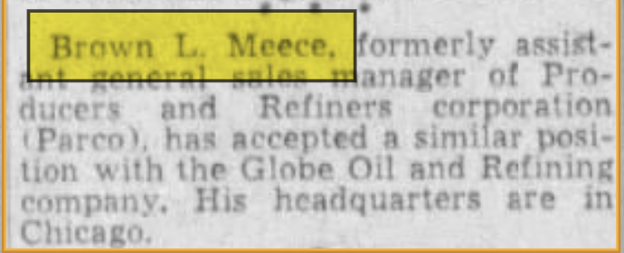
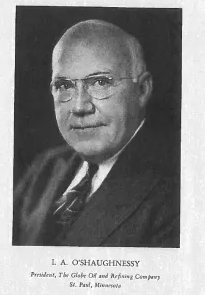
On December 25, 1932 the Tulsa World Sun reported that Brown Louis Meece accepted a similar position with the Globe Oil and Refining Company. Their headquarters were in Chicago, IL The Globe Oil & Refining Company, founded by I.A. O’Shaughnessy, was a significant independent oil operator in the early-to-mid 20th century. Notably, it constructed a major 10,000-barrel-a-day refinery in McPherson, Kansas, in 1933 during the Great Depression. The company was later sold to the National Cooperative Refinery Association in 1943.
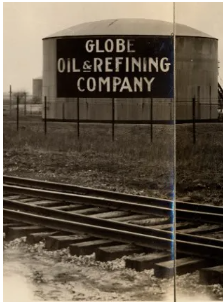
In the late 1920s, oil was discovered in McPherson County, Kansas. As a result, the Globe Oil & Refining Company built the McPherson refinery at a time when the country desperately needed jobs. The refinery created 350 construction jobs at the height of the Great Depression. Built in 1933, the refinery was soon producing 200,000 gallons of gasoline per day. The company played a key role in regional oil refining, particularly through its efforts in Kansas and its contributions to the war effort by operating certain facilities, even at a loss.
President Roosevelt appointed I.A. O’Shaughnessy to sit on the planning and coordinating committee of the 1933 National Recovery Act aimed at getting Americans back to work. The National Industrial Recovery Act (NIRA) of June 16, 1933, was a cornerstone of President Franklin D. Roosevelt’s New Deal, designed to stimulate economic recovery during the Great Depression. It created the National Recovery Administration (NRA) to regulate industry through codes of fair competition, fixing wages, prices, and working hours while suspending antitrust laws. I.A. O’Shaughnessy, Globe’s founder, also sat on the U.S. Petroleum Industry War Council during World War II.
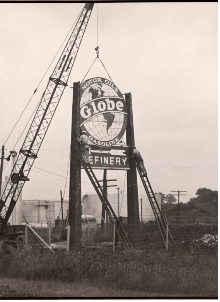
In 1929 Globe purchased the Lemont Refinery in Chicago Illinois from The Lemont Refining Company. Following its sale in 1929, the refinery continued to expand, doubling in size by 1933 to accommodate increased fuel demand.
NOVEMBER 28, 1929 THE LEMONT OPTIMIST- NEWS PAGE THREE LOCAL REFINERY COMPLETES ARRANGEMENTS FOR HUGE INCREASE IN PRODUCTION (Continued from Page 1) the ranks of active workers. It is now known as the Lemont plant of the Globe Oil Refining Company, it having been taken over by that company last May. “Rusting equipment, long cold, has been revamped, improved, reset, converted from idle junk into operating. money equipment. This process of renewal and rejuvenation is already well along, and starting December 1, we shall turn out 5,000 barrels a day, instead of 3,500, which is the present capacity of the plant.
“The plant was built in 1922 by the Shaffer Oil Refining Company, as a skimming plant with a capacity of about 1,000 barrels a day. It ran originally 011 crude oil from the Kansas fields, and consisted of two shell stills each equipped with a fractionating tower, and a batch agitator. About 1927 3. pipe still with two evaporator towers and a bubble tower was added to the equipment. “That,” says Mr. Kelley, “was the primary equipment of the plant when the Globe took it They called in an engineering company to work the refinery over and bring it in line with modern practice. These refinery engineers have apparently accomplished excellent results without performing what might be called a major operation. “Their first job was to revamp the two shell stills. They raised these considerably 011 their settings, redesigned and rebuilt their furnace and installed internal flues in the bottom halves of the stills. “They moved the stack taking the products of combustion from the still furnaces from the front to the rear of the stills, thereby giving the hot gases two passes, once from the front to the back, wiping the bottom sheet and once from back to front through the tubes immersed in the body of the oil.

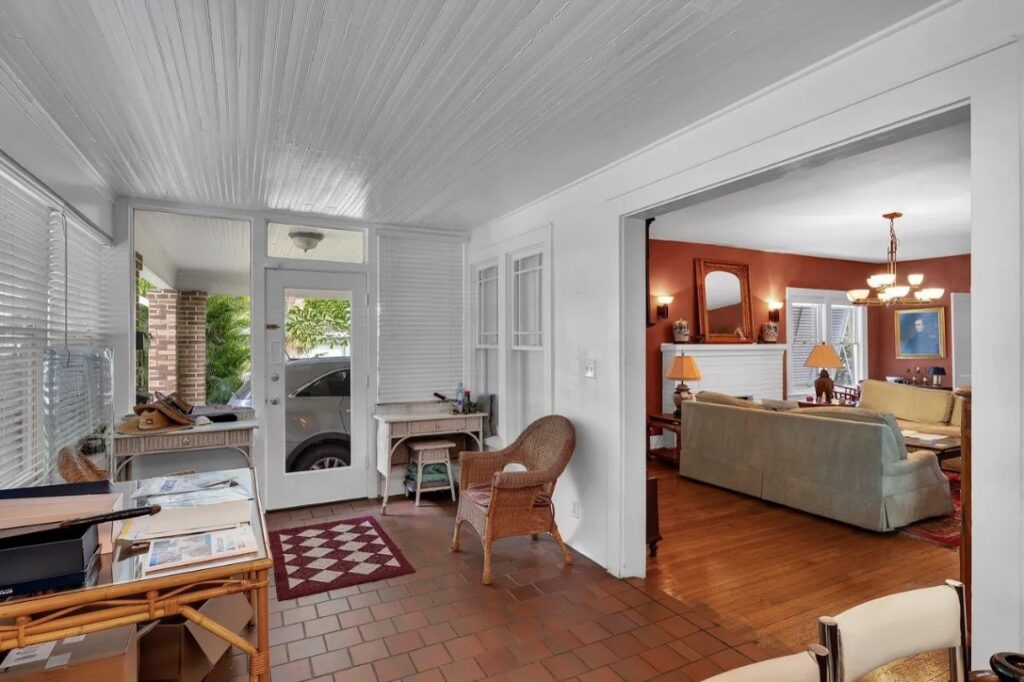
6 beds 5 baths 3,724 sq. ft. Sold for $2,100,000 on 7/17/24

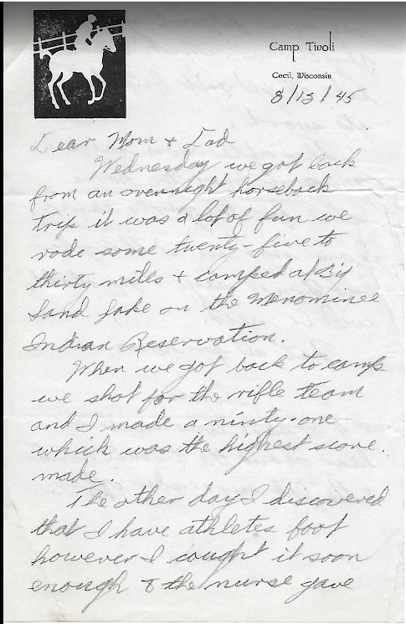
To give you a sense of what life was like and what the discussions were about in the 1940’s, read the following correspondence between my father and my grandfather. I’ll preface both letters by stating that the United States dropped the atomic bombs on Japan on August 6, 1945, Hiroshima, and August 9, 1945, Nagasaki. My dad was 14 years old and pretty nonchalant about the bombs. I’ve never heard the word “swell” associated with the atomic bombs before.
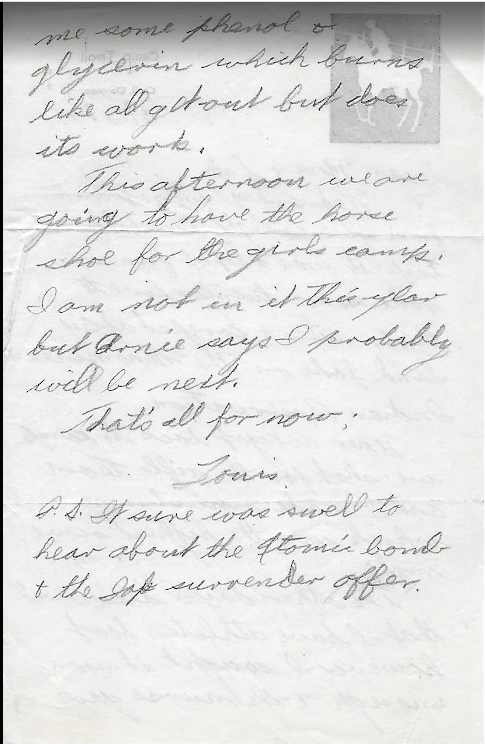
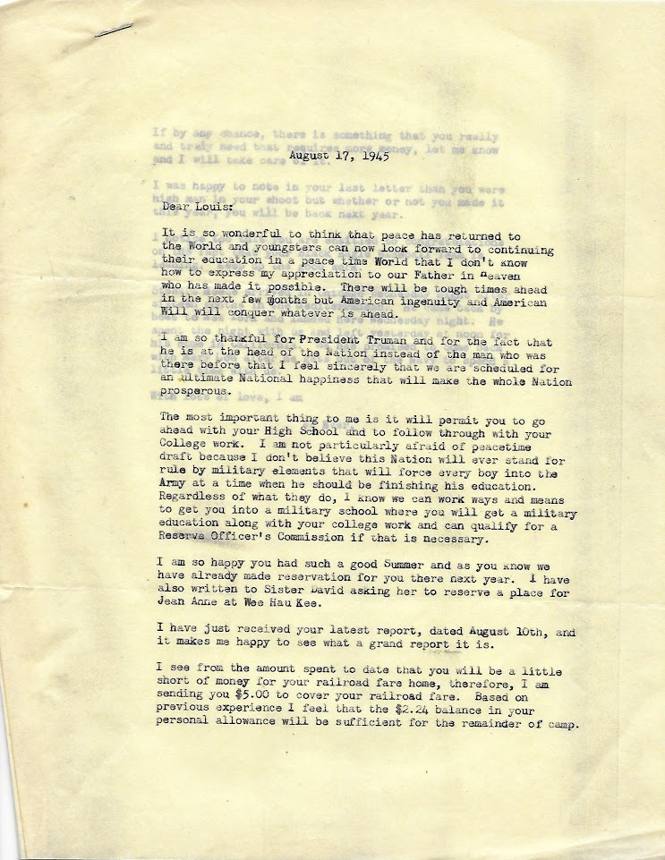
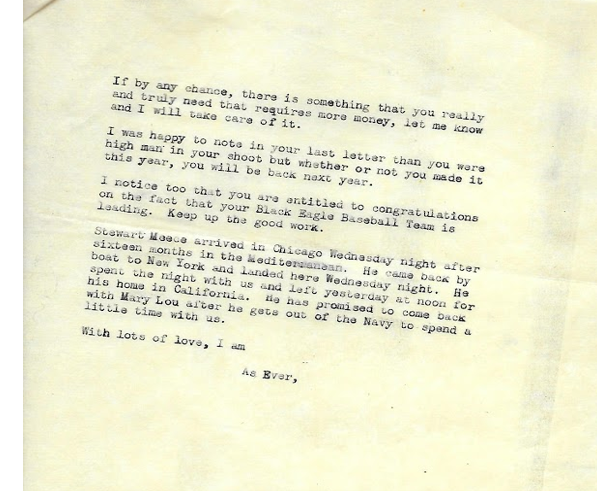
In a letter written on October 11, 1949 Brown write: “Paul Blazer is the man who offered me the job as Executive Assistant to him. It was when I wrote to Mr. O’Shaughnessy and submitted my resignation to Globe with the ultimate result that Mr. O’Shaughnessy decided I was worth as much to him as I was worth to Blazer and eventually had me elected a Vice President of this company with a very satisfactory salary increase that probably would not have come had it not been for Paul.”
The offices of the Globe Oil and Refining Company were in the Buckingham Building located at 59 E Van Buren St, Chicago, IL 60605.

On April 28, 1954, Brown would write: From my own personal experience figuring the twenty years with Globe to the first few years I have been over here… That being the case, grandfather would have worked for Globe until sometime in 1951 or 1952. Based upon what he had written, Brown appeared to be both undervalued and underappreciated at Globe. Given all of that, Brown still had regret. On April 5, 1954, Brown wrote: Had conditions turned out differently than they have here or had I stayed with Globe as I am pretty certain now I should have done, could have looked quite differently on actually helping you get in for yourself or starting you off for yourself but as things stand now, must think of Jean and Dick and make plans to help each of them get started off in life as I have tried to help you.
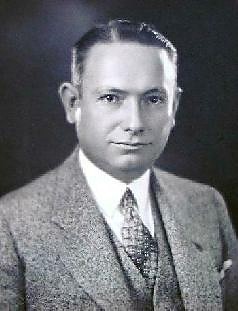
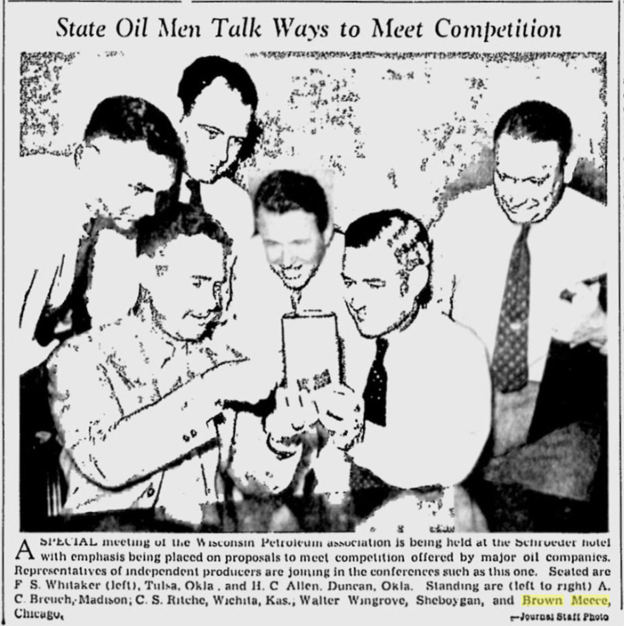
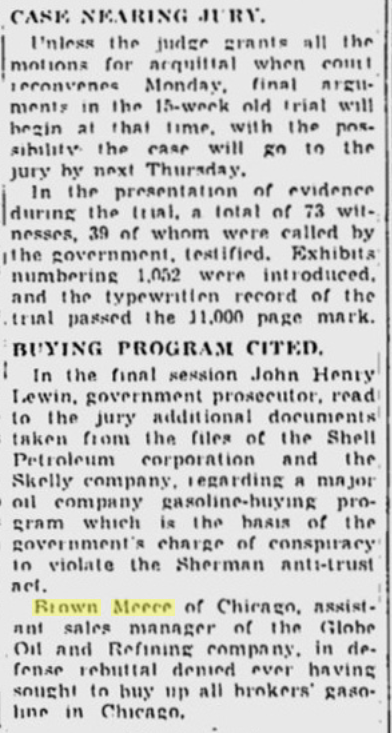
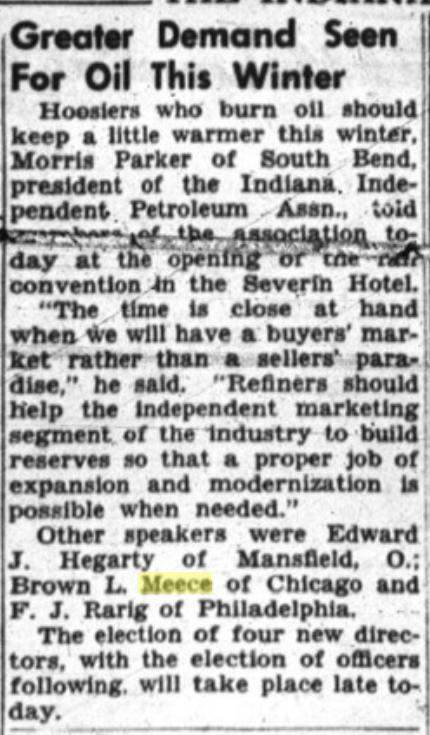
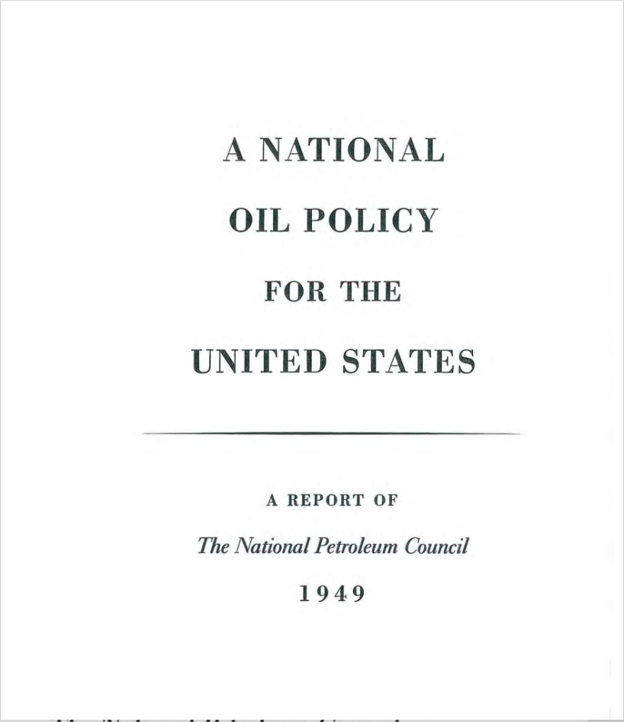
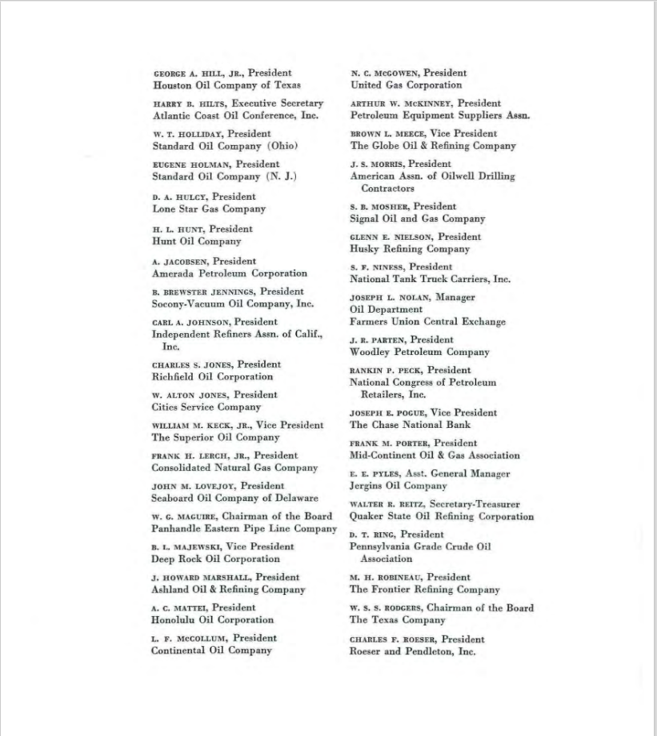
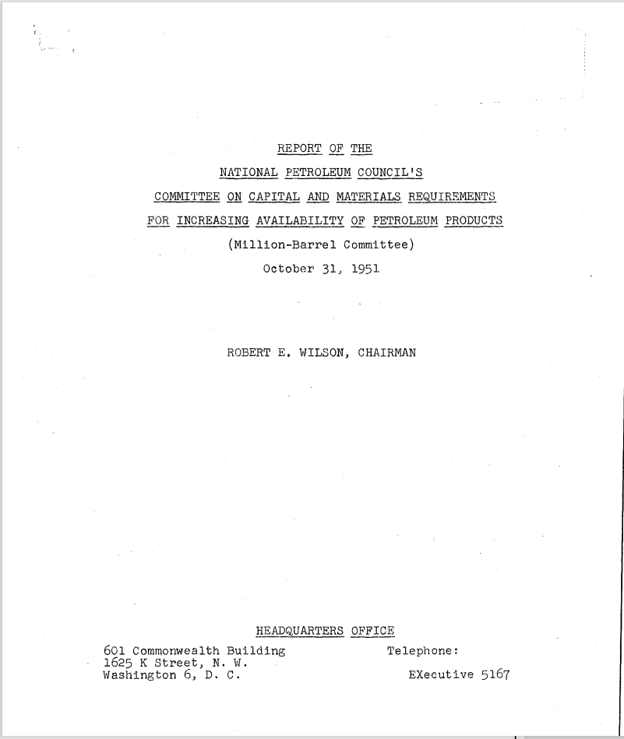
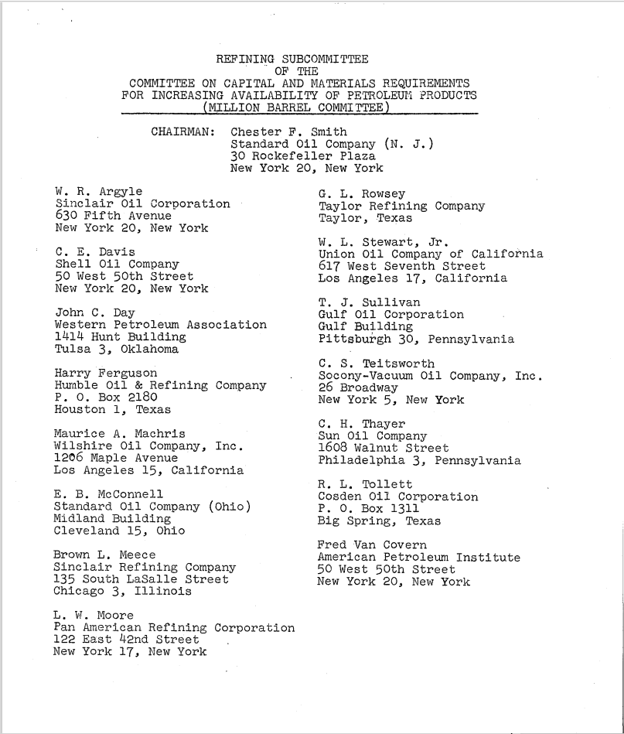
The National Petroleum Council (NPC) was established by the Department of the Interior on June 18, 1946, at the request of President Harry S. Truman. Brown L. Meece was an original member of the council. The National Petroleum Council was the successor to the Petroleum Industry War Council. The Petroleum Industry War Council (PIWC) was a critical World War II era advisory body established in 1941 by Secretary of the Interior Harold L. Ickes to mobilize the U.S. oil industry for the war effort.
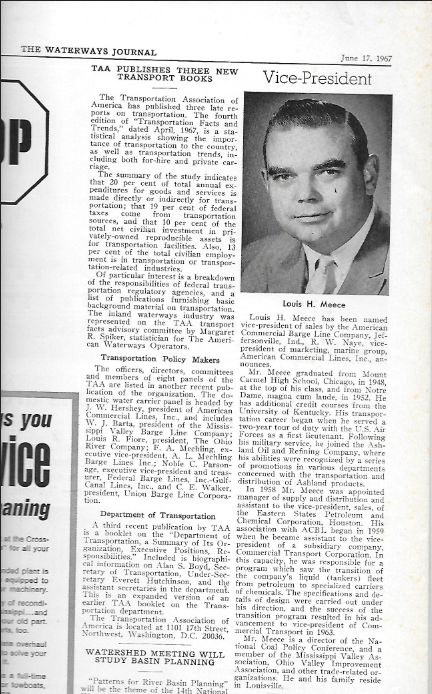
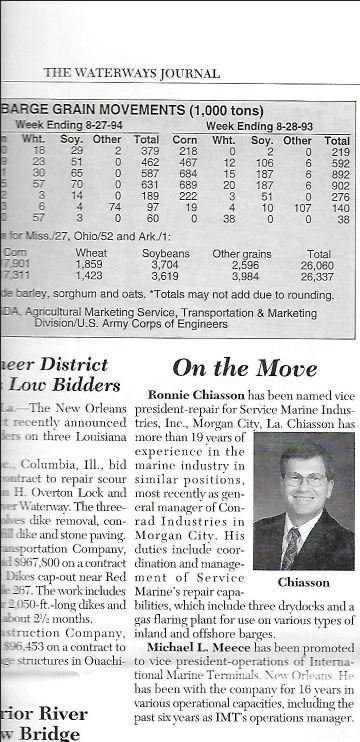
I first learned of my grandfather’s appointment to the National Petroleum Council in the late 1980s. I was reading a publication called the Waterways Journal. The Waterway Journal is a weekly news magazine published in St. Louis covering the industries, history, and culture of American waterways. The maritime publications company has been in business since 1887. The magazine contains a section titled This Week which contains news from past issues ten, twenty, thirty, forty, fifty and one hundred years ago. I was shocked to find Brown’s name in the Waterways Journal.
I immediately called my father and asked him about the article. He nonchalantly explained that he was a member of the NPC that basically controlled the movement of all oil and natural gas in the country. I could not be prouder. My grandfather, my father and I have all appeared in the Waterways Journal on multiple occasions. I can only imagine that we are part of a very exclusive club that can make that claim.
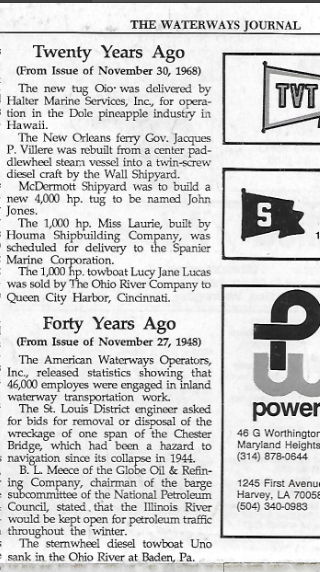
(From Issue of November 27, 1948)
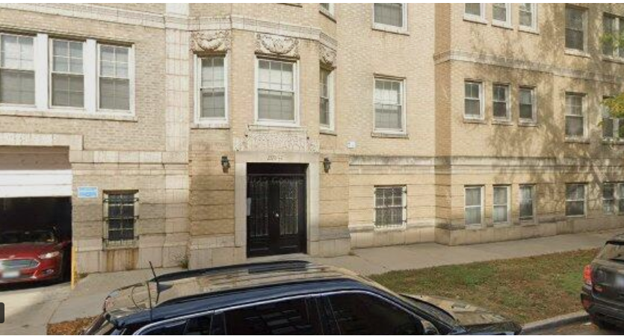
These are a few of the homes that they lived in while in Chicago.
6848 South Shore Drive Condo/Townhouse · 3 Beds · 2 Full Baths · 1 Half Bath · 2,200 Sq. ft. OWNER-OCCUPANT PARKING ONLY *** TASTEFULLY DECORATED 3 BEDROOM/2.5 BATH SOUTH SHORE CONDO. OVERLOOKING PRIVATE GOLF COURSE. HEAT INCLUDED IN ASSESSMENTS. MASTER BEDROOM SUITE. CEDAR CLOSETS. FORMAL DINING ROOM. HARDWOOD/CERAMIC FLOORS. BUTLER’S PANTRY/WET BAR. STEPS FROM THE BEACH/BIKE PATH. $170,182
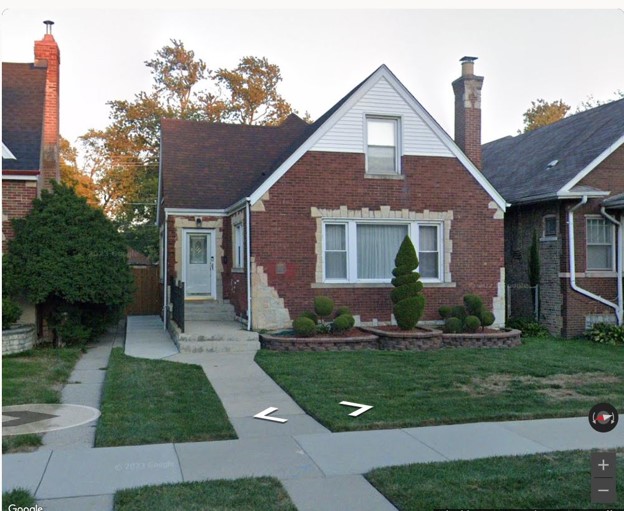
5 beds 3 baths 1,308 sq. ft. Built in 1939 $263,700.00 estimate


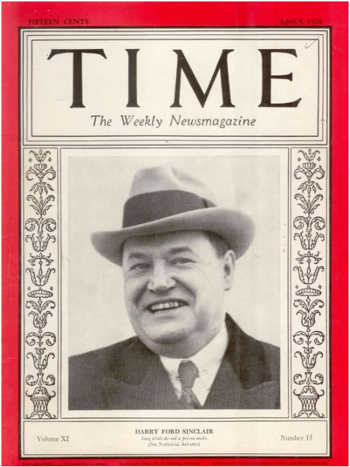
Sinclair Oil Corporation was an American petroleum corporation founded by Harry F. Sinclair on May 1, 1916. During the Great Depression, Sinclair saved many other petroleum companies from receivership or bankruptcy and acquired others to expand its operations. In 1932, Sinclair purchased the assets of Prairie Oil and Gas’ pipeline and producing companies in the southern United States, and the Rio Grande Oil Company in California. The purchase of Prairie also gave Sinclair a 65% interest in Producers and Refiners Corporation (Parco) which Sinclair subsequently acquired when Parco entered receivership in 1934.
In 1922 Harry F. Sinclair leased oil production rights, through Mammoth Oil, a subsidiary of Sinclair Oil, to the Teapot Dome in Wyoming, which led to the Teapot Dome Scandal. The Teapot Dome scandal was a political corruption scandal involving the administration of President Warren G. Harding. Albert B. Fall, the interior secretary, leased petroleum reserves designated for the Navy at Teapot Dome in Wyoming, as well as two locations in California, to private oil companies at low rates without competitive bidding. Fall was accused of accepting bribes totaling hundreds of thousands of dollars. In October 1929, Secretary Fall was found guilty of bribery, fined $100,000 and sentenced to one year in prison, making him the first Cabinet member to go to prison for his actions in office.
At the same time, Sinclair Oil Company is known for having made large payments to leading Fascists, all acting as intermediaries for Benito Mussolini. Harry Sinclair was arrested and imprisoned for actions related to the 1920s Teapot Dome scandal. While acquitted of bribery charges for securing government oil leases, he served roughly six months in jail (1929/1930) for contempt of Congress and jury tampering during his investigations. He hired detectives to monitor the jurors during his trial. Not exactly on the up and up!
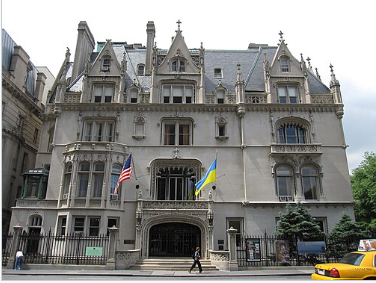
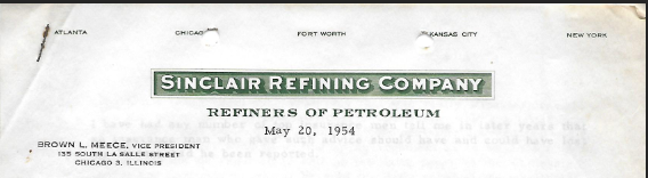
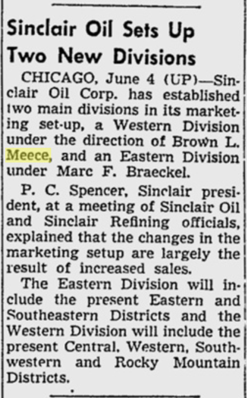
By 1930 Sinclair Oil was ranked as the seventh largest oil company in the United States and the largest in the Midwest. In 1955, Sinclair Oil Corporation ranked 21st on the Fortune 500 and Sinclair’s assets exceeded $1 billion. The Fortune 500 is an annual list compiled and published by Fortune magazine that ranks 500 of the largest United States corporations by total revenue for their respective fiscal years. It is my belief that Sinclair hired my grandfather sometime in 1951.
Sinclair’s office building was located at 135 South LaSalle Street in Chicago. The Field Building, located in Chicago’s Loop, is a 45-story Art Deco office skyscraper completed in 1934 and designed by Graham, Anderson, Probst & White.

On November 18, 1953 my grandfather wrote the following letter to my father: I know I could get you a job with Sinclair but I would hesitate very much to recommend that you enter the Sinclair organization. I have not told many people but I have regretted many times since making the change, that I did not keep my feet on the ground to get a better deal from Globe instead of leaving Globe as I did to accept the job here. In all honesty, I think the serious illness which hit me at Christmastime during the first year I was with Sinclair completely changed my future with Sinclair. Had I not cracked up at that time and been forced to go to the Hospital and to Florida for almost two months, I feel certain Mr. Spencer would have continued to use me in one of the top sales positions with this company, but after I cracked up he became worried and talked to me several times about mutual friends criticizing him for giving me too much work. I told him each time I had not complained then. but his only answer was “That is the hell of it, you would be the last one to complain.
In September of 1947 Perry C. Spencer was named as president of Sinclair Refining Company. He succeeded Harry F. Sinclair, who continued as president of the parent company, Sinclair Oil Corporation. He had spent many years in various capacities, including executive positions, in the oil and gas industries. In 1922 he joined the Producers and Refiners Corporation. This may have been when Brown first met Perry Spencer. In 1931 Brown was an Assistant General Sales Manager for Producers & Refiners Corporation (PARCO). With the acquisition of the Prairie Oil companies, of which Producers and Refiners was a subsidiary, Mr. Spencer became active with the Sinclair organization. He moved to New York in 1934 and was elected general counsel for the corporation in 1946.
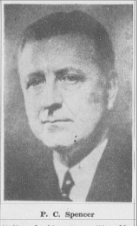
The November 18, 1953 letter continued: He told me in April when he was here for the Chicago meeting that there were going to be many changes and asked me to keep my shirt on and said I would be one of the top Executives in Sinclair as long as he is President. I know I did a good job for them on the crude oil investigation and the proof of the pudding is the fact that they set up the Sinclair Crude Oil Company almost 100% in accordance with my recommendations. About midway through that investigation which took almost eight months to complete, I was asked by Mr. Spencer’s assistant in New York whether or not I would be willing to go to Independence to take over the new crude oil company. I told Charlie Allen at that time I would be willing to do whatever Mr. Spencer asked me to do but it did not seem smart to me to replace a 62 year old man with a 61 year old man. I did tell him I would go to Independence on a commuter basis and in six months to one year, would turn the crude oil company over to a young man who could handle the thing to everybody’s satisfaction.
In all of my recommendations I recommended they set up a completely new corporation with a competent young man as a President and a competent young man as Vice President. Two of the men I selected from the ranks, one from the crude oil department and one from the pipe line, were subsequently made Vice Presidents of the crude oil company and one of our top refining men who had been Superintendent at Houston for about ten years is only 52 years of age and was selected as President. I am on the Coordinating Committee for the Crude Oil Company and meet with the Board of Directors every month but actually have had very little to do since I finished that investigation.
I talked to Mr. Spencer immediately after the changes were made last year. And told him at that time that several people had approached me regarding a connection with another company. He asked me not to make a change and assured me then that he would keep me busy. He told me at that time it was his intention to make me his assistant and the announcement was made shortly thereafter. Just a few months later he took me to the Big Board and advised them he had put the crude oil investigation in my hands. I was completely on my own and was allowed to make the investigation exactly as I thought it should be done and as I say, that covered almost eight months from the time I was put on it until the organization of the Sinclair Crude Oil Company was announced.
In May of this year when I was with him at Cleveland, I asked him then what I was going to do next and told him again I was not satisfied to sit around and do nothing. He asked me again to shake hands with him on continuing with Sinclair and told me he had several things in mind where I could be of use to Sinclair. He has been very cordial and very friendly whenever I have been with him, but circumstances are such that it is a little difficult for him to fit me into the organization in view of changes that have been made recently.
The first thing is I am getting considerably more salary than many of the men who have higher titles with the subsidiary companies. That was basically one of the reasons that I did not get too interested in the Sinclair Crude Oil Company because my salary is far greater than any Executive that has been in that particular work up to now. I am morally certain it is much higher than what they are paying to the new President of the Crude Oil Company. As the matter stands today, I am Mr. Spencer’s Assistant and my salary is paid on a special payroll on the Chicago Office Division that can be kept away from everyone else, except one or two men who are aware of what my salary is. If I had been transferred to the Crude Oil Company, it could very easily have been embarrassing down there.
In January 18, 1954 Brown would again write of the incident: It was immediately after that that I cracked up physically and Mr. Spencer insisted that I go to Fort Lauderdale to recuperate. I talked to him a number of times while I was in Fort Lauderdale and he was in Miami and when I first came back, I ran into him at the Airport in Columbus. His first and only question was as to how my physical condition was and whether or not I felt that I had licked the trouble which caused me to crack up. When he was out here in April, he came over to the office and told me again that mutual friends had accused him of killing me by giving me too much work to do. I told him at the time that I had not complained and his only answer was to laugh and say “That is the hell of it, you would be the last to do so.” He then asked me to leave my future in his hands and told me he was going to set it up in such a way that I would continue as a top Executive with Sinclair but would be able to relax and not kill myself with overwork.
I was very surprised to learn, through my research, that my grandfather left his position as vice president of the Globe Oil and Refining Company at the age of 60. Clearly, I.A. O’Shaughnessy never gave my grandfather his due. I’m sure that this, along with the prestige and compensation that Sinclair offered, had a lot to do with the move.
One cannot forget, however, that Sinclair Oil Corporation was a major, fully integrated, national petroleum company while the Globe Oil & Refining Company was a significantly smaller, regional refining operation, which had already sold its primary refinery. Sinclair was one of the largest oil companies in America with massive refining, pipeline, and marketing infrastructure, including 21,000 employees and 99,500 stockholders.
Globe Oil & Refining Company was considered a “country boy operation” which was a slang term used by salesmen and bankers for an unsophisticated, rustic shoestring operation. That might be overdoing it a bit given Roosevelt’s faith in O’Shaughnessy. In any event, Globe was a much smaller company. The company sold its Mcpherson refinery to the National Cooperative Refinery Association (NCRA) in 1943, and the Lemont refinery was later sold to Pure Oil in 1954. While influential in the Kansas oil industry during the 1930s, its total output was modest compared to the immense, nationwide operations of Sinclair.

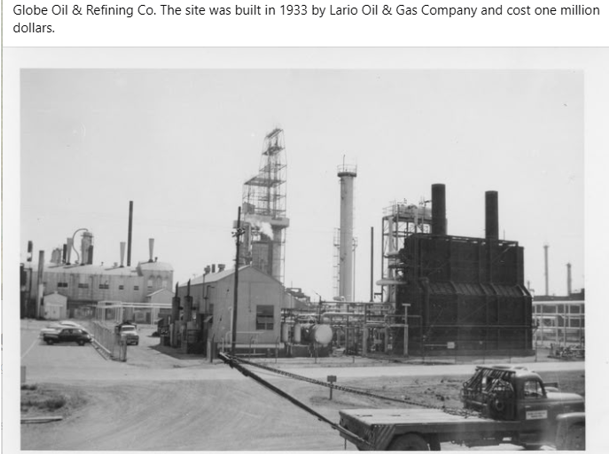
Not to be ageist or to belittle my grandfather’s wisdom and experience but this was clearly a young man’s game. I’m sure that this was a position, Vice President of the Western Division, that required high energy and stamina. Apparently, the job was too physically challenging and demanding. It sounds as if he was totally exhausted by December of his first year with Sinclair. Thankfully, he was given lesser assignments by Mr. Spencer, and he was graciously allowed to finish his career with Sinclair and retire in 1956. Brown remained in Chicago until 1959, when he moved to Fort Lauderdale, Florida.
The Houston Post Sun, Jun 29, 1952 ·Page 44
Brown L. Meece formerly western sales division in Chicago, has been appointed assistant to P. C. Spencer, Sinclair vice president and manager of Sinclair Refining Company’s president. Mr. Meece will continue to have his office in Chicago.
Interestingly, Brown spoke about a merger with Ashland Oil when he was still employed by Globe. At the time of the letter, he was providing guidance to my father regarding employment following his stint in the Air Force. The December 22, 1953 letter reads as follows: I have a little hesitancy on a connection with Joe Guilbault because I firmly believe that Globe will sell out within a year’s time after either Mr. O’Shaughnessy or Mr. Woodruff die. Both of them are reaching the age where that is going to happen one of these days and particularly in the case of Mr. O’Shaughnessy, I believe that a proposal to sell would be listened to within 24 hours after he passed on. I know Mr. Woodruff has wanted to do so for several years because he authorized me to attempt to work out a merger with Ashland and he would have done so readily had he been able to get Mr. O’Shaughnessy’s consent. Both of them are well above age 65, have more money than they can ever hope to spend and in Mr. Woodruff’s case, he has no heirs and in Mr. O’Shaughnessy’s case, I have not seen any indication on the part of any of his sons that they are capable of taking over when he does pass away.
In a letter dated November 18, 1953 to my father, my grandfather wrote: I had a nice visit with Paul Blazer and W. W. Vandeveer who was one of the partners in Allied who sold out to Ashland several years ago, and who is now a Director of Ashland and the largest individual stockholder. Van has been a friend of mine almost as long as Paul Blazer. I worked very closely with Van and with Flood Newman when they operated Allied and I think you know that after they sold out, Flood told me he had sifted out those people he felt had been helpful to him and to Van since the time they organized Allied, and Mr. Woodruff and I were two of the top twelve to whom he gave considerable credit for their success.
Both Paul and Van told me without any reservation that they were hoping that you would come back to Ashland after you finish your Army service and they definitely have a place in their organization for you. Under existing conditions, I am definitely inclined to recommend that course to you because I know that not only Paul and Van but Rex, Alex, Everett, Palmer Talbot and in fact, practically every one of the top men in Ashland that are there today are friends of mine and would do everything in their power to give you every possible break. In addition to that, all of them especially Alex and Rex think highly of your work and your ability and one of their greatest needs under these conditions is young management material which all of them feel is the case with you.
In a letter dated January 18, 1954, my grandfather wrote a letter to my father stating: I firmly believe that if you elect to go back to Ashland, you can look forward to a time when you will reach a spot in their organization just such as Paul Blazer said in your presence at the cocktail party in his home when we flew back to Ashland with him, that if I had accepted the position he offered to me several years ago, I would then be President of Ashland.
Brown and Paul Blazer were very good friends. Paul provided my father with a job in their lab in Ashland, KY over the course of two summers. Additionally, Paul Blazer hired my dad in a permanent position once he was released from the Air Force during the Korean War.
In a letter dated April 21, 1954 Brown wrote the following: We drove up to Palm Beach Saturday afternoon and had very nice visit with Paul and Mrs. Blazer. They have one of the prettiest homes it has been my privilege to see. It is a ranch type, one floor, except for the apartment for Charles which is over their garage, and is without question one of the most beautiful homes I ever had the pleasure of going through. Georgie handled all the decorations and they are exquisite. We just sat and talked to them for about two hours and then turned around and drove back home.
It appears that it was fairly common for these oil executives to maintain summer homes in Chicago or Ashland, for example, and winter homes in Ft. Lauderdale or Palm Beach. Questions arose as to whether Jean and Dick would complete the school year in Chicago or Ft. Lauderdale. The mode of transportation was either automobile, train or plane.
There were multiple direct train services from Chicago to the Florida East Coast, including Fort Lauderdale, in 1950. Key passenger streamliners operating at that time included the “City of Miami”, “South Wind”, and the “Dixie Flagler”, which provided regular, comfortable service. These trains generally ran on alternating days or every third day to provide continuous service. Journey time, in the early 1950s, was approximately 29 to 31 hours.
In 1950, corporations primarily owned and operated converted piston-engine aircraft, largely surplus military transports from World War II, to move executives and personnel. Key aircraft included the Douglas DC-3, Beechcraft Model 18 (“Twin Beech”), Lockheed Lodestar, and early Cessna models like the 195 Businessliner.
Common Corporate/Executive Aircraft in 1950:
Douglas DC-3: The staple of corporate aviation, often stripped and converted for executive comfort, offering long range and reliability.
Beechcraft Model 18 (Twin Beech): A very popular twin-engine, light transport for smaller teams and shorter routes.
Lockheed Lodestar: A faster, upgraded twin-engine aircraft, often converted from military transport roles.
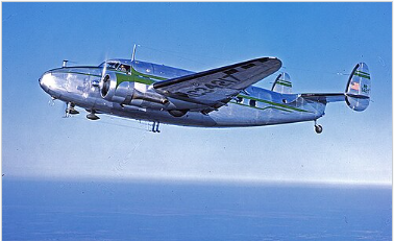
Before the widespread adoption of business jets such as the Lockheed JetStar and Gulfstream I, these piston-driven aircraft dominated the corporate hangars, focusing on durability and utility over speed. I’ve been unable to identify which type of plane that Sinclair used but I’ve included several examples of the common use of these aircraft in Brown’s correspondence:
John Suman, Vice President of Standard of New Jersey, invited me to ride to Washington in the Esso plane; when I told him that Mother and Jean were with me, he invited them also. Mother decided to go on the train and therefore Jean and I went with them on the plane, As soon as we got in the air, the co-pilot came back and invited Jean to sit in the co-pilot’s seat and she really got a birds-eye view of the country between New York and Washington before we landed at Washington.

Esso is a trading name for ExxonMobil. Originally, the name was primarily used by its predecessor Standard Oil of New Jersey after the breakup of the original Standard Oil company in 1911. The company adopted the name “Esso”, from the phonetic pronunciation of Standard Oil’s initials and as an acronym of Eastern States Standard Oil. companies would later object.
Brown to Paul Blazer: In his letter Louie asked if it would be out of order for him to ask you or Howard if he could fly to Washington with you and spend the 25th in Washington with me.
Fortunately, I was able to take Gram and the kids back to Florida in the company plane on Sunday. av. We also took Mary Louise Butz, daughter of Frank Butz, President of Hughes Oil Company, with us and had a perfect flight down. We had a heavy tail wind and made the trip in five hours and thirty-two minutes. We had lunches on the plane and even Gram and all the kids ate as much as they possibly could. We landed in Fort Lauderdale considerably earlier than I had expected, found Fred Kuhlman and our local agent, G. R. Smith and one of his salesmen there with our car and with another car to take our things to the house. In view of the fact we had the plane to go down, we took some stuff with us and really had a carload for Girling to take to the house for us.
In a letter dated December 28, 1953: According to present plans, I will take Jean, Dick and Gram to Fort Lauderdale in the company plane on Sunday, January 3rd. I will stay there on Monday to get things lined up and will then fly back to Chicago Tuesday morning. Rosemary Brennan and possibly Charlene are going back with us and we are also taking Mary Lou Butz, the daughter of Frank Butz, President of Hughes Oil Company, a Sinclair wholly owned subsidiary of which I am a Director. She is going to school in Palm Beach. It will take us about six hours to make the trip South and possibly a little longer coming back on Tuesday.
On September 4, 1962, a Lockheed Lodestar aircraft owned by Ashland Oil & Refining Company crashed near Lake Milton, Ohio, killing all 13 people on board, including several company executives. The plane suffered a catastrophic structural failure, losing its right wing in mid-flight. Although I was only seven at the time, I still remember the conversation between my parents when this happened.
The Korean War began on June 25, 1950, when approximately 75,000 soldiers from the North Korean People’s Army crossed the 38th parallel, the boundary between the Soviet-backed North and pro-Western South, in a full-scale invasion. Supported by the Soviet Union and China, North Korea sought to unify the peninsula under communist rule. In a January 1950 speech, Secretary of State Dean Acheson omitted South Korea from the U.S. “defensive perimeter” in the Pacific, a statement critics claimed “greenlit” the North Korean invasion.
Following the invasion of South Korea, Acheson was key in securing international support for military action and convinced Truman to intervene. He supported the decision to cross the 38th parallel and later backed the firing of General Douglas MacArthur. Senator Joseph McCarthy accused Acheson of being “soft on communism”.
“Korea, Communism, and Corruption” was the central 1952 U.S. presidential campaign slogan and platform for Republican Dwight D. Eisenhower. It attacked the Truman administration’s failure to end the Korean War, raising fears of communist subversion, and accusations of corruption, helping Eisenhower win.
In a letter dated November 6, 1952 Brown voiced his tepid but eventual support of Eisenhower and Nixon and his total disdain for Truman and his Secretary of State Dean G. Acheson:
“I believe Senator McCarthy has had as much to do with the results of this election as any one individual because it was his constant fight that put all the Democratic leaders on the defensive and finally brought a realization all over the country as to what Acheson and his clique had done. I have traveled thousands of miles in the last six weeks and everywhere I have gone, I have made it my business to talk to taxi drivers, pullman porters and Red Caps at railroad stations and Air Line Terminals and almost without exception, they have all said the same thing, that we must have a change, that we must have someone with enough courage to try to win the battle in Korea and not to be content to slaughter the pride of our country in trying to maintain hilltops in that bleak and barren a country. I still don’t have any use for Walter Winchell, but it was amazing to see what he says now in contrast to what he said when F. D. R. was his Lord and Master. .” I believe that the sentence describing Korea says a lot about my grandfather’s time in North Korea.
Harry S. Truman was unpopular when he left office due to the stalemate and heavy casualties in the Korean War, accusations of corruption in his administration, the controversial firing of General Douglas MacArthur, and the rise of McCarthyism and anti-communist fervor, which left many Americans feeling frustrated with the war and a stagnant domestic agenda despite his efforts. His approval ratings plummeted to historic lows, reflecting public exhaustion with the Cold War and a desire for change, encapsulated by Eisenhower’s campaign promise of “Korea, Communism, and Corruption”.
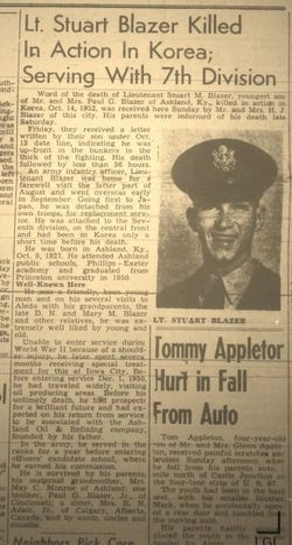
On Tuesday October 14, 1952, Lieutenant Stuart M. Blazer was killed in action along the DMZ in Korea. Stuart had only been in Korea for two weeks and he was almost immediately sent to the front to fight at Baldy Ridge or “Old Baldy”. The Battle for Old Baldy (Hill 266) was a series of five intense engagements during the Korean War, spanning from June 1952 to March 1953 in the western sector near Ch’orwon. It served as a critical UN outpost, and despite heavy casualties, the Colombian Battalion, US 7th Division, and other UN forces fought Chinese troops for control. We ultimately abandoned the position to China in March of 1953.
Paul and his wife Georgia were informed of his death late Saturday October 18, 1952. They had just received a letter from Stuart on Friday October 13, 1952. He indicated that he was at the front, positioned in the bunkers, in the thick of the fighting. He was dead less than 36 hours later. He was only 25 years old.
Unbelievably, my father, mother and her brother were involved in this event: On October 29, 1952 my father wrote: Got some terrible news today, first at lunch and then in a letter from Joan. Went over to buy some Prestone from Thomas at the Sinclair plant and met him at lunch with a fellow named McCrea and Bob somebody. Bob knows Paul Blazer Jr. pretty well and told me he had just heard that Stuart had been killed in Korea. Then this afternoon I got a letter from Joan in which she enclosed the clipping from the Ashland paper which I am forwarding. Her brother Pat delivered the telegram to the Blazers last Saturday and I guess they were pretty broken up about it. I know that Mr. Blazer thought an awful lot of Stu, who was apparently his favorite. I just hope this hasn’t affected his heart again. Am going to Ashland this weekend and will check with Ev. Wells and Chamberlain and possibly call the Blazers if Wells or Alex think it will be alight and will let you know how Mr. B is.
It is a shame to think of a lad with the intelligence and promise that Stu had has been only another of those wiped out by Truman, Acheson, etc. and their arrogant stupidity and greed. If only the people of this nation will open their eyes and vote for a change next Tuesday and so relieve us of the cupidity and stupidity that have put our country in such grave danger.
In a letter dated November 3, 1952 dad wrote: Thought I’d write tonight as I am sure you have been wondering about the Blazers. I called Mrs. Chamberlain shortly after arriving in Ashland Friday and spoke with her for awhile as I did not want to bother the Blazers. She gave me the story which is as follows: Fortunately the telegram got fouled up after delivery and went to Rex Blazer instead of P.B. Rex immediately called the family doctor and had him come The doctor then broke the news gently and put went home with Mr. B, staying with him while he told his wife and then putting him to bed with a sedative. In other words they both got the news in the easiest possible manner and were spared the shock of having it blurted at them. Mr. Blazer was kept in bed for two days and during that time Paul Jr. got home with his children and shortly Doris arrived with her daughter so that both Mr. and Mrs. Blazer were kept pretty well occupied with the young children and diverted from thinking of Stu all the time. Their plans for the present are to stay in Ashland until tomorrow to vote and then go away for awhile and rest and try to get over it. Mrs. Chamberlain says they have both taken the news very bravely and seem to be getting along all right. About all we can do now is hope and pray that the people of this country show some intelligence tomorrow and put this bunch of crooks and ignorant grafters out of power so that other families can be spared such tragedies.
My grandfather replied as follows: I am glad you called Mrs. Chamberlain and was happy indeed to learn that Paul and Georgia were saved from the shock which they would have received had they received the telegram direct. It is a terrible thing and regardless of how silly it may seem to say it, it calls home to me that you might be the next one just as other boys your age are being offered as sacrifice to the stupidity and crookedness of Acheson in the way that Paul Blazer’s son and Wilson Henry’s son were sacrificed.
My grandfather was horrified. He could not believe that this could happen to the son of such a wealthy, powerful and important man such as Paul Blazer. More importantly, he couldn’t believe that it could happen to such a dear friend. I believe, after reading through hundreds of letters, that Brown did everything in his power to keep my dad from stepping foot on Korean soil. This included making use of all of the powerful contacts that he made in Washington as well as staying in constant contact with my dad’s superior officers.
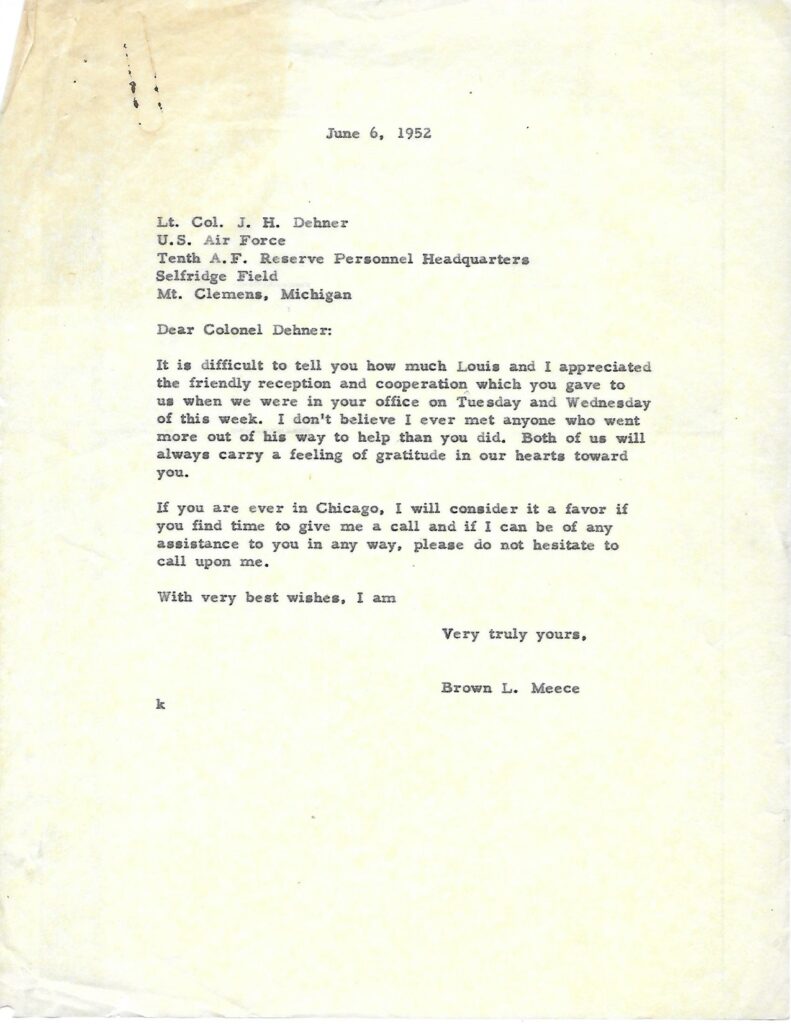
Dear Colonel Fisackerly:
Brown L. Meece
It is difficult to tell you how much Louis and I appreciated the friendly spirit in which you handled his case when we appealed to you for a waiver when in your office on Tuesday of this week. I am quite sincere when I say to you that I believe the way his case was handled will prove a blessing in disguise, for had your Medical Examining Officer overlooked his obvious overweight and recommended him for a Commission without further consideration, he would have gone ahead thinking that all of the things his Mother and I have said to him about trying to avoid taking on too much weight was just talk without too much back of it.
I feel quite certain that he realizes now that such is not the case, for I know your talk with him is something he will long remember and on the way home we discussed very clearly the fact that twenty pounds overweight almost wrecked his life. I feel confident that he will pay attention to that particular feature in the future and I know he could easily reduce his weight if as I think now he realizes that he should do so.
I dropped him off at Notre Dame Wednesday night and he has already cleared up all of his papers there, regained his Uniforms and placed his order with the Mishawaka Tailors for the other Uniforms which he will need to be ready to go in service.
I have already written to Colonel Dehner to thank him for the wonderful cooperation and assistance which he gave to us. The treatment which the two of you gave to Louis, made a profound impression on him and on the way back home, he said more than once that if all the Officers in the Air Force were as nice as you two, he would certainly be able to look forward to his years in the Air Force with a great deal of pleasure.
He has already arranged to have his feet treated and Dr. Brown thinks he can have the callouses completely removed from both feet before Le reports for duty on July 15th. He has also given his word to me that will start immediately to try to take off at least ten pounds before he reports for duty.
If by any chance you come to Chicago on your vacation, I would consider it a favor if you will call me and if you will let me know in advance, I will be most happy to make Hotel reservations for you or to assist you in any way that is possible.
Again, thanking you and with best
wishes, I am
Very truly yours,
Brown L. Meece
“The purpose of life is not to be happy. It is to be useful, to be honorable, to be compassionate, to have it make some difference that you have lived and lived well.”
― Ralph Waldo Emerson
I am convinced, subsequent to all of my research on Theophilus Franklin Meece (T.F.), that my grandfather Brown did not stray far from his roots. He truly did make the world a better place for many. It is difficult to imagine a young man coming from such a small town, Livingston, TX, having such success. I was reminded of that when I discovered that Harry F. Sinclair was born in Wheeling, WV and grew up in Independence, KS, where my father was born. The same was true of Paul Garrett Blazer, founder of Ashland Oil, who was born in New Boston, IL, a small town (population 600) that I had never heard of.
Brown did not start in the oil business until he was 31 years old. In that short time span, he ascended to Vice President of Sinclair Oil in charge of the Western Division. Not to mention the fact that he was an original member of the National Petroleum Council as well as Chairman of the Barge Subcommittee. Amazing! Did he have regrets? Did he make mistakes? Sure, but haven’t we all? The difference is, he adapted. He was able to overcome his mistakes, shortcomings and frailties in his latter years. He was able to persevere and succeed where most wouldn’t. Remember, it was Paul Blazer that told my grandfather that he would have been President of Ashland Oil had he accepted to the position that Paul had offered him. That’s high praise indeed!
Just think of the challenges that he faced in order to reach the climax of his career. How many Americans do you know that can say that they worked in, and survived, North Korea? He accepted the job with the American Smelting and Refining Company (ASARCO) just prior to the Santa Isabel massacre when 16 to 18 American citizens were executed. He survived World War I, where he was assigned to the 24th Anti-Aircraft Battery, 1st Anti-Aircraft Sector. This was the first anti-aircraft unit in U.S. military history! He then went through the ordeal in Oklahoma City where he was in charge of the National Guard when martial law was declared. He lived through the Great Crash, stock market crash of 1929, and the Great Depression. I still shake my head in disbelief when I revisit these periods of his life.
In addition to a stellar career Brown showed an unwavering commitment to his family, their success and happiness. He was known by his family for his love, dedication, selflessness and reliability. He could certainly be a taskmaster when it came to school, grades and discipline. He was relentless when it came to criticizing Louis and Richard about their excess weight and smoking. I think that some of this was a result of the ribbing he received about his weight at Texas A&M.
Both of his sons graduated from Notre Dame. Richard also attended Georgetown University Law Center. His daughter Jean was a graduate of Michigan State University. He sent them to the best schools. Both Louis and Brown attended Mount Carmel High School, which was an all-boys Catholic high school in Chicago’s Woodlawn neighborhood. All three would attend summer camps in various locations. My dad attended a working ranch in Montana one summer. Brown was very actively involved in every facet of their daily lives.
The correspondence between Brown and his children was exceptional. Fortunately, my mother saved hundreds of letters between my father, Louis H. Meece, and my grandfather, Brown Louis Meece. My parents divorced when I was young, so I was a little surprised that she saved them. These letters were a primary source for a lot of the information that I’ve discovered about both my grandfather and father. This was also the case with his siblings and their offspring. In 1943 Charles Stewart Jr., Brown’s nephew, wrote a letter to his wife, Mary Louise McFarland Meece. He was in Corpus Christ, TX at the time. Brown was the first family member to welcome Charles Jr. home after serving in WW II. The letter was as follows:
“I called Aunt Annie and sure enough she is the next to the youngest Meece being just next to Daddy and Brown. They run about as follows Inez, Frank, Mattie etc…down to Charles, Annie and Brown. There are all together 10 that lived to maturity and one that died. Well, well, well -I sure did get a kick out of this. Aunt Annie met me at Aunt Mattie’s and talked and talked. They both have lots of pictures and things of all the family and of course it was real fun to see them. I had never seen Aunt Mattie before and believe me they are a true Texas family. Aunt Mattie is 68 and a widow for 7 years. She has lived in Houston for 35 years and still lives in the house she and her husband built and homesteaded. Charlie who would have been 57 last Feb. 19 used to stay there with her a whole lot. She is a big kind big hearted lady and just as swell as anyone could be. She is extremely poor but doesn’t give a darn as she gets along very well on what she has. Brown is the darling of the family it seems and sends her money whenever she needs it. She has adopted two children one is married and has two children they call her Little Mattie the other is a boy and he has had thyroid trouble and just last July Brown finally talked him into going and getting an operation and had it all fixed up. Brown paid for the operation. It would seem that Brown and Charlie were the two boys that had more ability than all the rest and worked the hardest. They all say they were a whole lot alike.
Now for Aunt Annie. She is three years younger than Charlie and they always stuck together. She always went on his dates with him and he watched over her all the time. She was his pet. She is short, a widow with two children alive and one dead. His name was Charles after daddy. She had more things about Charlie than Aunt Mattie. She has for instance the last letter he wrote to his mother just before she died and telling her how sorry he was that he couldn’t come home because ‘his little girl’ mother was about to have Ted. He was a past master at letter writing. She also had a telegram that he sent her about a month before he died asking her to come to Artesia to see his “little family” and telling her he would pay all expenses if she would. She didn’t go then but she went when mother called to say that Charlie wasn’t expected to live. She didn’t make it before he died buy stayed there with mother a month or so later and of course that when she saw me. She remembers all about Ted and me as babies. I was her pet it seems. She has lots of pictures etc. that she says I can have and believe me I will take anything she will give me. I surely do like both she and Aunt Mattie. I had dinner with Annie on Sunday and then Sunday night I went over to see Mattie and she cooked me a chicken dinner. Some fun huh. I only wish you could be here to see them too because they are all very anxious to meet you and have asked me a gazillion questions about you.
This is only the start of all this, but I won’t tell you all by letter as it takes too long. I will tell you just this one more thing and that is that I found out where my name came from originally. It would seem that there was a Col. Charles Stewart of the Confederate army that used to stay at T.F. Meece’s hotel in Livingston and that he and grandpop were very good friends. Well my daddy was named after him and I was named after daddy. I saw the big colonial home in Houston that belonged to Col. Stewart and that his son lives in but his son wasn’t home. I am going over and meet him when I get back if I have time. Interesting, isn’t it! I sure do get a kick out of it. Incidentally grandpop was in the confederate army wounded a couple of times and came out a sergeant. He was the found the Meece Hotel in Livingston, Judge of that county all his life and senator until his health forced him to resign. He died of cancer when he was 78. He died two years to the day before grandmother died. This was about two years before Ted was born or about 1910. Well, I’ll save the rest for a later date. Aunt Inez, the one that offered to send me to school, is in Dallas so I should be able to see her on my way back up. Uncle Tom is in Shreveport, Louisiana and I should probably have the opportunity to see him before I go back. Annie has written to him to tell him I am in this part of the country and she says that if I don’t get a chance to go down he will come up. It is only about 100 miles from Shreveport to Houston.”
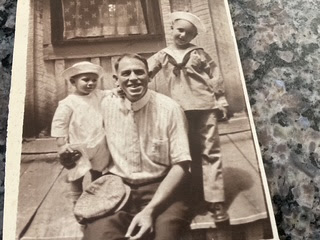
This is a photo of Charlie’s wife Minnetta Winifred Ritter Meece. She continued to run the business for a year or two following his death.
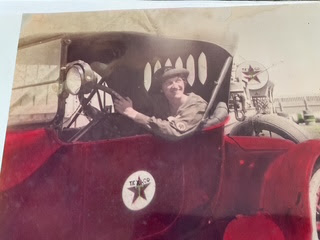
Charles writes extensively about his father, Charles Stewart Meece Sr. It is my understanding that he worked for the Texas Company or Texaco in Artesia, NM. He reportedly contracted the Spanish Flu from soldiers onboard a train and died on January 23, 1919 at the young age of 31. The 1918 Spanish Flu pandemic hit Artesia, NM, along with neighboring Roswell and Carlsbad, in the fall of 1918, causing significant disruption and mortality, with roughly 1 in 5 New Mexico families losing a relative.
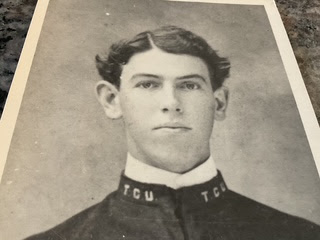
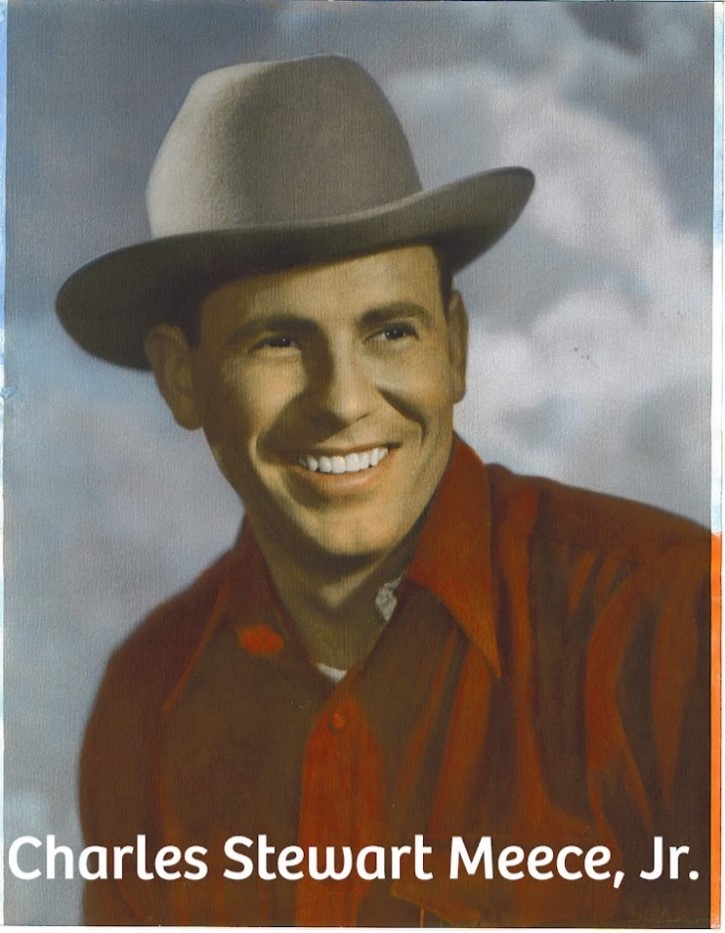
Unfortunately, Charles Jr. would die at an early age as well. Charles dies on November 25, 1916 at the age of 35. The following accounts came from an exhaustive and comprehensive genealogical research document encompassing six generations of the Meece family. The author was my first cousin Richard (Rick) Fredrick Linstead. The articles were as follows:
Notes for CHARLES STEWART MEECE: Died while piloting his own plane.
HOUSTONIANS KIN KILLED IN CRASH: Relatives of Charles Stewart Meece,38, of Casper Wyoming, a frequent visitor to Houston and well known in the oil business, have just received word of his death in a plane crash April 11, 1952. Mr. Meece was a member of a prominent pioneer family of Livingston. His grandfather, Judge T.F. Meece, rode in Hood’s Brigade in the Civil War. Charles Stewart Meece was co-owner of the Meco Oil Company in Casper at the time of his death. Mr. Meece is survived by his wife and three children in Casper, and two aunts in Houston, Mrs. W.H. Cubley and Mrs. A.T. Hutchins.
Casper Star Tribune, Casper, Wyoming, April 14th, 1952. PLANE SMASHES INTO SANDHILL; TWO MEN KILLED: The bodies of C. Stewart Meece, 35, 263 S Lowell, Casper oil man, and Jack Williams of Denver were found late Sunday afternoon amid the wreckage of their plane which had crashed 55 miles south of Valentine, NE Friday night. The plane disappeared shortly after takeoff from the airport at Gordon, NE. Mr. Meece had been on a business trip to an oil well location near Gordon. Mr. Williams, a friend had returned recently from South America and had gone along for the ride while visiting Meece.
25 PLANES HUNT WRECK: About 25 planes had been searching for the missing aircraft. These included a plane from the Casper Air Service, several other planes from Wyoming, several from the Nebraska Civil Air Patrol and a number of craft from the Air Rescue Service at Lowry Air Force base, Denver, CO. The wreckage was sighted by CAP pilot Allen Curtis of Alliance, NB. The two men apparently were killed instantly when the plane piled into the top of a sand hill just north of the Snake River and landed on the back. Mr. Meece was co-owner, along with H. O. English of the Meco Co. in Casper. The firm is engaged in oil drilling and production. Mr. Meece was a native of California, attending grade school and college there. In 1937 he went to work for the Eastman Oil Well Supply Co., of Denver. When he entered the navy in 1940, he was Rocky Mountain division manager for Eastman. After serving three years in the navy, in the African theater of operations, Mr. Meece came to Casper and was self-employed in the oil business here until he and Mr. English formed the Meco Co., two years ago. Survivors include his wife Mary Lou, and three children; Ken age 4, Peggy age 6, and Charles Scott age 10 weeks. The body was due to arrive in Casper Monday in Mr. English’s private plane. Funeral arrangements will be announced by the Horstman-Gay Mortuary.
Brown and Jessie left Chicago, IL in 1959 and retired to locations in Ft. Lauderdale and Pompano Beach. Brown spoke of possibly consulting or working with Phillips Petroleum following retirement. I’m not sure if he did either one. To my knowledge, the only time I met Brown was on a family vacation to Pompano Beach, FL in 1964. Pompano Beach is just north of Ft. Lauderdale. At that time, he was 73 years old.
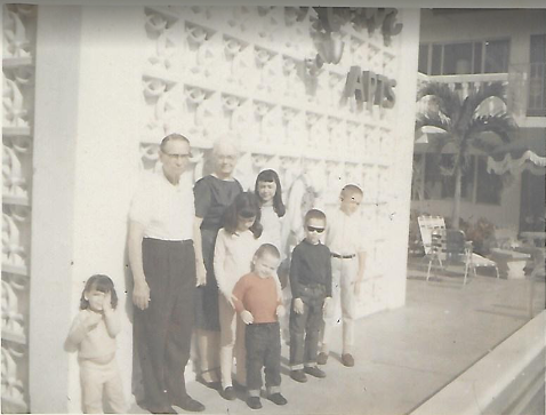
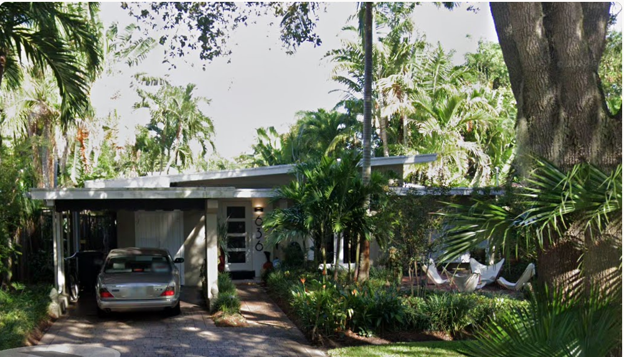
Brown Meece passed away on Saturday, March 10, 1973 at the Essex Tower Nursing Center in Ft. Lauderdale, FL. He was 81 years old. Jessie was 65 years old at the time of his death. She would live another 31 years, and she passed away on June 14, 2008 at the age of 101. Astonishing! She outlived her son Louis and her daughter Jean. Legacies are kept alive through stories, traditions, and memorials. Brown’s legacy will now live on forever.