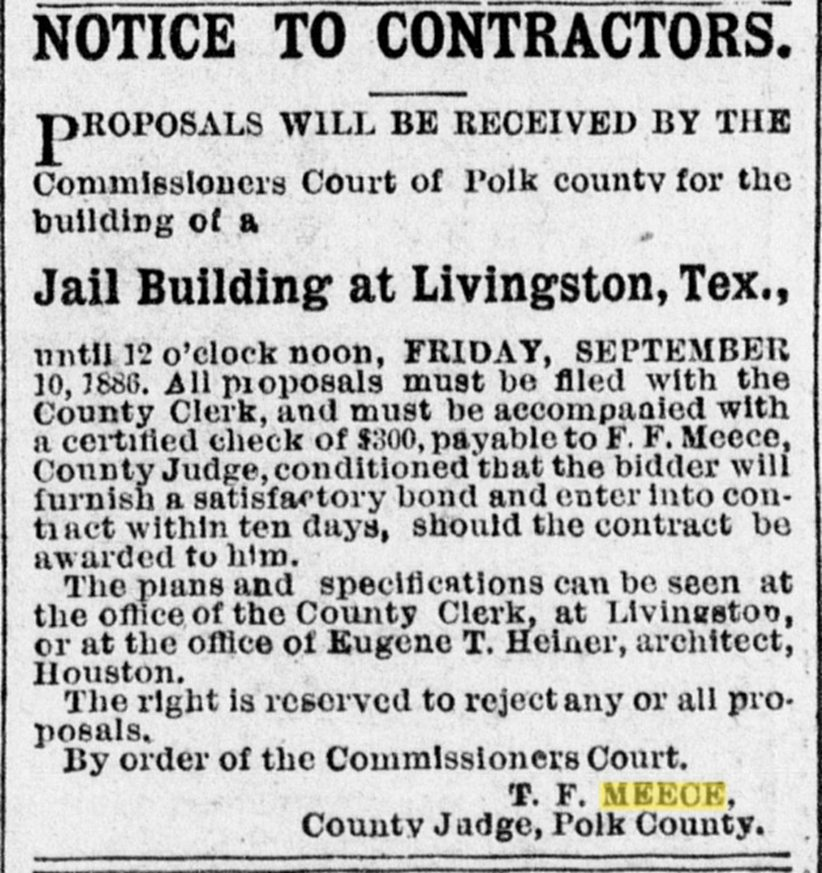
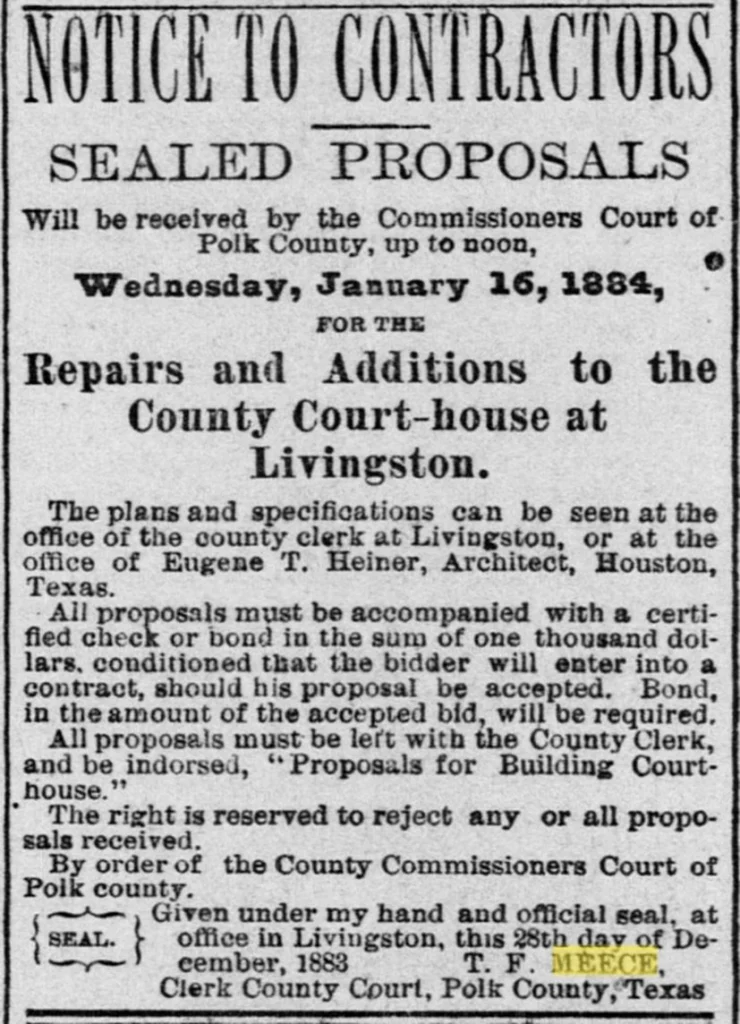
While Polk County Clerk and County Judge, T.F. would administer two fairly significant projects. One called for the repairs and additions to the County Courthouse in January of 1884. The second project was for the construction of a jail building in September of 1886.
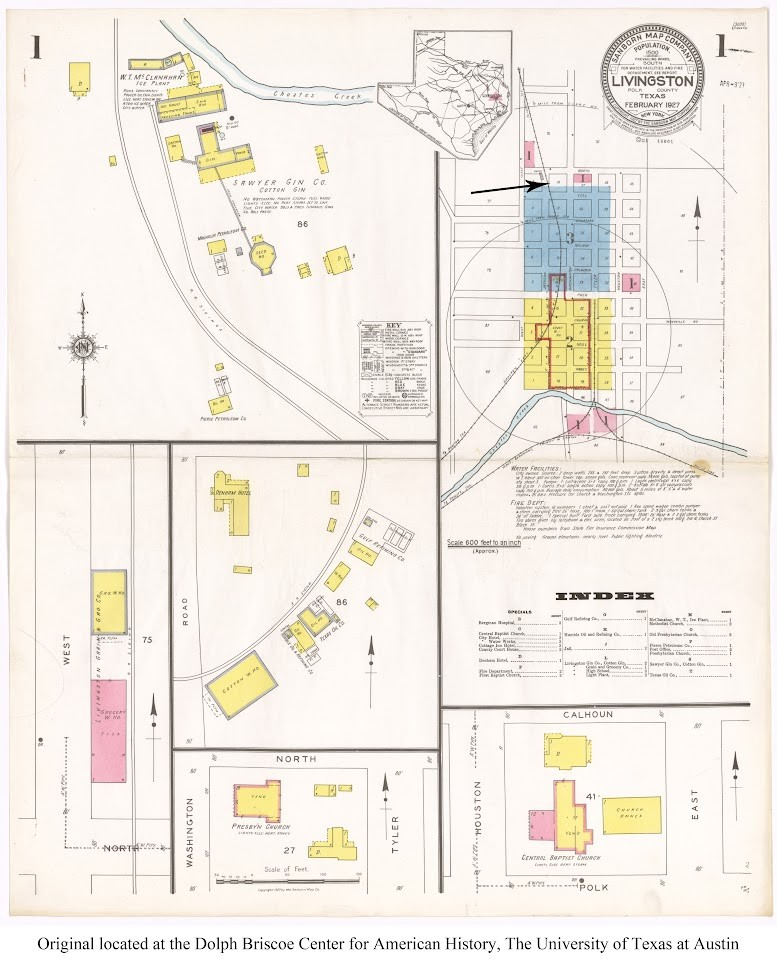
The Houston East and West Texas Railway Company reached Livingston, TX in the fall of 1887. The company’s initials were said to stand for “Hell Either Way Taken.” On December 30th, 1887 T.F. purchased the Meece Hotel and the northern one fourth of Block 10 for $650.00. On January 25th, 1888 he purchased an additional portion of that same block for $160.00. The location of Block 10 is identified on the Sanborn Map Company map. These maps were created to allow fire insurance companies to assess their total liability in urbanized areas of the United States.
The Meece Hotel was first associated with T.F. Meece in 1888 when a Polk County Newspaper described him as a merchant, land agent and owner of the hotel. T.F.’s first mention of the hotel was in an article in the East Texas Pinery dated 09/15/1892. It was an advertisement under T.F. Meece’s Column. The East Texas Pinery was a weekly newspaper first appearing in 1882 and operating until 1898.
The following is an article published in the East Texas Pinery on Thursday, August 2nd, 1894:
T. F. Meece’s Column
T. F. MEECE.
LAND and GENERAL AGENT, Livingston, Polk County, Texas. Will buy, sell, lease or rent lands, pay taxes; redeem from tax-sales; furnish abstract, correct reports of value, location, etc. Will also write deeds, mortgages or other instruments; negotiate loans, collect claims, register and collect jury or county warrants.
Pine, Cypress, Walnut and the hard timbers a specialty.
Persons wishing to purchase or lease lands on the A. Viesca surveys can do so by calling on or addressing me at Livingston, and all persons occupying any part of same without proper authority will please correspond with or see me at once.
Buy improved implements and save labor and time, as well as double and treble your products, The best cultivators and planters can be had by applying to me, cheap for cash or on fall time at reasonable prices. Payment to be secured by proper lien.
2759 acres Geo. W. Toliver survey, in the southern portion of the county, several small improvements on tract, title good, terms to suit purchaser.
1230 acres Joseph Morgan league, on and near railroad, 3 miles south pf Livingston, heavily timbered with pine, white, etc.,
300 acres N. D. Labodie, 2 miles east of Phoenix, title good, terms easy.
810 acres Isaac H. Pate league, on Menard’s creek, about 7 miles east of Livingston, improved, title complete.
160 acres Isaac Parker league, pear railroad, 5 miles south of Livingston, good timber, title good, cheap for cash.
320 acres-R. B. Honnay survey on Menard’s creek, 19 miles south of Livingston, title perfect.
1000 acres John Lindsey league. fine timber, on Long King creek, 5 miles north of Livingston, regular chain of tile, terms and prices reasonable.
558 1-2 acres Thomas Burris, league, being in the southwest portion of survey fronting on Trinity River, title good, terms easy.
Parties wishing to purchase cheap lands should correspond with me as I have several tracts offered at low figures, cash or part cash, with interest on time payment.
Those wishing to save time and labor in putting in and cultivating their crops can do so by purchasing a strictly first-class corn and cotton planter, which they can do by calling on or addressing me at Livingston.
All planters guaranteed to do better work and more of it in a day than three men and horses can do with the old style of planting in same time.
I am agent for some of the best Insurance companies in the United States and also the largest in England. Great care is taken in writing up policies so that no trouble is had in the adjustment of losses and damages. The following is the list of companies I represent, and would be glad to correspond with parties desiring policies.
East Texas of Tyler, Hibernia of New Orleans, Sun Mutual of New Orleans, Western Home of Sioux City Iowa, Liverpool, London & Globe, and solicitor for The Fire Association of Philadelphia.
The Meece Hotel is just opposite the depot, where travelers and passengers could get a hot meal at any hour, the best the country affords at reasonable prices.
A separate advertisement for the insurance business read as follows:
When you want Fire, Burglary or Guaranty Insurance, call on T. F. Meece, Local Agent. Office Holshausen building. Phone No, 101.
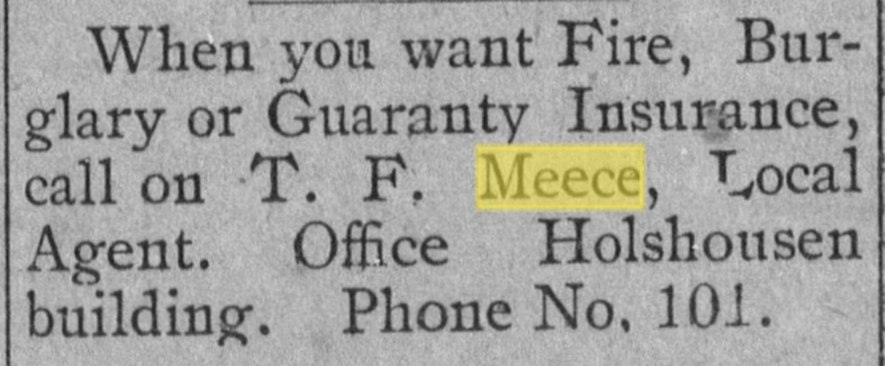
Apparently, a local journalist took issue with T.F.’s Column and published this rebuttal:
The local contributors to the Pinery could have been anyone who could pen a few interesting words, and often they were politicians with a platform to promote. The Pinery carried a column by T.F. Meece called simply “Meece’s Column”, which was a listing of real estate on the market. Politicians would write an item to explain some current issue as he saw it, without the intervention of an objective, disinterested journalist.
On the other hand, he received ringing endorsements from the paper:
T. F. Meece
No man in Polk County has been more intimately associated with the history and affairs of the county and for a longer time than Judge Meece. He has served the county in a number of official positions, including county judge, county clerk, sheriff and representative, and in every capacity proved himself to be an efficient public servant and worthy of the trust and confidence of the people. Judge Meece is at present engaged in the real estate and insurance business, and no one is better prepared to furnish information regarding the lands of Polk County and conditions prevailing here than he is. Those who contemplate investments would do well to correspond with him.
JUDGE T. F. MEECE
A Well-Known Real Estate and Insurance Agent.
If any town is to progress and develop as it should it is highly essential that its citizenship should include a capable and reliable Real Estate and Insurance agent. Livingston has such a man in the person of Judge T. F. Meece.
Judge Meece is one of the pioneer citizens of Polk County and is widely known as a high toned, honorable gentleman, worthy of any trust imposed in him. He is thoroughly familiar with land values in this section and can render valuable service to those who desire to buy or sell real estate. He is also an Insurance Agent and represents some of the strongest and most reliable Fire Insurance Companies of the world.
In addition to Judge Meece’s calling as a Real Estate and Insurance Agent, he is a licensed attorney and is particularly well versed in the laws pertaining to Real Estate, to which branch his practice is mainly confined.
He is an affable, courteous and accommodating gentleman, and a thoroughly progressive citizen who supports enthusiastically and courageously any cause which he is convinced will inure to the benefit of his town, County and people.
On the local front, T.F. and Amelia produced their youngest and final child, Brown Louis Meece, my grandfather. He was born on September 27th, 1891. In total they produced (11) offspring. According to The Hays County Times And Farmers’ Journal (San Marcos, Tex.), Ed. 1 Friday, February 20, 1903, T.F. was reported to have cancer at the front of his ear.
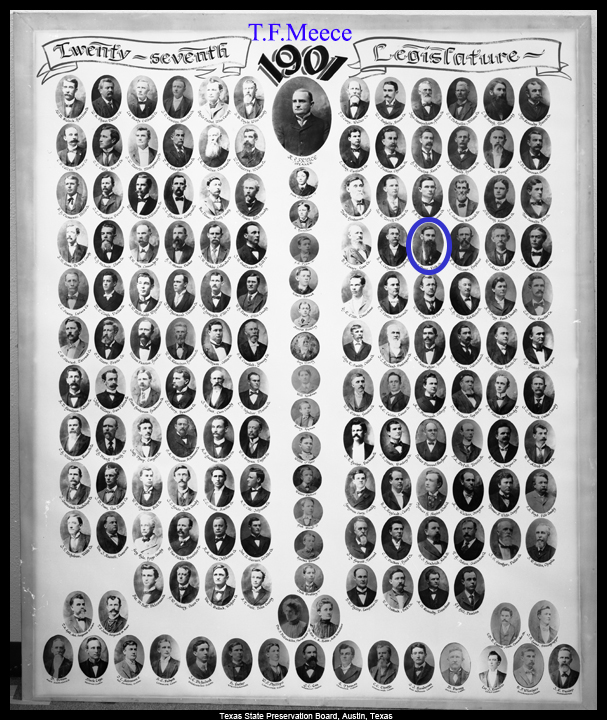
T.F. was elected representative of the Thirty-fifth District and served in Twenty-seventh Legislature, one regular and two special sessions. The Hon. Theophilus F. Meece of Livingston represented, in the Twenty-seventh Legislature, the counties of Polk and San Jacinto, which compose the 35th legislative district. In his race for the Twenty-seventh Legislature, he was nominated without opposition and without solicitation on his part, but he was opposed in the general election by a Populist candidate, whom he defeated by 501 votes. The regular session lasted from 01/08/1901 to 04/09/1901. The two special sessions lasted from 08/06/1901 to 09/04/1901 and from 09/05/1901 to 10/01/1901 respectively.
T.F. was on the House Committee on Irrigation, House Committee on Judicial Districts, House Committee on Penitentiaries, House Committee on Railroad Commission and the House Committee on Roads, Bridges and Ferries. “Mr. Meece possesses much positiveness of character, but is yet of a quiet and unobtrusive disposition, and at the close of his two years’ service in the capacity of representative, his record will show to his constituents that they have chosen well.”
T.F. shared a desk, and sponsored legislation with, a gentleman by the name of Robert Reuben Williams. Williams was also a member of the 33rd and 34th Legislatures. It does not appear that either one of them, as freshman House members, proposed any sort of groundbreaking bills. True to form T.F. co-sponsored a bill regulating liquor sales. The Houston Daily Post took T.F. to task publicly in an article entitled Omissions of the Legislature. Surprisingly enough, T.F. stated that he did not regard Williams as capable of filling the office of Governor of the State of Texas in a later election. The City of Livingston agreed and his opponent, Thomas Mitchell Campbell won the election, serving two terms.
In 1890 the Democratic representative convention of the Second district, Polk and San Jacinto counties, convened in Livingston on August 7th. L. F. Gerlach was elected chairman and T. F. Meece secretary. T.F. was elected County Chairman for a term of two years to the Democratic County Convention in May of 1896. He represented Polk County as President under the State Bureau of Immigration of Texas. In November of 1903 T.F. was appointed to a committee of the Commercial Club to study a rail connection between the Houston East and West Texas Railway Depot and a proposed sawmill East of and near town.
Livingston Commercial Club met.
“The Livingston Commercial Club (Chamber of Commerce) met Thursday, Oct. 1, 1908 at the courthouse. It was one of the most interesting sessions that has been held since the organization of the club. A. M. Turnbull was elected an honorary member of the club. Motion prevailed that the chair appoint a committee to secure the listing of lands for sale with the Commercial Club. C. A. Noblitt, T. F. Meece and S. H. German were appointed on the committee.”
I’m not sure how much commercial farming T.F. did, obviously, he farmed for subsistence to feed his family. After the Civil War, Southeast Texas’s agricultural market transitioned from a slave-based plantation system to one dominated by tenant farming and sharecropping. Farmers faced challenges such as falling prices, rising costs, and high interest rates, making it difficult to make a living. The expansion of railroads played a significant role in connecting Southeast Texas to markets, facilitating the transport of agricultural products. This helped to ease some of the financial challenges.
In 1880 T.F. spoke of growing crops of alfalfa, black winter oats, turnips and corn. Much of it was destroyed by a winter storm. Alfalfa is a major source of nutrients for a wide variety of animals but “pasture bloat” (gas) can cause serious health issues. It’s a highly productive crop and it can be used as a cover crop in crop rotations because it helps retain key nutrients in the soil. It also helps to prevent soil erosion.
In 1896 his son James sent a trial shipment of radishes by express to Denver, CO, Lincoln, NE and Nebraska City, NE. They packed them in barrels ice to preserve them in good condition while enroute to their destination. This was done in the hope of opening a new industry in Polk County. The same was true of experimental tobacco crops.
According to an article published in a local paper in March of 1898:
“Considerable talk of experimenting with the tobacco industry is being indulged in by our people who are tired of raising 5c cotton, and probably quite a lot of the finer grade tobaccos will be planted, many believing that the soils here will be very fine for its growth. (The price of cotton soared from 10 cents a pound in 1860 to $1.89 a pound in 1863 & 1864 due to the Civil War.) This week’s “Local” contains a letter from H. H. Craig, of Kansas City to T. F. Meece, of this place, proposing to furnish seed and pay half the expenses of cultivating an acre of fine grade tobacco as an experiment, and will make such arrangement with several farmers. Mr. Craig has some land in this county and thinks that tobacco, fruit and vegetable gardening as a diversity will greatly assist in developing our county.”
On January 8th, 1898 T.F. would lease 640 acres from Mrs. Mary Montgomery for pasture purposes only. The term of the lease was for one year in the amount of $32.00. Payment was required every (6) months in the amount of $16.00. It would appear that T.F. was moving away from agriculture and towards raising livestock. Cattle and cotton production dominated farming operations throughout the remainder of the 19th century. It also seems that T.F. did not retain his father’s farm of 1,100 acres. Perhaps it was sold and the money distributed to the three remaining children. It may have been deeded to his 2nd wife Nancy Burroughs. I have discovered a total of (102) property transactions made by T.F. Meece. I have only reviewed a fraction of those. I am sure that the Polk County Clerk’s Office will be more than happy if they never hear from me again.
As an aside, and quite likely a hobby, T.F. would compete in the Auditorium Exhibit in Houston, TX under the sugar and tobacco exhibits presenting two Japanese persimmons in December of 1987. On October 29th, 1908 the local paper printed the following:
A Large Persimmon
“Judge T. F. ‘Meece presented to us last week a Japanese persimmon that eclipses anything in the persimmon line we have seen. It weighed 1 1-4 pounds and measured 13 inches in circumference. The tree from which it grew is in Judge Meece’s yard. This shows that the finest fruit can be raised in this section.”
This sounds like a world record persimmon to me!
A dispute arose over representation in the State meetings of the Baptist Church. The old plan favored equal representation in the State Assembly and the new plan was based on contributions to the missions. The Livingston Baptist Church, which would become the Central Baptist Church, favored the new plan. Those who held to the old plan met and organized the First Missionary Baptist Church, which would eventually become the First Baptist Church of Livingston, on September 25, 1904. Reverend Phil H. Bilbro was the supply pastor. Brethren Doyle, Meece and Stone were named deacons. T.F., Amelia, Annie and Brown were charter members. Confused yet?
Sometime between the start of the First Baptist Church of Livingston in 1906 and T.F.’s death in 1914, he presented the church with a silver decanter for communion services. My family initially attended the Bethel Baptist Church, reportedly the oldest church in Polk County, when they first arrived from Tennessee. The church is still in operation today adjoining the Bold Springs Cemetery where many of my relatives are buried. The Pastor is Brother Harold Isaacs. He has been a big help with my research.
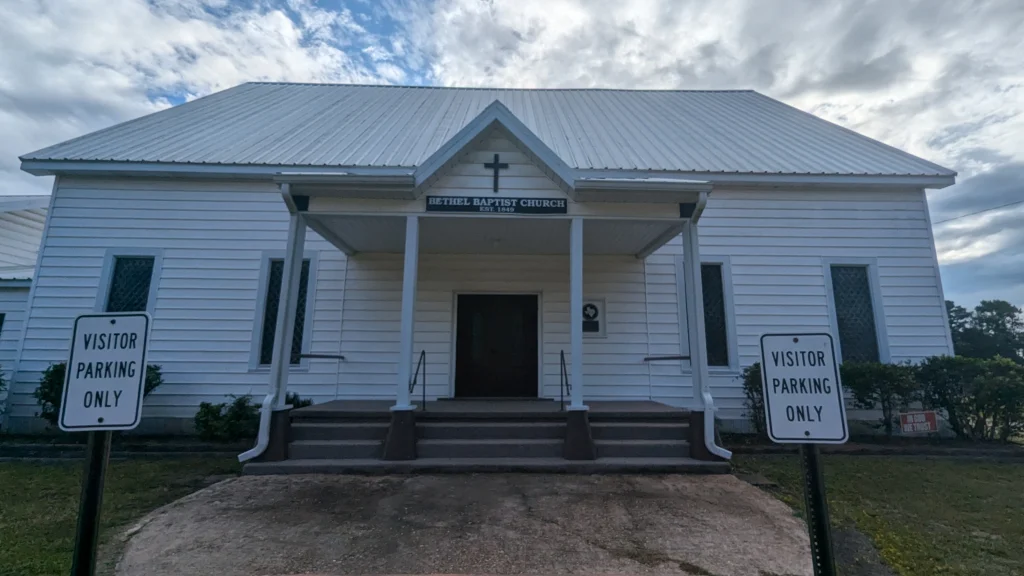
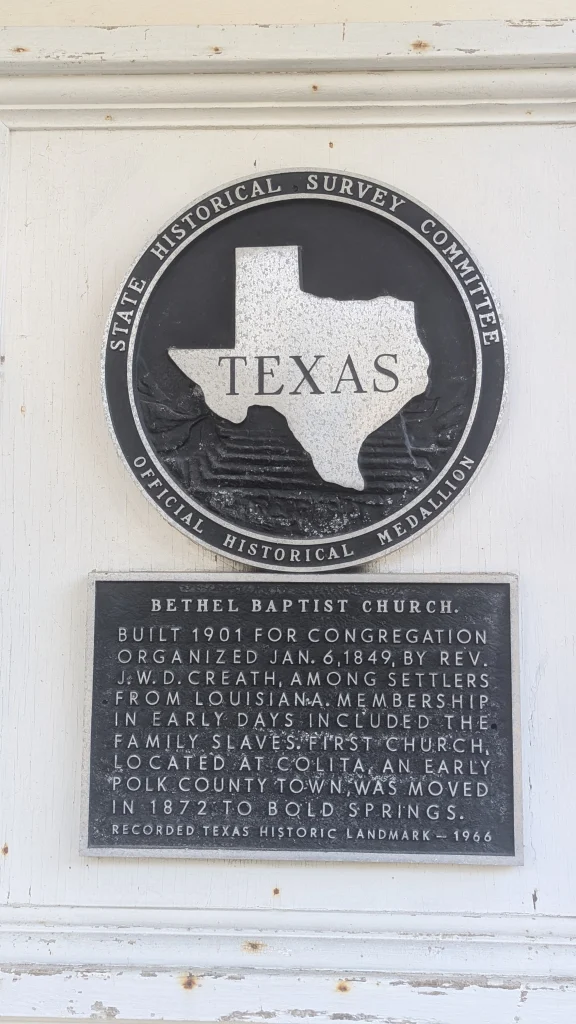
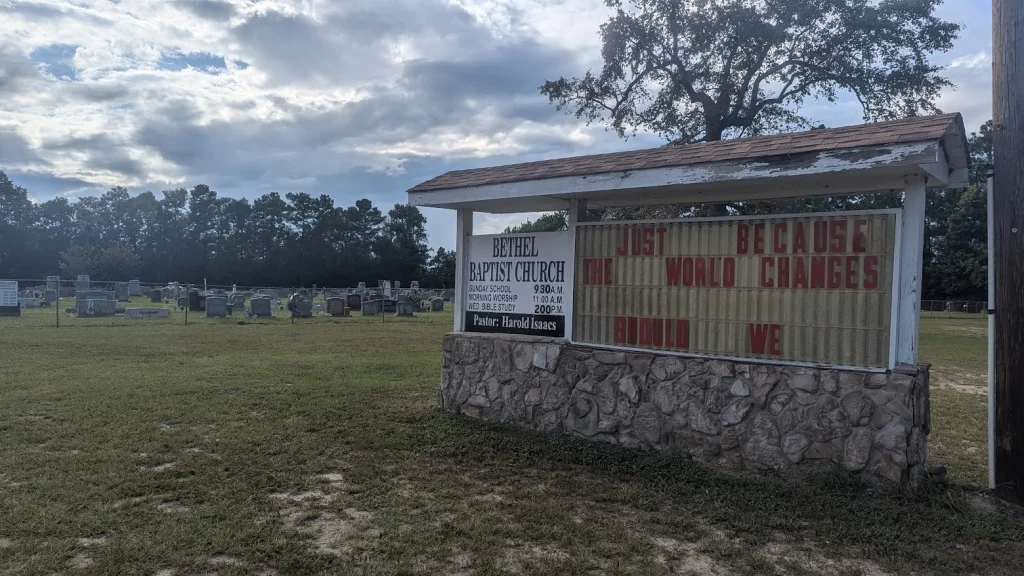
Initially the Baptists shared a church, prior to the split, erected under the auspices of the Methodists in the 1870’s, which was built on the lot of the Old Livingston Cemetery. My great-grandfather T.F., his wife Amelia Antoinette Brown Meece and their daughter Willie Uzell Meece are buried there in the Old City Cemetery.