“I have always been proud of my service in the Confederate Army, believing that it was my duty, also a privilege to respond to the call to my country’s defense.”
T.F. Meece
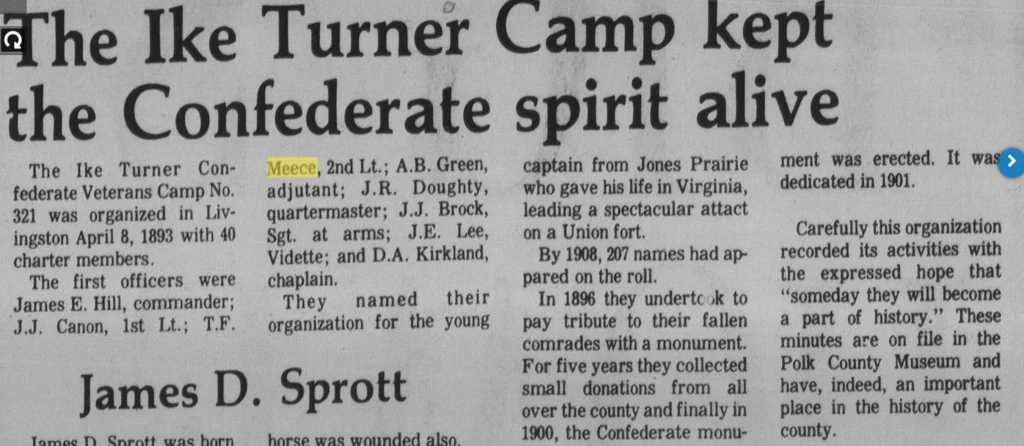
The Ike Turner Confederate Veterans Camp No. 321 was organized in Livingston, TX on April 8th, 1893 with an enrollment of (41) charter members. The first officers were as follows:
James E. Hill – Commander (a person in authority, especially over a body of troops or a military operation)
J.J. Canon – 1st Lt. (leads a platoon of soldiers or serves as the executive officer for a company-sized unit)
T.F. Meece – 2nd Lt. (typically serves as a platoon leader, managing a platoon of soldiers (16 to 44) or as a staff officer in a unit)
A.B. Green – Adjutant (a military officer who acts as an administrative assistant to a senior officer.)
J.R. Doughty – Quartermaster (a military officer responsible for providing quarters, rations, clothing, and other supplies)
J.J. Brock – Sgt. at arms (an officer appointed by a deliberative body, usually a legislature, to keep order during its meetings)
J.E. Lee – Vidette (a mounted sentry or picket stationed in advance of pickets or other troops)
D.A. Kirkland – Chaplain (a member of the clergy attached to a private chapel, institution, ship, branch of the armed forces)
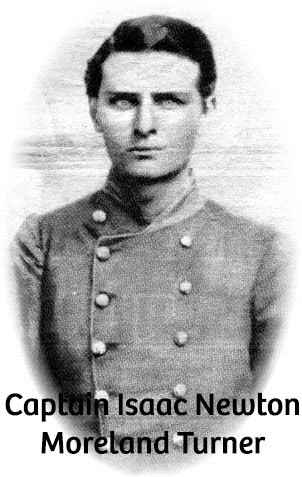
“The name, Ike Turner camp, was unanimously adopted, in honor of Captain Ike Turner of Hood’s brigade, who was killed in the Suffolk campaign in Virginia and was a Captain of Company K, 5th Texas Infantry, the “Polk County Flying Artillery.”
The question is, what took so long? The Civil War ended on April 9th, 1865. The selection of the date on which to organize the camp is not lost on anyone. Why did it take 28 years to do so?
The United Confederate Veterans (UCV) was founded in New Orleans, LA in 1889. It sought to unify the many separate organizations scattered across the former Confederate States into one larger regional body. Perhaps the slowness to organize, regionally or nationally, delayed the organization of the smaller camps. Whenever ex-soldiers of the South assembled for some type of celebration or some historic anniversary, there was suspicion in the north that the Confederacy was once again organizing. No doubt, reconstruction had a lot to do with the delayed assemblies as well.
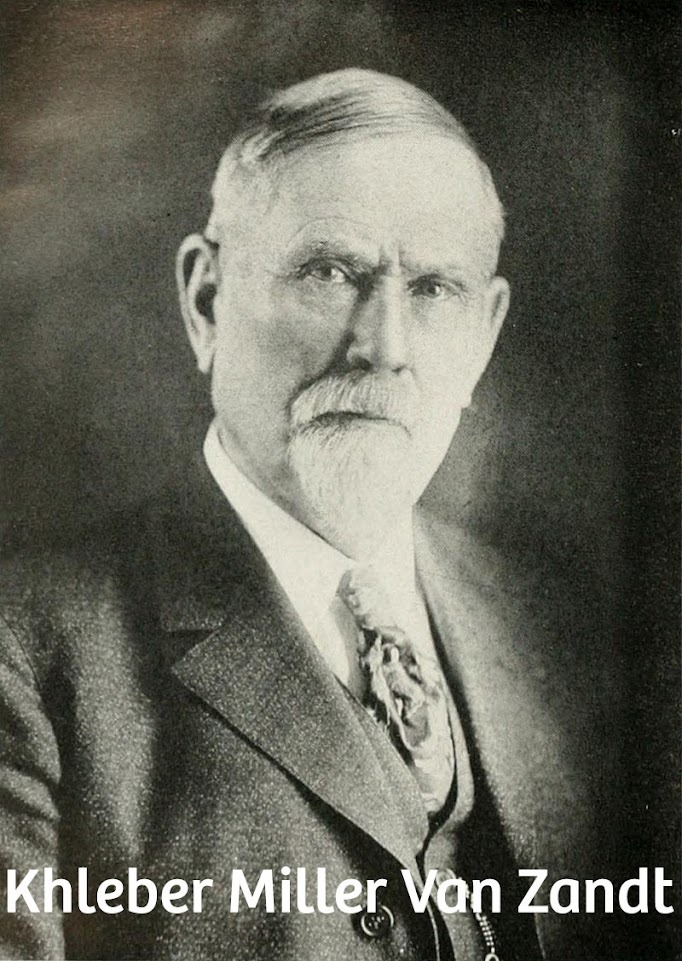
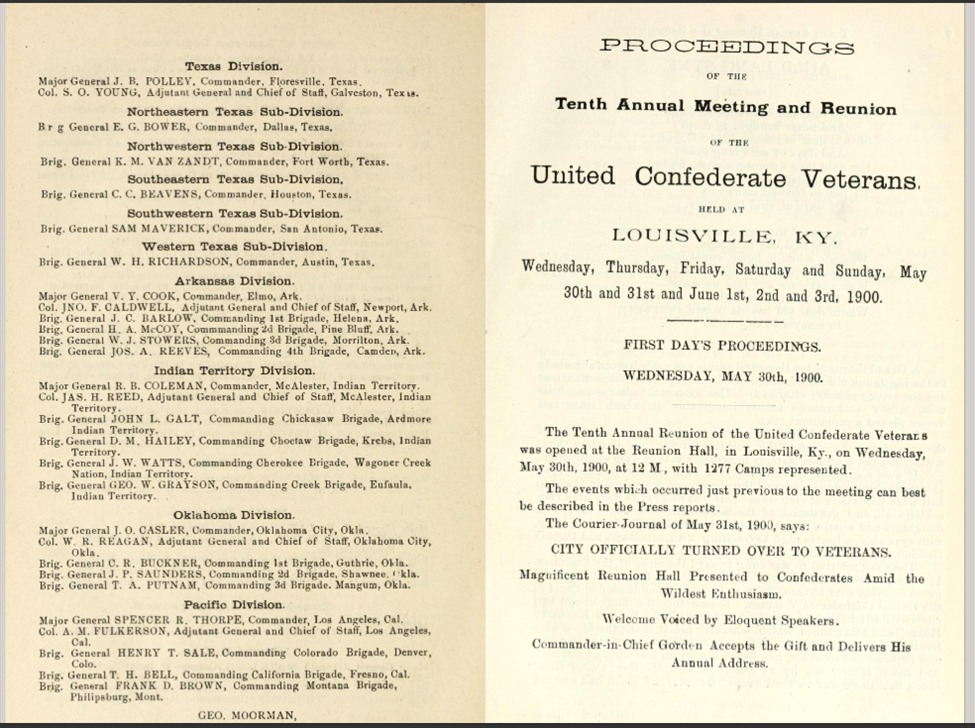
On May 24th, 1900, T.F. was appointed aide-de-camp to Major General K. M. Van Zandt who was commanding the Texas Division of the United Confederate Veterans. T.F. was promoted to the rank of Major. An aide-de-camp is a personal assistant or secretary to a person of high rank, and typically the foremost personal aide. Khleber Miller Van Zandt would eventually be elected to Commander-in-Chief of the UCV from 1918 until 1921.
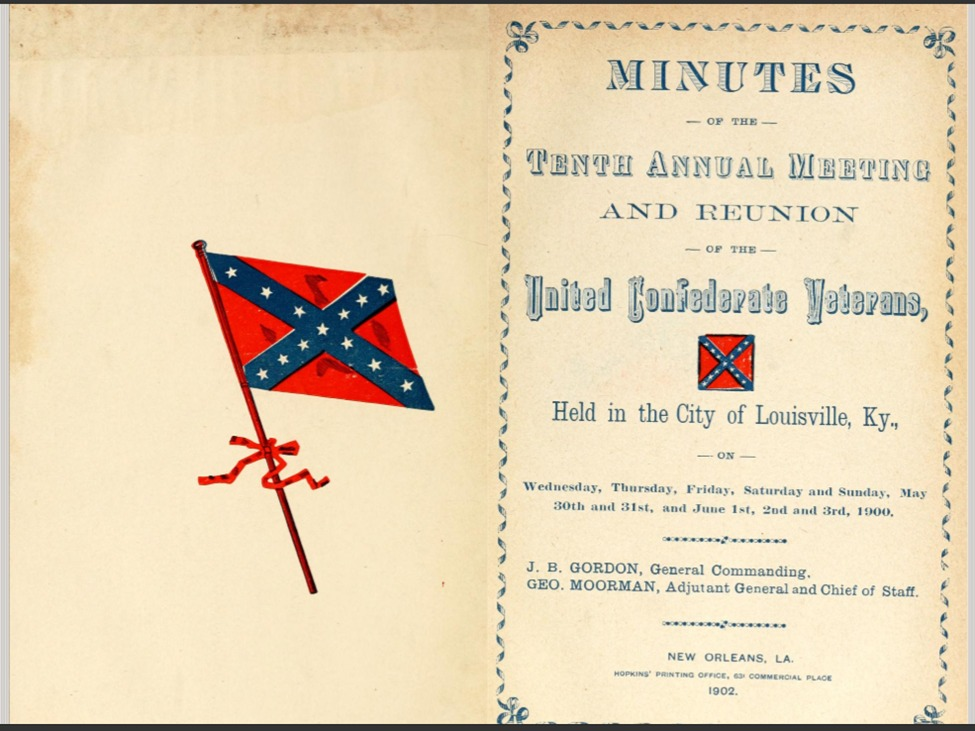
The Tenth Annual Meeting and Reunion of the United Confederate Veterans was held in Louisville, KY from May 30th until June 3rd, 1900. Under the Texas Division, Northwestern Texas Sub-Division, Brig. General K.M. Van Zandt, Commander, Fort Worth Texas is shown as in attendance. Although, not specifically listed, I can only assume that T.F. was in attendance as Van Zandt’s aide-de-camp.
The successor groups to the UCV are United Daughters of the Confederacy and the Sons of Confederate Veterans (SCV). Ironically, the SCV is located in Columbia, TN where T.F. was born. That’s coming full circle.
Like T.F., K. M. Van Zandt was born Tennessee. His family moved to Texas in 1839. His father Isaac Van Zandt was appointed by Sam Houston to negotiate the annexation of Texas by the United States. He was also a member of the convention that framed the first constitution for the State of Texas. He died in Houston, TX in 1874 while a candidate for Governor.
After attending Marshall University in Marshall, TX, K.M. furthered his education at Franklin College in Nashville, TN. He was admitted to the bar in 1858 and practiced law until the outbreak of the Civil War. According to the 1860 United States Federal Census, he enslaved nine individuals. He helped to organize and he became Captain of Company D, Seventh Texas Infantry. He was later promoted to Major. He took part in the battles of Fort Donalson, Chickamauga, Missionary Ridge, etc. He was taken prisoner for seven months following the surrender of Fort Donalson.
Van Zandt was an extremely successful businessman in Ft. Worth, TX. He began a dry goods business and then started the Tarrant County Construction Company, which built the Texas and Pacific railroad bed from Dallas to Ft. Worth. He was President of the Fort Worth National Bank and the K.M. Van Zandt Land Company. He was Director of the Fort Worth Life Insurance Company, the Fort Worth and Denver Railway and the Fort Worth Street Railway Company. The Fort Worth Street Railway Company was a streetcar system that operated in Fort Worth, Texas, from the late 19th century until the mid-20th century. It played a significant role in the city’s transportation infrastructure and urban development before being replaced by other modes of transport. He was the co-founder of the Fort Worth Democrat, the town’s first newspaper, and he was a member of the Thirteenth State Legislature. He was described as one “who wanted to lead rather than follow.” He was known locally as Mr. Fort Worth.
The purpose of the camps was to provide support and recognition for former soldiers, to preserve the Confederate cause and its history and to foster a sense of community and shared identity among veterans. The objectives of these organizations included burying and commemorating dead soldiers, caring for cemeteries, and providing aid to widows, orphans, and indigent veterans.
Isaac Newton Moreland (Ike) Turner was born in Putnam County, Georgia. His father, J.A.S. Turner, was a plantation owner with Texas land holdings in Polk and Liberty Counties. The Turner Family moved to Texas prior to the outbreak of the Civil War.
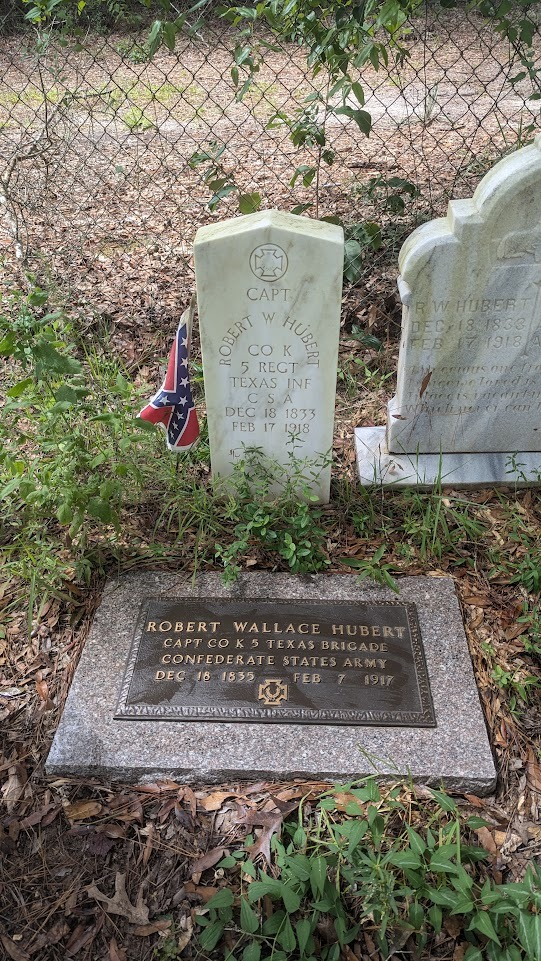
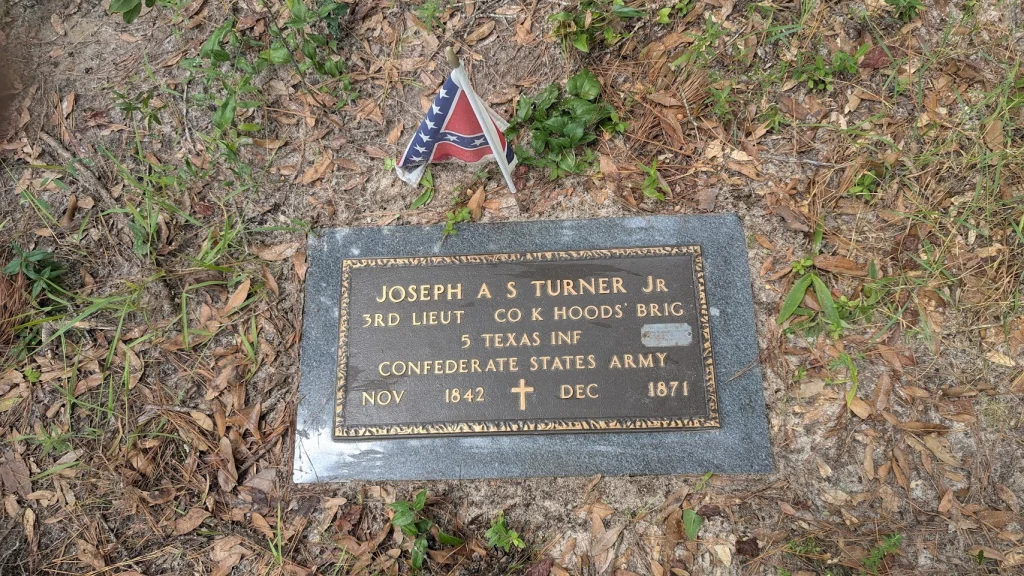
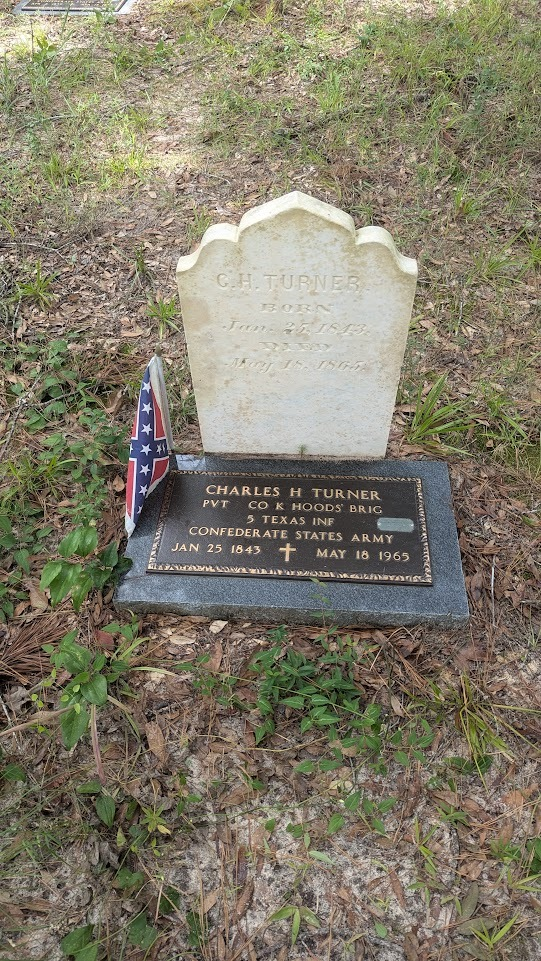
Theophilus Franklin Meece (T.F.) was a member of the Polk County Flying Artillery organized by Captain Ike Turner and his uncle Robert W. Hubert. This took place in May or early June of 1861. Robert’s sister, Martha Evaline Hubert, was married to Ike’s father Joseph Algernon Sidney Turner. They were mustered in as Company K, 5th Texas Infantry, but they retained their nickname, “Polk County Flying Artillery,” throughout the war. All of Turner’s younger brothers, William, Joseph, and Charles had joined the Company.
Captain Turner was the youngest officer of his rank in Hood’s Brigade. He was only 22 years old. Turner was able to procure (2) six-pounder cannon, through his father, and they began to drill as a light artillery unit. These cannons were first used in the Mexican American War. They were capable of firing a 6.1 lb. cannonball approximately 1,523 yards, as well as canister or spherical case shot (shrapnel). During the Civil War, spherical case shot, also known as shrapnel, was a common artillery projectile used against infantry and cavalry formations. It consisted of a thin metal casing filled with lead or iron balls and a small bursting charge, designed to explode in mid-air and scatter the balls over a wide area. This created a shotgun-like effect, devastating enemy ranks at ranges up to 500 yards.
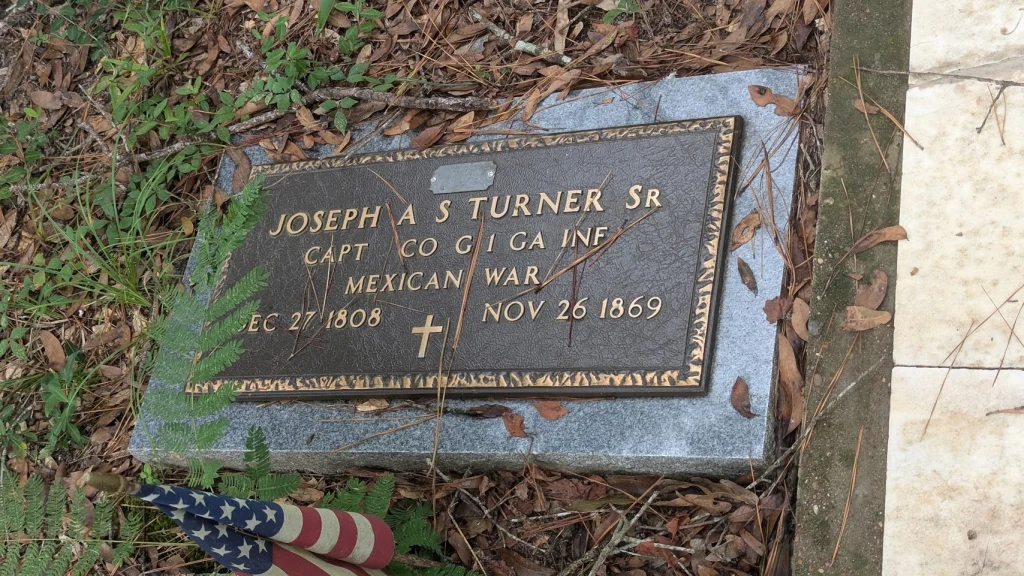
Captain Turner’s father, Joseph Algernon Sidney Turner, was born in December of 1808 in Putnam County, Georgia. He had himself served as Captain to a company of Georgians that accompanied Zachary Taylor to Mexico in 1846. He was clearly a very strong influence on his son. After all, these young soldiers were mostly farmers with absolutely no military experience. These were exciting times for these young men. They were full of optimism.
The Company failed to get service as artillerist and eventually accepted an opportunity to go to Virginia as an infantry unit. The Company assembled in Livingston, TX on Tuesday 9/3/1861 where Captain Turner was presented with a handsome flag (typically the Stars and Bars) during an address by the Honorable John L. Henry. Turner, in response, “promised to bring back heroes as husbands and sweethearts” for the noble women being left to cheer. Soldier dinners and entertainment were arranged for the entire Company prior to their departure.
Turner had led his troops through 16 battles, mostly in Virginia, and following the loss of all field grade officers at the Battle of Antietam he was elevated to Major. He had previously been wounded at Seven Pines, Virginia on May 31st, 1862 and at Second Manassas, VA on August 30th, 1862.
On April 14th, 1863 Captain, Isaac “Ike” Newton Moreland Turner was killed inside Fort Huger near Suffolk, VA. He was struck by a ball from a sharpshooter from across the river. He was carried to a field hospital where he died the following day. Ike’s last words, whispered to one of his brothers still in Company K, were a request: “If you can, please take me home to my mother, for I fear that she will worry so about me.”
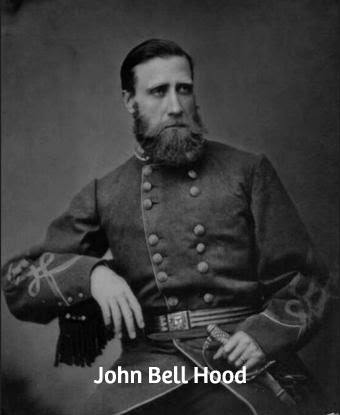
General Hood was reported to have said “he would sooner have lost any officer in his command of four brigades.” Hood lamented his death and considered Turner a gifted outpost officer of “preeminent qualities”.
On the same day that Ike Turner died his father began a letter to family in Louisiana expressing his weariness and disillusionment with the war. “We have had an excess of Freedom, which the masses in all ages have not been able to bear, and now we have an excess of despotism, north & south. There is no worse despotism than to be swallowed up in a military vortex. It is my opinion that a people that has the privilege of the ballot box can secure more liberty by their votes than they can by any other means. When we gain our independence, which I am in hopes we will do, we have not secured our freedom. A heavy, and I may say, enormous debt hangs over us, a large standing army which both the north & south will have to or will keep up, will destroy our liberties. The south particularly will have to become a military people in order to maintain her independence, and history shows that a military people can not have much freedom….”
Joseph goes on about the fact that he has been unable to find an overseer and that there aren’t any competent ones available. An overseer was a person, typically a white man, who supervised the labor of enslaved people on a plantation. They were responsible for maximizing productivity and ensuring enslaved individuals worked diligently under the direction of the plantation owner. Overseers often held significant power over the enslaved and could inflict physical punishment.
His son Joseph A. Sidney Turner Jr. had been wounded in the thigh in the Battle of Antietam and he was preparing to return to Virginia. Another son, William Hubert “Bill” Turner had been discharged due to disease and physical disability, and he was working on his uncle Bob’s plantation. Finally, his youngest son Charles Hines Turner had enlisted and had left for Virginia just two weeks prior to this letter. Sadly, he would die from disease (chronic diarrhea) in 1865. Chronic diarrhea, often caused by dysentery, was a major killer during the American Civil War, contributing to more deaths than combat. Unsanitary conditions, contaminated water and food, and lack of understanding about disease transmission led to widespread outbreaks. It’s quite likely that Joseph and his wife Evaline would not find out about Ike’s death for quite some time. There was no formal reporting, on either side, for sickness, injury or death.
Joseph would complete the letter with “If I understand the meaning of the word Christian, it is a follower of Christ. Did Christ, his Apostles & followers fight each other or even other people. No. Did they encourage resistance to the powers that be. Far from it… These reflections or opinions you will consider as rather novel or startling, as coming from me, but this war has upset nearly every old settled opinion I ever had.” Not exactly a supporter of “The Lost Cause”.
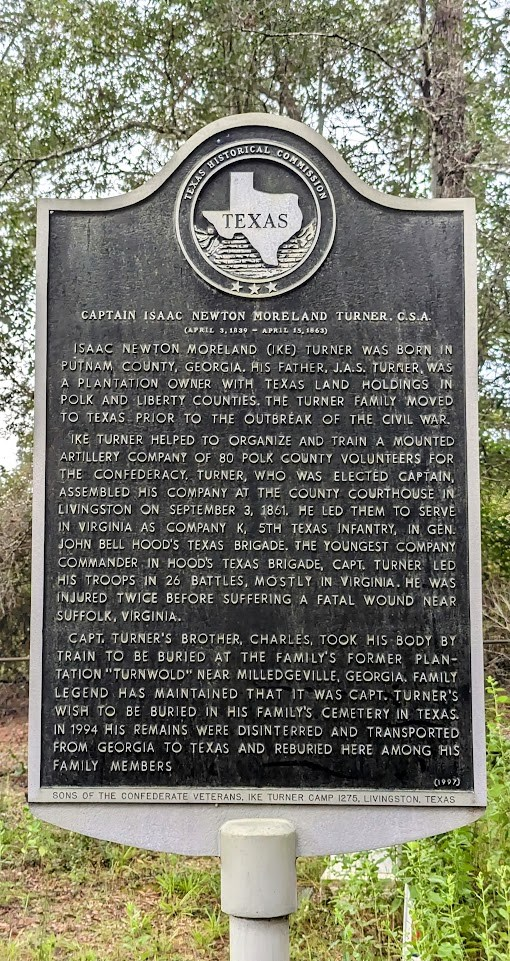
With the war raging around them, it was impossible to return his body to Texas. Capt. Turner’s brother, Charles, took his body by train to be buried at the family’s former plantation “Turnwold” (meaning Turner’s field) near Milledgeville, Georgia. Turnwold is among the most historic plantations in Georgia. Family legend maintained that it was Capt. Turner’s wish to be buried in his family’s cemetery in Texas. In 1994 his remains were disinterred and transported from Georgia to Polk County, Texas and buried amongst his family members.
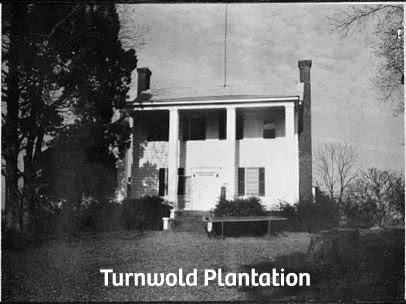
Joseph’s older brother, William (“Honest Billy”) Turner and his family would continue to own and operate the Turnwold Plantation. His son, Joseph Addison Turner, was a writer, editor, publisher, lawyer, and planter. He is best known for publishing the “Countryman”, a weekly newspaper produced from his Putnam County plantation during the Civil War. Turner was a staunch advocate for slavery and the Confederacy. He used the “Countryman” to voice his pro-Confederate views through articles and editorials. In June of 1865 Union officials placed Turner under military arrest for “publishing disloyal articles.”
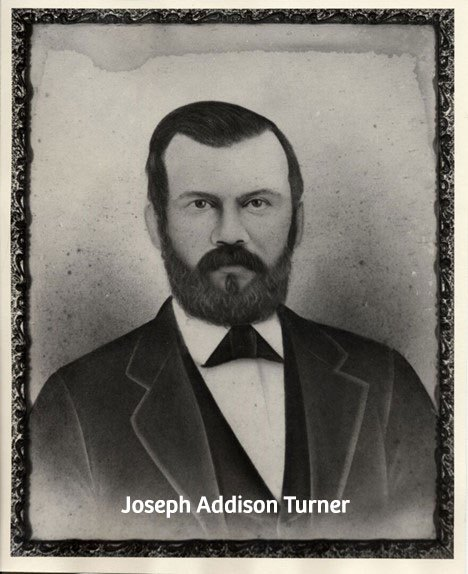
In March of 1862 Turner hired an Eatonton native, Joel Chandler Harris, as an apprentice and typesetter for the “Countryman.” He would go on to become an American journalist best known for his ‘Uncle Remis’ and ‘Brer Rabbit’ stories.
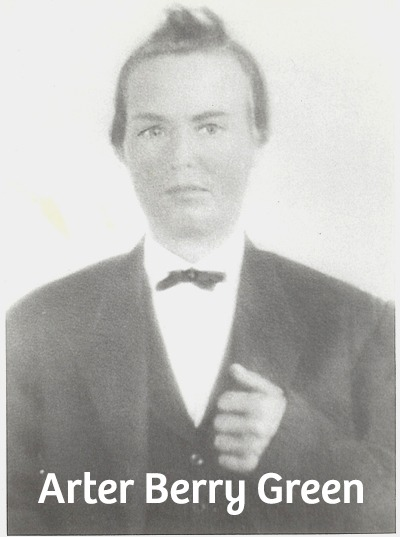
Arter Berry (A.B.) Green was one of the co-founders of the Ike Turner Camp. A.B. would make the following entry in a diary detailing his travels home, following the end of the Civil War:
4th-Started at 8 A. M., crossed the Oconee at 10, had three mules shod. Went to the Hat Factory to get some hats–none there. Stayed all night with J. A. Turner [at Turnwold Plantation where their captain, Ike Turner, had been buried in 1863], 9 miles from Eatonton.
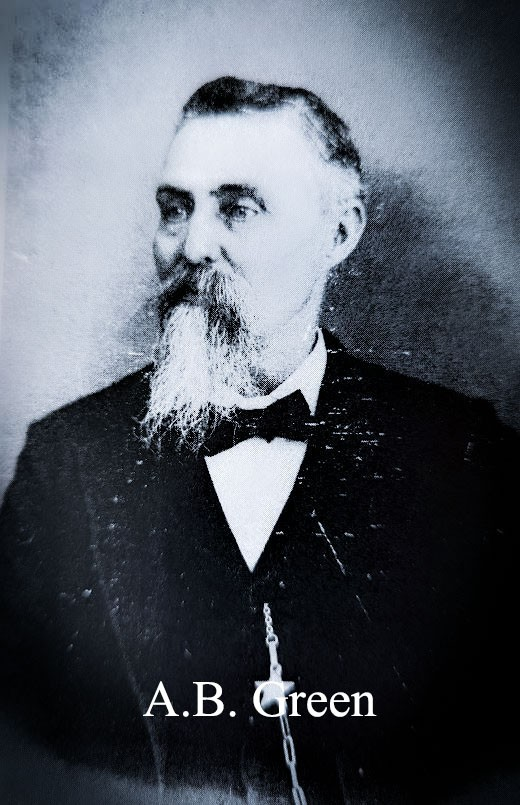
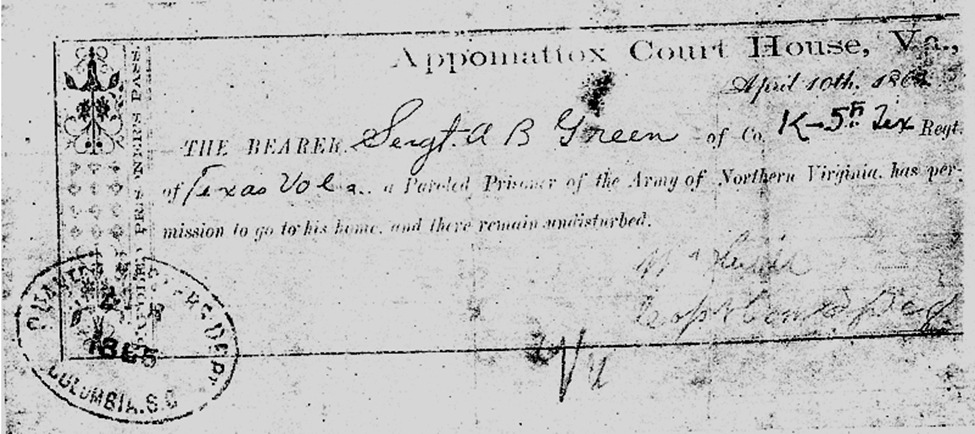
Remarkably, A.B. kept a diary of his travels which began on April 13th, 1865 in Appomattox Courthouse, VA and ended on July 11th, 1865 when he returned to Moscow, TX. Nearly (3) months! Evidently, they were in no hurry to return home.
Despite what had been written in the papers, in the following years, A.B., and therefore all of the members of the Ike Turner Confederate Veterans Camp No. 321, knew exactly where Isaac Newton Moreland Turner had been buried. A.B. met Joseph Addison Turner and he stayed at the Turnwold Plantation. Based on my research, there were no discussions or attempts to have Turner’s remains exhumed and moved to Livingston, TX.
The Ike Turner Confederate Veterans Camp No. 321 was founded in 1893. The first regular meeting was scheduled to be held at 2:30 PM on Friday, May 5th, 1893 when they voted to conduct quarterly meetings. Meetings were held in various towns such as Corrigan, Bold Springs, Livingston, Moscow and Providence. The East Texas Pinery, The Galveston News, Polk County Enterprise and the Houston Post were requested to publish the proceedings. It is my understanding that the Polk County Museum has retained the minutes of these meetings. They can also be found in the archives of the aforementioned newspapers.
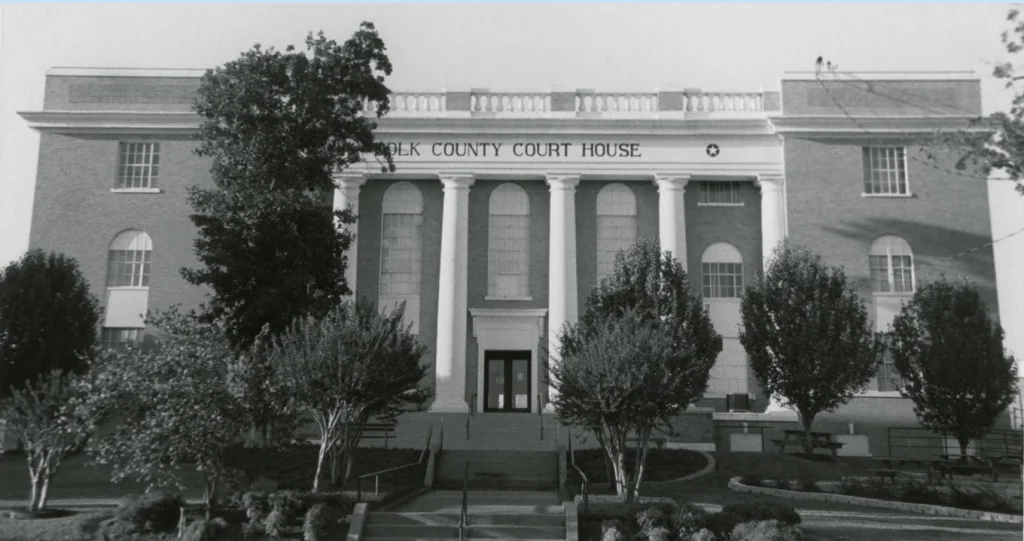
On December 12th, 1893 the Ike Turner Confederate Veterans Camp No. 321 meeting was held in Livingston. According to the Houston Post article, “Tables were prepared in the grove north of the schoolhouse and a bountiful repast spread (a meal that is large, plentiful, and rich in food), at which all were bountifully supplied with the delicacies for which our fair ladies are noted.” Following the dinner, the crowd moved to the Courthouse to listen to a speech by the Honorable Charles Stewart from Houston, TX. He “…treated the good people to one of his happiest strains of oratory, consuming probably an hour’s time. All were well pleased with the address and hope to be similarly entertained by Houston’s favorite son on other occasions.”
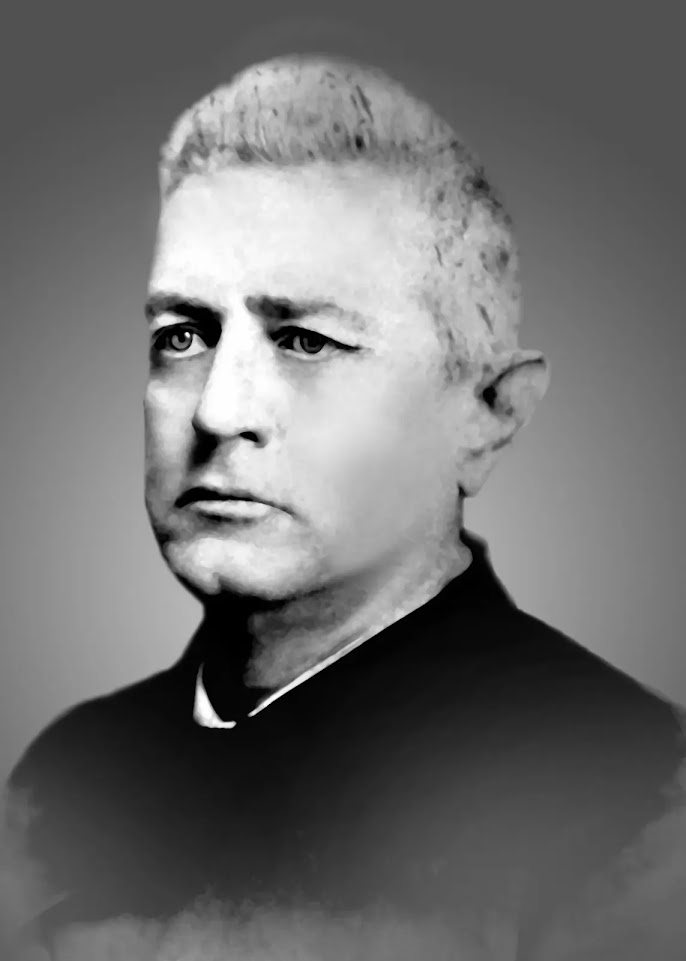
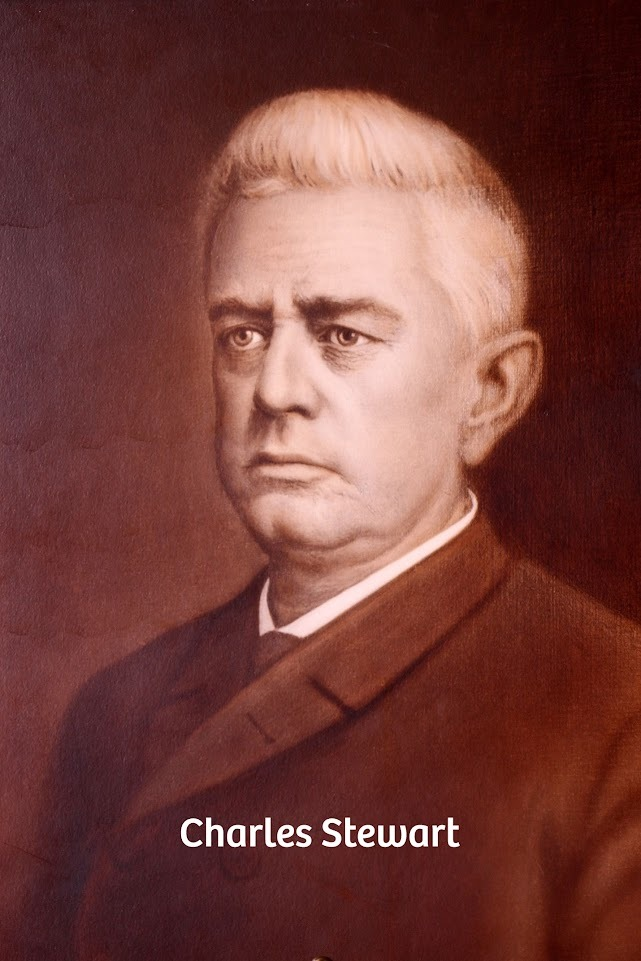
My great-grandfather clearly respected and admired Colonel Charles Stewart, so much so, that he named his son Charles Stewart Meece. He in turn named his son Charles Stewart Meece, Jr. Charles Stewart Meece Jr., would follow that up by naming his son Ken Stewart Meece. The epitaph on my great-grandfather’s headstone, “He was faithful to every duty” is identical to the one on Charles Stewart’s monument. Quite a tribute. In terms of our family tree, Charles Stewart Meece, Jr. was my 1st cousin 1x removed. Unfortunately, Charles Stewart Meece Sr. died on January 23rd, 1919 at the young age of 31. He reportedly contracted the Spanish Flu from soldiers onboard a train and died on January 23, 1919 at the young age of 31. He was buried at Woodbine Cemetery in Artesia, New Mexico located in Eddy County. Tragically, Charles Stewart Meece Jr. died at the age of 38 in a plane crash on April 11th, 1952 in Casper, WY.
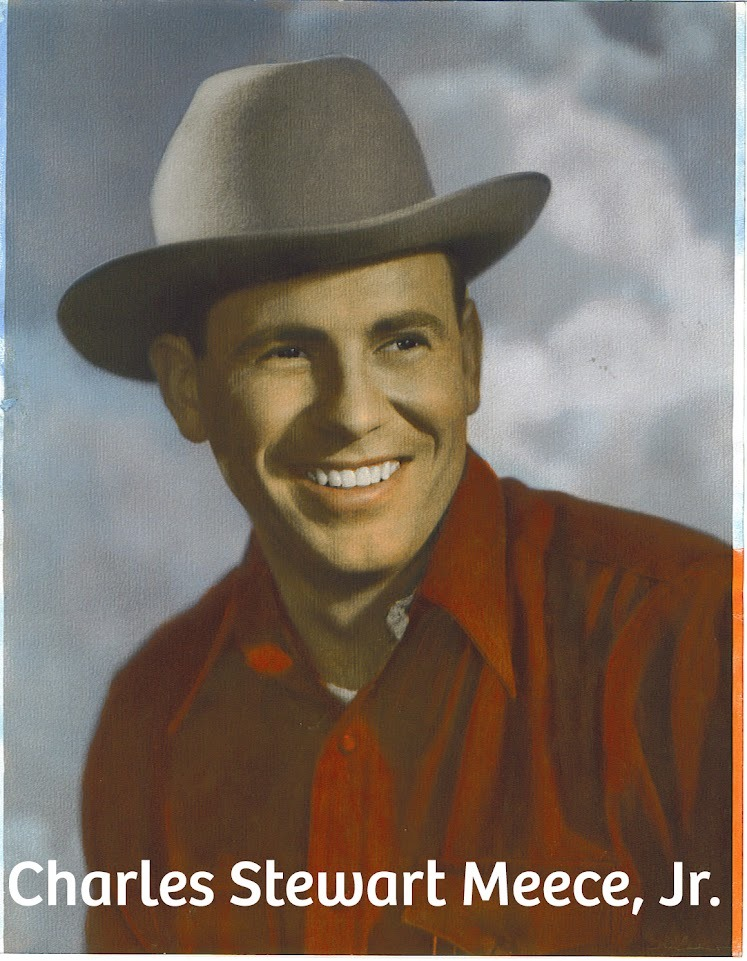
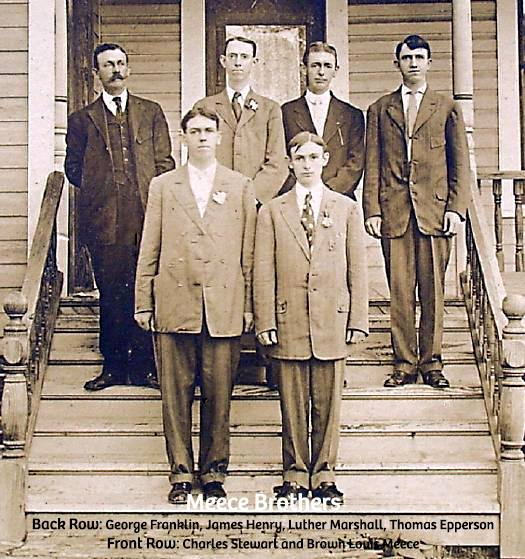
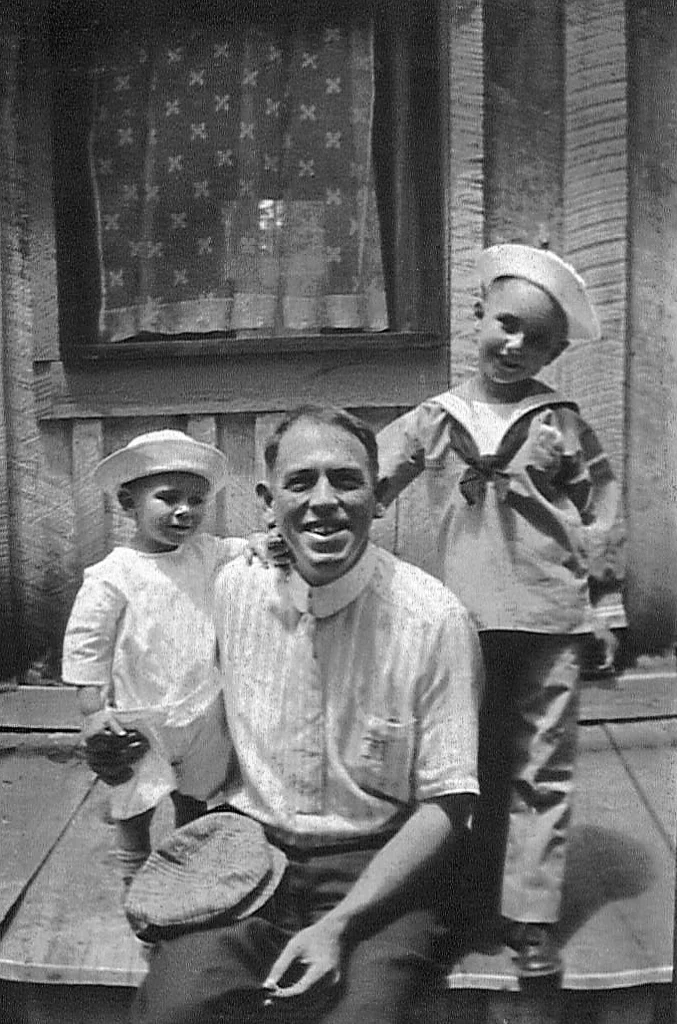
In a letter to his wife, Mary Louise McFarland Meece, in 1943 from Corpus Christi, TX, Charles Jr. wrote: “I will tell you just this one more thing and that is that I found out where my name came from originally. It would seem that there was a Col. Charles Stewart of the Confederate army that used to stay at T.F. Meece’s hotel in Livingston and that he and grandpop were very good friends. Well, my daddy was named after him and I was named after daddy. I saw the big colonial home in Houston that belonged to Col. Stewart and that his son lives in, but his son wasn’t home. I am going over and meet him when I get back if I have time. Interesting, isn’t it! I sure do get a kick out of it.”
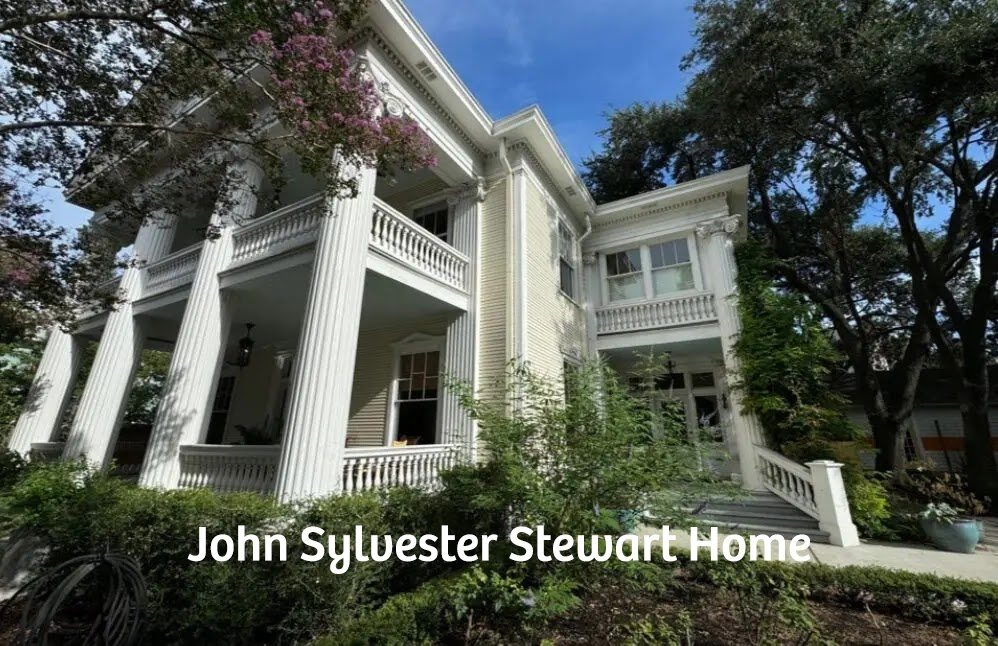
Charles Stewart was born in Memphis, TN on May 30th, 1836, which is in Shelby County. Collierville, TN, where I currently live, is also in Shelby County and on the outskirts of Memphis. In 1845, he and his family moved to Galveston, TX where Stewart began his law studies in 1852. Charles was admitted to the bar, before his eighteenth birthday, in 1854 and began to practice law in Marlin, TX, which is located in Falls County. He was elected prosecuting attorney for the Thirteenth Judicial District in 1856 and again in 1858. He married his wife Rachel Barry Stewart in 1860 and in that year, he reported owning (4) slaves. In 1861 Stewart was a delegate to the Secession Convention. He enlisted in the Confederate Army and served in the Tenth Regiment of Texas Infantry and later in Baylor’s Calvary.
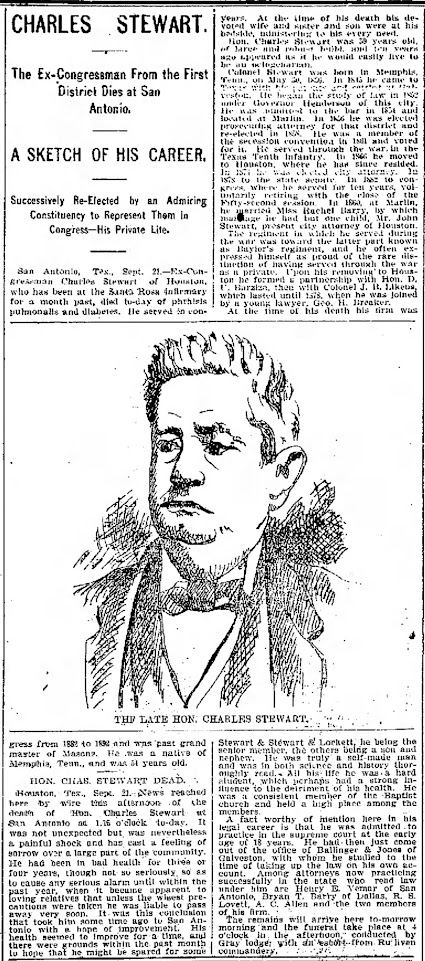
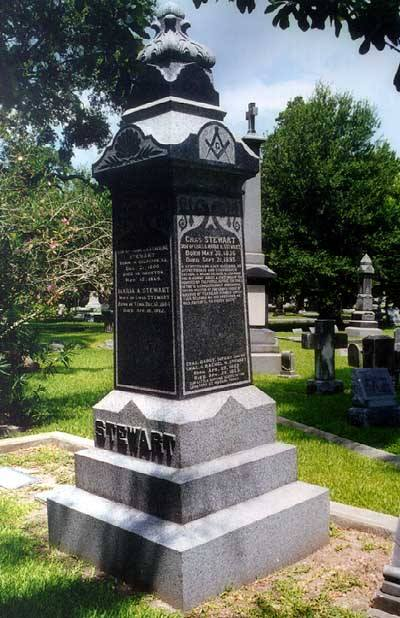
In 1866 Stewart moved to Houston where he practiced law. Stewart gained recognition as both a civil and a criminal attorney. He served as Houston city attorney from 1874 to 1876. In 1878 he was elected to the Texas Senate. After one term in the Senate (1879–72), Stewart was elected as a Democrat to the United States Congress, where he served five terms (1883–93). Stewart belonged to various Masonic bodies and in 1883 served as grand master of Masons in Texas. In 1892 he decided against running for office again. He returned to Houston, where he practiced law with his son, John S. Stewart. Following several years of failing health, Stewart died of phthisis (tuberculosis) and diabetes in San Antonio, TX on September 21, 1895. He was only 59 years old. He was laid to rest in Glenwood Cemetery, which is located in Houston, TX. Alas, Charles Stewart would not return for another meeting of the encampment.
The Standard History of Houston, Texas, described him as follows:
Another of the great criminal lawyers of Houston was the Hon. Charles Stewart. He was a man of unsullied character and too big in every way for little things. He was of splendid physique and personal appearance and is described [as] one of the most superb orators that ever faced a jury. He handled many of the most famous criminal cases tried in Harris County in the late seventies and eighties, one of the most famous being that of a young man named Crisom, who had killed a doctor for reproving him for swearing in the presence of ladies. The case was a desperate one, and at the first trial Crisom had been sentenced to death, but was granted a new trial because of irregularity on the part of the jury that condemned him. At the second trial the prosecution was powerful and it is said that but for the eloquence of Colonel Stewart, Crisom would have undoubtedly been hanged. As it was he escaped with a verdict of manslaughter and a short term in the penitentiary!
Another account refers to him as “…earnest, liberal, progressive, and charitable, a logical thinker, an eloquent speaker, ripe lawyer, able legislator, good citizen [and] kind.”
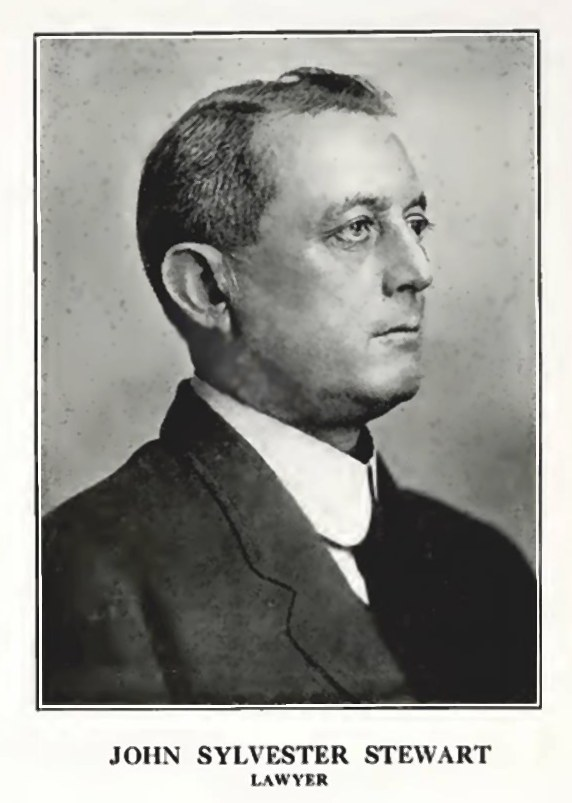
Charles Stewart’s son, John Sylvester Stewart, was highly successful in his own right. The Houston Press Club published “Men of Affairs of Houston and Environs” (“Men of Affairs of Houston and Environs” is the title of a book, specifically a newspaper reference work, that focuses on prominent individuals and institutions in Houston and its surrounding areas.)and wrote this about John:
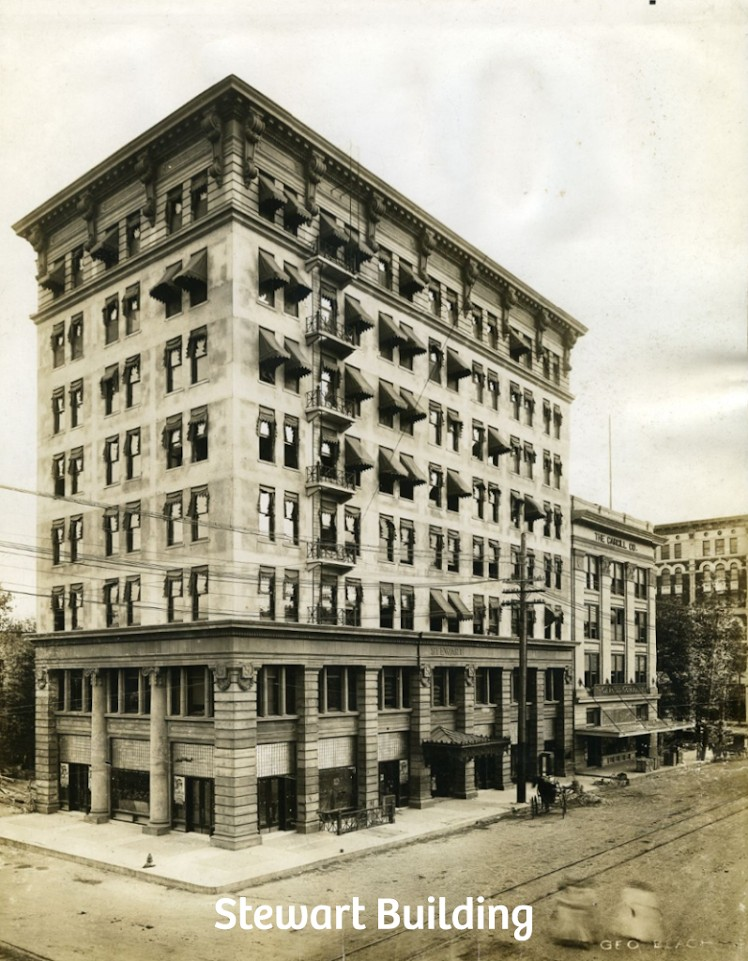
JOHN SYLVESTER STEWART, president of the Stewart Abstract and Title Company, and one of the owners of the Stewart Building, was born in Marlin, Texas, July 1, 1864. His father, Charles Stewart, was born in Memphis, Tennessee, his mother, Rachel Barry Stewart, in North Carolina. He graduated from the Washington-and-Lee University of Law in 1886 and has resided in Houston since 1865. He began practicing law in 1886, and made steady progress until he became recognized as one of the ablest members of the Texas bar. From 1892 to 1900 he was City Attorney of Houston. Some years ago, he and his mother erected the eight-story building that bears their name. It was the first large building of concrete construction to be built in Houston and is still recognized as one of the city’s sightliest sky-scrapers. Mr. Stewart is a member of the Press Club, Masons, Knights of Pythias, Red Men and the Elks, and his fraternal spirit is in evidence on all occasions. He was married in 1893 to Miss Anita Bolmes and has five children: John Sylvester Jr., Grafton, William Bryan, Anita, and Bessie.
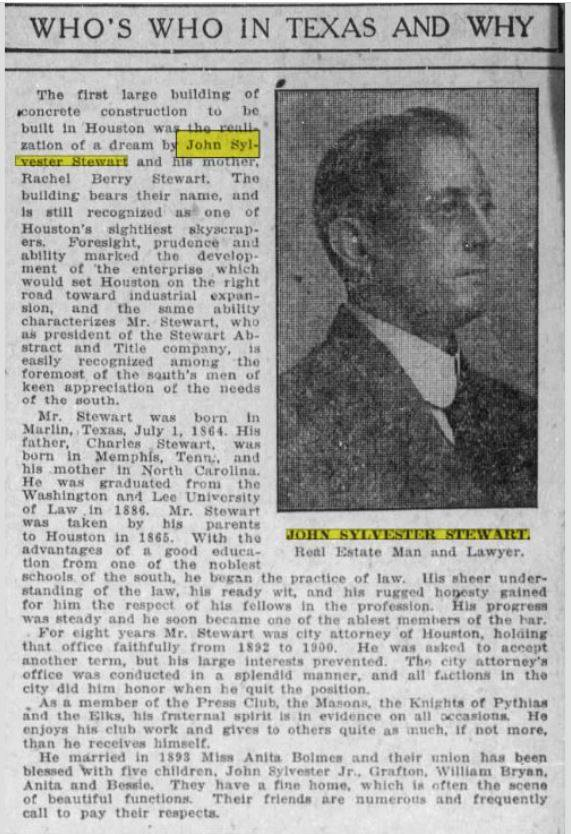
The Stewart home, that Charles Stewart Meece Jr., wrote about, still exists and it received a “Protected Landmark Designation” from the City of Houston. Sadly, the eight story office building was razed in 1973 and turned into a parking lot. “Politicians!” We lived in Houston, TX for a short period of time. My brother Bryan Edward Meece was born there. I believe my father was working for the Texas Gas Transmission Corporation.
At the first meeting of the Ike Turner Camp, “Chairman T. F. Meece reported, recommending that the wives, daughters and sons of members of the camp and widows of Confederate soldiers or sailors be admitted as honorary or social members without fee. Adopted.” Aside from the usual business being concluded, delegates to the State and National (UCV) encampments were appointed and officers for the ensuing year were voted for.
Some of the other matters that would come up at these meetings included:
• A committee of five, including the commander, was appointed to obtain reduced rates on the railroads to the meeting in Houston.
• A committee was also appointed to examine the names of the applicants and recommend a superintendent for the confederate home at Austin.
• Committees on resolutions of respect for deceased comrades were appointed. (This, unfortunately, began to happen all too often.)
• The Camp would make donations to various individuals, comrades that were ill, and organizations such as the Old Ladies Confederate Home in Austin, TX.
• Comrades were requested to give personal accounts of their experiences in the war.
At the 04/16/1908 meeting in Livingston the by-laws were amended to reduce the number of meetings annually to three. As new officers were elected each year, T.F. would hold the office of Commander and Adjutant following his initial selection as 2nd Lieutenant. Commander was the highest-ranking officer within a camp. The Adjutant (or Adjutant General) served as the chief administrative and record-keeping officer, managing correspondence, membership, and other essential administrative tasks.
Periodically, visiting Confederate comrades would visit. There were often meetings between old veterans that had not seen one another since the war ended. At the meeting that occurred on July 8th, 1909, “The Historical Committee was authorized to: have the historic data published as soon as sufficient funds can be raised to pay for its publication. T. F. Meece was appointed a committee of one to raise the funds for same.”
At the January 1st, 1910 meeting, there was sad news to report. “Notice also that I have appointed Ex-Judge T. F. Meece to fill the office of Adjutant, vacated by the death of our most honored, worthy and esteemed comrade, A. B. Green, who held this office from the organization up to his death. I hope the camp will look well to electing another to fill his place at the next annual meeting for electing officers. Comrade Green was always faithful to his business, ever at his post, never failed to attend a single meeting of the camp from the time the camp was organized up to the last meeting. He was elected to this office at the organization and held same until his death. His death has cast a sad gloom over the camp and community at large. Motion was adopted requesting Comrade James E. Hill to deliver a eulogy upon the life, habits and character of Adjutant A. B. Green at the next meeting of the camp and that Adjutant Meece notify him thereof.”
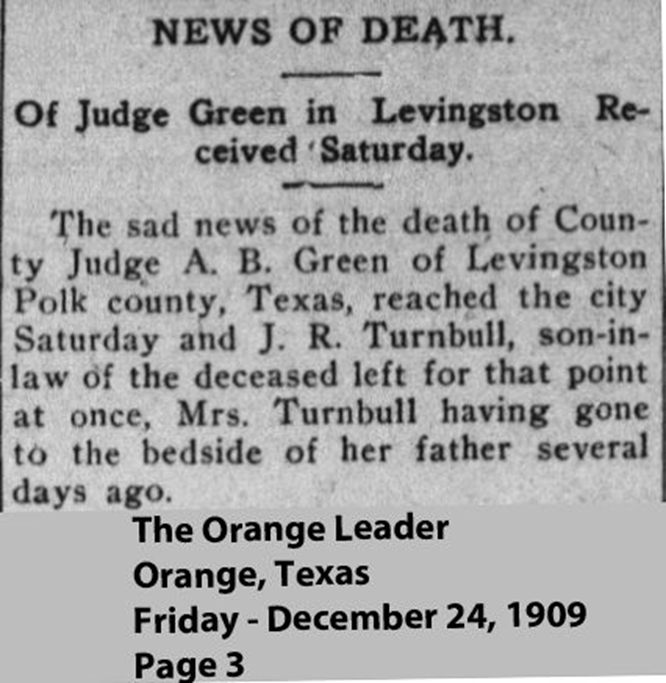
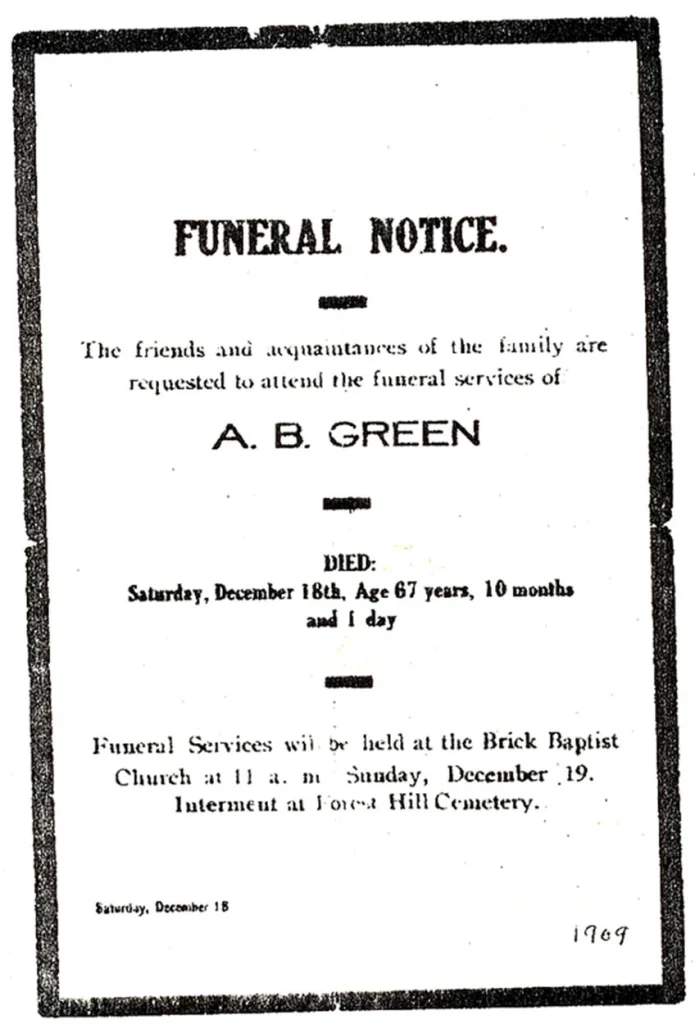
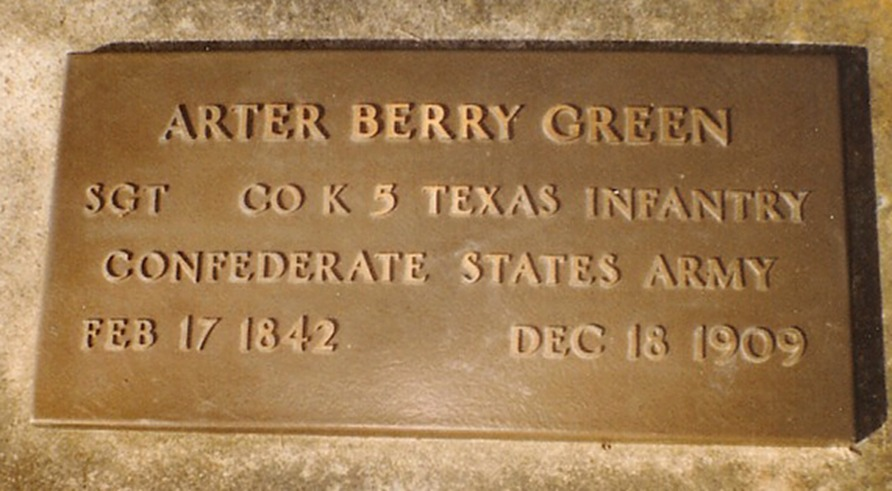
Arter Berry (A.B.) Green was born on February 17th, 1842. He was appointed the Adjutant for the Ike Turner Confederate Veterans Camp No. 321 upon its inception and held that position until the day he died on December 18th, 1909. A.B. was buried in Forest Hill Cemetery which is located in Livingston, TX. “Arter” is primarily a surname, not a given name, and it’s a variant of the name Arthur. It’s believed to have originated in England and Wales, likely influenced by the Gaelic form of Arthur, Artair. The name “Arthur” itself has various possible meanings, including “bear” or “strong man”.
A.B.’s father was David Grigg Green who was born on October 4th, 1813 in Bell Buckle, Tenn. Bell Buckle is approximately 54 miles S/E of Nashville. David moved to Texas, what was Mexico at that time, in 1835. He did so in response to Sam Houston’s appeal for volunteers to fight the “Mexican Oppressors.” He was a veteran in the Army of the Republic of Texas. He was the original founder of Greenville, which would later become Moscow, TX, located just 16 miles from Livingston. He would marry Matilda Burch and they produced 11 children. He was a blacksmith by trade.
When he was 16 years old, A.B. worked in the store of Patrick & McConnell until 1861 when he and his brother Henry Robert joined Company K, 5th Texas Infantry. Neither they, nor their father, were slave owners. For them, it was their patriotic duty to fight for the State of Texas, the state that their father had helped win its independence. A.B. fought in the battles of Malvern Hill, Seven Pines, Gaines Farm, Manassas, Gettysburg, Chickamauga, Battle of the Wilderness, the Siege of Petersburg, Darbytown, the Siege of Richmond, and he was at the surrender at Appomattox Courthouse. He was wounded four times.
Art resumed his work with the general store in Moscow after the war and travelled throughout East Texas purchasing cow and deer hides. On March 25, 1869 he married Amanda Adelle Magee. Art and Amanda had 13 children, of which only 6 lived to be adults. Art operated a lumber company commissary for several years, as well as becoming a storekeeper and postmaster in Tyler County. He moved back to Moscow in 1881 so that his children could attend school. In 1884, he was elected County Clerk and resided in this position for the remainder of his life. Art served seven terms as County Clerk and two terms as County Judge. In addition to his political career, he was an abstractor and farm owner.
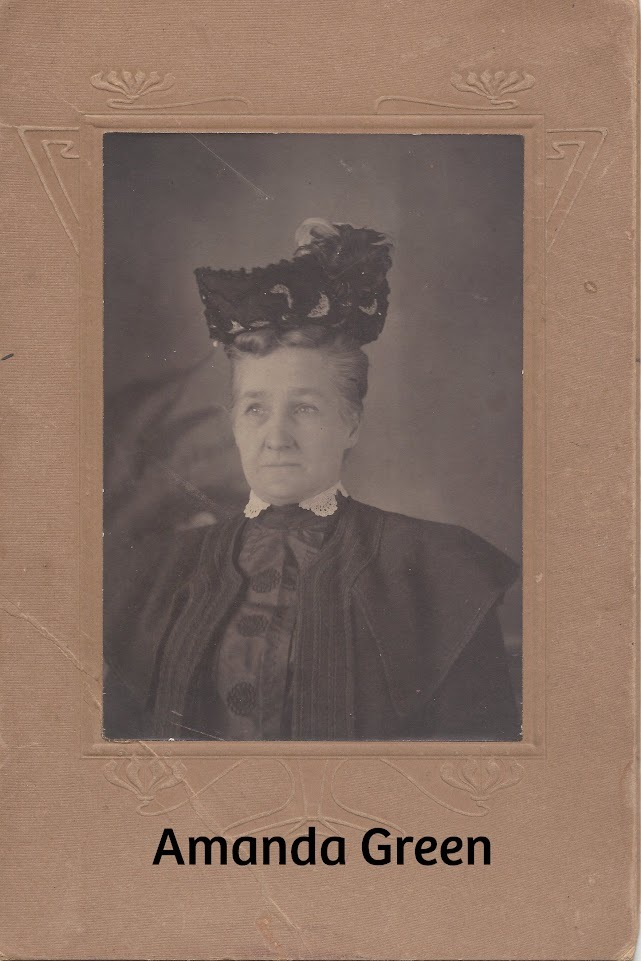
The following obituary was printed in the Confederate Veteran Magazine:
A. B. GREEN,
A. B. Green was born in November, 1842; and died at Livingston, Tex, in December, 1909, survived by his wife and six children.
Comrade Green enlisted in the Confederate army in September, 1861, as a member of Company K, 5th Texas Regiment, that being a part of the last Texas troops sent to Virginia. The 1st, 4th, and 5th Texas Regiments and the 18th Georgia Regiment composed the famous “Hood’s Texas Brigade.” Comrade Green was in nearly every battle from the first to the surrender of General Lee. He was wounded three times, but never so seriously as to keep him from his command any length of time. He did his duty faithfully as a soldier, and none was ever more deserving of honors through meritorious conduct. Returning to his home in Polk County at the close of the war, he began life again as a farmer, and in a few years entered the mercantile business. Later on he was elected to the office of County Clerk, and served for eight years, after which he was made county judge for four years. No fitter epitaph could be inscribed on his tomb than that “the corner stone of his life was integrity.”
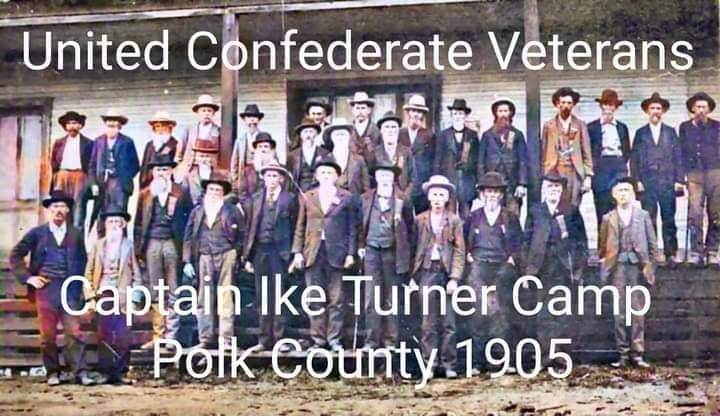
Members of the Ike Turner Camp C.S.A. This picture was taken one day during a regular meeting of the Confederate veterans’ organization. They are standing on the porch of Bergman’s Store in Moscow. The following have been identified: Front row: (2) Mr. Kent, (3) J.G. Locke, (4) Foster Poe, (5) I.N. Snell, (6) W.M. Kennedy, (7) J.R. Doughty, (10) Luce DeWalt, (11) Pleas Rowe. Second Row: (1) A.B. Green, (2) Dr. E.P. Angell, (3) R. Newton Green, (5) Prof. Marcellus Winston. Back Row: (1) T.L. Epperson, (2) D.S. Chandler, (5) Wyley Polk, (#8) A.C. Garvey, (9) T.F. Meece, (10) M.N. Kinard, (12) D.T. Manry.
In October of 1910 a meeting had been cancelled and delayed a couple of times, reasons unknown. The following plea was put forward by I.N. Snell and T.F. Meece:
“We are all growing old and feeble and time will soon be no longer with us, and it behooves us, one and all, to make the best of our remaining days. We should strive to leave a true and honest record of our lives behind for the benefit of our children and the rising generation. We have all been through one of the bitterest wars that has ever been recorded in the annals of history which will ever be remembered by us, and especially our foes. It will ever be a pleasure for me to meet and greet my dear old comrades of the sixties. May God help us all to make our last days on earth as pleasant as possible.”
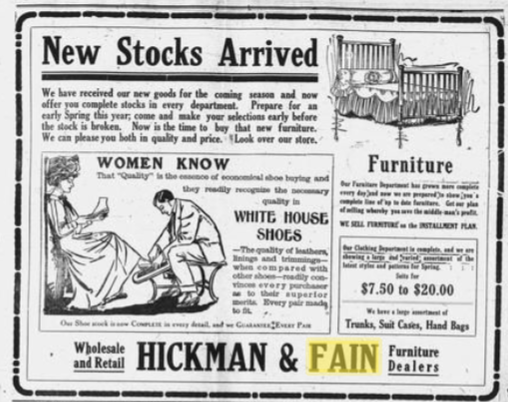
At the meetings in Livingston, the firm of Hickman and Fain would provide free tickets to the moving picture show at the opera house. In Moscow, “They had buggies and hacks to meet them at the depot and carried them to the schoolhouse where the meeting was to be held and when the time for dinner came they were carried to the Goodwin Hotel were a sumptuous dinner awaited them.”
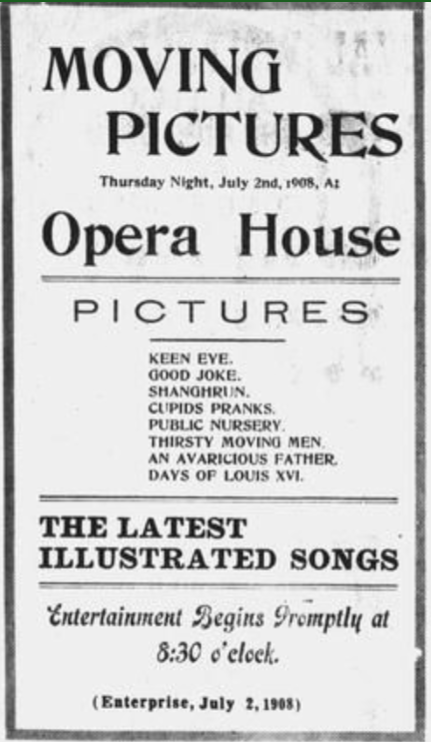
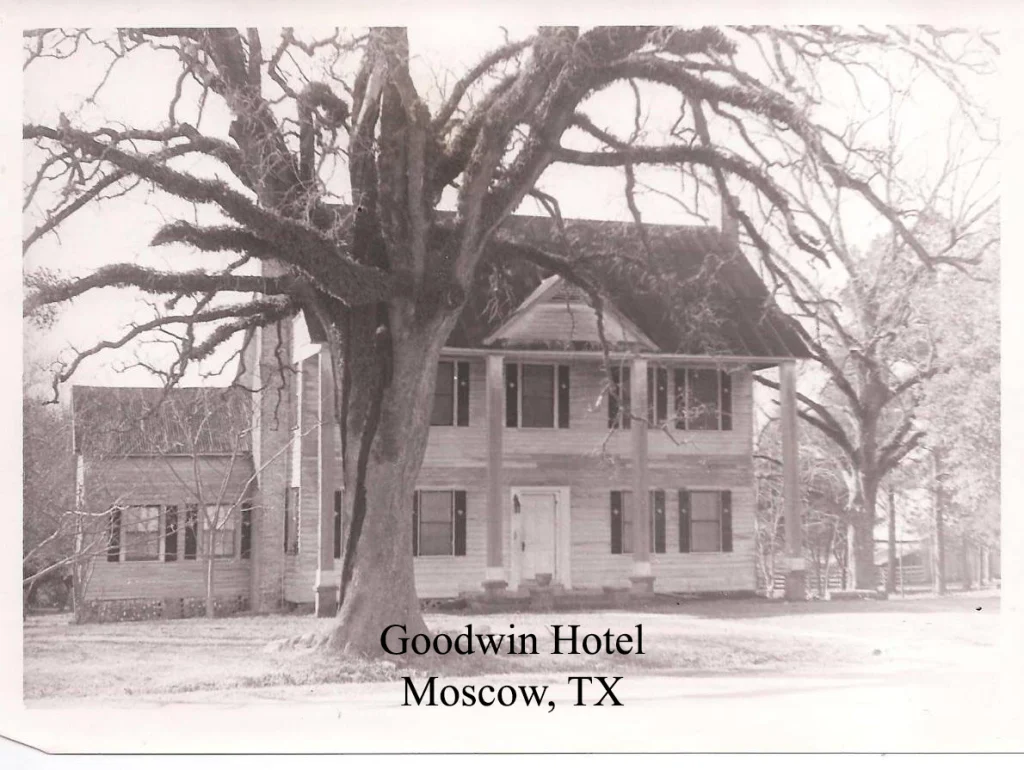
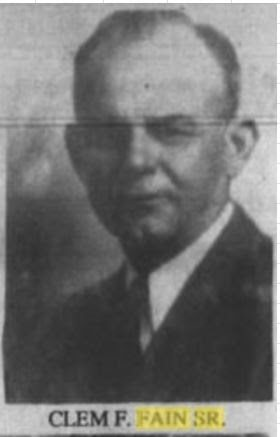
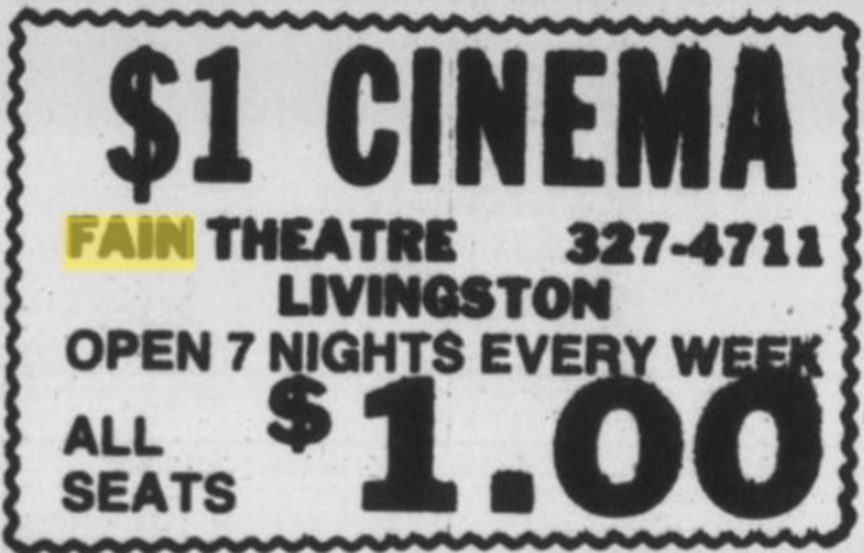
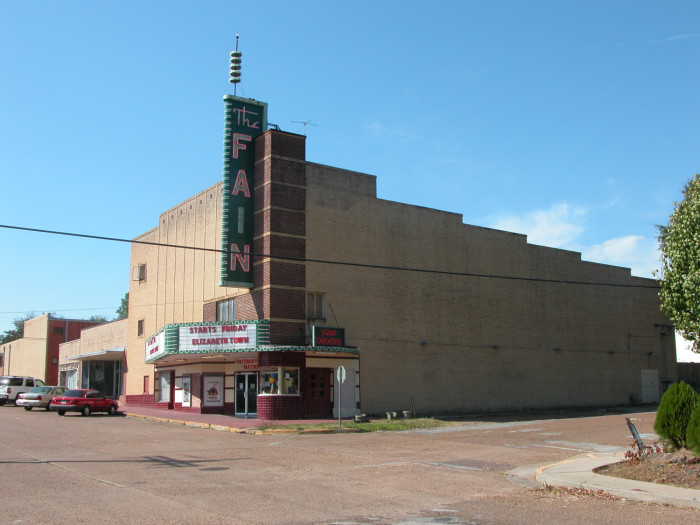
Clement Franklin Fain, Sr. was a partner with a Mr. June Hickman in a mercantile business (Hickman & Fain) in Livingston. Based upon the advertisements that I’ve seen, I would describe it as a department store. Fain had previously been a Manager for the Livingston Lumber Co. store in Buck, TX. In 1911 Fain would purchase the Happy Hour Theatre, the first movie theatre in Livingston. It was initially called the Unique Picture Show when it was first constructed. It would eventually be renamed The Fain.
One of the founders and owners of the Unique Picture Show was a gentleman by the name of L.A. “Lock” McKinnon. He also owned the City Drug Store. Tragically, his two sons Croson (13 yrs.) and Angus (8 yrs.), would die in May of 1910 from drowning in Long King Creek. “A large part of the population of the town were at the house, or soon came, and the scene was heartrending; indeed, the moans of the stricken parents and relatives so sad. The entire citizenship of the town was heart sick, the enormity of the accident being so appalling. Everyone shed tears, and the atmosphere seemed to be sadness.”
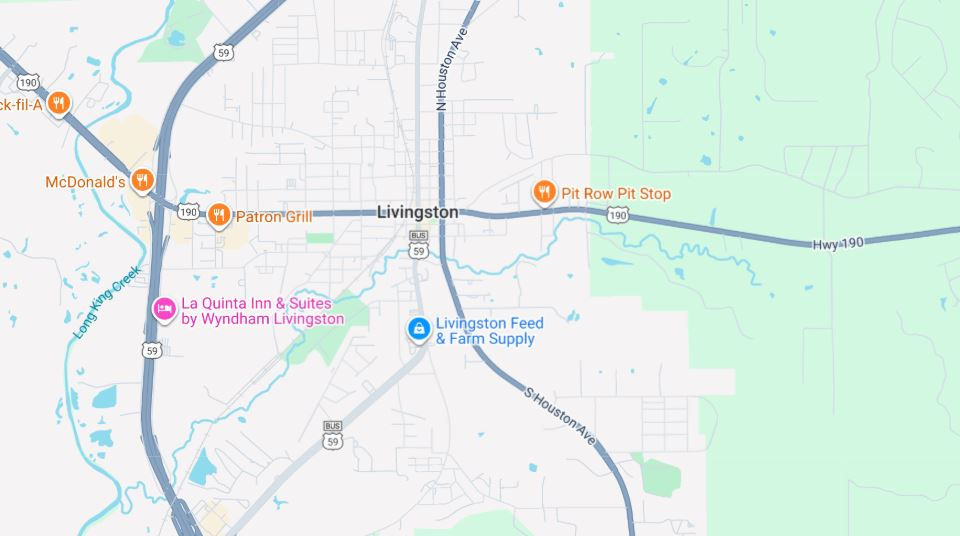
“Lock” sold the City Drug Store to A.J. Peebles, a local competitor, owner of the Capitol Pharmacy. In November of 1911, McKinnon and his family moved to Hubbard City where he planned to open an ice factory. I can only imagine that Livingston was a constant reminder of their terrible loss and they were looking for a new beginning.
Clement Franklin Fain, Sr. sold the theatre to his nephew Samuel Frank Fain in 1940. Samuel would go on to build a new theatre, which still exists today, in August of 1948. It is, by far, the coolest looking building in Livingston.
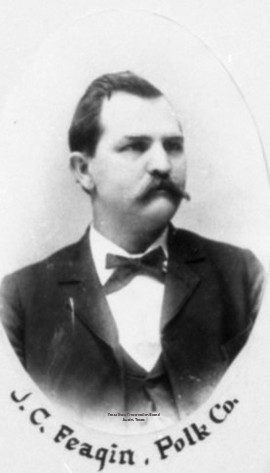
At the November 23rd, 1911 meeting, the “Hon. Jas. C. Feagin was introduced and delivered a fine and very appropriate address, which was much appreciated by all present, and especially so by the veterans in attendance. On motion, unanimously adopted, Mr. Feagin was elected an Honorary Member of the Camp.” The Veterans reportedly enjoyed the meeting but regretted that the ladies and young people had not attended.
On June, 6th, 1912 the following article was published: “All Confederate soldiers of the army and navy, who were honorably discharged or retired from such service, are cordially and earnestly invited and urged to attend said meeting and become active members of said Camp. But a few years more and we will all pass over the river, having answered our last roll call. Come and let us enjoy the reminiscences of the camp, our social gatherings, and recite to each other and to our friends the pleasures, as well as trials and hardships of the camp, the march and the battlefield.”
T.F. was a member of both the Monument Committee and the Historical Committee. The Historical Committees produced and published, with the assistance of the Polk County Enterprise, The Historical Polk County Texas Companies and Soldiers Organized in and Enrolled from Said County in Confederate States Army and Navy 1861-1865. I was able to find a copy of this book online as well as secure (2) copies through Amazon.
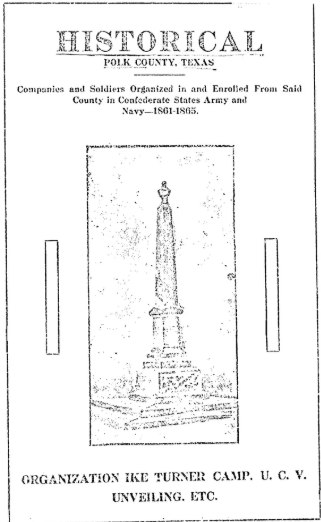
The Monument Committee was responsible for the purchase and dedication of the Confederate Monument. The Monument was constructed, October 10th, 1901, on the courthouse lawn. A.B. Green’s daughter, Rowena Green, unveiled the Civil War monument on behalf of her father. For some years, in the mid 1980’s, the inscription on the monument had been unreadable. The Monument was refurbished by the Ike Turner SCV and the Ike Turner Chapter UDC on April 26th, 1993. The Monument is inscribed as follows:
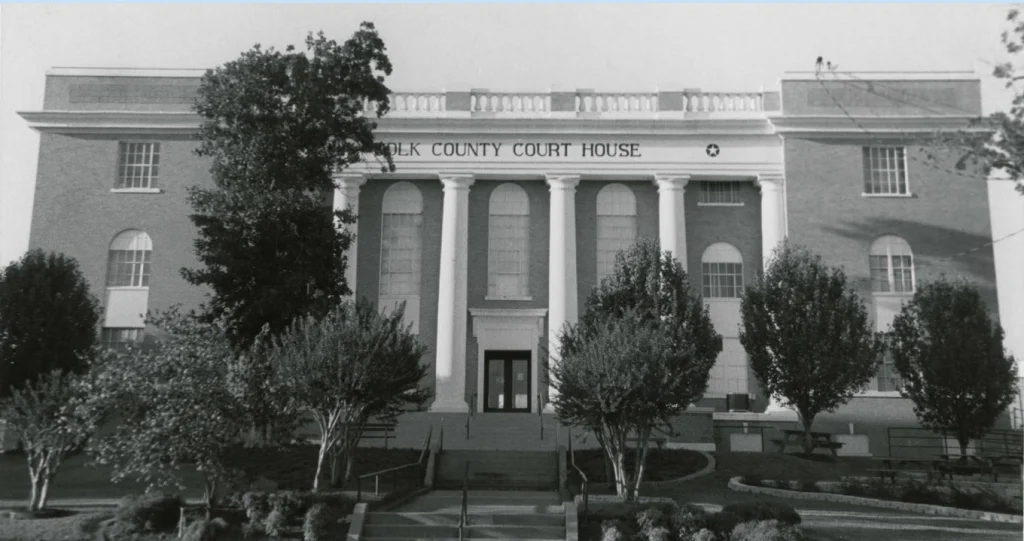
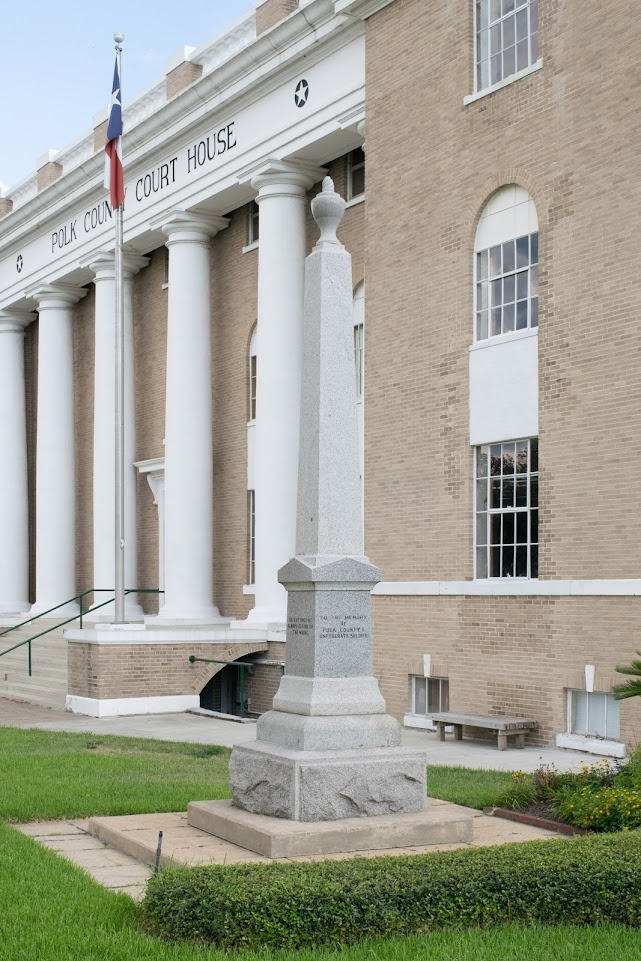
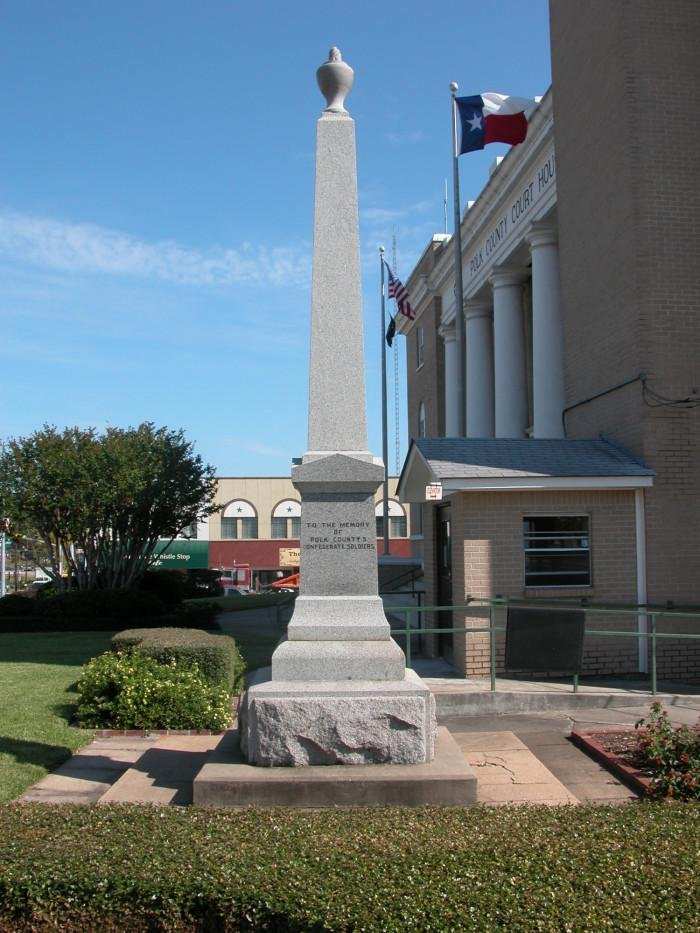
TO THE MEMORY OF POLK COUNTY’S CONFEDERATE SOLDIERS
TAKE THAT BANNER DOWN ‘TIS TATTERED AND BROKEN IS THE STAFF AND SHATTERED AND THE VALIANT HOSTS ARE SCATTERED OVER WHOM IT FLOATED HIGH SOFTLY, SLOWLY TREAT IT GENTLY IT IS HEAVY FOR IT WAVED WHERE HEROES FELL
ERECTED BY IKE TURNER CAMP SONS OF CONFEDERATE VETERANS
POLK COUNTY FURNISHED THE CONFEDERACY MORE SOLDIERS THAN SHE HAD VOTERS
DEFEAT DOES NOT ALWAYS ESTABLISH THE WRONG
One week after the dedication, an article appeared in the newspaper, the Livingston Local, on Thursday, Oct. 17, 1901, which read: The unveiling of the Confederate monument and barbecue was a most pleasant event. Large numbers of people from throughout the county were present. The exercises were concluded with a grand ball at the courthouse, in which the young people of the county “tripped the light fantastic” (dancing nimbly and lightly, often in a joyous or carefree manner) until a very late hour.”
On July 10th, 1913, an announcement was made:
Attention Veterans and Friends,
“The Historical Roll of the Soldiers and Companies organized and enrolled in the Confederate Army and Navy from Polk County has been printed in book form and is now ready for delivery. The cost of printing these books was 25 cents each, for which price they may be had by anyone making application to me. If ordered sent by mail enclose 5 cents extra for postage.”
T. F. Meece
Livingston, Texas.
On July 24th, 1913, a 2nd announcement was published:
Roll of Polk County Confederates.
“The Enterprise has recently printed and turned over to Adjutant Judge T. F. Meece for the Ike Turner Camp a 66-page booklet containing a historical roll, sketches and other data concerning the soldiers enrolled and companies organized from Polk County in the Confederate Army and Navy. The book also gives in full the addresses delivered by Judge J. M. Crosson and Judge J. E. Hill at the unveiling of the Ike Turner monument in Livingston on October 10th, 1901. In it is also found an account of the organization of Polk County and much other information which should prove interesting not only to the members of Ike Turner Camp and their friends and relatives but to everyone who desires to know something of the early history of Polk County. The data for the book was secured and prepared for publication by Jas. E. Hill Sr, J. M. Alexander, T. F. Meece and the late A. B. Green. It represents many hours of patient, careful work and is as accurate and complete as it could be made.
The books are in the hands of Judge T. F. Meece, Adjutant of the Ike Turner Camp of Confederate Veterans of whom they can be had at cost of 25 cents each and 5 cents additional for postage when desired sent by mail.”
At the October 9th, 1913 meeting, a motion was made that the Commander appoint a committee to interview the ladies of the county with the purpose of organizing a chapter of the Daughters of the Confederacy. Comrades J. S. Evans and T. F. Meece were so appointed. A second motion was made to change the meetings to two a year, meeting at Livingston and Corrigan. Lastly, a motion was made to have the picture of Captain Ike Turner enlarged and properly framed so that it can be on exhibit at each and every meeting of the camp. The Adjutant was charged with having it done. On 10/30/13 a chapter of the Daughters of the Confederacy was formed and the officers were elected.
Theophilus Franklin (T.F.) Meece passed away on May 18th, 1914. I’m not sure how long the Ike Turner Confederate Veterans Camp No. 321 continued to meet. Obviously, the ranks had been depleted to such a degree that attendance had suffered greatly and they were compelled to reduce the number of meetings to two annually.
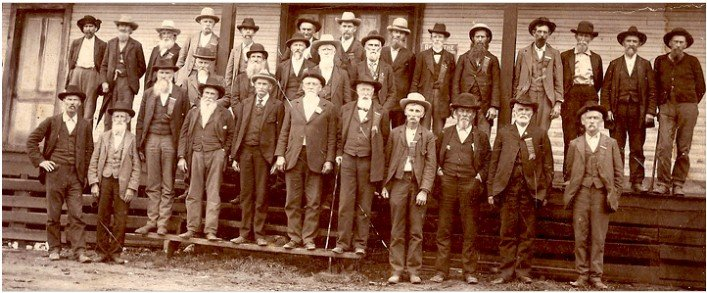
Members of the Ike Turner Camp C.S.A. This picture was taken one day during a regular meeting of the Confederate veterans’ organization. They are standing on the porch of Bergman’s Store in Moscow. The following have been identified: Front row: (2) Mr. Kent, (3) J.G. Locke, (4) Foster Poe, (5) I.N. Snell, (6) W.M. Kennedy, (7) J.R. Doughty, (10) Luce DeWalt, (11) Pleas Rowe. Second Row: (1) A.B. Green, (2) Dr. E.P. Angell, (3) R. Newton Green, (5) Prof. Marcellus Winston. Back Row: (1) T.L. Epperson, (2) D.S. Chandler, (5) Wyley Polk, (#8) A.C. Garvey, (9) T.F. Meece, (10) M.N. Kinard, (12) D.T. Manry.
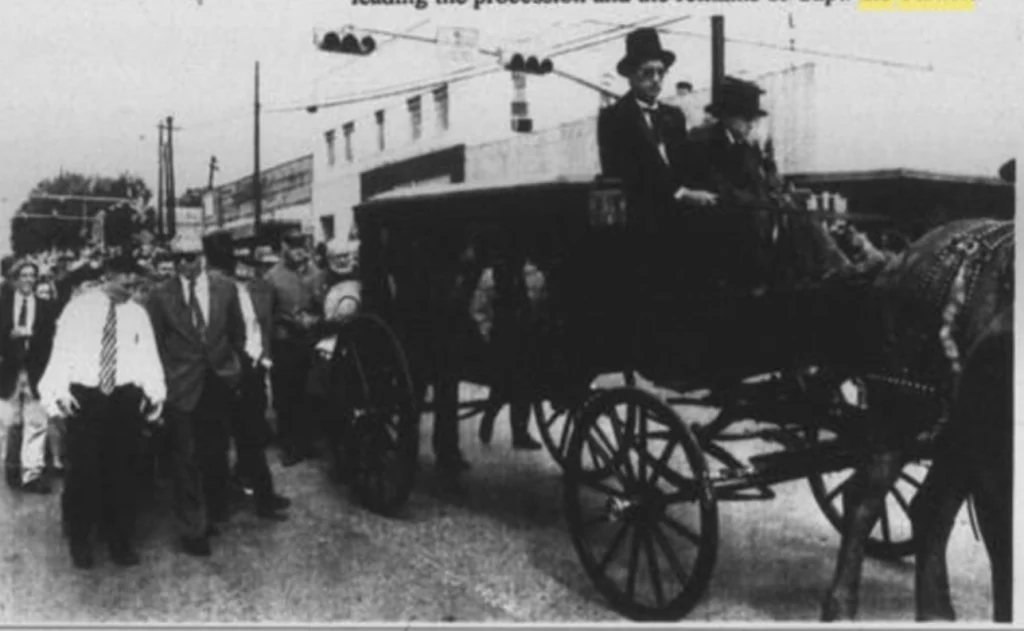
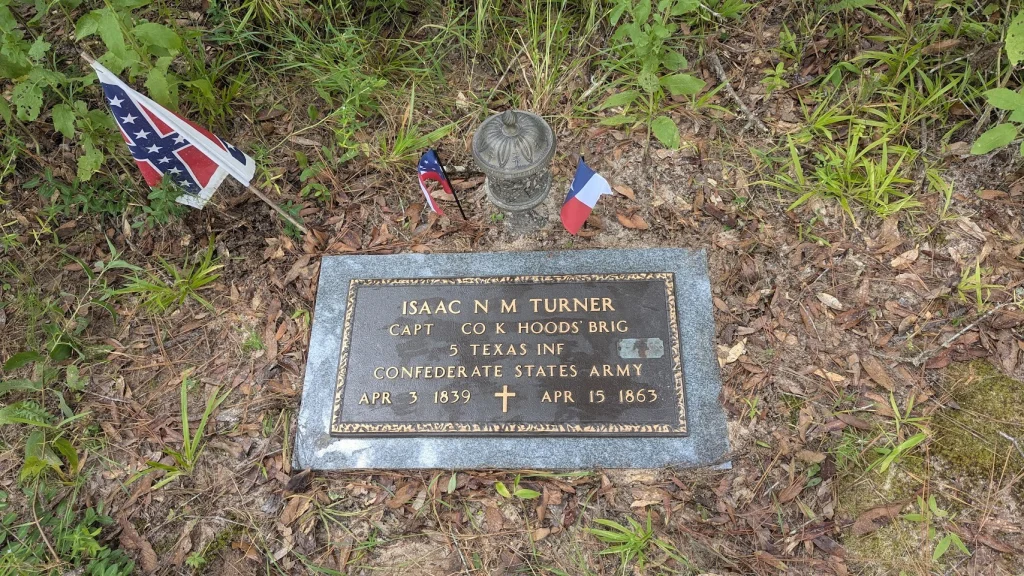
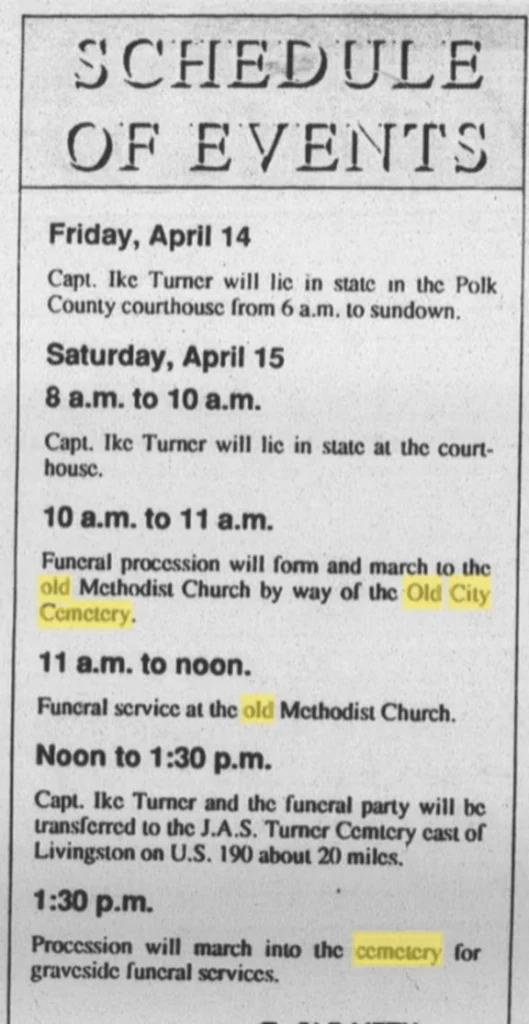
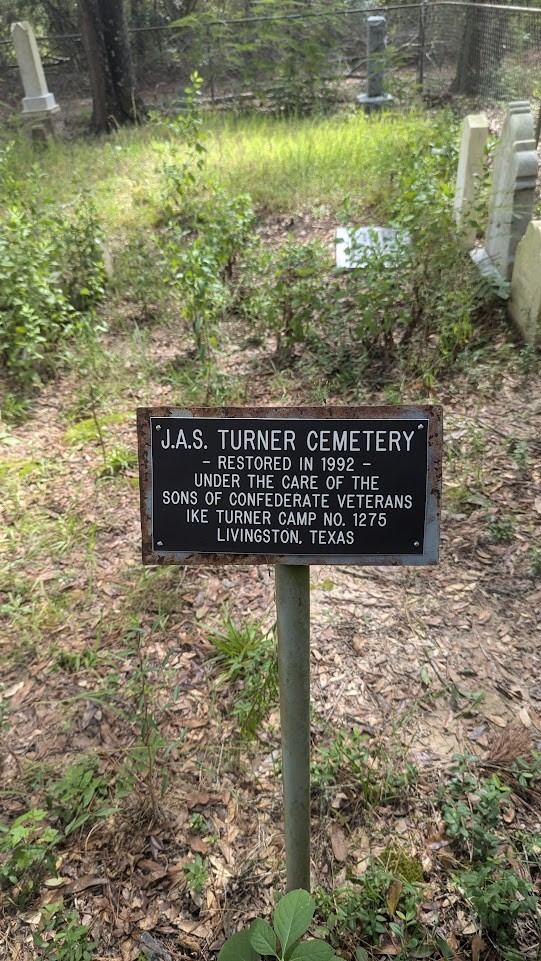
On April 15th, 1995 the remains of Captain Isaac Newton Moreland (Ike) Turner were buried at the J.A.S. Turner Cemetery. The cemetery is located approximately 17.3 miles east of Livingston, TX in Polk County. The remains were disinterred from the Turnwold Plantation, near Milledgeville, Georgia. The entire affair was conceptualized and carried out by the Ike Turner Camp 1275 of the SCV. To my knowledge, this is the 2nd coming of the original Ike Turner Confederate Veterans Camp No. 321, which was organized in Livingston, TX on April 8th, 1893.
The body would lie in state at the courthouse until Saturday the 15th, which was the anniversary date (132 years) of his death. The funeral procession circled the Old Cemetery to honor the Confederate veterans buried there. This is where my great-grandfather (T.F.) is buried. This was quite an affair for both Milledgeville and Livingston. The event was recognized nationally in the press.
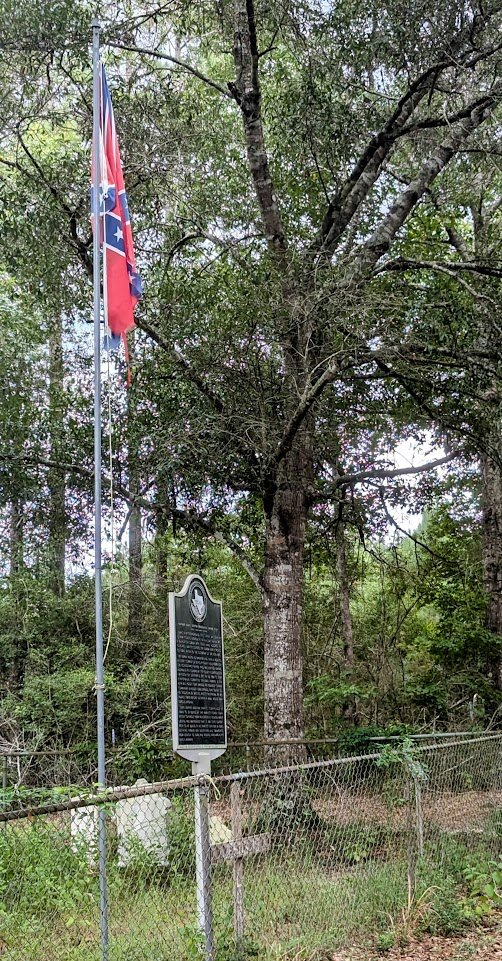
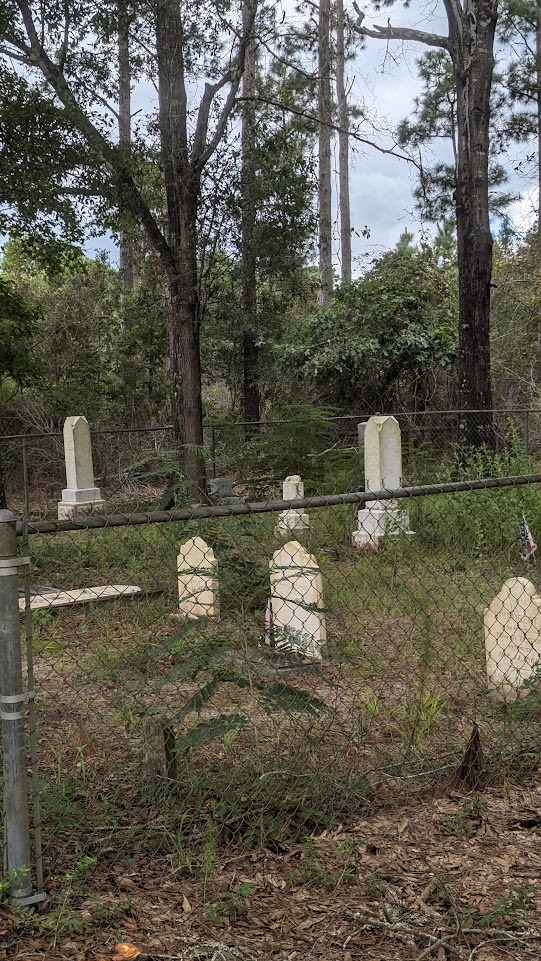
The Ike Turner Camp 1275 is still active. It is my understanding that there was a pause between the 1995 version and today’s version. They have both a website and a Facebook page. I had tried several times to contact the camp before they finally responded. They had little to no historical information about the camp. Based on what I was told, their primary focus is on Civil War reenactments and caring for the J.A.S. Turner Cemetery. From what my wife and I witnessed, during our visit to the cemetery, they do a very poor job of taking care of the cemetery. The cemetery was overgrown and the Confederate flag was in tatters.
In addition to his membership in the UCV United Confederate Veterans and the Ike Turner Confederate Veterans Camp No. 321, T.F. was a member of the Hood’s Texas Brigade Association. The Hood’s Texas Brigade Association was officially organized on May 14, 1872, and the first reunion of the veterans was held that same year. Between 1872 and 1933, the association held 63 reunions, with the last reunion taking place in Houston in 1933. Its primary purpose was to commemorate and honor the achievements of the Hood’s Texas Brigade.
It appears that T.F. attended several of these reunions. He was not in attendance for the 39th reunion in which the Association dedicated a monument to Hood’s Texas Brigade in Austin, TX. “President General Hamby read a letter/telegram from T.F.
According to an article in the East Texas Pinery dated July 2nd, 1891, a Hood’s Brigade Reunion was held in Livingston, TX on June 28th. There were reportedly over 300 people on the grounds of the courthouse to welcome the survivors of the brigade. A train arrived from Houston carrying three coaches packed to capacity. The train stopped at the courthouse just long enough for the passengers to disembark.
After reading any number of books about the Civil War and about Hood himself, I’m not sure that I understand my great-grandfather’s unvarnished allegiance to him. Perhaps, it was his successes at the Battle of Gaines Mill and Second Bull Run. Hood survived unscathed but his brigades suffered significant losses. Charles Bruce Catton won the Pulitzer Prize for History and the National Book Award for Nonfiction in 1954 for his book A Stillness at Appomattox, a study of the final campaign of the war in Virginia. He wrote that “the decision to replace Johnston with Hood was probably the single largest mistake that either government made during the war.” I can not think of a more hyperbolic or prejudiced statement pertaining to the Civil War. Clearly, the author had little regard for Hood.
Hood’s aggressive actions, seemingly without strategy or tactics, cost the lives of his men as well as physical harm to himself. He was severely wounded in the left arm at the beginning of his assault on “Devil’s Den” and “Little Round Top”, rendering his arm almost useless. Not to mention the fact that he left his troops without leadership at a critical moment in the Battle of Gettysburg. T.F. was wounded and captured. His brother James was mortally wounded and died on July 10th. His brother Calvin was captured and died while a Union prisoner.
Hood was again wounded at the Battle of Chickamauga, which resulted in the amputation of his right leg. He returned to battle, strapped to his horse, in the Atlanta campaign after relieving General Joe E. Johnston. He was nothing more than a gnat to Sherman and the Union Army. Hood withdrew, following significant losses, hoping that “Sherman would follow him. He did not. Hood would move his forces north into Tennessee where he would suffer successive failures in Columbia, Spring Hill, Franklin and finally Nashville. Ironically, T.F. was born in the Spring Hill/Columbus area.
Hood would launch a full-frontal assault, as expected and unfortunately, over two miles of open field at the Battle of Franklin. The Union commanding general claimed that the Confederates suffered 6,252 casualties, including 1,750 killed and 3,800 wounded. Critically, the military leadership was decimated. The casualties included (14) Generals and (55) regimental commanders. The Battle of Nashville marked the effective end of the Army of Tennessee. Hood resigned his command on January 13th, 1865 and he was not given another field command. Hood would attempt to lay the blame on his subordinates and the soldiers themselves. While his performance was dismal, it did not rise to the level of “…the single largest mistake that either government made during the war.”
It is estimated that at the beginning of the war, the Texas regiments were comprised of approximately 3,500 men. Recruitment increased that number to approximately 4,400. The brigade sustained a 61 percent casualty rate and, at its surrender, numbered close to 600 officers and men.
After the war, Hood moved to New Orleans and became a cotton broker and started an insurance business. The yellow fever epidemic of 1878 closed the New Orleans Cotton Exchange and bankrupted the local insurance industry. Hood (August 30th), his wife and his oldest daughter would die from yellow fever in 1879. The Texas Brigade Association supported his surviving ten children for more than 20 years.
John Bell Hood was buried in Metairie Cemetery in New Orleans. Amazingly enough, I attended funerals there and passed by the cemetery on countless occasions when I lived in New Orleans. I lived there for roughly (20) years and never realized that Hood was buried there. My father’s (Louis Harden Meece) house was only (4) minutes away. His house was flooded by Katrina and razed following the storm. Fortunately, he had moved north to Jeffersonville, IN several years earlier.
It’s difficult to criticize my great-grandfather’s adoration of Hood. We’re talking about events that occurred 160 years ago, in the midst of the Civil War. I’ve read numerous accounts about Hood, including The Lost Papers of Confederate General John Bell Hood, and the battles that he was fought in and none of it has changed my mind. I respectfully disagree with my great-grandfather.
Another topic that I’ll take issue with is “The Lost Cause.” The primary tenet is that “secession” from the Union had little or nothing to do with slavery. The southern states seceded to protect their rights, their homes and to break from a tyrannical government. “Secession” was both constitutional and noble. Robert E. Lee opposed secession. He wrote that “Secession is nothing but revolution.” After reading Company Aytch, by Sam R. Watkins, you would be hard pressed to find Privates that would tell you that they were fighting for State’s Rights or slavery. The antebellum plantation owners and political elites would espouse that, but the “everyman” was simply fighting for his comrades, his family and his land.
Secondly, slavery was portrayed as a positive good. Submissive, happy and faithful slaves were better off under slavery. I want to see that poll! According to a local paper, there were 2,949 slaves in Polk County compared to about 584 taxpayers or 429 voters. Approximately one-half of the property owners had slaves.
The third tenet states that the Union had a numerical advantage both in terms of men and resources. I believe that there is some truth to that. If McClellan hadn’t been so afraid of Lee’s shadow and had he focused on something other than becoming the next President, the Union could have ended the war sooner. The same goes for Pope. If he had been less braggadocios and more focused on the task at hand things could have ended differently. Burnside was the very definition of insanity at Fredericksburg. He repeatedly assaulted impregnable Confederate positions, failing to achieve success each and every time. The old axiom of “Doing the same thing over and over again and expecting different results.” applies here.
Maj. Gen. Joseph Hooker was outmaneuvered, outsmarted, outwitted and outfoxed by Lee and Stonewall Jackson at Chancellorsville. He foolishly, and publicly offered his resignation, not believing that it would be accepted. Lincoln did accept and replaced him with Meade. In all fairness, none of these men were a match for Lee. I do believe, however, that if Grant or Meade had been placed in charge of the Army of the Potomac earlier, the war would have ended sooner.
The fourth tenet was that Confederate soldiers are portrayed as heroic, gallant and saintly. I can only speak to what I know about my great-grandfather. That’s true.
The fifth tenet is that Robert E. Lee emerged as the most sanctified figure in “Lost Cause” lore. I’m sorry but Lee didn’t read the “tea leaves” when he decided to invade the north. The Confederacy suffered heavy casualties at Chancellorsville and his good luck charm, Lt. Gen. Stonewall Jackson was mortally wounded. He lost contact with James Ewell Brown “Jeb” Stuart, which seriously impacted intelligence gathering during the march north. Lee underestimated the strength of the Union forces at Gettysburg; the Union held the high ground and the “fish hook” defense allowed the Union to quickly defend any breaches.
In the end, Lee had met his match in Meade. Honestly, while Meade was meeting with his subordinates, prior to battle at Gettysburg, Lee and Longstreet were behaving like children and not talking to one another. I recently read a Facebook post, under a picture of Robert E. Lee, that read “When I grow up I want to be like Lee.” A comment followed stating that “it was every southern boy’s ambition.” I countered with a comment stating “When I grow up I want to be like U. S. Grant or George Meade.”
Finally Southern women were idealized as pure, saintly and white. In reality, Southern women steadfastly supported the cause, sacrificing their men, time and resources, more so than their Northern counterparts. They played a significant role in perpetuating the “Lost Cause” through their aid and memorial organizations, some of which still exist today.
Much has been said about Longstreet. He had his moments. Many believe that he was responsible for the loss at Gettysburg. Lee even denied that, stating that he wished that he had followed Longstreet’s advice. Longstreet did a complete 180° after the war. He called for acceptance of Reconstruction and federal laws, including those abolishing slavery and granting citizenship to blacks. He and Grant were good friends before the Civil War. They served together during the Mexican War. Longstreet was Grant’s best man at his wedding. Their friendship continued after the war with Longstreet supporting Grant’s presidential campaign.
There were, of course, political and monetary benefits to reversing his stance once the war ended. Most in the South felt that Longstreet was a traitor. I believe he was a good General but it’s difficult to comprehend such a dramatic reversal. I’m still trying to figure that one out.
On a recent trip to Washington DC, we visited the Arlington House. I was reminded that Robert E. Lee was offered command of the Union Army. This offer was made by his friend Francis Preston Blair, of the famed Blair House, and the Secretary of War Simon Cameron. Without hesitation, Lee refused. He wrote that “I declined the offer he made me to take command of the army that was to be brought into the field, stating as candidly and as courteously as I could, that though opposed to secession and deprecating war, I could take no part in an invasion of the Southern States.”
His mentor General Winfield Scott told Lee “You have made the greatest mistake of your life; but I feared it would be so.” His decision ultimately cost him and his family almost everything. Could you imagine what would have happened if Lee had accepted command of the Union Army? If he could have escaped the interference of Lincoln and Stanton and avoided the political appointments to military positions, I believe that Robert E. Lee would have made short work of the conflict. No harm or offense intended towards the south.
T.F. must have felt so much animosity and hatred towards the Union for the loss of his brothers. Not only that, the sheer loss of the war, Reconstruction, the abolition of slavery, the economic hardships, etc. would dramatically affect the lives of Southerners. Did he allow this bitterness and resentment to control him? No, he became educated, he got involved in local, State and National politics. He married Amelia and became a father of (11) children. He became a successful entrepreneur. T.F. became actively involved in organizations that cared for those veterans who were unable or incapable of taking care of themselves. Instead of allowing helplessness to overwhelm him, as many did, he became a tool for change in the community of Livingston, Polk County and the State of Texas
Despite our differences, I’ve never been so proud of or respected anyone more than my great-grandfather. The greatest tribute I could ever offer, is to tell his story.